
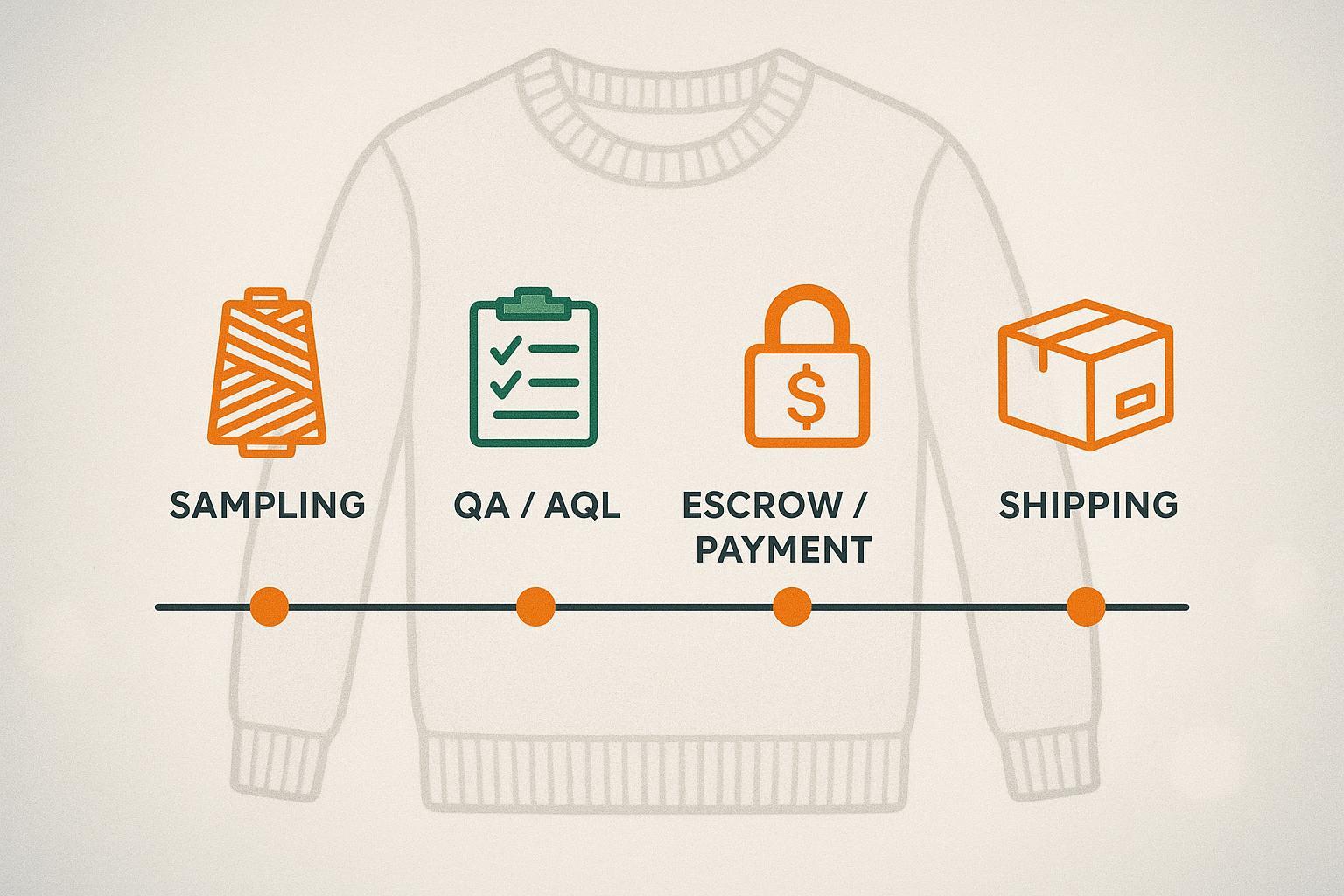
If you are building a small collection and need a low‑risk way to prove demand, this checklist gives you a clear path to launch with speed, cash‑flow control, and engineered quality. It is designed for early-stage labels in the US and EU running pilots with WHOLEGARMENT or traditional fully‑fashioned construction. You will find numeric gates, escrow‑ready payments, AQL targets, and a reorder protocol that reduces surprises.
Key takeaways
Pilot sizing that protects cash: start with 50–100 total units per style, with 10–25 per color and 1–2 pieces per size across S–XL.
Fast but controlled sampling: rapid prototypes in 3–7 days when using known yarns; plan two to six weeks for the full proto to PP to TOP ladder.
Standards‑backed quality: target AQL 0.0 critical, 2.5 major, 4.0 minor for general programs, and elevate to 1.5 for premium.
Escrow‑compatible payments: 20–30 percent deposit to book yarn and programming, 30–40 percent on PP or TOP approval with preliminary lab results, balance after final AQL pass and pre‑shipment documentation.
Reorder certainty: when yarn is locked, line start in 10–15 working days and shipment in 20–30 working days for standard repeats.
Yarn color consistency: hold approved shade lots for 30–60 days with clear substitution rules and re‑qualification if the lock expires.
How this low MOQ private label knitwear pilot program works
A pilot should follow a simple temporal workflow so every stakeholder knows what happens next and what triggers payment. For context on the end‑to‑end steps of OEM and ODM knitwear, see the overview of the OEM and ODM knitwear production process.
Step 1 — Pre‑engagement setup
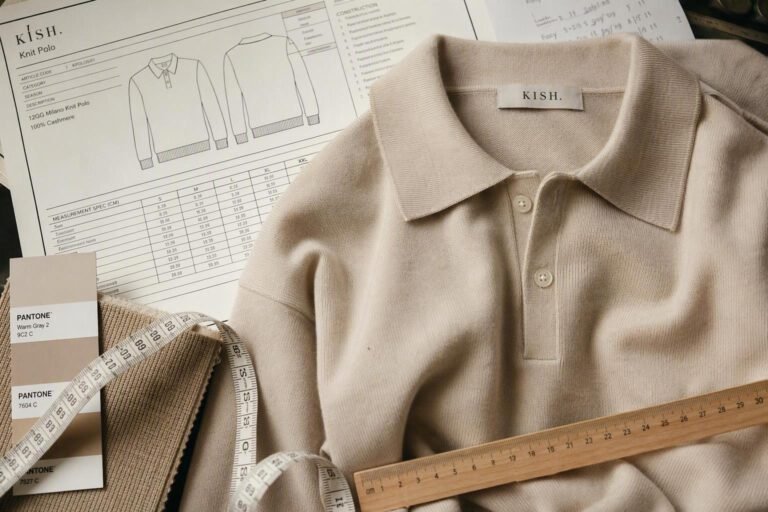
Tech pack essentials: confirm machine gauge and stitch map, yarn composition and count, tolerance table, finishing instructions, and measurement spec with shrinkage allowance. Dimensional change should reference ISO 6330 procedures and report in a format familiar to buyers using AATCC 135 or 150.
Construction choice: decide whether the style is WHOLEGARMENT or traditional fully‑fashioned with linking. WHOLEGARMENT supports seamless, one‑piece construction that can reduce seam variability, as noted by Shima Seiki’s communications in their WHOLEGARMENT materials. See the company’s WHOLEGARMENT overview for context.
AQL target and lab plan: set defect class targets now and pre‑book tests. For knitwear pilots, pilling, dimensional stability and color fastness are non‑negotiable. A compact matrix appears in Step 5.
MOQ and size‑run heuristics: as a pilot policy, use 50–100 units per style total, 10–25 units per color, and one to two pieces per size across S–XL to get an early fit read without overextending inventory.
Step 2 — Sampling ladder
Move in four rungs: prototype, fit, pre‑production sample, and top‑of‑production sample. When yarn and structure are already qualified, a rapid prototype can be ready in three to seven days. Complex stitches or new yarns will require a longer window, and the full ladder with revisions typically spans two to six weeks depending on complexity and scheduling. A general manufacturing timeline for apparel often places bulk production after approvals into a two to four week band, plus freight; see this broad design to delivery overview for context.
Documentation at each rung should include a signed measurement table, shrinkage notes, tolerance checks, and clearly labeled comments for rework. If the construction is WHOLEGARMENT, budget time for programming and simulation before the first knit. If it is traditional, plan for linking quality checks and potential rework loops.
Step 3 — Payment terms and escrow milestones
Payments should align with auditable gates so cash release follows progress, not promises. The structure below ties releases to sample approvals and inspection outcomes, which aligns with common pre‑shipment inspection practice where inspections occur around 80–100 percent completion, as explained in QIMA’s overview of pre‑shipment inspections.
Milestone | Trigger and evidence | Suggested release |
|---|---|---|
Deposit | Purchase order issued, tech pack frozen, yarn booking initiated, prototype scheduled | 20–30% |
Mid release | PP or TOP sample approved, preliminary lab results available for pilling, dimensional change, and color fastness | 30–40% |
Balance | Final AQL pass per agreed plan, PSI report on file, forwarder receipt such as B L copy or AWB | Remaining balance |
For AQL context, see the accessible explainer of AQL and ANSI ASQ Z1.4 sampling, which is equivalent to ISO 2859‑1 in practice.
Step 4 — Inline controls and AQL for knitwear
Adopt AQL targets by defect class and stick to one sampling plan across the pilot. A sensible preset for general knitwear pilots is 0.0 for critical, 2.5 for major, and 4.0 for minor defects, tightening major to 1.5 on premium programs. Plan inline checkpoints from yarn lot verification through finishing and inline measurements. For a detailed look at a seven‑checkpoint approach, see the guide to quality assurance and inline production control.
Step 5 — Lab testing you should pre‑book
Knitwear pilots benefit from a small, focused battery of tests. The methods below are widely recognized, and the property‑method pairing allows different labs to run equivalent protocols.
Property | Primary methods | When to mandate |
|---|---|---|
Pilling resistance | ISO 12945‑1 or ISO 12945‑2 | All sweater knits |
Dimensional stability | ISO 6330 for procedure; report in AATCC 135 or 150 format | All programs |
Color fastness to washing | ISO 105‑C06 or AATCC 61 | Dark or bright shades, kidswear |
Color fastness to rubbing | ISO 105‑X12 or AATCC 8 | Dark shades, denim‑adjacent palettes |
Optional compliance checks | pH ISO 3071, formaldehyde ISO 14184‑1, azo dyes EN 14362‑1 | Market claim dependent |
For a concise primer on common textile tests including pilling and wash fastness, consult this lab overview of top fabric tests. For buyers and technicians who want to understand test catalogs and sample preparation conventions, see the AATCC quality control catalog.
Step 6 — Milestone Gantt with target windows
This compact Gantt helps keep the team synchronized. Owners can be brand, factory, or lab depending on the step.
Phase | Target window | Owner | Dependency |
|---|---|---|---|
Tech pack freeze | Day 0–2 | Brand | RFQ readiness |
Prototype knit | Day 3–7 when yarn is known | Factory | Tech pack freeze |
Fit and revision loop | Day 7–21 | Brand and factory | Prototype knit |
PP sample approval | Day 14–28 | Brand | Fit loop complete |
Lab tests scheduled | Day 14–28 | Lab and factory | PP sample produced |
TOP confirmation | Day 21–35 | Brand | Lab prelim pass if required |
Bulk production | Day 30–60 | Factory | PP or TOP approval, deposit on file |
PSI and final AQL | 80–100 percent complete | Third‑party or brand QA | Bulk production |
Shipment and documents | Post PSI pass | Factory and forwarder | Balance release conditions |
If you are new to gauges and machine selection and how they influence handfeel and appearance, this short guide to knitting machine types and gauge selection will help you align fabric expectations with your sample plan.
Step 7 — Final inspection and shipment pack
Run a pre‑shipment inspection after the order is substantially complete with the agreed AQL and sampling plan. Confirm care labels, fiber content, country of origin, carton markings, and attach final lab reports to the shipment file. External inspection providers typically base their sampling on Z1.4 or ISO 2859‑1; SGS outlines these inspection types and standards alignment in their final random inspection service page.
Step 8 — Reorder SLA and yarn‑lock policy
Reorder service level: when the yarn is locked and programming unchanged, expect line start within 10–15 working days from PO confirmation and shipment within 20–30 working days for standard repeats, subject to machine availability and seasonality.
Yarn‑lock rules: reserve the approved shade lot for 30–60 days after pilot approval and define a minimum reserve per color that supports 50–100 units. Maintain shade bands and do not mix dye lots within the same garment. If the lock expires, require a re‑qualification sample before production resumes.
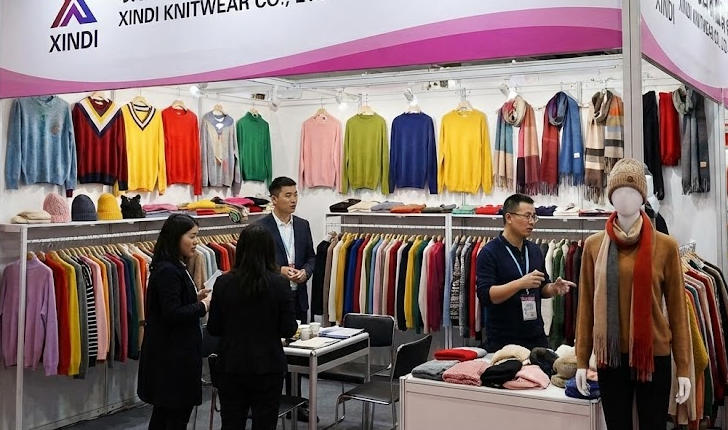
Operational example — Escrow and PP or TOP gate at Xindi Knitwear
Disclosure: Xindi Knitwear (Knitwear.io) is our product.
Here is how a typical milestone flows in practice. After the tech pack is frozen, the brand issues a purchase order and places a 20–30 percent deposit in escrow. Xindi schedules rapid prototyping, often within three to seven days when we are knitting on known yarns and familiar stitch families. The fit loop follows with annotated measurement tables and tolerance checks. On pre‑production sample approval, preliminary lab tests for pilling, dimensional change, and color fastness are uploaded to the job folder. At this point, the mid release is triggered and the escrow platform releases the 30–40 percent tranche automatically. Inline controls track yarn lot and machine tension, and a mid‑run pilling spot check is booked for risk styles. A final AQL inspection uses the agreed sampling plan and defect class targets. When the inspection passes and the forwarder issues the transport document, the platform signals the balance release. This sequence keeps cash aligned with evidence while keeping the schedule moving.
Next steps
Book a pilot call to scope your low MOQ private label knitwear pilot program and confirm timelines and gates. Use the contact and booking options on Knitwear.io.
Request the Pilot SOP checklist and milestone templates, including a one‑page tech pack, a printable checklist, and an escrow milestone example, via our About page.
Author: A senior knitwear production manager who has run WHOLEGARMENT and fully‑fashioned pilots for US and EU labels, specializing in AQL planning, lab scheduling, and shade‑lot control.