
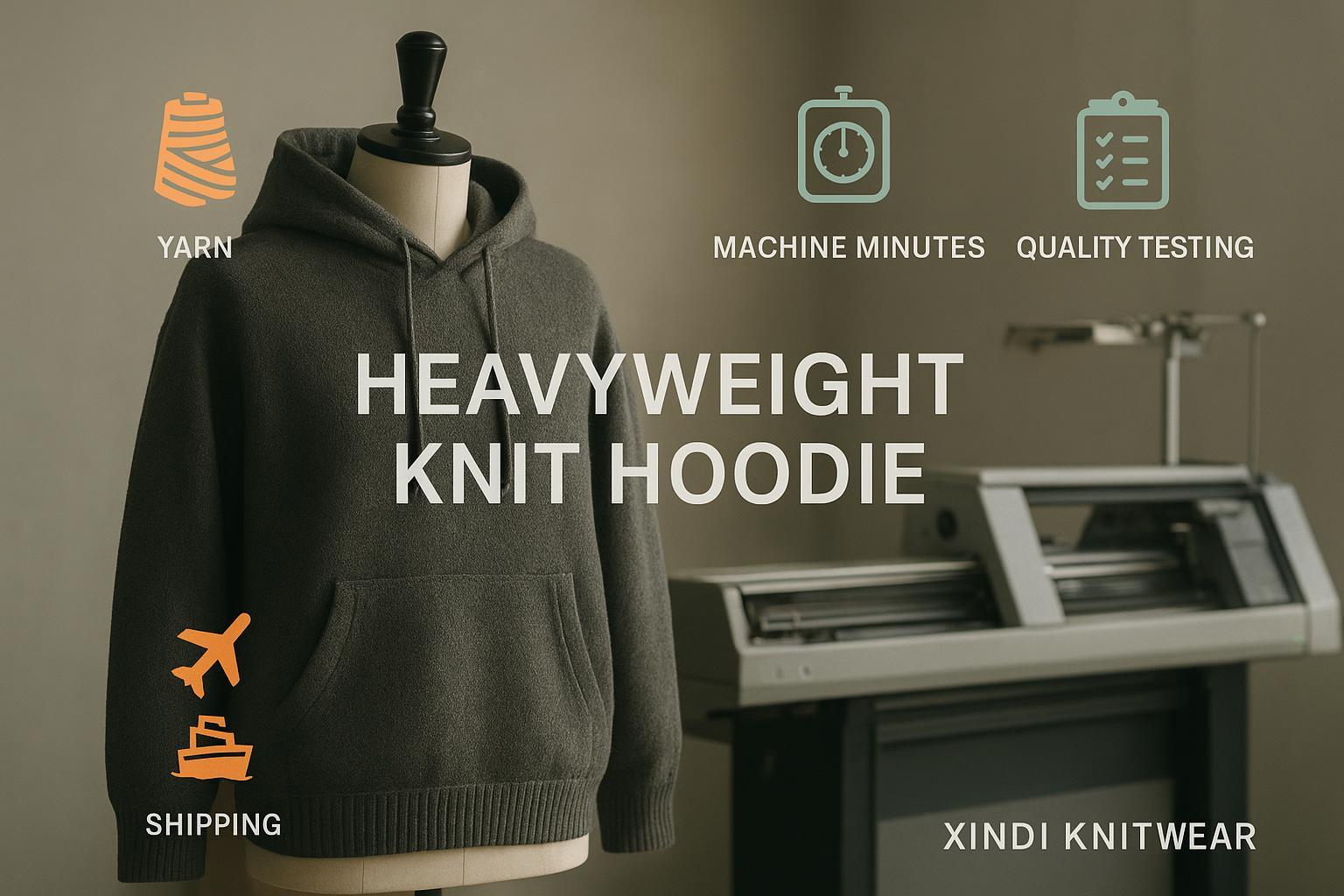
Heavyweight streetwear knits (500–800 gsm) live at the intersection of craft and engineering. This step-by-step tutorial gives you a factory-grade framework for knitwear costing—from yarn inputs and machine minutes to AQL/testing and landed cost to the US/EU. We’ll model three realistic archetypes (3–5G coarse, 5–7G dense/WHOLEGARMENT-feasible, 7–10G high-density) and three logistics scenarios (50–100 DDP air → US; 150–200 FOB South China → US/EU by sea; 300+ DAP/DDP → US/EU). You’ll also get a downloadable BOM/costing template you can paste into a spreadsheet and swap in your live quotes.
Step 1 — Lock the archetype and size run
Choose your baseline so the math maps to reality. For 500–800 gsm streetwear knits we’ll reference three archetypes you can select per style:
3–5G coarse crew/hoodie (ultra-heavy, sculptural structures)
5–7G dense crew/hoodie (often WHOLEGARMENT‑feasible depending on design)
7–10G high-density heavyweight sweater (refined hand, still ≥500 gsm)
Define: silhouette (crew/hoodie), target GSM, size run distribution, colorways, and if one-piece (WHOLEGARMENT) or panels. If you need a quick refresher on how gauge affects fabric density and hand, see the short primer in Sweater Types by Gauge on our site: gauge implications and examples.
Key takeaways
Knitwear costing hinges on a few big levers: yarn $/kg, machine minutes by gauge/structure, overhead allocation, and freight/duty rules.
Convert GSM and pattern area into mass and then into yarn kg; verify by weighing your PP sample after finishing.
Route matters: cut-and-sew vs fully fashioned vs WHOLEGARMENT change both minutes and waste; compare using minutes × rate, not assumptions.
AQL/testing protects luxury standards; specify methods (AATCC/ASTM/ISO) and budget per lot before bulk.
Landed cost clarity starts with Incoterms responsibilities and volumetric weight math; use official HTS/TARIC tools for duty.
Step 2 — Convert specs to yarn consumption for knitwear costing
Here’s the backbone of knitwear costing: turn garment specs into yarn kg.
Estimate garment fabric area by size (front + back + sleeves + hood if applicable), based on your block or tech pack.
Compute mass = GSM × total area (converted to m²).
Adjust for stitch density/structure penalties (cables, inlay, jacquards generally push consumption and minutes).
Add yield loss for swatching, tension tuning, joins, and colorway changes.
Verification is essential: weigh your PP sample post-wash/finish. Aim for your modeled mass to be within ~3–5% of actual; if not, tune your area or structure multipliers. Think of this like calibrating a scale before you start pricing—small drifts multiply over a lot.
Step 3 — Input yarn specs and costs
Record fiber, count/ply, supplier, and certifications (OEKO-TEX, RWS, GRS, GOTS). Insert your supplier‑quoted USD/kg; public “average” prices are unreliable, so don’t guess. If your design is WHOLEGARMENT‑feasible, higher knitting time may be offset by minimal assembly waste—model it explicitly in minutes, not slogans. If you want more context on make routes, this overview compares common knit routes: fully fashioned vs cut & sew vs WHOLEGARMENT.
Step 4 — Choose route and model machine minutes
Route options:
Cut‑and‑sew: knit yardage/panels, cut, and sew.
Fully fashioned: knit shaped panels and link them.
WHOLEGARMENT: knit the whole garment as a single 3D piece; no panel linking/sewing.
WHOLEGARMENT’s qualitative advantages—eliminating panel linking/sewing, near‑zero cutting waste, and enabling seam‑free comfort—are documented by the technology provider; see the official overview from Shima Seiki in their sustainability spotlight: WHOLEGARMENT process benefits. In your costing, capture:
Programming/setup minutes (especially for jacquard/cable patterns)
Knitting minutes per size/gauge/structure
Linking/sewing minutes (0 for WHOLEGARMENT)
Finishing minutes (wash, dry, block, de‑pilling if required)
Apply minutes × your shop or supplier rate ($/min). Keep this rate separate from overhead (below) to preserve clarity. Here’s the deal: if a cable‑heavy 5G hoodie adds 20% to knitting minutes, you’ll see it immediately when the minutes line moves, not buried in an all‑in rate.
Step 5 — Trims, branding, and packaging
Line‑item everything: main/size/care labels, hangtag + string, patches/embroidery, zipper/eyelets/drawcords (for hoodies), polybag, carton, packing inserts. Call out MOQs that force over‑buy or unit uplift at low volumes.
Step 6 — Overhead allocation
Overhead per unit = (machine minutes × overhead rate) + (fixed setup ÷ batch size).
Overhead rate covers energy, depreciation, floor QA, maintenance, compliance, and admin. Fixed setup captures tool/fixture prep, pre‑production meetings, or one‑off programming surcharges. For small runs, fixed costs dominate—model them transparently.
Step 7 — Waste and yield modeling
Separate yarn yield loss (swatch/tension/joins) from assembly waste:
Cut‑and‑sew: cutting off‑cuts are real; add an assembly waste factor.
Fully fashioned: near‑zero cutting waste; still account for rejects/rework.
WHOLEGARMENT: minimal cutting waste; still account for programming trials and early rejects.
Cables, tuck/inlay, and heavy 3D structures increase both consumption and minutes. Track yarn issued vs finished garment weights during PP and first bulk to validate your assumptions.
Step 8 — AQL, inspection, and lab testing
For luxury knits, define your inspection and test plan up front:
AQL sampling commonly follows ISO 2859‑1 General Inspection Level II with Critical 0 (no tolerance), Major 2.5, Minor 4.0. A reputable QC explainer breaks down how to pick sample sizes and acceptance numbers: ISO 2859‑1 AQL overview and calculator context.
Select lab methods aligned to heavyweight knits. The AATCC testing hub lists the core methods and updates; for example, AATCC TM135/TM150 for dimensional change, TM16 for light, and colorfastness/crocking methods used across the industry: AATCC testing resources and catalogs.
Budget the inspection (per lot) and tests (per style/fiber/color) as explicit line items in your costing template.
Step 9 — Landed cost for knitwear costing: Incoterms, freight math, and duty lookup
Volumetric weight (air): chargeable weight is the greater of actual vs dimensional. The common IATA divisor converts CBM to kg at ~167 kg/CBM; learn the rule and confirm any service-specific divisor with your forwarder: IATA chargeable weight basics.
Incoterms responsibilities: FOB shifts main carriage/import clearance to the buyer; DAP delivers ready for unloading with buyer doing import; DDP puts import duty/tax on the seller. See the concise explanation from ICC Academy: DAP vs DDP responsibilities and risk.
Duty lookup: use the official tariff tools, not blog summaries. For the US, search HS 6110 and drill to the 10‑digit level on the Harmonized Tariff Schedule: USITC HTS search. For the EU, use the CLASS portal to access TARIC/Combined Nomenclature and measures: EU TARIC/CLASS entry point.
Your landed cost per unit stacks like this: EXW/FOB factory cost + freight + insurance + duty + brokerage + destination/last‑mile + surcharges. What happens to your margin if the divisor changes from 167 to 150 and your cartons are “airy”? Model it once and you’ll never be surprised again.
Worked scenarios (replace placeholders with your live quotes)
The numbers below show structure only. Swap in your supplier/forwarder/customs values.
Scenario | MOQ | Incoterm & Mode | Freight basis | Duty source | Costing notes |
|---|---|---|---|---|---|
2a Speed-to-market | 50–100 | DDP air to US | Chargeable kg = max(actual, CBM×167) × $/kg + clearance/last‑mile | USITC HTS 6110 10‑digit | Packaging optimization can materially cut CBM at this size. Budget broker + DDP admin. |
2b Replenishment | 150–200 | FOB South China, ocean to US/EU | CBM share × ocean rate + origin/destination charges | USITC/EU TARIC | Buyer arranges main carriage and import. Align sailing schedule with launch window. |
300+ Scaling | 300+ | DAP/DDP to US/EU | Ocean or intermodal; compare DAP vs DDP duties/taxes | USITC/EU TARIC | Under DDP, seller carries import taxes; model hidden destination charges conservatively. |
Practical example: modeling one heavy hoodie
Disclosure: Xindi Knitwear is our product. The CSV below mirrors a neutral quoting layout that can be used with or without Xindi’s framework. Paste it into a spreadsheet; yellow cells are inputs you replace with live quotes.
Section,Field,Unit,Input/Calc,Value,Notes
Header,Style Code,,Input,,
Header,Gauge (G),,Input,5G,
Header,Target GSM,gsm,Input,650,
Header,Route (Cut&sew/FF/WHOLEGARMENT),,Input,WHOLEGARMENT,
Header,Size Run,,Input,S/M/L/XL,
Yarn,Fiber/Blend,,Input,Merino/Cotton,
Yarn,Certification,,Input,OEKO-TEX,
Yarn,Count/Ply,,Input,2/26 Nm,
Yarn,USD/kg,$/kg,Input,,Get spinner quote
Yarn,Modeled garment mass (size M),kg,Calc,=GSM_to_mass(area_M),Use pattern area
Yarn,Structure penalty,%,Input,8%,Cables/inlay/jacquard
Yarn,Yield loss,%,Input,5%,Swatch/joins/tuning
Yarn,Consumption (M),kg,Calc,=mass_M*(1+penalty)*(1+loss),
Yarn,Consumption (size S/L/XL),kg,Calc,=scale_by_area(),Adjust by pattern
Yarn,Material cost (avg),$/pc,Calc,=consumption_avg*USD_per_kg,
Knitting,Programming/setup,minutes,Input,,Per style
Knitting,Knitting minutes (avg),minutes,Input,,Per size/gauge/structure
Knitting,Rate,$/min,Input,,Shop/supplier rate
Knitting,Knitting cost,$/pc,Calc,=(prog_min/batch)+(knit_min*rate),Setup amortized
Assembly,Link/Sew minutes,minutes,Input,0,0 for WHOLEGARMENT
Assembly,Link/Sew rate,$/min,Input,,If applicable
Assembly,Assembly cost,$/pc,Calc,=minutes*rate,
Finishing,Finishing minutes,minutes,Input,,Wash/dry/block
Finishing,Finishing rate,$/min,Input,,
Finishing,Finishing cost,$/pc,Calc,=minutes*rate,
Trims,Labels/Tags,$/pc,Input,,Main+size+care+hangtag
Trims,Hoodie components,$/pc,Input,,Zipper/eyelets/drawcord
Trims,Packaging,$/pc,Input,,Polybag+carton
Overhead,Overhead rate,$/min,Input,,Energy/QA/depr
Overhead,Fixed setup,$,Input,,PPM/program one‑off
Overhead,Overhead cost,$/pc,Calc,=(total_minutes*rate)+(fixed/batch),
QA/Testing,AQL inspection,$/lot,Input,,ISO 2859-1 Level II typical
QA/Testing,Lab test panel,$/style,Input,,AATCC/ASTM/ISO set
QA/Testing,QA cost,$/pc,Calc,=(AQL/lot + tests/style)/batch,
Factory Total,EXW/FOB unit,$/pc,Calc,=sum(material+process+trims+overhead+QA),
Logistics,Incoterm,,Input,DDP (US),Per scenario
Logistics,Carton qty,pcs/carton,Input,,Pack plan
Logistics,CBM per carton,CBM,Input,,Measure
Logistics,Actual mass per carton,kg,Input,,Weigh
Logistics,Divisor (air),kg/CBM,Input,167,Confirm with forwarder
Logistics,Chargeable kg,kg,Calc,=max(actual, CBM*divisor),
Logistics,Air rate,$/kg,Input,,Quote
Logistics,DDP admin/brokerage,$/shipment,Input,,Quote
Logistics,Duty/tax,$/shipment,Input,,USITC HTS lookup
Logistics,Freight+import per unit,$/pc,Calc,=(air_rate*chargeable+brokerage+duty)/units,
Landed,Landed cost per unit,$/pc,Calc,=EXW/FOB unit + freight_import,
Sensitivity,Yarn $/kg delta,$/kg,Input,,Try ±10–20%
Sensitivity,Minutes delta,%,Input,,Try ±10–15%
Sensitivity,Duty rate delta,%,Input,,Check HTS/TARIC
How to use it:
Fill input cells with spinner quotes, forwarder rates, and official duty results.
Keep minutes and overhead separate so you can see whether a gauge change or structure decision is moving cost more through time or materials.
Verify modeled mass vs PP weight before placing bulk.
Common pitfalls and verification checklist
Don’t guess yarn $/kg. Ask the spinner and record certification scope IDs.
Weigh PP after finishing; if your knitwear costing model is off by >5%, recalibrate area/penalties.
For DDP air, confirm the dimensional divisor in writing; it varies by service.
Pre‑agree AQL levels and defect classifications; align lot size to sample size math.
Lock Incoterms in the PO; hidden destination charges under DDP can erode margin.
Next steps
Download the CSV above and build your first scenario. If you’d like a factory‑ready version, our internal quoting layout at Xindi Knitwear can be used as a reference to structure your tabs and formulas.
If you’re planning a 50–100 pc pilot run, this quick brief may help: low MOQ production considerations. For timelines and handoffs, see our OEM/ODM knitwear production process overview.
That’s the whole playbook. Replace the placeholders with live inputs, verify against your PP, and your heavy-knit cost model will be accurate, auditable, and repeatable—exactly what your season plan needs.