
Counterfeits are getting closer to the real thing, but knit craftsmanship still leaves a trail. This guide is written for brand and distributor anti‑counterfeit teams who need a repeatable, evidence‑led process to distinguish a fake vs real Arc’teryx beanie and document the decision. Scope covers current toques in market as of 2026, especially the Bird Head Toque and related styles. Label conventions and factory details can vary by season, so treat each check as a converging signal, not a single-point verdict.
Why knit craft first? Because embroidery geometry, knit gauge regularity, and finishing discipline are hard to fake at scale and show up in photos and in‑hand inspections.
Key takeaways
Start with visuals: logo geometry (the “dead bird” and wordmark), label typography, and hangtag print fidelity. If two of these fail from photos, reject or escalate.
Knit tells win in-hand: inconsistent knit gauge, wavy course lines, and sloppy crown finishing are strong indicators of a fake.
Use labels as compliance checks, not magic bullets: verify CA number formatting and care symbols; treat barcodes/QRs as non‑decisive.
Lining and construction matter: certain SKUs feature an inner lining band; missing or crudely substituted linings are a red flag.
When signals conflict or value is high, commission fiber analysis (FTIR/microscopy). Material substitution (e.g., acrylic for wool) is common in fakes.
Document everything with macro photos and instrument settings; reproducibility protects your team in disputes.
How to tell if Arc’teryx beanie is real: quick triage
Photo-only screening (marketplace or remote intake): Compare the bird logo’s proportions and stitch thinness to an authentic reference, check the “C’” in the wordmark for spacing/shape, and scrutinize care-tag typography alignment. Poor macro definition, thicker/filled embroidery, or off-spec fonts should trigger a reject or an in‑hand review. Visual cues and examples are consistent with the image-led analysis in the SNKRDUNK beanie guide (2025–2026), which documents thinner, crisper authentic embroidery and an elongated fake logo trend; treat it as a pattern, not an absolute rule. See the evidence pattern in the SNKRDUNK article: Real vs. Fake Arc’teryx Bird Head Toque “Orca” (updated 2026‑01‑30).
In-hand intake: Measure knit regularity with a ruler or loupe (stitches/cm), check inside for expected lining construction on applicable models, and review crown/tail finishing for loose ends or skipped stitches. Barcodes should scan, but scannability isn’t proof of authenticity. Use these tactile checks to confirm or overturn your photo triage.
Escalation triggers: Mixed signals, high payout risk, or suspected fiber substitution. Commission FTIR/microscopy and log chain‑of‑custody. Treat any “QR/NFC=authentic” claims skeptically—Arc’teryx beanies don’t have consumer-facing serial/RFID systems per the brand’s counterfeit guidance.
Side-by-side comparison table
Below is a field-ready grid to compare an item against a known authentic reference. Evidence levels: Visual (photo), Hand (in‑hand), Lab (instrumented).
Dimension | Real | Fake | Evidence | Action |
|---|---|---|---|---|
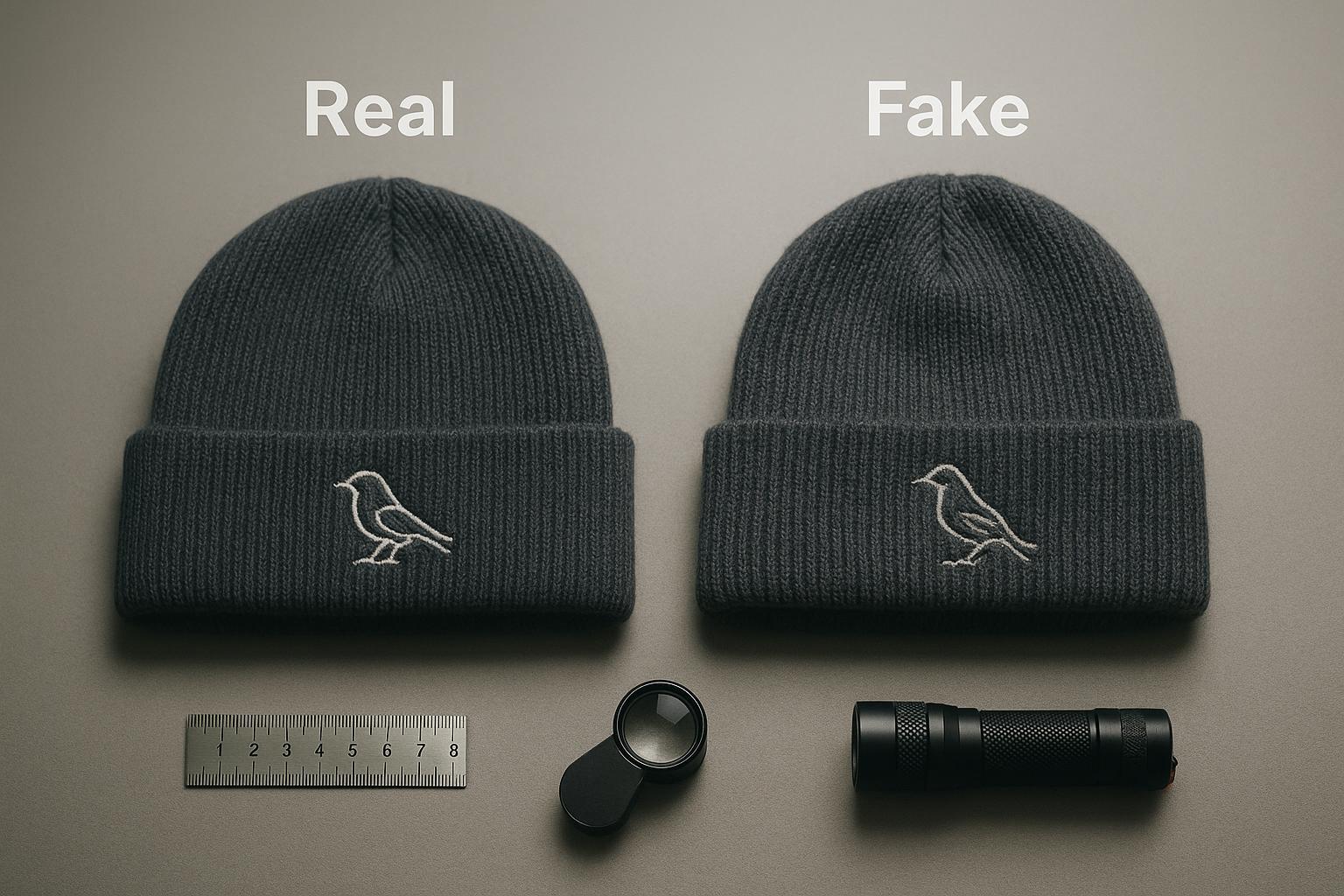
Embroidery/logo geometry & density | Thin, crisp stitches; accurate Archaeopteryx proportions; clean “C’” letterform | Thicker, slightly filled stitches; elongated bird; inconsistent letter spacing | Visual | If 2+ geometry/typography errors → Reject |
Knit gauge & tension regularity | Even stitches across panels; straight course lines | Wavy course lines; variable stitch size in nearby areas | Hand | If unevenness is pronounced → Reject |
Fiber composition | Matches claimed blend on care tag (e.g., wool/synthetic) | Substituted acrylic or unexpected blend | Lab | Mixed signals/high value → Escalate to FTIR/microscopy |
Care label compliance (CA, symbols) | Correct CA formatting; ISO-consistent symbol set and languages | Wrong/missing CA; odd symbol order/phrasing | Visual | Incorrect compliance → Reject or escalate for verification |
Season/model codes | Present and consistent with exemplar (where applicable) | Missing/mismatched codes or model name | Visual | Mismatch with other fails → Reject; otherwise escalate |
Lining & construction | Expected inner lining band/material for the model; tidy seams | No lining where expected; rough interior finish | Hand | Missing expected lining + other tells → Reject |
Hangtag & barcode print | Sharp typography, proper paper stock; barcode scans | Low print fidelity; barcode scans but looks off | Visual | Non‑decisive alone; use with other evidence |
Weight & dimensions | Within tolerance bands vs authentic reference | Noticeably lighter, thinner, or asymmetrical | Hand | Out of band + other tells → Reject |
Stitch finish quality | Clean crown/fold; minimal loose ends | Loose threads, skipped stitches, messy back-tack | Hand | Multiple finish defects → Reject |
UV/blacklight & microscopy | Expected low fluorescence; consistent thread twist | Bright label/thread fluorescence; inconsistent twist | Lab | Used for escalation; record instrument settings |
Embroidery and logo geometry
Authentic Arc’teryx embroidery tends to be thinner and more precise, while common counterfeits look thicker and slightly filled. The Archaeopteryx can appear elongated on fakes, and the wordmark’s “C’” often shows spacing or curvature errors. For reproducibility, capture macro photos and overlay a vector grid to compare proportions and count stitches across a fixed 10 mm span. The pattern reported in the SNKRDUNK Bird Head Toque comparison (2025–2026) aligns with this approach and provides visual benchmarks in context.
Evidence and context: See the image-led analysis of thinner authentic stitching and elongated fake logos in the SNKRDUNK beanie guide (2026 update). Link provided in the Resources section below.
Knit gauge and tension regularity
Even knit tension and clean, straight course lines are hallmarks of factory-grade production. Counterfeit toques often reveal wavy courses or inconsistent stitch size when you move from one panel to the next. Measure stitches per centimeter using a ruler and loupe, then compare across panels. Think of it like reading graph paper—authentic knits keep the grid tidy; fakes ripple.
Method tip: Record panel locations and lighting conditions when photographing the knit surface so your team can replicate measurements later.
Fiber composition and lab verification
When indicators conflict, fiber testing turns opinions into evidence. A fast burn/micro screen can flag acrylic substitution, but for disputes or high-value items, commission FTIR or microscopy through a third‑party lab and log chain‑of‑custody. Many authentic Arc’teryx toques list wool/synthetic blends on official product pages; counterfeits frequently cheap out with acrylic.
Standards & limitations: Base care-symbol checks on ISO 3758. Use FTIR/microscopy as the decisive step if composition is in doubt. Treat screens (burn/UV) as preliminary only.
Care labels, CA numbers, and season/model codes
Treat labels as compliance artifacts. Verify that the CA number is formatted correctly and resolves to the right holder in the Government of Canada CA Identification Number registry. Confirm that care symbols follow ISO order and design, and check for multilingual accuracy. Post‑2017, many Arc’teryx categories include season/year/model/title on internal tags; beanies vary, so compare with a known authentic exemplar from the same model/season when possible.
Why it matters: Counterfeits often misuse numbers or scramble symbol sets. Matching the right code to the right model closes a loophole many fakes rely on.
Lining and construction
Certain SKUs (e.g., Bird Head Toque) are described by the brand and customers as having a distinct interior face or lining band for comfort. Authentic examples typically show tidy interior finishing. Fakes often omit the lining to save cost or mirror the same knit on both sides. If you expect a lining for a given model/season and it’s absent—especially alongside sloppy finishing—that’s a strong signal.
Context: Brand product pages and image-led comparisons emphasize inner comfort construction on the Bird Head Toque; use model-matched exemplars to avoid season variance traps.
Hangtags and barcodes (non‑decisive)
Barcodes and QR codes on hangtags usually encode a standard retail GTIN. They can be copied, so treat them as format checks, not authenticity proofs. Focus on typography sharpness, color accuracy, and scannability; low print fidelity can support other evidence but shouldn’t drive the decision alone. According to GS1 guidelines, retail barcodes are identifiers, not anti‑counterfeit systems.
Weight, dimensions, and symmetry
Build tolerance bands by measuring known authentic beanies for grams and flat dimensions. In an intake scenario, weigh the item and measure width/height at consistent points. Noticeably lower mass or asymmetric panels hint at lower yarn density or shortcut construction. Publish your lab’s tolerance bands internally (e.g., ±5–8% weight; ±0.5–1.0 cm key dimensions) so reviewers can judge consistently.
Stitch finish quality
Inspect the crown, fold, and interior ends under a light box. Authentic finishing keeps loose ends tucked, back‑tacks neat, and transitions smooth. Counterfeits often reveal skipped stitches or stray ends that catch the finger. Keep a defect log per AQL so your team can quantify “messy.”
UV/blacklight and microscopy indicators
Under UV, some counterfeit label inks and threads fluoresce more brightly. Microscopy at 50–200× can reveal filament bundles, twist consistency, and finish residues that differ from authentic samples. These tools are escalation-grade—not every intake needs them—but when you use them, record lamp wavelength, filters, magnification, and camera exposure so results are reproducible.
Decision tree and intake checklist
Decision tree
Photo-only: If logo geometry and label typography both look off, reject. If only one fails, request in‑hand inspection. If photos are low quality, request macro closeups and defer.
In-hand: If knit gauge irregularity plus missing-expected lining are present, reject. If only one is present, review finishing quality and weight/dimensions; escalate if mixed.
Escalation: If value is high or signals conflict, commission FTIR/microscopy; freeze payout until lab results land.
Intake checklist (condensed)
Macro photos of logo and wordmark with overlay grid; care tag closeups; hangtag front/back.
Knit gauge counts across three panels; lining and interior finishing photos.
Weight (g) and flat dimensions (cm); instrument settings for any UV/micro.
Lab escalation playbook
Screening: Perform a standardized burn/microscopy screen first to justify FTIR spend. Photograph residue and fiber morphology.
Chain‑of‑custody: Bag, tag, and log the item; record handlers and timestamps. Include a sealed swatch taken under camera.
Methods: Request FTIR spectra and, where relevant, DSC for blend confirmation; ask the lab to note peaks and provide a plain‑language summary. Store results with your case file for audits.
FAQ
Do Arc’teryx beanies have RFID, holograms, or serial numbers consumers can use to authenticate? No. The brand advises buying from authorized sellers and checking construction and labels; item‑level RFID in retail is for inventory and operations, not consumer anti‑counterfeit verification.
What should I check first from photos to decide how to tell if Arc’teryx beanie is real? Start with logo geometry and stitch thinness, then verify care‑tag typography and hangtag print fidelity. If two areas fail, reject or escalate to in‑hand review.
When should I send a beanie for lab fiber testing? Escalate when signs conflict, payout risk is high, or fiber substitution is suspected. FTIR/microscopy provide decisive, vendor‑independent evidence.
Do care tags on toques show model/season codes? Many post‑2017 Arc’teryx categories include season/year/model/title on internal tags. Beanies vary; compare to a model‑matched authentic exemplar.
Resources and disclosure
Counterfeit guidance and reporting channels from Arc’teryx are outlined on the brand’s official help pages. Use them as policy context for your SOP: brand counterfeit guidance.
Regulatory and standards references: the Government of Canada CA Identification Number registry portal for label holder lookups; ISO 3758:2023 — Care labelling code using symbols for care‑symbol correctness; GS1 2D Barcodes at Retail Point‑of‑Sale for what barcodes can and cannot prove.
Image‑led embroidery and lining cues are documented in SNKRDUNK’s Real vs Fake Arc’teryx Bird Head Toque (2026 update); use as a visual reference, not a sole authority.
Disclosure: Xindi Knitwear (Knitwear.io) is our product. For methodology support, see these neutral resources:
Quality Assurance & Inline Production Control — intake SOPs, stitch-density observation, and AQL basics: https://knitwear.io/quality-assurance-inline-production-control/
Knitwear QC Guide — gauge/tension checks and finishing criteria: https://knitwear.io/knitwear-qc-guide/
Knitwear Finishing & Assembly — interior finishing and lining expectations: https://knitwear.io/knitwear-finishing-assembly/
Methodology notes (instruments and reproducibility)
Macro imaging: Fixed tripod, diffuse light, 1:1 macro, include a scale. Capture RAW, then overlay vector grids for logo geometry checks.
Knit measurements: Record stitches/cm in three locations and average; note anomalies and panel positions.
UV and microscopy: Log lamp wavelength (e.g., 365 nm), filter type, magnification (50–200×), and camera settings. Photograph both authentic and subject items under identical conditions.
Documentation: Store images, measurements, and lab reports in a case file with timestamps. Re-run borderline cases with a second reviewer.
Author: A knitwear production and QC lead with experience in embroidery analysis, knit gauge benchmarking, and third‑party lab coordination for fiber identification.