
If you’re planning a 50–300 unit cardigan pilot, “best value” isn’t just the lowest quote. It’s the mix of landed unit cost, how flexibly you can split MOQs across colors and sizes, and how quickly an accurate, production-ready sample appears on your desk.
This guide ranks best-value cardigan manufacturers for low MOQs and fast sampling in 2026 using a transparent scoring framework. You’ll find a comparison table, segment-based picks, buying criteria, and mini case breakdowns that show how unit price and timelines actually move.
Soft CTA: Want a ready-to-use checklist? Download the Low‑MOQ Private‑Label Pilot Checklist to de‑risk your first run: Low‑MOQ Pilot Checklist
Key takeaways
Best value = landed cost efficiency + split‑MOQ flexibility + sampling speed/accuracy at 50–300 units.
For US-based zero-inventory pilots, on-demand makers can win despite higher unit cost if speed and cash flow matter most.
China and Turkey often balance cost with small-batch agility; confirm split rules by size/color and yarn-lot constraints before POs.
WHOLEGARMENT is helpful for certain cardigan styles (fewer seams, potential waste reduction) but machine access and gauge constraints apply.
Publish or request proof: sampling timestamps, first-pass approval rate (PPS), and any available ASTM/AATCC lab test windows.
Prices and lead times shift with yarn, gauge, and season—treat all figures as directional and verify during RFQ.
How we chose (methodology and weights)
We evaluated suppliers against a seven-dimension rubric tailored to low‑MOQ knitwear pilots (weights sum to 100):
Landed cost efficiency at low MOQ — 20%
MOQ flexibility & replenishment agility — 18%
Sampling speed & sample‑to‑bulk reproducibility — 18%
Quality stability (pilling/shrinkage/colorfastness) — 14%
Technical capability breadth (gauges, 3D/WHOLEGARMENT) — 12%
Certifications & material ecosystem — 10%
Communication & project management — 8%
Standardization: We normalized claims using public pages (2024–2026 window) and prioritized evidence with dateable policies (e.g., sampling SLA, MOQ per style/color/size). Where exact numbers weren’t public, we flagged “confirm during RFQ.” We also considered whether suppliers publish or can provide ASTM/AATCC data (e.g., ASTM D3512 for pilling; AATCC 135 for dimensional change; AATCC 61 for colorfastness).
Data sources include official factory pages, reputable third‑party overviews, and first‑party resources that explain small‑batch workflows. See Sources & methodology for links.
Disclosure: Xindi Knitwear (Knitwear.io) is our product. We evaluated it using the same criteria and weights as other manufacturers in this list. Learn more at Knitwear.io.
Helpful internal guides for process context:
Low-MOQ Production overview: Low MOQ Production
Practical timelines and MOQs: Lead Times & MOQs FAQ
At-a-glance comparison (best value cardigan manufacturers)
Below is a quick scan of options by region, sampling speed, capabilities, and typical lead times. Treat these as starting points and confirm specifics during RFQ.
Manufacturer | Region | MOQ (per style/size) | Sampling (speed, fee) | Capabilities/gauges | WHOLEGARMENT | Certifications | Bulk lead time | Price notes (from/range) | Best for |
|---|---|---|---|---|---|---|---|---|---|
Tailored Industry | USA | Zero MOQ (on‑demand); ~300 pcs/style for bulk w/o subscription | On‑demand 3–6 business days; private‑label 3–9 days; dev fee may apply | Flatbed; on‑demand knit; Shopify integrations | Limited (focus on on‑demand) | N/A public | 1–3 weeks after dev (on‑demand) | Higher unit price; pay for speed/US‑made; subject to change | Zero‑inventory US pilots |
Istanbul Clothing Manufacturers | Turkey | ~100 pcs/model (varies) | 7–10 days pre‑production sample; fees vary | Broad apparel; confirm knit gauges | TBD (confirm) | TBD (confirm) | 3–4 weeks (stock); 6–7 weeks (special) | Quote‑based; subject to change | Low‑MOQ Turkey custom |
Fashion Atlas Group | Turkey | From ~60 pcs (varies) | Not stated; typically 1–2 weeks | Networked production; confirm gauges | TBD (confirm) | TBD (confirm) | Network dependent | Quote‑based; subject to change | Sub‑100 pilots in Turkey |
Ermi Textile | Turkey | States no low MOQ barrier | Not published | Menswear; confirm knit specifics | TBD (confirm) | TBD (confirm) | Quote‑based | Quote‑based; subject to change | Menswear‑focused programs |
JM Knitwear | India | Low MOQs (not numeric public) | Not public; confirm 1–2 weeks typical | Flatbed knit; merino/cashmere/cotton | TBD (confirm) | Sustainability options stated | Quote‑based | Quote‑based; subject to change | India pilots |
Mirthuni Apparel Sourcing | India | ~300 pcs/color/style | Not public | Networked; confirm knit gauges | TBD (confirm) | TBD (confirm) | Quote‑based | Lower unit price at higher MOQ; subject to change | Scale‑ready at 300+ |
Italian Artisan (network) | Italy | ~50 pcs for some partners | Not public | Access to Italian knit ateliers | Varies by atelier | Varies by atelier | Varies | Premium Italy pricing; subject to change | Italy‑made small runs |
Himalayan Cashmere | Nepal | Flexible minimums | Not public | Cashmere focus | Typically fully fashioned | TBD (confirm) | 7–14 biz days ship guidance | Cashmere premiums; subject to change | Artisanal cashmere |
Xindi Knitwear (Knitwear.io) | China | From 50–100 pcs | 3–5 days typical (public pages); sample fees vary | 3–16G; 3D/WHOLEGARMENT available | Yes (select styles) | OEKO‑TEX/GRS/GOTS/RWS options | Commonly 4–6 weeks (seasonal) | Competitive small‑run pricing; drivers: yarn/gauge/weight; subject to change | Low‑MOQ pilots with speed |
Notes: “TBD (confirm)” flags data you should verify during RFQ. All timelines/prices are subject to change by season, yarn, and complexity.
Top picks (segment winners)
1) Tailored Industry — Best for zero‑inventory US pilots that can’t wait
One-line positioning: US on‑demand/private‑label knitting with 3–9 day turnaround and zero MOQ via subscription tiers.
MOQ rules & replenishment: Zero‑MOQ on-demand; bulk option ~300 pcs/style if not on subscription. Replenishment aligned to stock yarns and capacity.
Sampling speed/accuracy: On‑demand 3–6 business days; private‑label customizations 3–9 days (policies subject to change).
Capabilities (gauges, WHOLEGARMENT): Flatbed/on‑demand focus; confirm exact gauges and seamless availability for cardigans.
Certifications & yarns: Premium stock yarns (e.g., merino/cashmere) oriented to speed; certifications not prominently listed—confirm as needed.
Lead times (sample→bulk): Often 1–3 weeks for on-demand fulfillment once styles are configured.
Price notes: Expect higher unit costs versus Asia/Turkey; you’re buying speed, US‑made, and zero inventory risk (subject to change).
Best for / Not for: Best for founders prioritizing cash flow and ultra‑fast drops. Not for the lowest unit FOB.
Pros / Cons: Pros—speed, domestic logistics, no inventory. Cons—premium unit price, custom bulk without subscription needs higher MOQ.
Evidence links: Tailored Industry’s pages outline turnaround and tiers: 3–9 day on‑demand and pricing and Subscription/bulk options
2) Istanbul Clothing Manufacturers — Best for Turkey‑based low‑MOQ custom with week‑level sampling
One-line positioning: Custom maker with low MOQs around ~100 pcs/model and 7–10 day pre‑production sampling.
MOQ rules & replenishment: ~100 pcs baseline by model; confirm splits by color/size and dye‑lot constraints.
Sampling speed/accuracy: States 7–10 days for pre‑production samples; confirm remake policies and PPS checkpoints.
Capabilities (gauges, WHOLEGARMENT): Broad apparel producer—confirm knit gauges, linking, and WHOLEGARMENT availability.
Certifications & yarns: Request OEKO‑TEX/GRS/GOTS/RWS doc links during RFQ.
Lead times (sample→bulk): 3–4 weeks (stock); 6–7 weeks (special fabrics/yarns) per site guidance.
Price notes: Quote‑based; Turkey can balance speed and cost, especially for EU/UK logistics (subject to change).
Best for / Not for: Best for EU/UK‑adjacent timelines and small‑batch customs. Not for ultra‑low sub‑50 MOQs.
Pros / Cons: Pros—published sampling/bulk windows. Cons—need to confirm cardigan‑specific gauges and WHOLEGARMENT.
Evidence link: Low‑quantity manufacturer details: ICM low‑quantity page
3) Xindi Knitwear (Knitwear.io) — Best for low‑MOQ pilots from 50 units with 3–5 day sampling and WHOLEGARMENT options
One-line positioning: China‑based OEM/ODM specializing in 50–100 unit cardigan pilots with documented 3–5 day sampling and optional WHOLEGARMENT/3D knitting.
MOQ rules & replenishment: From 50–100 pcs; supports multi‑color/size efficiency via yarn optimization and flexible scheduling (confirm splits and any surcharges by color/size).
Sampling speed/accuracy: Public pages indicate 3–5 day sampling, with controls that help samples translate into bulk reliably.
Capabilities (gauges, WHOLEGARMENT): Broad gauge range (e.g., 3–16G); particularly strong in WHOLEGARMENT/3D for cardigans where seamless construction adds value.
Certifications & yarns: Certified yarn options (OEKO‑TEX, GRS, GOTS, RWS) available with documentation when required.
Lead times (sample→bulk): Commonly 4–6 weeks depending on season/yarn availability.
Price notes: Competitive small‑run pricing; drivers include yarn type (stock vs dye), gauge, stitch density, and trims (subject to change).
Best for / Not for: Best for founders who need low‑MOQ pilots that can scale to 200–500 units with reproducibility. Not for US‑made requirements.
Pros / Cons: Pros—low MOQs, fast sampling, WHOLEGARMENT option set, certified yarn access. Cons—international freight/duties; confirm lead‑time windows around peak season.
Evidence links: Public first‑party pages: Low MOQ Production; Custom Knit Cardigans
Soft CTA: Compare your options using this free resource: Lead Times & MOQs FAQ (small‑batch realities)
4) Italian Artisan (network) — Best for Italy‑made small runs with premium positioning
One-line positioning: Platform access to Italian knit ateliers with small‑run feasibility (≈50 pcs for some partners).
MOQ rules & replenishment: Varies by atelier; pilots around ~50 pcs possible; confirm splits by color/size.
Sampling speed/accuracy: Timelines vary; many partners aim for week‑level development on straightforward stitches.
Capabilities (gauges, WHOLEGARMENT): Wide craft spectrum; some partners may support seamless; verify by style.
Certifications & yarns: Italian yarn ecosystems with premium options; request certificate IDs as needed.
Lead times (sample→bulk): Often 4–8 weeks depending on atelier capacity and yarn sourcing.
Price notes: Premium Italy pricing; strong for brand storytelling and EU logistics (subject to change).
Best for / Not for: Best for premium capsules requiring Italy‑made. Not for tight FOB targets.
Pros / Cons: Pros—craft, proximity for EU labels. Cons—higher unit price vs. Asia/Turkey.
Evidence link: Knitwear article indicating low MOQs: Italian Artisan overview
More great options (quick notes)
Fashion Atlas Group (Turkey) — From ~60 pcs; network speed, confirm cardigan gauges and sampling SLA. Evidence: Custom Clothing, Turkey
Ermi Textile (Turkey) — Menswear focus; “without a low MOQ” positioning; confirm knit specifics and sampling. Evidence: Men’s clothing manufacturer
JM Knitwear (India) — Low‑MOQ sweaters/cardigans; verify numeric MOQ, sampling windows, and certifications. Evidence: third‑party roundup mention: XTClothes knitwear list
Mirthuni Apparel Sourcing (India) — ~300 pcs/color/style; scale‑ready if you can meet higher MOQs; confirm knit gauges. Evidence: Low‑MOQ guide (India)
Himalayan Cashmere (Nepal) — Artisanal cashmere cardigans with flexible minimums; confirm AQL/test process and timelines. Evidence: OEM/private label overview
Buying criteria: how to judge “best value” at 50–300 units
Unit price vs. landed cost: FOB is step one; landed is what you actually pay. For a 12G cotton V‑neck with buttons, your landed cost moves with yarn (stock vs dye), trim counts, freight mode, and duties. For practical modeling, see the knitwear.io primers on small‑batch costing: How to cost a low‑MOQ sweater and Low‑MOQ cashmere landed‑cost calculator.
MOQ flexibility & replenishment: Ask if you can split MOQ across sizes and colors. Clarify dye‑lot minimums (e.g., ~1 kg/color), cone waste assumptions, and any surcharge for extra size breaks.
Sampling speed & reproducibility: A quick sample matters only if PPS fits and translates to bulk. Ask for timestamped sampling logs, remake counts, and first‑pass approval rate over the last 6–12 months. For quality gates, reference standards like ASTM D3512 (pilling), AATCC 135 (dimensional change), and AATCC 61 (colorfastness); see a practical overview in this review: Anti‑pilling essentials review — 2026.
WHOLEGARMENT vs. fully fashioned: Seamless can reduce linking time and some waste, but machine availability and stitch constraints apply. Choose the construction that fits your silhouette, hand‑feel, and capacity window.
Mini case breakdowns: price and timeline snapshots
These anonymized scenarios illustrate how costs and calendars move. Figures are directional and subject to change; verify during RFQ.
12G cotton cardigan (V‑neck, 5 buttons), 50 units, 2 colors, US delivery
FOB/unit: $14–$18 (stock‑service cotton yarn)
Sampling: 3–7 days depending on queue; 1 round of fit tweaks assumed
Freight/duties: Ocean LCL adds ~$1.20–$1.80/unit; air adds ~$3.80–$5.40/unit (seasonal)
Landed/unit: $16–$24 (ocean) or $18–$26 (air)
Timeline: RFQ→PPS ~7–10 days; bulk 4–6 weeks; freight 2–5 weeks ocean or 5–10 days air
12G extra‑fine merino cardigan, 100 units, 3 colors, EU delivery
FOB/unit: €26–€34 (stock or quick‑dye merino)
Sampling: 5–10 days; lab dip if dyeing adds 3–5 days
Freight/duties (Turkey→EU): ground/short‑sea often €0.80–€1.50/unit; duty treatment varies by product code
Landed/unit: €27–€37 (ground/short‑sea)
Timeline: RFQ→PPS 10–14 days; bulk 4–6 weeks; transit 3–10 days
12G 2‑ply cashmere cardigan, 50 units, single color, US delivery
FOB/unit: $65–$95 (yarn market‑dependent)
Sampling: 7–12 days incl. yarn confirmation
Freight/duties: Air preferred for small cashmere runs, ~$4.50–$7.00/unit
Landed/unit: $70–$104
Timeline: RFQ→PPS ~10–15 days; bulk 5–7 weeks; air 5–10 days
Price drivers across all: yarn type and sourcing (stock vs dye), gauge and stitch density, trims (buttons, labels), finishing steps, AQL levels, and seasonality.
WHOLEGARMENT vs fully fashioned (when to choose what)
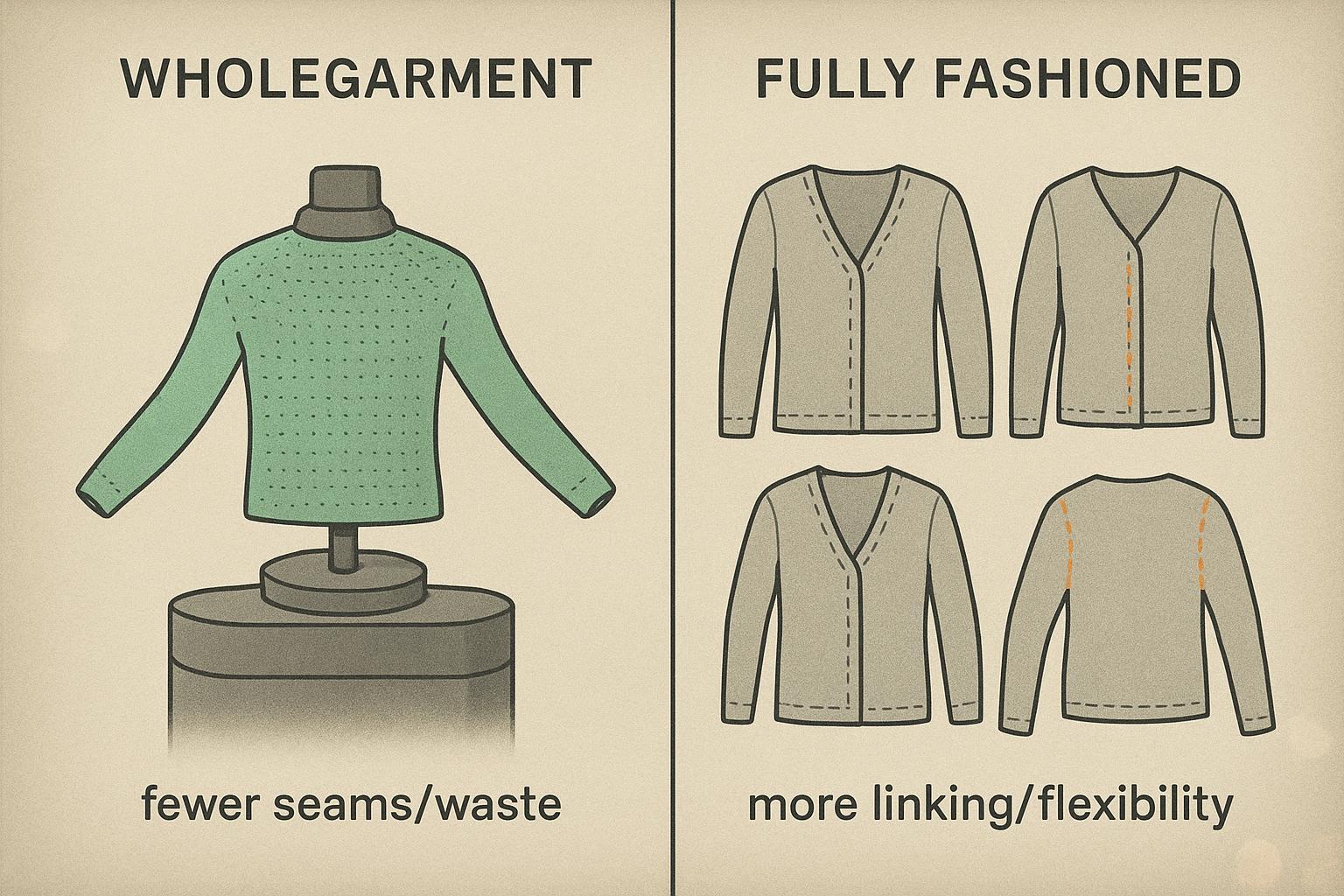
Choose WHOLEGARMENT when: the silhouette benefits from fewer seams, you want a cleaner interior, or time saved on linking helps your deadline. Expect constraints by machine availability and stitch options.
Choose fully fashioned when: you need maximal stitch variety, modular panel adjustments between sizes, or your supplier’s seamless capacity is limited during peak season.
Cost note: Seamless may reduce some labor and waste; fully fashioned may be more flexible for complex stitch layouts. Always cost both if timelines allow.
Pricing notes (and an important disclaimer)
All price figures are directional, derived from public signals and typical small‑batch ranges, and are subject to change without notice.
Always request live quotes tied to your exact tech pack, yarn source (stock vs dye), size curve, and color count.
Ask for landed cost modeling (FOB + freight + duties + surcharges) to avoid surprises. If you don’t have a model yet, this primer helps: How to cost a low‑MOQ sweater.
FAQ
What MOQ is realistic for cardigans with multiple colors/sizes?
Many best value cardigan manufacturers can start from 50–100 units per style, but splits across colors/sizes may trigger surcharges or dye‑lot constraints. Confirm kg‑per‑color and size‑curve rules before POs.
How fast can I get a production‑ready sample?
Some suppliers cite 3–5 days for straightforward cardigans, while others publish 7–10 days. Speed depends on yarn availability and programming queue; ask for timestamped samples and PPS checkpoints.
How do I verify OEKO‑TEX/GRS/GOTS/RWS claims?
Request current certificate numbers and check against the issuer’s registry. Keep the chain‑of‑custody (spinner → knitter → finisher) intact in your records.
When should I choose WHOLEGARMENT over fully fashioned?
When your design benefits from fewer seams and you can secure machine time at your gauge. If you need complex panel shaping or capacity is tight, fully fashioned is the safer bet.
What impacts landed unit cost most at low MOQ?
Yarn type/sourcing, gauge/stitch density, freight mode, and duties. Trims and packaging add up, too. Model scenarios before you commit.
How do I set AQL and ensure reproducibility from sample to bulk?
Define AQL in your PO and use PPS approvals with measurement tolerances. Reference lab standards (e.g., ASTM D3512; AATCC 135/61) and ask for first‑pass approval rates.
Sampling-to-bulk timeline (visual)
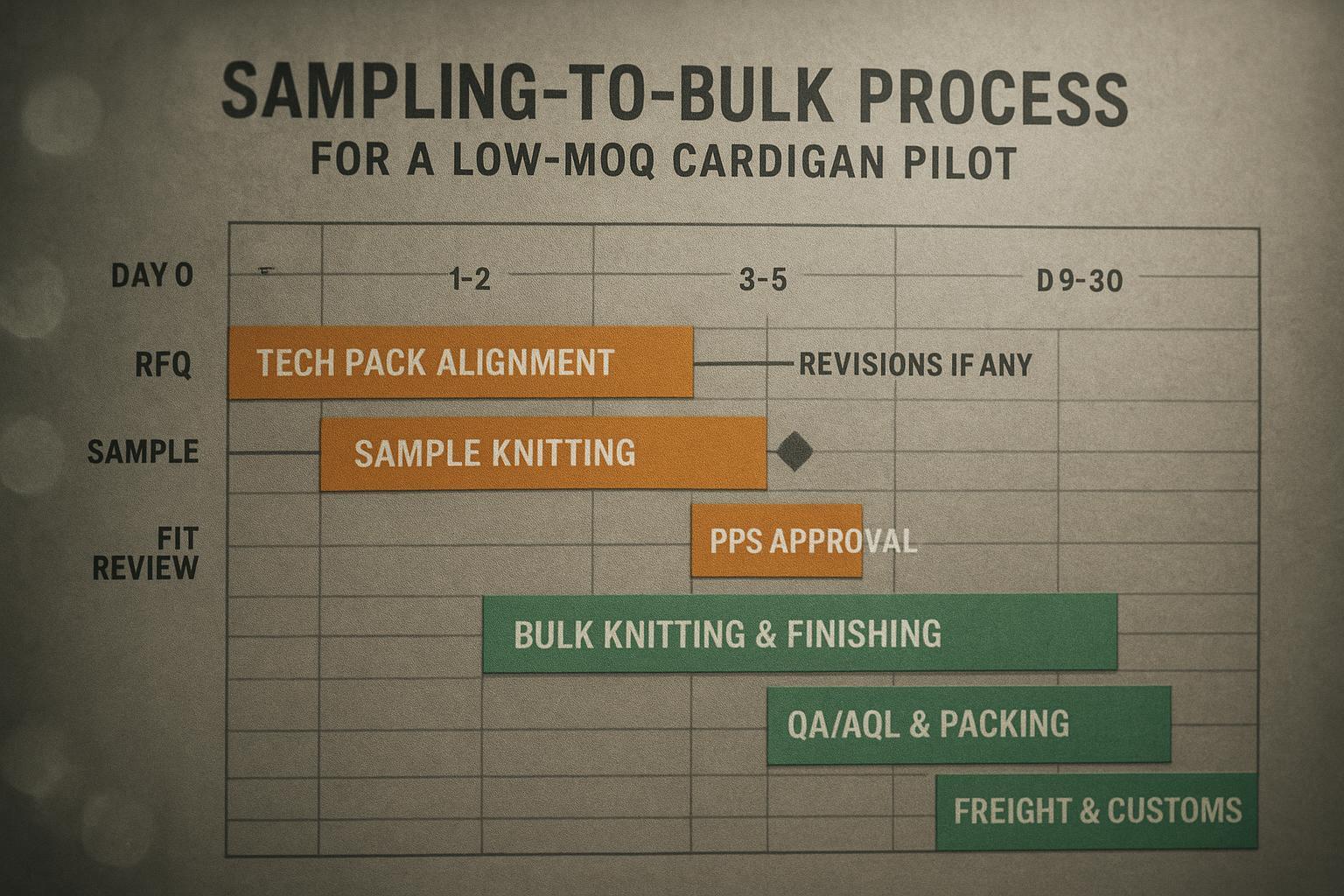
Use this as a baseline and add buffers around holidays and yarn‑dye windows.
Sources & data methodology
Tailored Industry — turnaround tiers and on‑demand model described on site pages accessed Feb 2026: Tailored Industry homepage and Pricing and tiers
Istanbul Clothing Manufacturers — published low‑quantity guidance and timelines (accessed Feb 2026): ICM low‑quantity page
Italian Artisan — small‑run knitwear feasibility and indicative MOQ (accessed Feb 2026): Italian Artisan knitwear article
Additional context and how‑to guides (first‑party, accessed Feb 2026): Low MOQ Production; Lead Times & MOQs FAQ; Anti‑pilling essentials — ASTM anchor; Landed‑cost primers
Link density is intentionally limited; for supplier‑specific quotes, request current spec‑tied offers.
Next steps (soft CTA)
Download the Low‑MOQ Pilot Checklist to structure your RFQ, sampling, and AQL steps: Low‑MOQ Private‑Label Pilot Checklist
Then shortlist 2–3 suppliers above and run a timed sampling trial using the timeline visual here. Save evidence (timestamps, fit notes) so you can compare apples to apples on value.
By design, this list avoids absolutist claims. Treat all figures as directional, confirm during RFQ, and document your own sampling timelines and AQL outcomes so “best value” reflects your exact constraints.