
Cashmere is premium. Small runs are unforgiving. When you combine both, guessing your unit cost is a fast route to blown margins. This guide shows you how to build a practical landed cost calculator for low-MOQ cashmere sweaters that accounts for FOB vs DDP, duties/taxes across the US/EU/UK/CA/AU, SKU fragmentation from size curves and colorways, and packaging choices—so you can minimize unit landed cost under real lead-time and MOQ constraints.
Key takeaways
A purpose-built landed cost calculator clarifies what moves between buyer and seller under FOB vs DDP and prevents double-counting fees.
Don’t hardcode duty or VAT/GST rates. Pull them live from official portals and record the date/screenshot in your file.
Low MOQs magnify fixed costs (lab tests, brokerage minimums, AQL inspections); amortize them carefully across all shippable units.
SKU fragmentation (more colorways, wide size curves) drives up waste and setup time; model it explicitly before committing.
Air vs sea and carton optimization can swing per-unit cost dramatically at 50 units—test scenarios before booking.
Before you start: what you need on your desk
You’ll need: a working HS/HTS classification for the exact garment, an Incoterms decision (FOB or DDP), an estimate for international freight/insurance by mode, your packaging plan (polybag, carton size, inserts), any required lab tests (pilling/shrinkage/colorfastness), and clarity on size curve and colorway count. If you’re new to the realities of small runs, see the context on minimums in the internal primer on Low MOQ Production at Xindi: low‑MOQ realities and drivers.
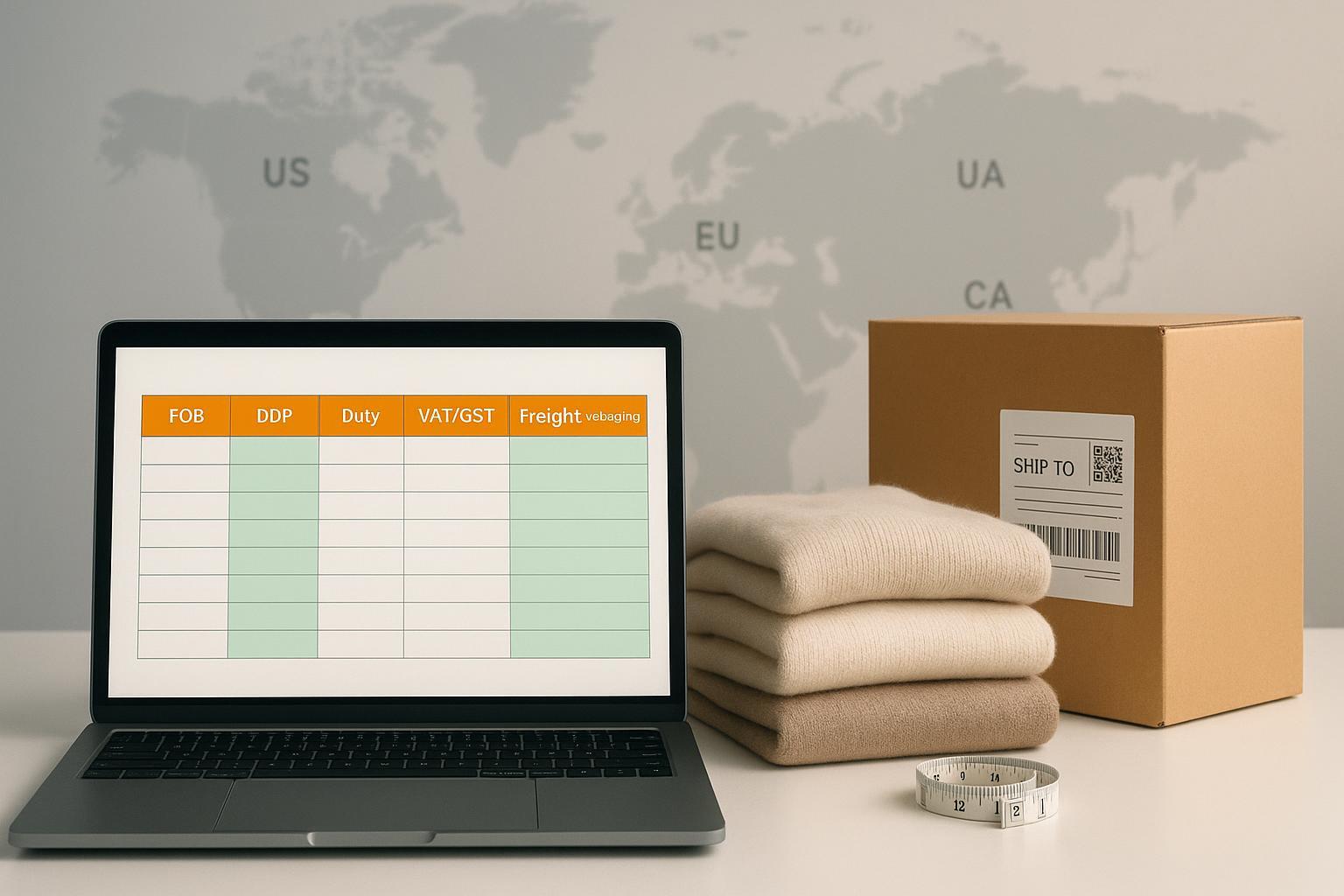
Who pays for what under Incoterms
Under FOB, the seller clears export and loads at origin; the buyer pays and manages the rest. Under DDP, the seller delivers to your named place with import clearance and taxes paid. Your calculator should shift responsibility (and therefore pricing) accordingly.
Cost element | FOB (buyer pays) | DDP (seller pays) |
|---|---|---|
Main carriage (ocean/air) & insurance | Yes | Included |
Import clearance & brokerage | Yes | Included |
Customs duties & VAT/GST | Yes | Included |
Destination terminal/THC & security | Yes | Included |
Final delivery to warehouse | Yes | Included |
Export clearance & origin THC | Included | Included |
For concise refreshers on these rules, see Trade Finance Global’s overviews for FOB and DDP. In practice, keep a note that for containerized apparel, FCA can be operationally safer than FOB even though FOB is common in the trade.
Build your landed cost calculator step by step
Your objective is to minimize unit landed cost subject to lead time and MOQ constraints. That means structuring inputs so you can run sensitivity checks without re-building the model each time.
Define SKU structure and quantities
Style → colorways → sizes. Baseline (as requested): 50 units total, 1 color, 5 sizes (XS–XL). Add fields for alternative curves and color counts.
Enter ex‑factory price and Incoterm
If pricing is FOB, ex‑factory + origin handling is baked into FOB. If pricing is ex‑factory, add origin THC/export fees separately. Add a toggle for FOB vs DDP so cost responsibilities shift to the right party while you still show the components for transparency.
Freight and insurance
Input quoted freight by mode (air courier, air freight, or LCL). Allocate across units by actual or dimensional weight/cube. Carton dimensions matter at small quantities—optimize pack density to avoid dimensional weight penalties.
Clearance, duties, VAT/GST, and local delivery
Add lines for brokerage, customs duty, VAT/GST (where applicable), terminal/THC at destination, security fees, and drayage/final-mile to your warehouse. Under DDP, these are embedded in the seller’s delivered price, but keep them itemized in your model to compare.
Packaging, testing, and compliance
Per-unit: polybag, labels, hangtags, inserts. Per-shipment or per-style: cartons, lab tests (pilling, shrinkage, colorfastness), certification paperwork, AQL inspection. Amortize fixed items across the total shipment.
Allocation rules and formulas
Freight allocation: by share of shipment cube/weight or unit share if near-identical. For air/courier, use dimensional weight (L×W×H/denominator per carrier) for each carton.
Duty base: market-specific (see Market lookups below). VAT/GST base: customs value + duty + eligible charges for EU/UK/CA/AU.
Objective function: unit landed cost = (all buyer-responsible costs) ÷ total units delivered for that scenario. Compare scenarios that alter mode, size curve, colorways, and packaging.
Copyable calculator template (CSV)
Paste the below into a new Google Sheet or Excel (use Data → Text to Columns on commas). Cells that require user input are marked INPUT. Replace example numbers with your own; duty and VAT/GST rates must be fetched live from official portals.
Section,Line item,Who pays (FOB/DDP),Basis,Quantity/Units,Rate,Amount (auto),Notes
Header,Incoterm,INPUT,,FOB or DDP,,,Toggle determines responsibility mapping
Header,Destination market,INPUT,,US/EU/UK/CA/AU,,,Controls duty/VAT logic tabs
SKU,Total units,INPUT,,50,,,
SKU,Colorways,INPUT,,1,,,
SKU,Sizes (e.g., XS-S-M-L-XL),INPUT,,5,,,
Factory,FOB unit price (if FOB),Seller,per unit,50,35.00,=Quantity*Rate,Enter FOB unit if offered
Factory,Ex-factory unit price (if exw),Seller,per unit,50,33.00,=Quantity*Rate,Only if not FOB
Origin,Origin THC/export docs,Seller,per shipment,1,120.00,=Quantity*Rate,Add if exw pricing
Freight,International freight & insurance,Buyer (FOB) / Seller (DDP),per shipment,1,420.00,=Quantity*Rate,Use air/LCL quote; allocate by units
Clearance,Brokerage/entry fees,Buyer/Seller,per shipment,1,95.00,=Quantity*Rate,Add ISF/entry/security as applicable
Customs,Customs value (calc),System,formula,, ,=IF(Destination="US",ExFactoryOrFOB+AllocFreightAdj, CIF),See market tab for definition
Customs,Duty rate %,INPUT,,live lookup,,,
Customs,Duty amount,Buyer/Seller,formula,, ,=Customs value*Duty rate,
Tax,VAT/GST rate %,INPUT,,live lookup,,,
Tax,VAT/GST amount,Buyer/Seller,formula,, ,=VAT base*Rate,See market tab for VAT base
Destination,Terminal/THC & security,Buyer/Seller,per shipment,1,80.00,=Quantity*Rate,
Destination,Final delivery to warehouse,Buyer/Seller,per shipment,1,110.00,=Quantity*Rate,
Packaging,Per-unit packaging,Buyer/Seller,per unit,50,0.80,=Quantity*Rate,Polybag/labels/inserts
Testing,Lab tests (pilling/shrinkage/colorfastness),Buyer/Seller,per shipment,1,220.00,=Quantity*Rate,Amortize across units
QC,AQL inspection (if any),Buyer/Seller,per shipment,1,150.00,=Quantity*Rate,
Subtotal,All buyer-responsible costs,System,sum,, ,=SUM(line items with Buyer responsibility),Depends on Incoterm
Result,Unit landed cost,System,formula,, ,=Buyer cost subtotal/Total units,
Sensitivity,Scenario label,INPUT,,Baseline (50u / 1 color / 5 sizes),,,Use copies for what-ifs
Tip: add separate tabs for US/EU/UK/CA/AU with a simple duty/VAT checklist and fields to paste live rates.
Practical example: prefilled baseline with a cashmere specialist
Disclosure: Xindi Knitwear is our product. The following is a neutral, practical example that shows how a prefilled baseline can look, not a performance claim. Learn more about the manufacturer at Xindi Knitwear (Knitwear.io).
Scenario: 50 units total, 1 color, 5 sizes (XS–XL). FOB unit price placeholder $35. Air small-parcel consolidated freight quoted at $420; brokerage $95; destination charges $80; last-mile $110. Packaging $0.80/unit. Lab test panel (pilling/shrinkage/colorfastness) $220; optional AQL inspection $150. Duty and VAT/GST are left as inputs you must pull live from official portals.
What the model reveals at this scale:
Packaging and lab tests add ~$5.40/unit in this example before duty/tax. Consolidating colorways (sticking to 1) and right-sizing cartons can shave another $1–$2/unit by avoiding dimensional weight.
Switching from air to LCL at 50 units may not save money once minimums and handling are included—run both scenarios with your forwarder’s quotes.
A wider size curve with uneven demand (e.g., XS and XL slow movers) increases unit cost via leftovers and partial-cone yarn waste. Remap your curve to projected demand and re-run.
Market lookups: how to fetch live duty and VAT/GST
Use these official portals to pull current measures. Paste rates into the calculator and note the date and a screenshot in your shipment file.
United States (HTSUS and possible Section 301)
Find the HTS 10-digit code for knitted cashmere sweaters under Chapter 61, heading 6110 using the USITC database. Start here: the USITC HTS search portal. If the country of origin is China, check whether additional Section 301 duties apply and whether exclusions exist via the USTR Section 301 actions page. The U.S. does not impose a federal VAT at import, but you should still record duty and fees per CBP entry with your broker.
European Union (CN/TARIC and import VAT base)
Use Access2Markets to look up the CN code and MFN/provisional measures for your origin and product (e.g., “cashmere sweater” within 6110.12). Start at the Access2Markets home and navigate to Duties and Taxes. Compute VAT on the VAT base (customs value + duty + eligible pre-import charges) at the member-state rate.
United Kingdom (UK Global Tariff and import VAT)
Look up the commodity code and UKGT duty via the GOV.UK service. Begin with the tariffs on goods imported into the UK page and follow the prompts. Apply import VAT (typically 20%) to the customs value plus duty and eligible charges; VAT-registered importers may use postponed accounting.
Canada (Customs Tariff and GST/HST)
Use CBSA’s Customs Tariff schedules for Chapter 61 to identify the duty rate for your exact description under 6110.12, then compute GST/HST on the duty-paid value; see the CBSA importer’s guide for the components and process.
Australia (Working Tariff and GST on imports)
Check the current Working Tariff for Chapter 61 and apply any relevant preferential rates. Import GST equals 10% of the taxable importation base (customs value + duty + transport/insurance to the place of consignment). The Australian Border Force explains this at its page on GST and other taxes on imports.
Troubleshooting and red flags (read before booking freight)
Misclassification risk: Similar sweater lines can map to different subheadings based on fiber content, gender, and construction. If your volumes justify it, consider a binding ruling (e.g., BTI in the EU, or a CBP binding ruling in the US). In your file, keep the HS printout and the broker’s confirmation.
Section 301 stacking in the US: If your cashmere sweaters are China-origin, verify whether Section 301 surcharges apply on top of MFN. Exclusion lists change—don’t rely on last season’s number; re-check and document.
VAT/GST base mistakes: In the EU/UK/CA/AU, the VAT/GST base typically includes the customs value plus duty and eligible charges before tax. If you apply VAT/GST only to ex‑factory, your margin forecast will be wrong.
Duplicate brokerage: Forwarders sometimes bundle brokerage while a separate broker also invoices an entry fee. Confirm who files the entry and remove duplicates in your model.
Dimensional weight surprises: At 50 units, a few oversized cartons can push air costs up sharply. Run carton optimization with your packaging team and ask the forwarder for the dimensional divisor used on your route.
Quick start: a 5-step workflow you can run today
Classify the exact garment and save a screenshot from the market’s official tariff portal; paste the rate into your landed cost calculator.
Decide FOB or DDP and confirm which party handles freight, clearance, duty, VAT/GST, and last mile; mirror that in your model.
Enter your packaging and testing plan; amortize fixed costs across units and check the unit impact.
Run sensitivities: 1 vs 3 colorways; narrow vs broad size curves; air vs LCL; alternate carton sizes; pick the lowest unit landed cost that meets your launch window.
Sanity-check with your broker/forwarder and keep their quote PDFs linked in the file.
If you’re benchmarking suppliers or alternative regions for small runs, these resources help frame MOQs and capacity without hype: a pragmatic Portugal knitwear factory guide and a broad China knitwear supplier list.
You now have a working framework—and a copyable template—to calculate and lower your unit landed cost for low-MOQ cashmere sweaters. Populate the fields, fetch duty/VAT live from the portals above, and pressure‑test scenarios until the numbers support your launch window. When in doubt, ask your broker to validate the duty/VAT base and keep that confirmation attached to your model. Good luck, and let’s make the math work before the yarn is ordered.