
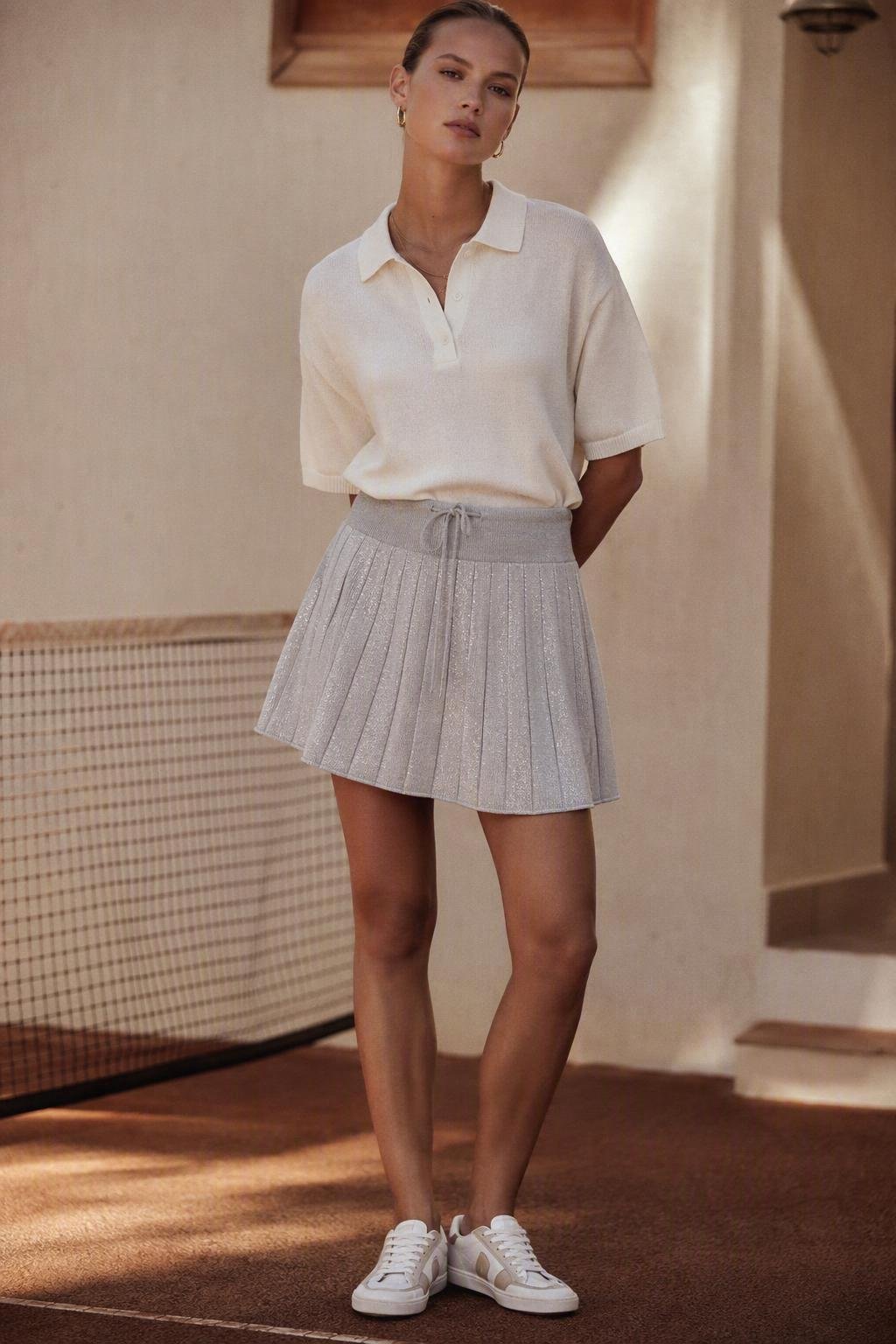
Few pieces straddle sport and luxury as gracefully as a merino lurex knit tennis skirt. One season you see it on a resort runway, the next it anchors an everyday outfit that reads effortless rather than athletic. For independent knitwear labels, that versatility is the point — but so is the question of how to build a version of your own, on a small budget, without gambling your whole run on an untested design.
This guide breaks down what makes this piece recognizable, how to style it beyond the court, and — most importantly — how an emerging brand can develop, sample, and produce its own merino lurex knit tennis skirt at realistic low minimums.
What Makes a Merino Lurex Knit Tennis Skirt Distinct
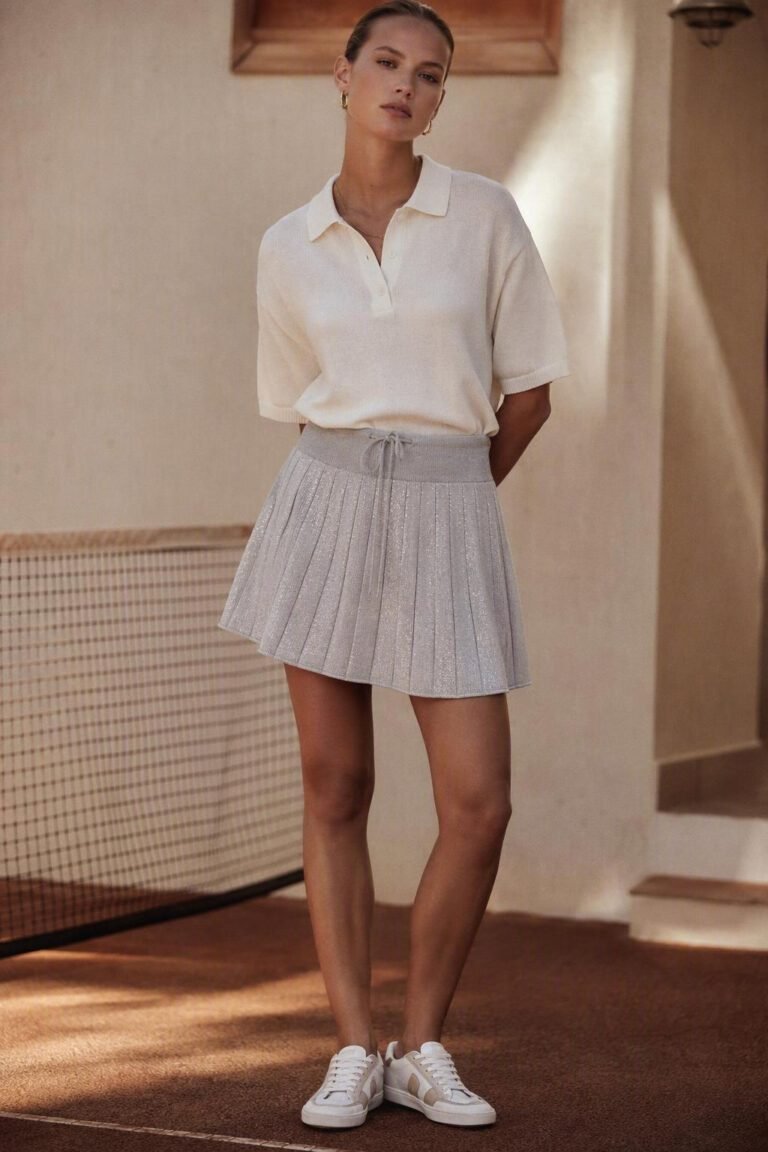
Knit tennis skirts are a deliberate departure from the stiff, performance twill you get from a courtwear brand. Woven in fine merino, they take the familiar A-line mini and soften it. A version like Casablanca’s signature piece — retailed in silver, white, and navy — typically pairs merino wool with lurex, a metallic thread that adds a subtle shimmer rather than a loud sparkle.
A few design codes keep showing up across versions of this style:
A pleated or A-line mini silhouette. The body needs enough shaping to hold a flattering line, but because it is knit rather than twill, it drapes and moves instead of standing stiff.
A contrasting ribbed waistband. This does more than look sporty. Rib has strong recovery, so it grips without folding or rolling — a critical detail for a skirt with no other closure.
A drawstring. It serves a real function: it lets one size wear across a slightly wider range and reduces the returns that come from a too-tight or too-loose waist.
Tonal “tennis club” palettes. White, cream, silver-grey, and navy dominate because they read as preppy and timeless, and the metallic thread reads best against a clean base.
Before you dismiss lurex as “evening only,” it helps to know how it behaves. Lurex is typically a thin metallic film plated around or alongside the merino yarn. Plated correctly, it sits on the surface so you get a quiet glimmer without sacrificing the softness of the wool underneath. Plated carelessly, it can feel scratchy and snag more easily — which is exactly why construction quality matters more here than on a plain knit.
Key Takeaway: A merino lurex knit tennis skirt is a knit interpretation of classic tennis dressing. Its elegance comes from three engineered details: a shaped pleat or A-line, a recovery-rich ribbed waistband, and a restrained metallic thread that catches light without shouting.
How to Style It Across the Seasons
Because the knit tennis skirt is lighter and draper than a standard skirt, you style it for movement and mood, not for structure you expect to hold a sharp pleat through a match. Think “tennis club that stopped for coffee,” not game day.
Warm weather and transitions. Let the metallic thread carry the look. A fine merino tennis skirt reads beautifully with a tucked-in knitted tank or a crisp boxy polo, finished with retro sneakers or loafers. Keep the palette tonal — white with silver, cream with navy — and the lurex becomes a quiet premium detail rather than a party moment.
Cooler months. The light merino weight is what makes this piece work under layers that would swamp a heavier skirt. Layer a collared knit mock or polo, add an oversized cardigan or a tailored blazer, and ground it with crew socks and loafers or a pair of suede boots. The A-line keeps a little volume, so it balances an oversized top without disappearing.
Evening. This is where lurex earns its keep. Because the thread is subtle, you can dress the same skirt up by swapping the knit top for a satin or dark fine-knit layer and adding taller or heeled footwear. The shimmer does the elevating — you do not need a heavily embellished top on top of it.
The consistent theme across seasons: treat it as a knit piece first, tennis piece second. Let it drape, layer it, and use the metallic thread as the one refined accent in an otherwise calm outfit. And because the waistband has a drawstring, you can raise or lower it slightly to shift the proportion — pull it higher with an oversized top for more leg, or lower it with a cropped knit for a relaxed, sportier line.
Producing Your Own Version at a Small-Batch Level
For most indie labels, the interesting question is not just how to wear the trend — it’s how to release your own knit tennis skirt without betting your cash flow on a huge order. The good news is that this piece is well suited to low-MOQ production, provided you spec it carefully. Knit skirts sit in a factory’s dress-and-skirt lane, and a low MOQ knitwear production program commonly starts around 50 pieces per style and colorway, with a recommended gauge band of roughly 7 to 12 for knit dresses and skirts.
Here are the decisions most likely to shape your outcome.
Choose a fine-to-medium gauge. A coarse, chunky gauge would make the skirt bulky at the hip and fight the clean A-line. A tighter gauge lets fine merino hang smoothly and, in this case, keep the lurex running evenly so it reads as shimmer rather than bumps. Your factory’s machine stock and yarn choice will determine the practical range, so treat gauge as a call to make with technical input, not a fixed number you invent.
Engineer the waistband before anything else. On a skirt with no buttons or zipper, the ribbed waistband is doing all the work. Specify a denser rib than the body, with enough negative ease to grip without folding or rolling. If you add a drawstring, decide early whether it is decorative, functional, or both — that choice changes how the channel and eyelets are finished so the cord does not distort the knit.
Plan the hem and pleat for real life. For a pleated or A-line knit mini, the hem must resist curling and hold a crisp line under movement. Options include a fully fashioned hem edge knitted closed on the machine, a rib or fold-over hem for stronger recovery, or a linked seam where the panels and pleats meet. Because merino drapes differently than a stiff fabric, you want to check that the line survives sitting, walking, and washing — not just hanging on a hanger.
Expect the merino-plus-lurex to need extra care. Metallic yarns change how a knit behaves. They lower elasticity, can raise friction against the skin, and snag more readily than wool alone. Keep the lurex plated or subtle rather than dominant, and budget for a proper sampling pass before you commit to bulk. This is not a design you want to validate for the first time at scale.
If you are working through a partner that already runs small-batch knitwear, ask how they handle the custom knitwear manufacturing process from tech pack to finished garment, and whether a start-from-50-units private label knitwear program fits your runway. Sampling timelines of a few days and bulk runs close behind are realistic targets for an established low-MOQ shop.
Key Takeaway: A knit tennis skirt is a strong low-MOQ product because a single skirt silhouette can test sporty-luxe appeal for one style, one colorway, and a manageable first run — if you lock gauge, waistband engineering, and hem finish before you ever place the order.
What to Verify During Sampling
Low MOQ lowers your risk on inventory, but it does not lower your risk on quality — that is contained in the sampling pass. Before you approve, confirm these on the actual garment:
Hand feel. Fine merino should feel soft against the leg; the lurex should read as shimmering sheen, not scratch or roughness.
Waistband recovery. Stretch the rib and check it snaps back without gapping, folding, or rolling after repeated wear.
Drawstring channel. Pull the cord and confirm the channel and eyelets do not pucker or distort the knit.
Hem and pleat stability. Move, sit, and wash a sample to make sure the hem holds its line and any pleat recovers rather than permanently creasing or curling.
Lurex snag and pilling. Metallic threads are the most likely point of failure — check them for snags along seams and for pilling after washes.
Shrinkage and colorfastness. Wool shrinks and metallic trims can be sensitive, so ask for wash-test results rather than taking a swatch card at face value.
Fit and grading. Test at least the smallest and largest of your size range so one grade does not undercut the silhouette at either extreme.
None of these are negotiable once you have made the design. A garment that feels beautiful on the first sample but pills, gaps, or curls after three washes will cost you more in returns and reputation than the low order saved you upfront.
Pro Tip: Order one colorway as a sample run before scaling across multiple shades. Silver or cream are safer first bets precisely because they show the lurex well and travel across seasons.
The Takeaway for Emerging Knitwear Brands
The merino lurex knit tennis skirt is a genuinely portable idea for a small label. It sits at the intersection of durable tenniscore styling and premium knitwear — two lanes with steady, seasonal demand — and it is light enough to layer, quiet enough for evening, and distinct enough to become a signature piece.
More importantly, it does not require heroic order volume to test. Because a single skirt style with a fitted waistband and clean hem can run at low minimums, you can validate the silhouette, the lurex hand feel, and the cut with one small batch — then scale only the colors and sizes your audience proves out.
The next step is practical: talk to a knitwear factory about a swatch of fine merino with a subtle lurex plating and a sample of your waistband drawstring construction. A good partner will show you the gauge and recovery numbers, not just a photo, before you commit to your first run.