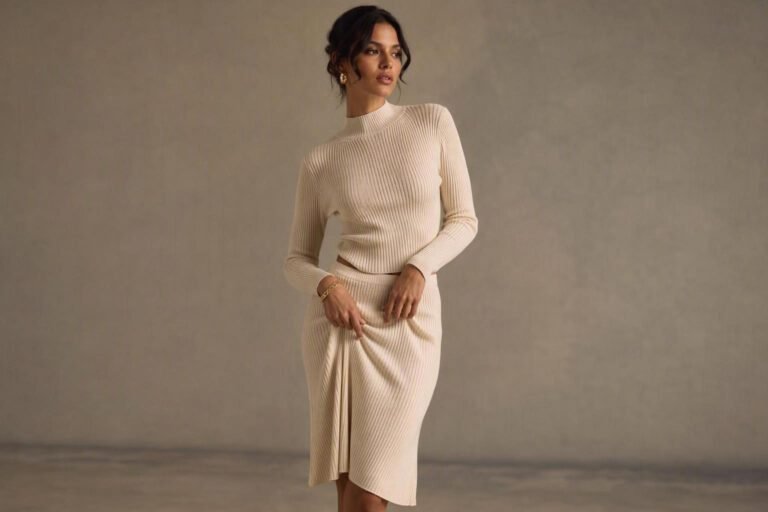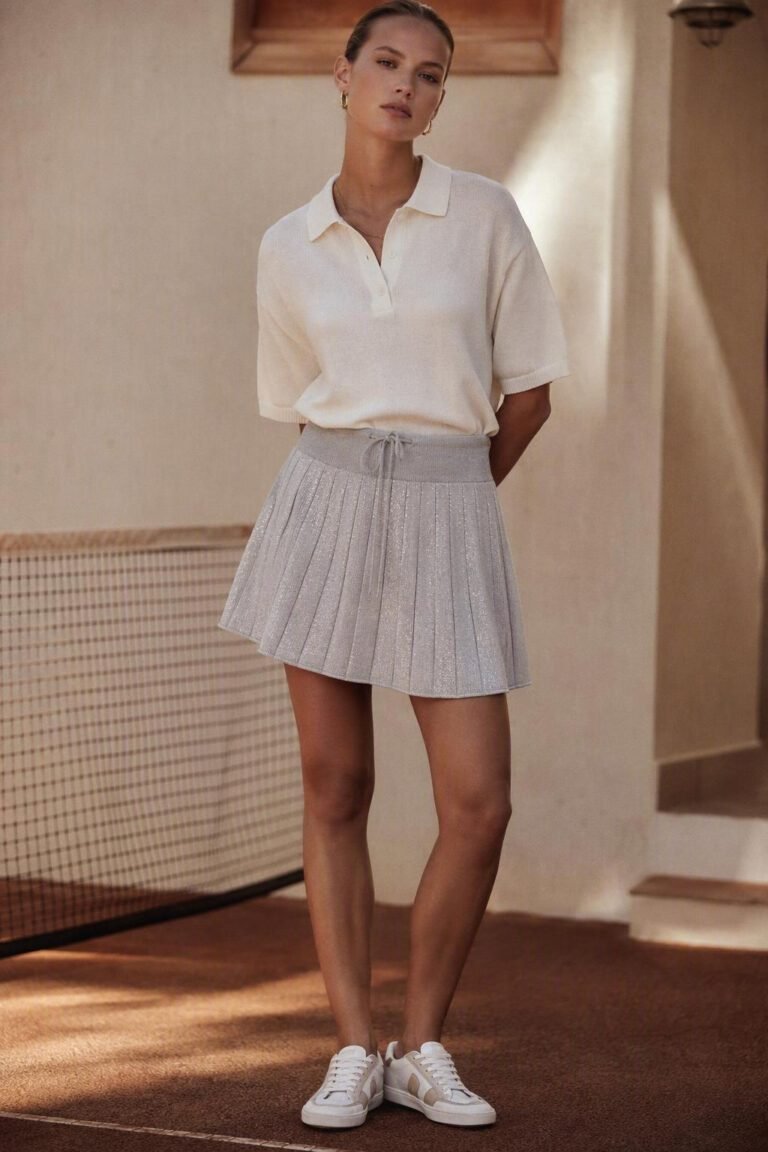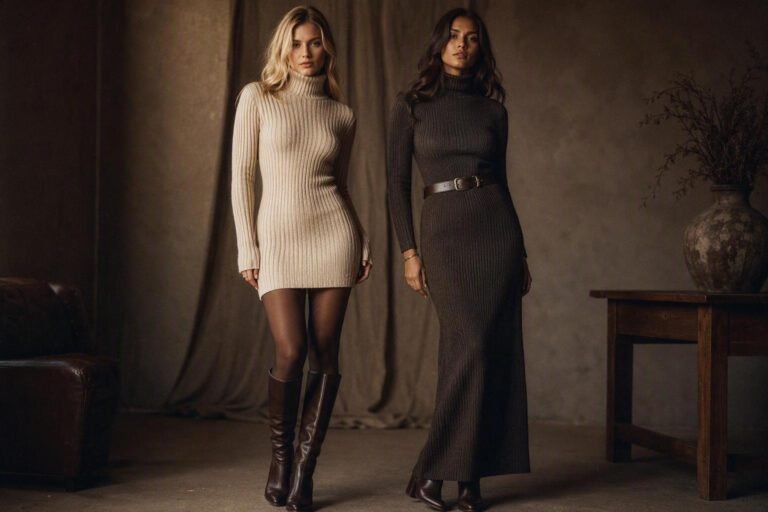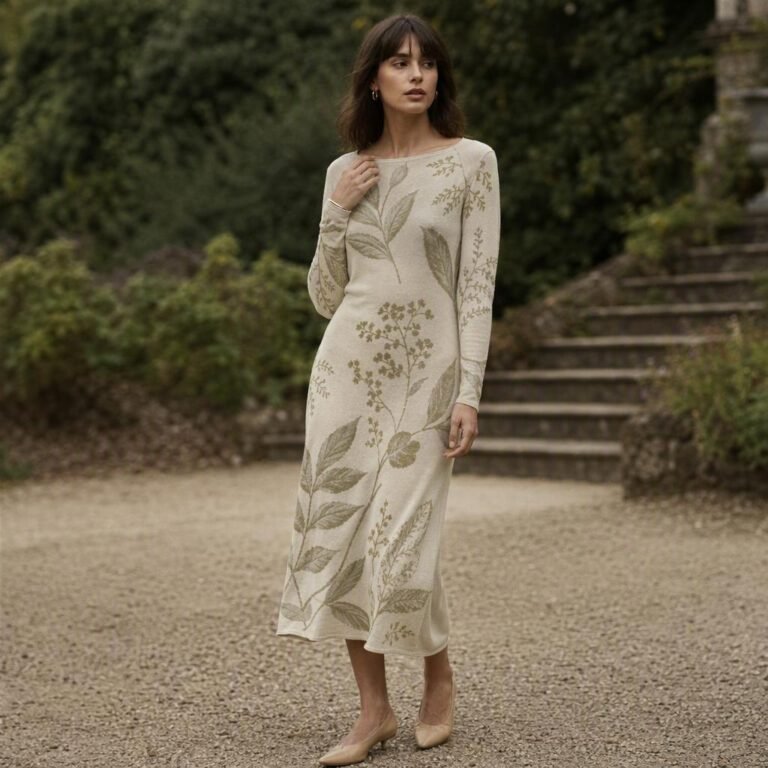

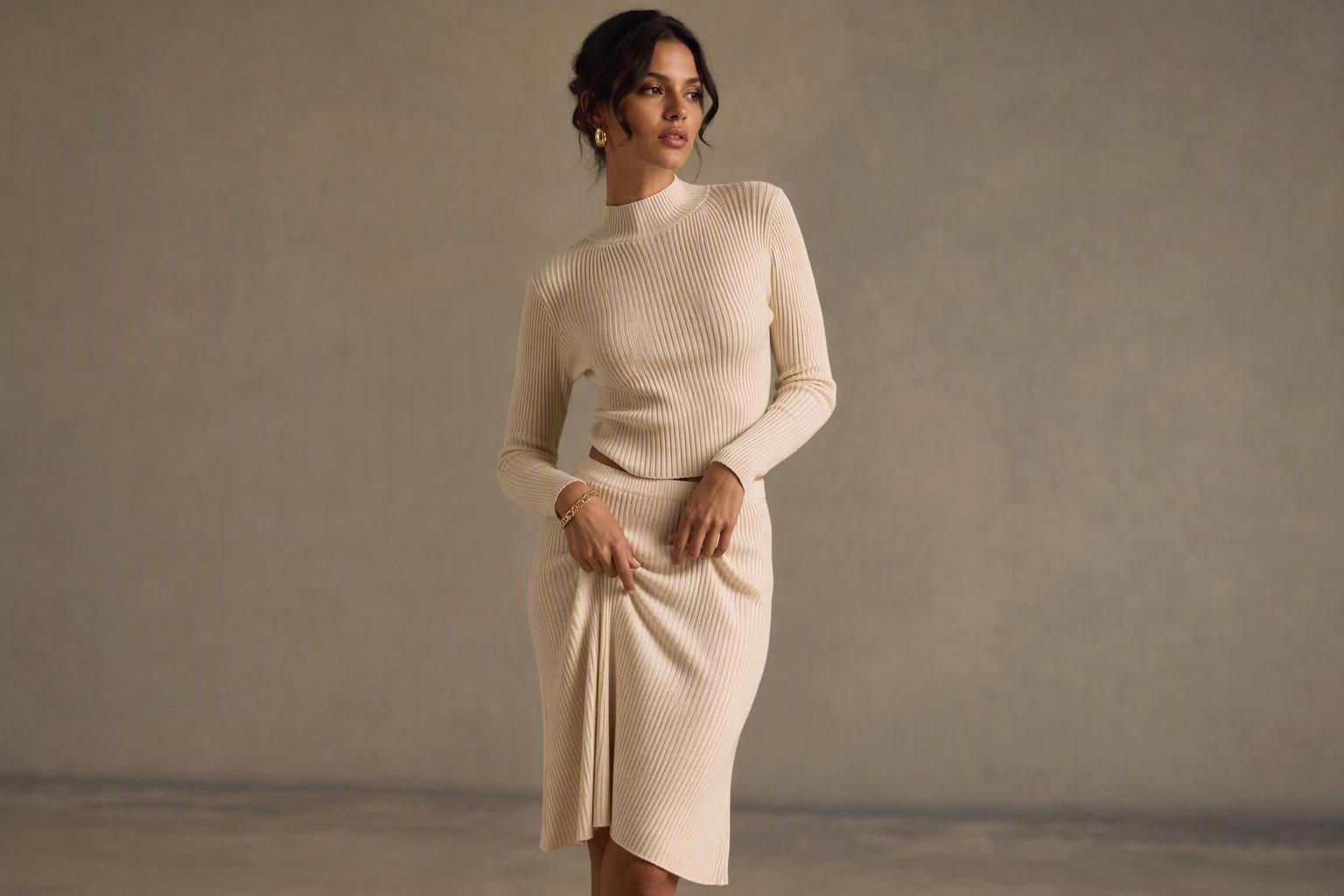
There is a reason the two-piece knit skirt set keeps coming back. Slide on a matching knit top and knit skirt and the outfit is decided before you leave the house, yet it reads as intentional rather than thrown together. The trick is that the best examples work as a set and as separates, which is why designers keep treating them as a wardrobe foundation rather than a one-time novelty.
The real decision is the skirt length. A midi knit skirt that hits below the knee behaves differently from a maxi knit skirt that sweeps to the ankle, and not just visually. The length changes how the knit drapes, how it moves, how it flatters, and even how it needs to be constructed. This guide walks through the midi-versus-maxi call from both sides: which one to choose and style, and what a two-piece set actually asks of a knitwear production partner if you make your own at low MOQ.
What a knit skirt-and-top set does well
Think of a matching set as an outfit that removes the hardest stylistic step. Matching knits in the same yarn, gauge, and shade look cohesive by design, so you avoid the guesswork of pairing an unrelated top and bottom. Fashion editors describe coordinating sets as the ultimate one-and-done dressing for this reason. Vogue’s matching-set shopping guide calls them the fuss-free outfit solution.
The smart versions go further and reward mixing. When the skirt is a genuinely wearable length, you can pair the knit top with tailored trousers or jeans, and wear the knit skirt with a tucked-in blouse or shirt. Buying a knit co-ord set effectively gives you the foundation for several looks instead of one.
Here is the fine print that styling roundups rarely mention. A co-ord only looks expensive when the fabric is right. Sets made from thin, cheap knit sit flat on a hanger and cling awkwardly on a body. Weightier fabric that drapes rather than stretches out is what separates the elevated set from the costume.
Midi knit skirt set or maxi knit skirt set: quick read
Midi knit set | Maxi knit set | |
|---|---|---|
Hem | Below the knee to mid-calf | Ankle to floor |
— | — | — |
Mood | Polished, modern, day-to-evening | Effortless, dramatic, long-lined |
Best occasions | Office, brunch, smart-casual, travel | Dinners, resort, weddings, relaxed weekends |
Body types | Flatters most when hem hits a slim point | Elongates; best streamlined for petites |
2026 direction | Rising midi hemlines, sleek column shapes | Fluid, drapey, movement-forward |
Knit behaviour | More stable, easier hem control | Needs hang-testing; more drape and stretch risk |
Choosing the length that flatters you
Length guidance always comes down to where the hem lands relative to your leg. The cleanest rule is to let the skirt hit the slimmest part of your lower leg, which is usually just below the knee or just above the ankle. Byrdie’s maxi-versus-midi skirt guide makes the same point, noting that a midi sits between the knee and ankle with mid-calf as the sweet spot.
For petite frames, a well-placed midi tends to work better than a maxi, especially when it hits just below the knee or above the ankle and is paired with a fitted top and elongating shoes. Taller frames often pull off a maxi most easily because it preserves a long vertical line without extra styling work. If you have an hourglass shape, a maxi set creates a clean, unbroken column, while a midi shows a little calf and keeps a defined waist. Those with a straighter or more athletic build often find a structured or ribbed midi adds shape, while a softer maxi gives an elongated finish.
Styling follows fit. A fitted knit top with a high-waist skirt defines the waist in either length, and a slim belt can break up an all-knit monochrome without undoing the co-ord effect. Shoe choice changes the register completely: heels, strappy sandals, or pointed boots dress a set up, while white sneakers or flats make it an everyday look.
When each set length reads best
Midi is the more versatile pick. It reads composed without being formal, which is why it moves easily between an office day and a dinner out. The current trend direction leans this way too, with sleek column-like and pencil midis becoming the most-worn skirt length for everyday dressing in 2026.
Maxi is the moodier, more relaxed choice. Because the hem extends toward the ankle, a maxi knit skirt set carries ease and a quiet sense of occasion. It suits dinners, weekends away, and warmer months where you want movement and drape rather than structure. If you are layering for cold weather, both lengths work under a long coat, but a maxi keeps your legs warmer with tights.
Your wardrobe should probably hold one of each. A midi knit skirt set covers the polished majority of your calendar, and a maxi set steps in when you want the outfit to feel more deliberate.
What styling sources get repeated, and what they miss
Most guides agree on the basics: keep accessories restrained so the matching set stays the focus, and let one piece stand out if you are not wearing them together. There are a few formulas that reliably work for a knit skirt-and-top co-ord:
Let the set lead, then adjust with shoes and layers. A long coat or tailored blazer changes a knit set’s formality without breaking its coherence. A lightweight cardigan over the matching top softens it for daytime.
Tuck or belt for definition. Fully tucking a knit top into a high-waist knit skirt, or adding a slim belt, defines the waist and flatters more body types.
Balance the proportions. A relaxed top reads best with a slimmer skirt, and a fitted top balances a fuller or longer skirt. This stops a two-piece set from looking bulky.
Mind the hem edge. A knit skirt that cups at the hem or sticks to bare legs is a length problem, not a styling problem, and it has more to do with the fabric than the outfit.
What almost no styling article tells you is why knit co-ord sets are harder to get right than they look. A two-piece set is a small engineering problem in matching, and that is where understanding the knit itself matters.
The production side of a matching knit set
When a knit co-ord set fails, it is usually not the styling. It is the match. The top and skirt have to respond to the same yarn, the same gauge, the same finishing, and the same dye lot, or they drift apart in shade, handfeel, and shrinkage after the first wash. That consistency is the core of an OEM/ODM knitwear program, and it shapes every technical decision below.
How skirt length changes knit behaviour
Length is more than a measurement on a spec sheet. A maxi skirt carries more vertical fabric, which means more weight pulling down and more opportunity for the knit to grow, stretch, or drape unevenly as you move. A midi skirt is physically easier to control because there is less fabric to manage, so hem balance and walking ease come more reliably.
For either length, the fit has to be drafted from the finished skirt length plus waist and hip ease rather than guessed from a generic chart. Longer knit skirts usually need a length correction after hang testing, because the same knit can settle differently after washing or steaming. If you are ordering a knit maxi skirt, expect the factory to account for that drop.
Matching the two pieces is the real skill
The single biggest mistake in a knit co-ord is ordering the top and skirt as if they were independent garments. They are not. The shades must come from one dye or well-controlled dye lots, and the shrinkage and handfeel have to move together so the set stays coherent after repeated wear. This is why the strongest co-ord programs are built on one consistent yarn base in a single gauge, rather than mixing sources.
For an emerging label, the practical route is to start from matching stock-service yarns and existing knit bases, then confirm the two pieces against each other in the same sample approval. A lighter-weight knit used for both the top and a midi skirt keeps sampling simple and drops cost. Adding custom yarn dyeing or heavily patterned structures raises MOQ and coordination risk, because now shade and print must match across two separate pieces.
Waistbands and trims carry the skirt
A knit skirt lives or dies at the waistband. The usual options are a wide waistband with internal elastic, a folded waistband, or a ribbed waistband, and each has to balance comfort with hold. Too soft and the skirt slips; too tight and it distorts the top edge. Matching ribbing at the waist and hem also deserves attention, because rib that does not match the main fabric (in dye lot, gauge, or texture) is immediately visible.
The most reliable approach is to source the skirt fabric and its trims together, ideally from the same supplier, so shade and recovery line up. When an exact trim match is hard at low volume, many brands use the main knit as the edge treatment, which only works when the fabric has enough stretch and recovery to handle a banded finish.
Construction: cut-and-sew, fully-fashioned, or whole garment
Three construction routes exist, and the co-ord format changes which one makes sense. In cut-and-sew, fabric is knitted, cut by pattern, and sewn; it is flexible and suits lightweight tops and skirts, but cutting creates roughly 10 to 20 percent waste and visible overlock seams. Fully-fashioned knitwear shapes each panel on the machine before linking, giving cleaner finishes and very low waste at a higher cost. WHOLEGARMENT 3D knitting produces the garment in one seamless piece for near-zero waste, which is why seamless knit labels like to build fine-gauge knit dresses and tops this way.
For an emerging label’s first knit co-ord, a midi-length skirt in a cut-and-sew or simple fully-fashioned construction with a wide waistband and matched rib trim is usually the safest low-MOQ route. If you are weighing construction, understanding the difference between fully-fashioned and cut-and-sew knitwear clarifies the cost and finish trade-offs before you commit. Treat a maxi knit skirt as the more technical style, and explore fully-fashioned or WHOLEGARMENT 3D knitting, a method that builds seamless garments in one piece with near-zero waste, after confirming the factory’s setup cost and capability for a full set.
Producing your own knit set at low MOQ
The good news is that a matching knit top-and-skirt set does not force you into factory-scale orders. Low-MOQ knitwear production commonly starts around 50 pieces per style and color, and knit dresses and skirts typically fall in the 50-to-100-piece range depending on construction and yarn, as documented on knitwear.io’s low-MOQ production page. Custom yarn dyeing, complex knits, and heavy trim coordination push minimums up, which argues for a clean first launch on a simple midweight knit.
Lead time follows the same logic. Fast-track sampling can finish in three to five working days, with bulk production typically running roughly three to five weeks after approvals when you use stock-service yarn, and whole-garment or fully-fashioned programs adding setup time. For a fuller picture of what to expect in sampling and bulk, knitwear.io’s low-MOQ lead-times and MOQ FAQ lays out the typical ranges.
If you want to develop your own knit co-ord, the essentials to lock down in a tech pack are the finished skirt length per size, waist and waistband width, stretch and recovery targets, fabric composition with gauge and weight, the construction method, trim specifications, and the approved measurement tolerances after washing. Getting these agreed in one sample approval is what stops the top and skirt from drifting apart later.
Key Takeaway: Choose a midi knit skirt set for versatility and polish, or a maxi set for a longer, more dramatic line. If you are producing the set, build both pieces on one matching yarn base and confirm them together in a single sample so shade and shrinkage stay in step.
Frequently asked questions
What is the difference between a midi and a maxi knit skirt? A midi knit skirt falls below the knee to mid-calf, while a maxi knit skirt extends to the ankle or floor. Midi is more versatile for daily wear and tailoring; maxi gives a longer, more relaxed silhouette suited to evening and warmer weather.
Can a midi or maxi knit set flatter a petite frame? Yes. Petites usually do better with a midi that lands at a slimming point below the knee or above the ankle, styled with a fitted top and elongating shoes. A maxi works for petites too, but only when it is streamlined and waist-defined rather than bulky.
What top goes with a midi or maxi knit skirt? A fitted knit top works with both. In a co-ord set the knit top matches the skirt by design. You can also wear the set as separates, pairing the skirt with a tucked-in blouse or a cropped knit top depending on the mood.
How should you wash a two-piece knit set? Wash both pieces together gently in cold water and lie them flat to dry. This keeps the shade and shrinkage of the top and skirt aligned so the set stays matching over time.
Can I make my own knit skirt-and-top set at low MOQ? Yes. Low-MOQ knitwear production starts around 50 pieces per style and color for knit dresses and skirts. Building the top and skirt from one matching stock-service yarn base and confirming them in a single sample approval keeps the set consistent and the minimum order practical.
Next steps
A two-piece knit skirt set earns its place in any rotation when the length suits you and the pieces truly match. For shoppers, that means choosing a midi for day-to-day wear or a maxi for a longer, more relaxed line, and checking fabric weight before you buy. For labels, it means designing the set as one coherent garment problem, not two separate ones, with an eye on matching yarn, gauge, and shade across both pieces.
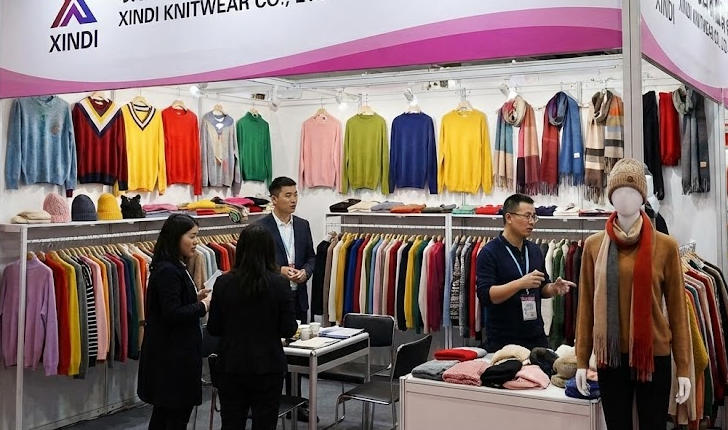
If you are developing a knit co-ord and want to test a low-MOQ run against a factory that produces knit dresses, skirts, and tops as a full program, Xindi’s custom knitwear development page is a practical starting point for how a small label moves a matching set from concept to a finished collection.