
The collection looked right on the mood board. The yarns sat together, the silhouettes told a story, the lookbook made sense of the whole wardrobe. Then the drop went live, sell-through flattened in week three, and the stock that was supposed to carry the season is now a markdown decision you have to make before the next sample round.
That experience is usually diagnosed as a taste problem — the market didn’t get it, the timing was off, the color was wrong. For independent knitwear labels in North America and Europe, running small teams and small runs, the more useful diagnosis is a sequencing problem. Knitwear commits money earlier than almost any other apparel category: yarn is bought by weight, color is dyed in batches, machines are programmed, and capacity is reserved months before a single customer sees the style. When demand stalls, what hurts is not that the forecast was wrong. It is how much was locked in before the forecast had a chance to be tested.
This article sets out an inventory framework built specifically around knit manufacturing: modular design, smaller first runs sized to real minimums, rapid sampling as the true speed lever, yarn and fabric reuse across styles, and reorder triggers that fire on measured data. The through-line matters as much as the individual practices. Flexibility only lowers markdown exposure if the collection still reads as designed rather than assembled — so every lever below is paired with the design discipline that keeps it from turning your line into a parts bin.
Key takeaways
A stalled lifestyle collection is usually a commitment-sequencing problem, not a forecasting failure. You cannot buy accuracy at small scale; you can buy time.
In knitwear, the binding minimum is often kilograms of yarn per color at the dyehouse, not garment units. Your inventory plan is really a yarn plan with a garment count attached.
Modular design, small first runs, fast sampling, yarn reuse and reorder triggers work as one system, in that dependency order.
Small-batch unit cost and markdown exposure have to be compared on the same units and the same season, with the arithmetic visible.
A flexible collection stops feeling repetitive when novelty lives in proportion, texture, color and styling — not in the number of new programs.
The two changes most brands can make first: size the first run to the real dye-lot floor, and set reorder triggers before launch.
Why a Stalled Lifestyle Collection Is a Commitment Problem, Not a Taste Problem
Lifestyle positioning concentrates risk. A brand selling a wardrobe idea rather than a single product tends to build the season around a few hero styles and a few signature colorways, because that is what makes the story legible. It is also what makes a demand stall expensive: when the story doesn’t land, it doesn’t land across a large share of everything you committed to, all at once.
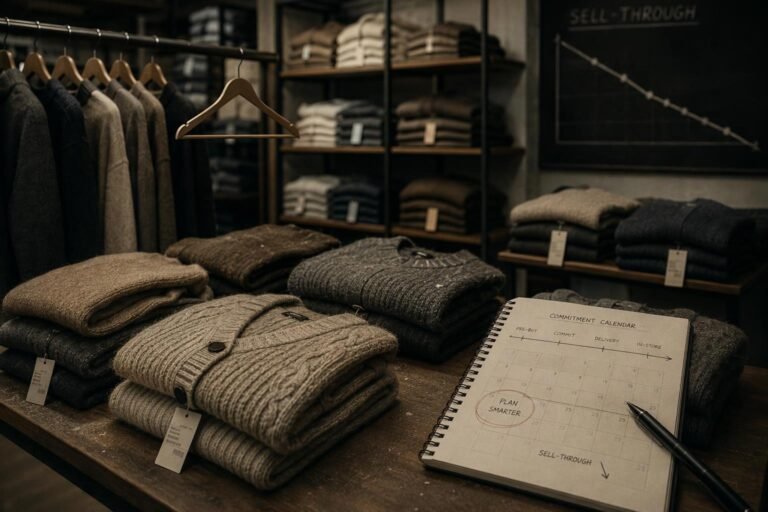
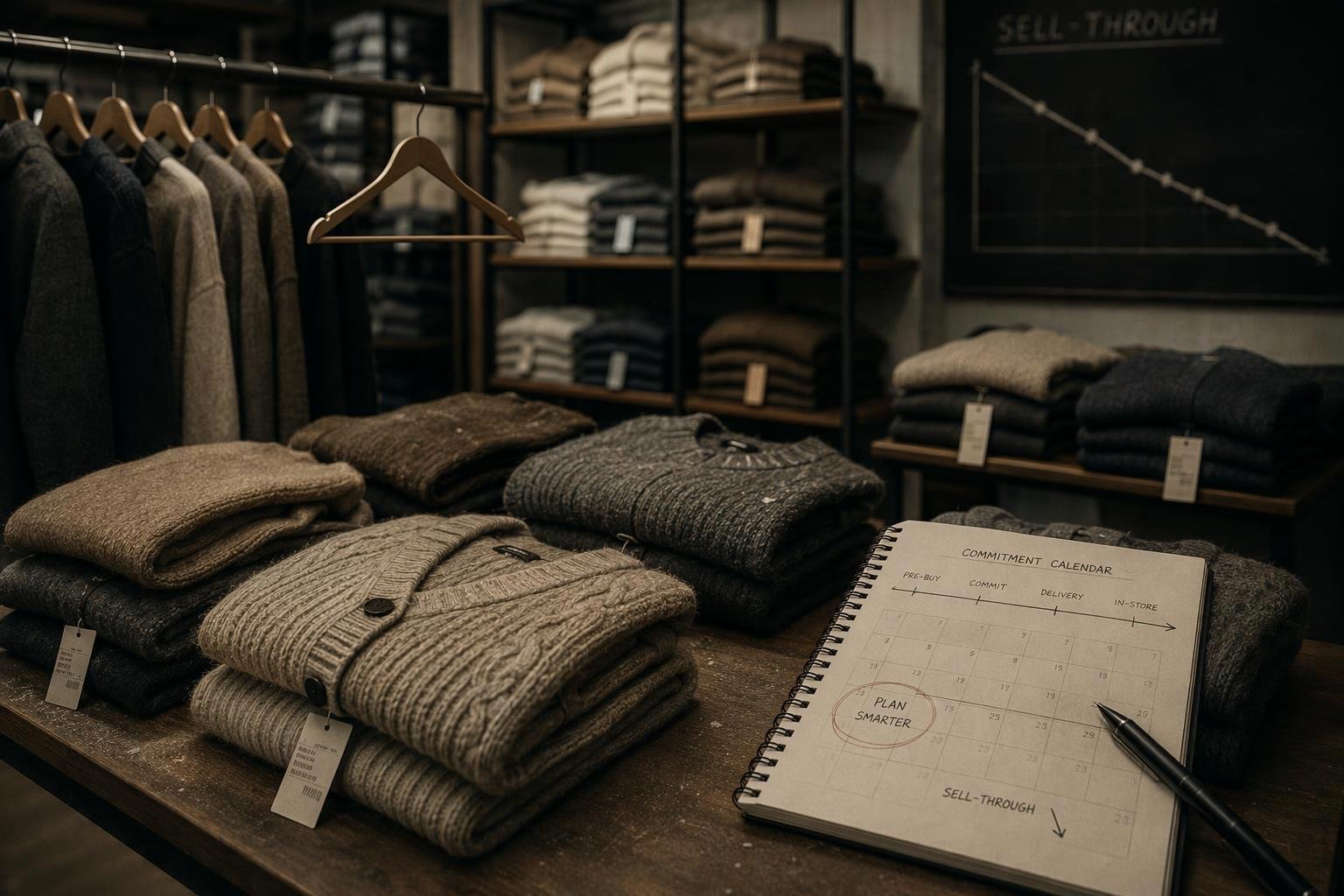
The operational way to see this is as a ladder of commitments. Demand signal comes first — pre-orders, soft intent, wholesale interest, last season’s sell-through kept separate from hope. Then yarn, bought in kilograms per color. Then sampling, which costs sample and lab-dip money. Then capacity, held as a time-limited slot. Then quality control, then replenishment, then the supplier contract that binds the whole thing. Each rung locks money before the next piece of evidence arrives, and in knitwear the early rungs are the least reversible.
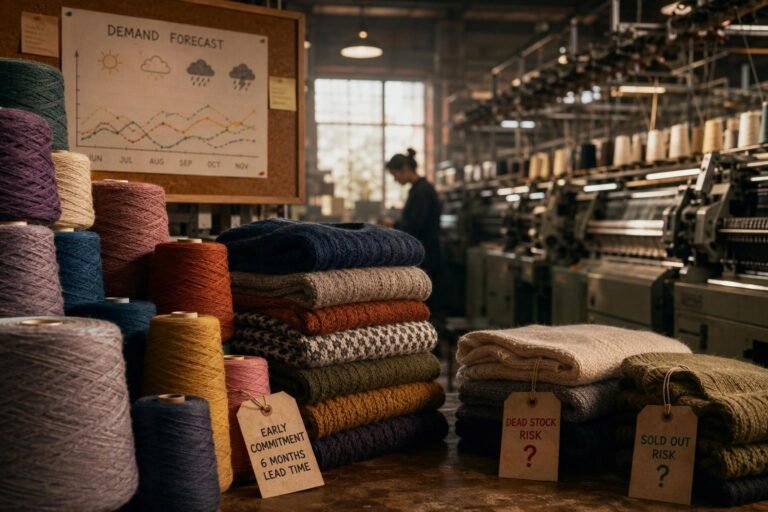
That is why “forecast better” is not a strategy at this scale. As Uphance’s demand-planning material puts it, the buy is committed six to twelve months before the demand signal exists; by the time real sell-through data arrives, the yarn is dyed and the machine slot is gone. A brand with deep pockets can buy accuracy through inventory buffers. A small brand has to buy time through sequencing — keeping each commitment smaller than the evidence behind it.
The stakes are visible in the markdown line. Industry data cited by Toolio puts markdowns at roughly $300 billion in lost US retail revenue in 2018, about 12% of total sales, and notes that on average only about 60% of apparel products sell at full price. Those are apparel-retail averages, not knitwear-specific figures, and the full-price number is a benchmark to measure yourself against rather than a target you are failing. The point is directional: the gap between what you commit and what sells at full price is where margin goes.
What this means for you: before the next season, map your own commitment ladder and mark the rung where the most money is locked in earliest. For most small knitwear labels, that is the yarn and dye decision — which is exactly where the rest of this framework starts.
The Knitwear-Specific Constraints That Shape Any Inventory Plan
Generic lean-retail advice assumes you can reorder fabric from a roll. Knitwear doesn’t work that way, and an inventory plan that ignores the mechanics will fail at the first reorder. Four constraints shape everything that follows.
Planning bands for dye-lot minimums per colour, as cited in the article. These are ranges quoted by different suppliers, not promises, and they move with gauge, fibre, finish and season. The binding minimum for an order is the largest applicable upstream requirement, not the sum of every minimum quoted.
Yarn is bought in kilograms against an estimate. A 300-gram sweater at 500 units implies 150 kg of yarn before any waste allowance — and that garment weight is itself an estimate until the first knit-down confirms it. Knitting loss at the machine, linking and finishing adds to the figure, and it runs higher on complex structures like cable or intarsia than on a plain knit. Ask for consumption in kilograms and in pieces, with the loss rate written out.
Dye-lot minimums are set in kilograms per color. This is the floor that surprises small brands most, because it is invisible in a garment-level MOQ conversation. Planning bands for knit piqué, for example, commonly sit around 250–300 kg per color, with smaller shops sometimes advertising 100–150 kg and larger mills or specialty finishes quoting 300–500 kg. Those are planning bands, not promises — they move with gauge, fiber, finish and season — but the order of magnitude is the point: a 200-unit run in a custom shade can trigger a yarn commitment several times the size of the garment order. The binding minimum is the largest applicable upstream requirement, not the sum of every minimum you have been quoted.
Gauge cuts cost twice, in opposite directions. Gauge is needles per inch on the machine: 1.5–3gg for chunky statement knits, 5–7gg for classic mid-weight sweaters, 12gg for fine knitwear and dress knits, 14–18gg approaching woven-shirting fineness. Coarse gauges consume more grams of yarn per garment but knit faster; fine gauges use less yarn but take more machine minutes and demand better yarn quality, because defects hide less. The cheapest gauge for a given design is not obvious, which is why it belongs in the conversation with your factory rather than in a spreadsheet assumption.
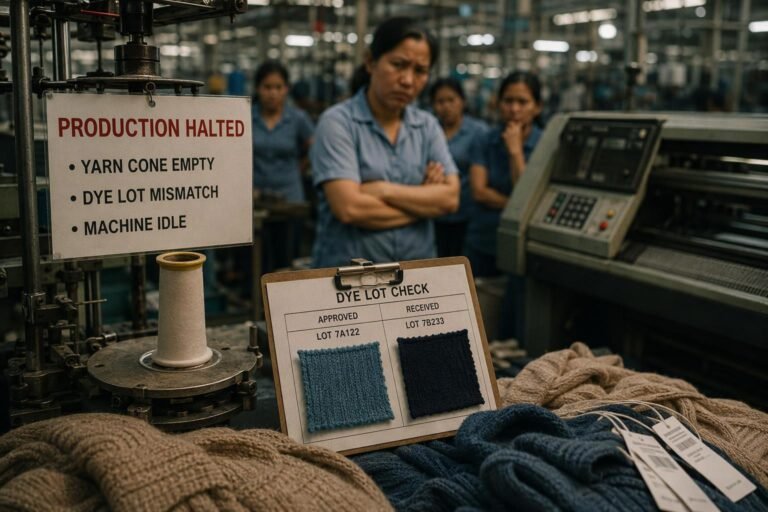
The reorder failure mode lives at the yarn store, not the machine. Knitting capacity is flexible; a specific yarn is not. Dyeing runs in batches, each lot landing within a tolerance band rather than at an exact point — typically Grade 4 to 4-5 on the grey scale, which is visible on direct comparison. A style can sell out, the factory can have capacity, and the repeat can still arrive in a shade that no longer matches the first drop, because the yarn that made it is finished.
This is where the distinction between color reference and dye lot earns its keep. A color reference is the shade you want — a Pantone number, an approved lab dip, a signed hanger. A dye lot is the batch of yarn produced when that color was dyed, with its own lot number. The reference stays the same for years; the lot changes every time the yarn is dyed. Two sweaters can both be the same navy and still sit a shade apart. That is why lot numbers belong on the purchase order, the yarn receipt and the sealed sample you keep.
What this means for you: your inventory plan is really a yarn plan with a garment count attached. Until you know the per-color kilogram floor and how many colorways you are running, you don’t know your true minimum order.
The Framework: Five Levers That Work Together
The five levers below are not a menu. They depend on each other in a specific order. Modular design determines what can be reused across styles. Reuse determines how small a first run can be, because shared yarn and shared panels spread the fixed commitment. Small runs only work if sampling is fast enough to keep the calendar intact. And all of it only converts into lower markdown exposure if reorder triggers fire on real data rather than on the contract’s optimistic lead time.
Each lever follows the same structure: why it matters, how to implement it, the failure mode that undoes it, and an example. Read them as a sequence, not a checklist.
Lever 1: Modular Design That Multiplies Outfits Without Multiplying Programs
Why. Modularity is what lets a small brand offer range without committing to range-sized inventory. The design-research literature on modular garments describes the mechanism precisely: a small set of module types, flexibly recombined, can produce a wide range of garments and silhouettes while minimizing part diversity to streamline fabrication. That is a design-research framing, not a commercial knitwear production standard — but the underlying logic transfers directly to a line sheet.
How. Some knitwear elements are genuinely modular: bodies and silhouettes, sleeve and neckline treatments, collar and trim, hem and cuff finishes, stitch blocks within one gauge, and colorways. Others are not modular without real cost: a gauge change, a fiber change, or radically different shaping each forces new programming or a new yarn route. The implementation is to define a module library per season, cap the number of module types, and write the recombination rules into the line sheet so design, production and sales are working from the same grammar.
Failure mode. Modularity that multiplies SKUs instead of multiplying outfits. The brand ends up with more styles, more colorways and the same markdown problem, having paid extra setup for the privilege.
Example. One body block in three necklines and two sleeve lengths reads as six styles to a buyer but runs as one program with shared panels. The buyer sees range; the factory sees repetition.
Lever 2: Smaller First Runs Sized to the Real Floor
Why. A first run exists to buy information, not to capture volume. The smaller it is, the less inventory is exposed if the style doesn’t land — but only if it is sized against the constraint that actually binds.
How. That constraint is usually kilograms per color at the dyehouse, not garment units. Published floors vary widely across suppliers: low-MOQ knitwear manufacturers advertise around 50 pieces per style per color at the low end, while conventional China sweater factories commonly quote 300 pieces per style per color, and basic knitwear benchmarks generally sit in the 100–300 piece range per style. Treat these as planning bands, not promises. The sizing method is arithmetic: start from the colorway count, convert each colorway to kilograms using actual yarn consumption plus a stated loss rate, and let the dye-lot minimum set the true floor. Then decide whether to consolidate colorways onto shared yarns or accept the commitment.
Failure mode. Ordering a fourth colorway purely to satisfy a per-color floor. That is exactly the surplus the industry already struggles with — Business of Fashion and McKinsey put 2023’s surplus at 2.5–5 billion garments worth USD 70–140 billion — and nobody wanted the fourth colorway in the first place.
Example. A two-colorway launch on a shared stock-service yarn commits a fraction of what a four-colorway launch on custom-dyed yarn commits, before a single unit sells. The second version may look richer on the line sheet. The first version is the one that survives a slow start.
Lever 3: Rapid Sampling as the Real Speed Lever
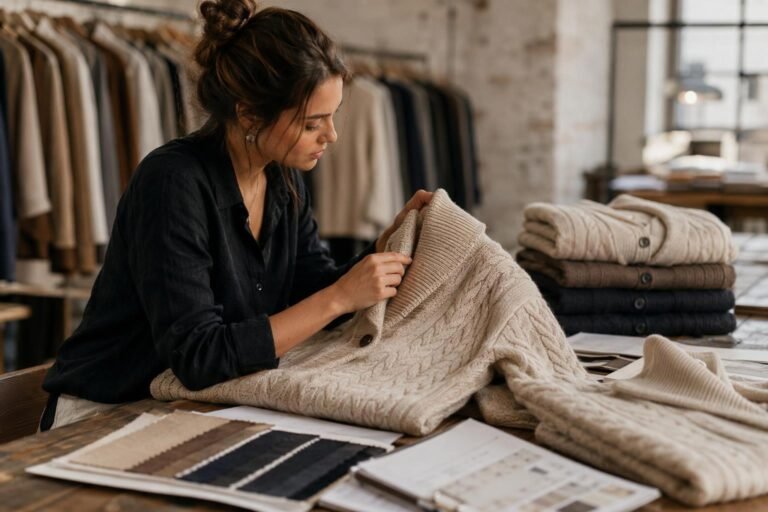
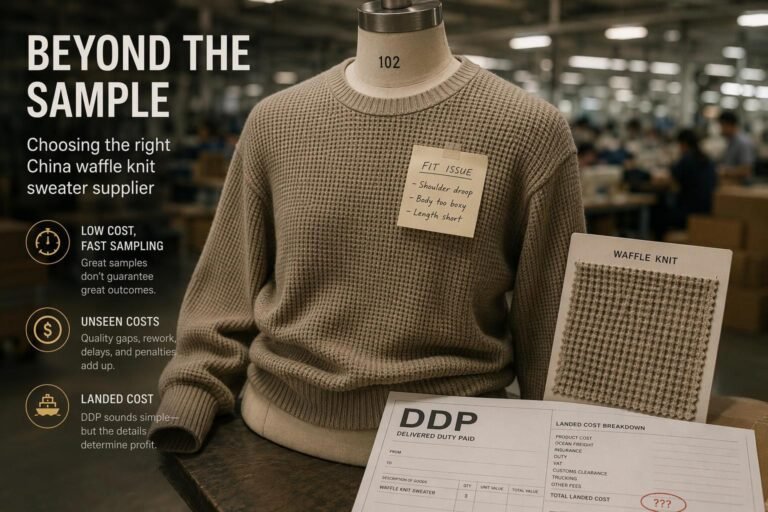
Why. Sampling is where calendar time is won or lost, not an administrative step before the real work. The sequence runs: tech pack and measurements, lab dip if the color is custom, knit-down, fit approval, then bulk release. Lab dipping alone can add one to two weeks when you are starting from scratch on a custom shade, and that time sits on the critical path.
How. Freeze the tech pack before sampling begins. Name a single approver with a written deadline — the bottleneck moves to the approver the moment the factory gets fast, which is why the approver belongs in the pack. State tolerances and test methods in the pack: measurements and grading against an approved size specification, the color standard including the light sources used to assess it (D65 daylight and TL84 store light are standard in textile assessment), and any instrument readout such as a ΔE tolerance if your supplier provides one. Then use release states so safe work proceeds while open items stay visible: hold, provisional capacity hold, material-only release, limited production release, full bulk release, shipment release. “Approved” is not binary.
Failure mode. Sampling rounds that reopen design decisions. Each reopened round pushes the launch past the season window and forces you to sell into a falling demand curve — the most expensive way to learn that the sample was fine.
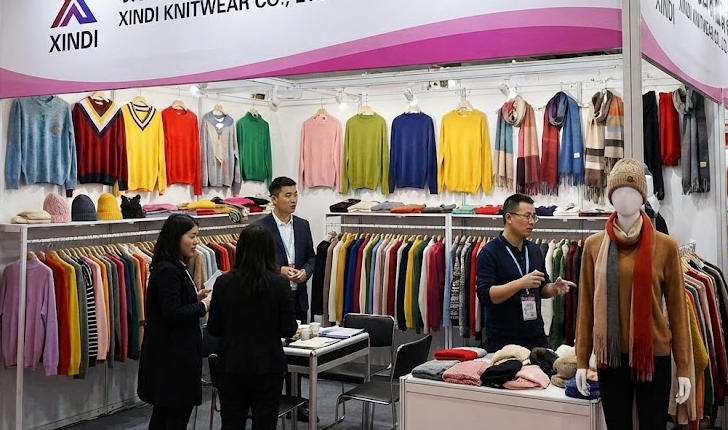
Example. A 3–5 day prototype turnaround only shortens the critical path if the brief that arrives is complete. Xindi Knitwear, for instance, publishes a 3–5 day sampling turnaround from tech packs or photos; that compresses the factory’s half of the loop, not your review time.
Lever 4: Fabric and Yarn Reuse Across Styles — and Where It Breaks Down
Why. Reuse is what makes small runs add up. Three styles sharing two yarn colors beat six style-color singletons on both minimums and price, because the dye commitment is spread across the range instead of multiplied by it.
How. Build the season around two or three yarn platforms. The reuse hierarchy matters: same yarn and same dye route across styles is the reliable case. Same color reference across different fibers, gauges or dye routes is where visible shade variation appears under daylight — if any style is on a different fiber, a different gauge or a different dye route, you are almost guaranteed to see variation. Reserve yarn in the first order, with ownership, storage, refundability and reuse terms written down. Keep a sealed standard color sample from every bulk lot, and record lot numbers on the PO, the yarn receipt and the retained sample.
Failure mode. Treating “same navy” as a specification when it is only a color reference, then discovering the mismatch at reorder. Mixing lots within one delivery is where visible mismatches come from.
Example. A capsule where a cardigan, a crew and a beanie share one yarn platform and one dye lot reads as a coordinated story and runs as one yarn commitment. A capsule where each piece quietly runs a different fiber reads the same on the mood board and commits three times as much.
Lever 5: Reorder Triggers That Fire on Real Data
Why. Replenishment is where flexibility either pays off or evaporates. The reorder point is roughly average daily demand multiplied by lead time, plus safety stock — and the lead time that belongs in that formula is the measured one, not the contracted one. The contract says 45 days; the rolling average is 62. Use the actual.
How. Set the trigger structure before launch, with a named owner for each style. What to measure: sell-through against plan, size and color depth remaining, weeks of supply left, rolling lead time per factory, and quality rejection rate. Threshold logic should be written down in advance rather than argued in the moment. The supplier needs three things to act: yarn availability and lot continuity, a capacity slot, and a confirmed release cutoff. The yarn-reserve decision belongs inside the trigger, not as an afterthought — a trigger that fires without reserved yarn produces a repeat in a new shade.
Failure mode. Reordering against the contract lead time and landing the repeat after the demand window. The style sold; the repeat arrived late and in the wrong shade; the markdown happened anyway.
Example. A style hits its trigger in week three, but there is no reserved yarn and no lot continuity. The repeat arrives in a new shade, and the customer who wanted the original now has a reason not to buy.
Weighing Small-Batch Unit Cost Against Markdown Exposure
Small runs cost more per unit. That is not a negotiating position; it is the fixed-cost-recovery mechanism behind every MOQ. Line setup, pattern programming and administrative overhead are the same whether you order 50 pieces or 500. At 100 units, setup might account for $10 per piece; at 500 units, $2. That $8 gap is what a factory has to absorb if it drops your minimum without a trade-off — which is why the premium is real and why pretending otherwise wastes everyone’s time.
The article’s worked illustration, using round numbers rather than observed results. Both scenarios assume a $120 retail price and a 40% markdown on unsold units. The larger run returns more total gross margin here because it sells more units; the article notes the comparison reverses at a 40% sell-through for the larger run or a 60% markdown depth. Substitute your own sell-through and markdown assumptions.
The honest comparison is not unit cost against unit cost. It is total margin against total margin, on the same units, in the same season. A worked illustration with round numbers, not a promise:
Larger run: 500 units at $40 landed cost, retail $120. Sell-through 55%, so 275 units sell at full price and 225 are marked down 40% to $72. Revenue: $33,000 + $16,200 = $49,200. Cost: $20,000. Gross margin: $29,200.
Smaller run: 200 units at $46 landed cost, retail $120. Sell-through 75%, so 150 sell at full price and 50 are marked down 40%. Revenue: $18,000 + $3,600 = $21,600. Cost: $9,200. Gross margin: $12,400.
Per unit sold, the smaller run returns about $62.70 of gross margin against about $58.40 for the larger run — but the larger run returns more total margin because it sold more units. The comparison flips depending on what you assume about sell-through and markdown depth, which is exactly why you should substitute your own numbers rather than trust this illustration. Change the larger run’s sell-through to 40% and the arithmetic reverses. Change the markdown depth to 60% and it reverses again.
The calculation is arithmetic, not a guarantee. It also assumes the demand exists to sell the extra units at some price, which is the assumption a stalled collection has already falsified. And the answer flips entirely if the style is a proven repeat: on a style you know sells, the larger run’s lower unit cost wins, because the markdown risk you are avoiding is small and the setup saving is real.
The decision rule: pay the small-batch premium on unproven styles, and use the reorder mechanism to capture the volume once demand is real. A label doing $100 million in sales will still put out a first run of a few hundred pieces, watch what sells, then chase the winner with 10,000 more. That is how dead stock stays low — and it only works if the factory can take the small first order and still scale when the reorder lands.
Keeping a Flexible Collection From Feeling Repetitive
This is the objection that stops most brands from trying the framework: if everything shares a body, a yarn and a stitch platform, won’t the collection look like the same sweater six times?
It will — if novelty is carried by the module count rather than by the design decisions inside the modules. That is a design failure, not an inevitable consequence of modularity. The fix is to separate two kinds of novelty and manage them in opposite directions.
Novelty the customer sees should be high. Proportion and length within a shared body. Stitch blocks and texture within one gauge — a rib against a cable against a jacquard reads as three different garments even when the silhouette is identical. Neckline and trim treatments. Color as the seasonal signal on a stable yarn platform. And sequencing: drops that read as a story rather than a catalog, so the assortment has a narrative arc instead of a flat wall of options.
Novelty the factory sees should be low. New programs, new yarns, new gauges and new dye routes are where cost and risk live. Every one of them is a new commitment, a new minimum and a new failure mode. The goal is a high ratio of perceived novelty to production novelty.
Failure mode. A “safe” collection where every piece is a variation of the same crewneck in the same weight. It reads as a basics drop, invites direct price comparison with every other basics drop, and gives the customer no reason to pay your price rather than someone else’s.
Example. A six-piece capsule built from two bodies, three stitch treatments and two colorways photographs as six distinct looks. The buyer sees a collection; the factory sees two programs. That gap is the whole point.
One caution from the modular-design research: larger modules reduce assembly time but restrict visual variation within a region, while smaller modules offer more flexibility at the cost of more parts. The module size is itself a design decision with a production consequence, and it should be made deliberately rather than by default.
What a Supplier Must Be Able to Do to Support This Model
The framework only works if your supplier can support it. That makes supplier screening a concrete exercise rather than a vibe check. Six capabilities matter:
Low per-color minimums with transparent kilogram conversion. Ask what the per-color minimum is in kilograms, and ask them to convert it to pieces for your specific style and size mix. A supplier who quotes only in garment units is hiding the real floor.
Rapid sampling with a stated turnaround and a named approver loop. Ask for the turnaround in days and ask who on their side owns the approval gate.
Programming capability for 3D and WHOLEGARMENT and complex stitch structures. WholeGarment is a registered trademark of Shima Seiki and describes knitting a complete garment, sleeves and collar included, as a ready-to-wear item; other machine makers offer the same technology under different names. It requires real technical understanding on both sides, so ask how programming communication is handled.
Yarn sourcing and dye-lot retention with written reserve terms. Ownership, storage, refundability and reuse should be in the agreement, not in an email.
Capacity that can hold a time-limited slot for a reorder. A provisional hold with an expiry date protects a possible slot for planning only; it should expire rather than become a purchase obligation.
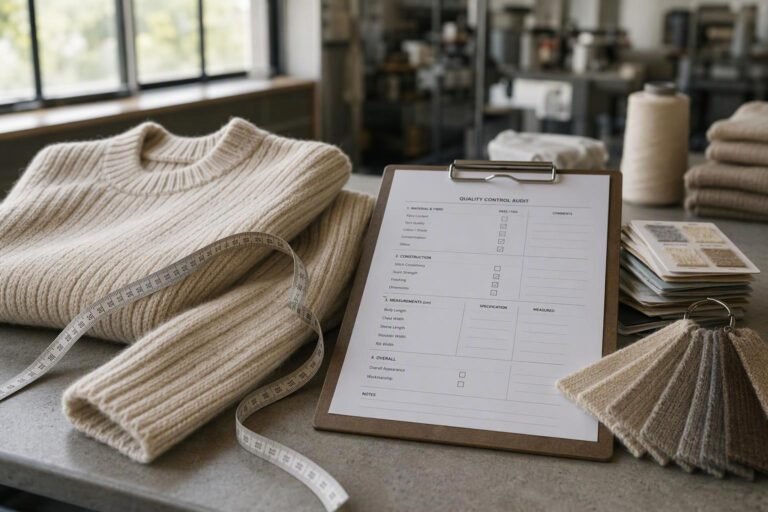
Documented quality gates. Defect classification into critical, major and minor, the acceptance rule for each class, and the test methods and acceptance criteria written into the tech pack. Final inspection typically uses AQL sampling under ISO 2859-1 (ANSI/ASQ Z1.4 in the US), with apparel commonly applying AQL 2.5 for major and 4.0 for minor defects. At General Inspection Level II, small lots produce small sample sizes — a 150-piece lot is inspected on a handful of units — so the sample is a screen, not a guarantee. That is another reason the written classification matters.
Where first-party facts are relevant: Xindi Knitwear publishes low MOQs from 50 units, a 3–5 day sampling turnaround from tech packs or photos, 3D knitting and WHOLEGARMENT capability, and certified yarn options including OEKO-TEX, RWS, GRS and GOTS. Those are the company’s own published offerings, stated within their scope — not an industry benchmark, and not a substitute for confirming the specifics of your own program.
Questions to ask any supplier:
What is your per-color minimum in kilograms, and what does that convert to in pieces for my style?
Which colors are stock-service, and what is the fallback color if the lab dip doesn’t converge?
What is your sampling turnaround, and who approves on your side?
Can you hold reserve yarn from the first lot, and on what written terms?
How long can you hold a capacity slot for a reorder, and when does it expire?
What are your defect classes and acceptance rules, and where do they live in the tech pack?
A One-Page Operating Rhythm for the Season
The framework collapses into a repeatable cadence. Run it once per season and it becomes the operating rhythm rather than a project.
Pre-season. Build the module library and cap the module types (Lever 1). Select two or three yarn platforms (Lever 4). Count colorways against the dye-lot floor in kilograms before committing to the range (Lever 2). Freeze the tech packs, including tolerances, test methods and the named approver (Lever 3).
Sampling window. Run lab dips, knit-downs and fit approvals against the frozen pack. One approver, one deadline. Use release states so material can be bought while open items stay visible (Lever 3).
Launch. Place small first runs sized to the real floor (Lever 2). Keep a sealed lot sample from every bulk lot and record lot numbers on the PO and the yarn receipt (Lever 4). Set reorder thresholds and name an owner for each style before the drop goes live (Lever 5).
In-season. Review sell-through and weeks of supply weekly. Fire triggers against measured rolling lead time, not the contract number. Release reserved yarn against confirmed repeats (Lever 5).
End of season. Run a markdown post-mortem: which styles missed, and was the miss a design miss or a commitment miss? Review module performance — which bodies, stitch blocks and colorways earned their place. Decide carry-forward on yarn platforms, because the yarn decision is the one that compounds across seasons (Lever 4).
Each step maps back to a lever, which is the point: the rhythm is the framework running on a calendar instead of on a spreadsheet.
Conclusion
When lifestyle demand stalls, the brands that protect margin are not the ones that forecast better. They are the ones that commit later and smaller, reuse more, and reorder on measured data. Forecasting accuracy arrives too late to be useful in knitwear; sequencing arrives in time.
The five levers are one system. Modular design determines what can be reused. Reuse determines how small a first run can be. Small runs only work with fast, disciplined sampling. And all of it only converts to lower markdown exposure if reorder triggers fire on real data, against real lead times, with reserved yarn behind them. Pull one lever out and the others lose their effect: small runs without reuse multiply your minimums, and reuse without triggers just means you run out of the shared yarn at the moment the style sells.
The single change most brands can make first is usually the same one: size the first run to the real dye-lot floor, and set reorder triggers before launch. Both are cheap to do, both are reversible, and both change the shape of the season.
If you are planning a season and want to test the framework, the practical starting point is a tech pack, a yarn platform decision, and a reserve-yarn conversation with your supplier — before the next design freeze, not after.
Frequently Asked Questions
How small can a first knitwear run realistically be?
It depends on the dye-lot floor, not the garment MOQ. If your color is a stock-service shade, the floor can be as low as the supplier’s per-style minimum — around 50 pieces per style per color at the low end. If the color is custom-dyed, the kilogram minimum at the dyehouse sets the real floor, and it can translate to several hundred pieces depending on garment weight. Ask for the conversion in writing.
Can one yarn really carry a whole capsule?
Yes, within one gauge and one dye route. No, across fiber or gauge changes — if any style is on a different fiber, a different gauge or a different dye route, you are almost guaranteed to see shade variation under daylight. The reliable case is same yarn, same dye route, multiple styles.
What is the single most important reorder trigger?
Measured rolling lead time combined with remaining weeks of supply. The contract lead time is a planning assumption; the rolling average is what actually happens. If the repeat can’t land inside the remaining selling weeks, the trigger has already fired too late.
Does modular design make a collection look repetitive?
Only if novelty is carried by the module count rather than by the design decisions inside the modules. Proportion, stitch texture, neckline treatment, color and drop sequencing can all create perceived novelty without new programs. The goal is high novelty the customer sees and low novelty the factory has to build.
Is the small-batch premium worth it?
On unproven styles, usually yes — the premium buys information and limits markdown exposure. On proven repeats, usually no — the lower unit cost of a larger run wins once the demand risk is small. Run the arithmetic on your own sell-through and markdown assumptions rather than on someone else’s.
What should be written into the supplier agreement?
Reserve-yarn ownership, storage, refundability and reuse terms; dye-lot retention and priority on repeats; release states and change control; and the quality gates with their test methods and acceptance criteria. This is guidance on what to raise with a supplier, not legal advice — where the order value or the IP exposure is significant, have a lawyer review the agreement.