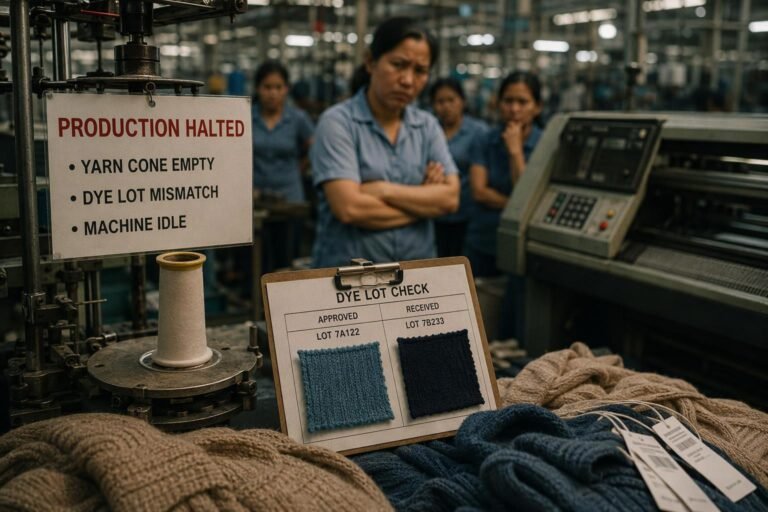

The failure rarely arrives as a headline. It arrives as an email: the spinner no longer carries your count, the dye house has closed its shade for the season, or the production slot you were told was “held” turns out to have been provisional and has just gone to a larger account. The launch calendar is fixed, the stockist is confirmed, and the backup you assumed existed was never more than a verbal reassurance.
For a label running low minimums, resilience is usually framed as a budget problem — as if the only protection available is to buy more yarn, hold more stock, commit to more units. That framing is what makes small brands feel structurally exposed. It is also mostly wrong. Redundancy does cost minimums when you buy it in quantity, but a knitwear program has several places where protection can be bought in time, documentation and decision rights instead. The work of this playbook is to show which is which.
Five control areas carry most of the load: qualifying backup yarns so they are genuinely production-ready, placing approval gates between sample and bulk, seeing capacity you can actually rely on, writing escalation paths before you need them, and building contingency that does not multiply your minimums. They are connected — a backup yarn is worthless without a re-approval gate, and capacity visibility is worthless without a named owner who acts when a slot slips.
One principle governs all five: a redundancy layer only counts once it is qualified to a defined tier. “The mill says they can make it” is not a backup. A tested, approved, documented alternative is.
Why Knitwear Fails Differently From Wovens
Knitwear fails along a different seam than wovens, and the framework only makes sense if you accept three premises up front.
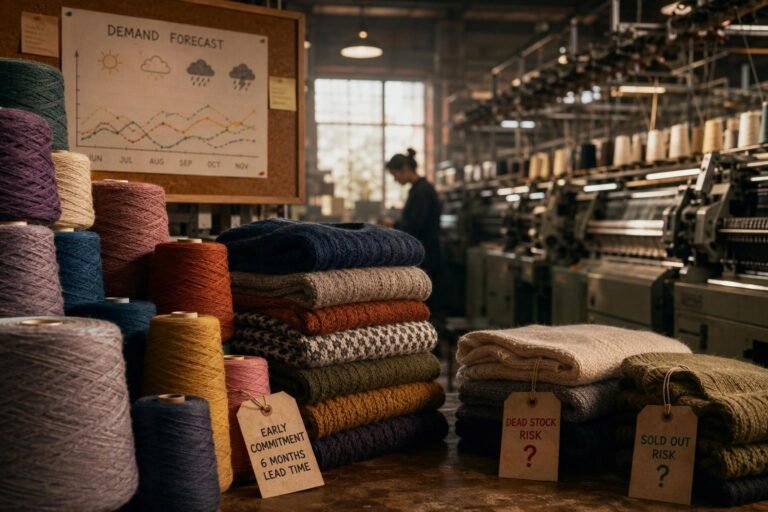
First, yarn is committed before knitting begins, and custom dyeing inserts a lead-time step that most woven programs never face. A cut-and-sew woven style can often buy greige fabric and defer the colour decision; a knitwear style frequently cannot, because the yarn has to be spun, dyed and delivered before a single course is knitted. Yarn sourcing alone commonly runs one to three weeks, and custom dyeing pushes it longer — a window that sits upstream of the thirty to forty-five days bulk production typically takes once approved. When yarn slips, everything downstream compresses, and compression is where quality slips.
Second, a garment can be structurally sound in a substitute yarn and still fail commercially. Loop length, machine gauge and yarn count together determine weight, tightness, dimensional stability and spirality tendency, so a yarn that knits cleanly can still change the hand feel, the shrinkage behaviour after laundering, or the way the finished garment drapes. A substitute that passes on the machine has proved almost nothing about the garment.
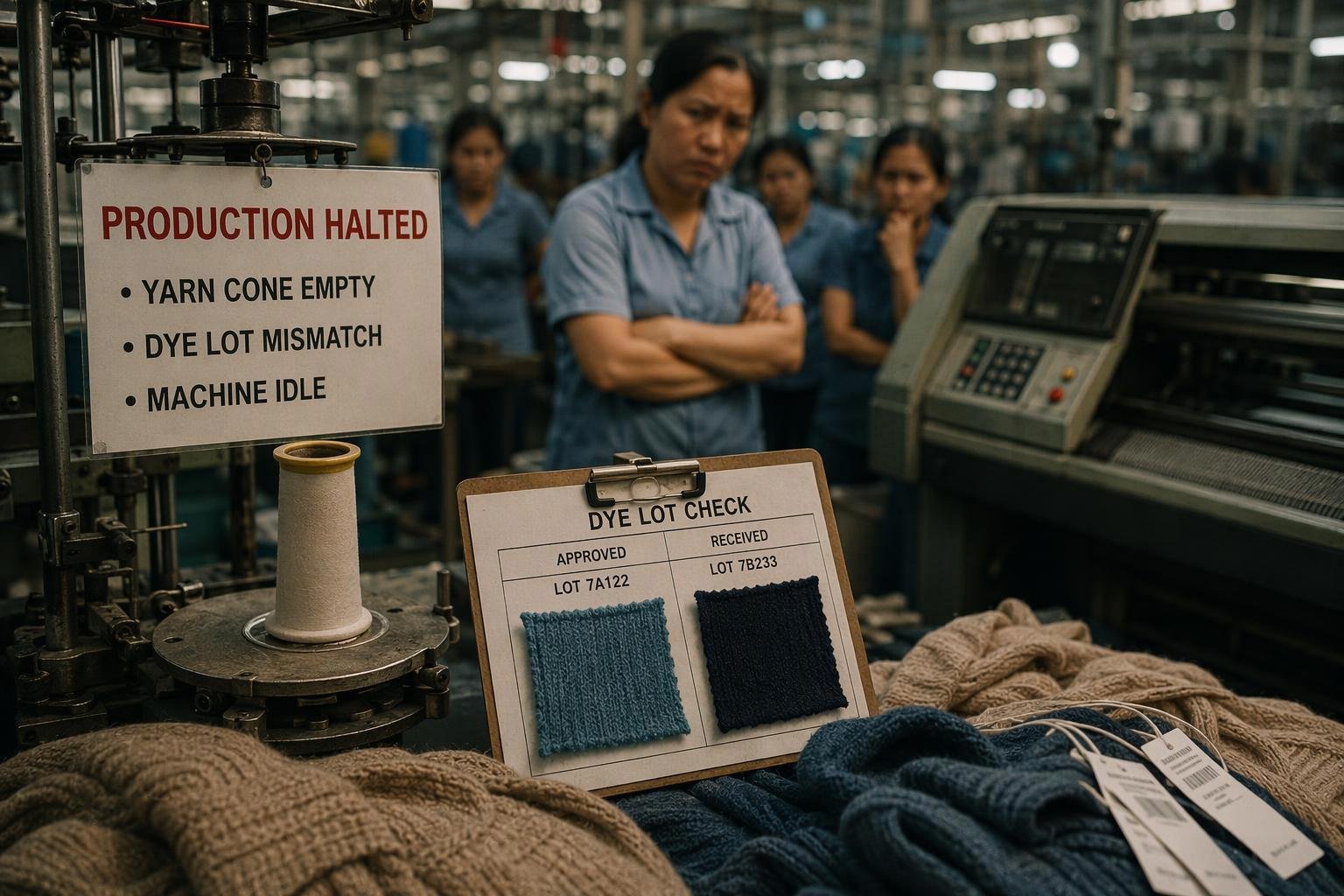
Third, colour consistency across reorders is a tolerance question, not an exact-match promise. A dye lot is a single batch dyed together; a second lot months later involves different water, a different dyestuff batch and a marginally different substrate. A good dye house controls that tightly and the result is close — but identical is a claim nobody in the chain can honestly make across separate lots.
What this means for you: the three premises point at the same conclusion. Yarn identity, colour approval and lot planning need their own controls, separate from the garment sample, because the garment sample cannot prove any of them.
The Resilience Framework at a Glance
The five control areas are one system, not five checklists. Each one closes a specific failure, and each one interacts with the others in a way that decides whether it works.
Control area | Failure it prevents | What it costs a low-MOQ program |
|---|---|---|
Backup yarn qualification | Losing a yarn source or lot mid-season with no release-ready alternative | Sampling and testing time; small yarn quantities for trials |
Approval gates | Bulk released against an approval that never covered colour, shrinkage or yarn identity | Calendar time and admin, not quantity |
Capacity visibility | Planning a launch against rated capacity that was never committed | Commercial terms — deposit, yarn booking, approval deadline |
Escalation paths | A decision stalling in one person’s inbox while the slot expires | Named owners and agreed timelines |
Contingency planning | Discovering mid-season that protection was never budgeted | A scheduled reorder and, sometimes, a unit-price premium on the first run |
The interactions are where most programs leak. A qualified backup yarn is useless if no gate exists to re-approve colour on it — you will have the alternative in hand and no authority to release against it. Capacity visibility is meaningless without an escalation owner, because the moment a provisional slot fails to convert, someone has to decide whether to pay to hold it, re-sequence, or move. Contingency planning without tiered yarn qualification turns into a quantity commitment you cannot afford.
That is why protection here is graded. A backup can be qualified to different depths, an approval can be clean, limited or held, and a capacity slot can be provisional or committed. Each grade carries a defined qualification cost, and the framework’s job is to make sure you know which grade you are buying before the season starts rather than after the failure.
Qualifying Backup Yarns So They Are Actually Production-Ready
The question that matters is narrow: what evidence would let you release a bulk order against this backup tomorrow? Everything else is conversation.
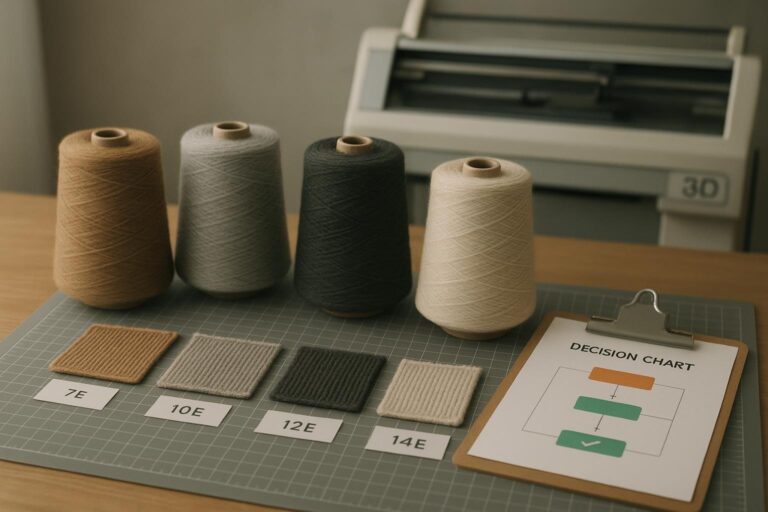
A backup yarn becomes production-ready when four things are true. It runs the same fibre content and count route, so the machine programme and the consumption calculation still hold. Its hand feel and shrinkage have been tested on your actual construction, not on a stock swatch — shrinkage in particular is a property of how the yarn behaves once it is looped, relaxed and laundered, so the test has to be run on the garment or a panel of it. Its colour has been achieved on that yarn rather than assumed from the primary; a lab dip approved on one yarn says nothing about how a different fibre or lot takes the same recipe. And it is qualified for the style, not merely for a swatch. A yarn that produced a beautiful development swatch has demonstrated that it can be knitted. It has not demonstrated that it can be linked, washed, pressed and measured to your graded spec at production speed.
Certification chains add a constraint that catches brands out. GOTS requires every company involved in processing a certified product to be certified, with transaction-based verification across the chain. RWS works through scope certification and transaction certificates issued each time goods change ownership. GRS requires each stage of production to be certified from the recycling stage to the last seller in the final business-to-business transaction. OEKO-TEX Standard 100 certification attaches to the certified article and its stated scope. The practical consequence is uniform: a backup yarn must carry its own valid scope and transaction documentation. It cannot inherit the primary’s. If your organic cotton backup comes from a spinner outside the certified chain, the garment is not organic regardless of what the fibre is.
What this means for you: write the release test down for each yarn in your line and check whether it has actually been met. If the answer is “the mill says they can,” the backup is theoretical.
Three Substitution Tiers and What Each Re-Approval Requires
The tiers below are a proposed decision framework, not an industry standard. Their purpose is to stop a substitute being released on the wrong approval — the most common way a qualified backup turns into a quality claim.
Tier 1 — Identical yarn. Same mill, same count, same colour route. This protects against lot failure, not mill failure. Re-approval is light: confirm the lot, and check the colour against the approved standard before bulk. Because the route is unchanged, the existing fit, shrinkage and hand-feel approvals still hold.
Tier 2 — Functionally equivalent. Same fibre and count, different mill or different lot. This is where most “backups” actually sit, and where most programs under-approve. It triggers full sample re-approval for fit, shrinkage and hand feel on the new yarn, plus colour approval achieved on that yarn. The construction is nominally the same; the behaviour is not.
Tier 3 — Design-approved substitute. A different fibre blend or count, accepted as a design change. Everything in Tier 2 applies, plus a documented design sign-off, because the garment’s character has changed. A cashmere-merino blend standing in for pure cashmere is not a sourcing substitution; it is a different product, and it needs the brand’s design authority to say so in writing.
The tiers exist so that nobody releases a Tier 2 yarn on Tier 1 evidence. If you cannot name which tier a backup sits in, treat it as Tier 3 until proven otherwise.
Approval Gates Between Sample and Bulk
“Sample approved” is too broad to authorise every operation, and treating it as a blanket release is the single most common approval failure in knitwear. An approval sample should be identified by purpose, material status, revision and release authority. A prototype knitted in substitute yarn may prove construction and silhouette; it cannot prove bulk colour, shrinkage, hand feel or finished-garment performance.
The gates below sit between an approved sample and a bulk release. Each freezes something specific.
Development sample. Proves construction and silhouette. It may legitimately use substitute yarn, provided that is disclosed and recorded — an undisclosed non-bulk yarn is a hold condition, not a shortcut.
Fit and measurement approval. Freezes the graded spec: fit comments, the point-of-measure table, grade rules, tolerances and the measurement condition. Once frozen, later comments that conflict with the current measurement revision trigger a review, not a quiet edit.
Colour approval. Freezes the lab dip and the tolerance. This is the gate that makes a later dye-lot argument resolvable, because it establishes the physical standard everything is measured against.
Pre-production or sales sample in bulk-intent yarn. Proves the combination — approved construction and approved colour together, on the yarn that will actually run. This is the gate that catches a Tier 2 substitution before it reaches the machine floor.
Bulk release. Freezes the tech pack revision, bill of materials, yarn identity, colour standard and lot plan, and links them to an accepted capacity window.
A simple status framing keeps the release honest. Green means the required evidence exists for the stated purpose and the operation can proceed. Amber means a limited release: a documented deviation is excluded from the released scope, or material may proceed only under a named limited release with a hold point before affected use. Red means a hold — a required approval is open, bulk material differs from the approved basis, or the colour authority is absent.
What this means for you: the gates cost calendar time, not quantity. They are the cheapest resilience you will buy, and they are the reason a backup yarn can be released quickly when you need it.
Seeing Capacity You Can Actually Rely On
Rated capacity is a theoretical output under stated conditions. Available capacity is what remains after committed work and operational limits are taken into account. The two numbers can differ by a wide margin, and a supplier quoting the first is not necessarily misleading you — it is answering a different question than the one you asked.
Illustrative worked example, not industry data. Rated capacity is reduced by confirmed bookings, unsuitable machines, material constraints and a quality allowance; the remainder is what can actually be committed to your window.
Four questions convert one into the other. Which figure is being quoted? What would change it? Which stage is inefficient at your quantity? And what condition reserves the slot?
The third question matters more in knitwear than in most categories. A factory can have open machine hours and still be unable to take your order, because it lacks the programmer for a difficult jacquard, the linking skill for a fine-gauge neckline, the finishing control for a wool blend, or the yarn allocation for a repeat shade. The bottleneck is often not knitting at all — it can sit at linking, washing, pressing or packing, where a short run creates changeovers and small batches. Asking which stage is inefficient at your quantity turns a flat “small orders are expensive” into a surcharge you can evaluate against a visible setup cost.
The fourth question is the commercial one. A supplier may reasonably reserve capacity only after a deposit, a yarn booking or a sample approval. That condition belongs in your commercial plan from the start, not discovered after the launch calendar is fixed. If your slot is provisional, it should have an expiry date and a named condition that converts it to committed — and if that date passes without conversion, it should trigger escalation rather than hope.
What this means for you: record capacity as a commitment with conditions, not as a machine count. “Forty machines” is a capability statement. “Knitting and linking window accepted subject to the navy shade deadline” is a plan.
Escalation Paths: Triggers, Owners and Timelines
The template below is a proposed structure for you to adapt. It is not a description of how any particular factory operates, and it should be agreed with your supplier rather than imposed on them.
Triggers. Escalation should fire on defined events, not on frustration. The four that matter most: a missed approval gate; a colour result at the edge of the agreed tolerance; a capacity slot that has not converted from provisional to committed by its expiry date; and a yarn lot that differs from the approved basis. Each of these is observable, dated and decidable.
Owners. Every trigger needs a decision owner at three levels. Technical — the person who can judge whether a colour result, a shrinkage figure or a yarn substitution is acceptable. Commercial — the person who can commit money, re-sequence the order or accept a premium to hold a slot. Brand-side — the person who owns the design and the customer promise, and who must sign off a Tier 3 substitution. Name the approver and a named backup for fit, colour, testing, artwork and packaging. A single point of approval is a single point of failure, and escalation that stalls in one inbox is not escalation.
Timelines. Each step needs an expectation attached. A missed gate should be raised the day it is missed, with a decision due within an agreed short window — days, not weeks — because the cost of the decision rises with every day the slot sits unresolved. A colour result at the edge of tolerance should be reported before shipment, not after the cartons open. A provisional slot approaching expiry should be reviewed ahead of the date, not on it.
De-escalation. Define what closes the escalation and who confirms it. If the condition is met, the program returns to normal status; if it is not, the next level takes the decision. Without a de-escalation rule, escalations accumulate and lose their signal.
What this means for you: write the trigger list, the three owners and the decision windows into the order documentation before the first bulk release. The template is only useful if it exists before the failure does.
Contingency Planning Without Sacrificing Low-MOQ Flexibility
This is the tension the whole playbook has to resolve. Redundancy usually costs minimums: a second yarn source, a second colourway, a held dye lot all multiply quantity commitments. A label running fifty to a few hundred units per style cannot absorb that multiplication across a range.
The way out is to recognise that the minimums that hurt are upstream and separate from your garment MOQ. Yarn and dye-lot minimums are set by the spinner or dye house by yarn specification and shade, and they are not the same number as the factory’s garment minimum. A custom shade can require more yarn than a small garment run consumes, so a low garment minimum works comfortably with stock-service yarn and fails with custom dyeing. That distinction is the design space.
Five places protection can be bought without multiplying MOQ:
Stock-service colours. A spinner’s stock service holds a fixed colour card in pre-dyed cones, so you can order small quantities per colour from stock while the production-run minimum stays reserved for your reorder. This is the fastest route to a genuinely low per-colour minimum.
Grouped colour orders. Blending or grouping colours into a single order shares the setup across shades rather than paying it five times.
Dye-lot sharing across styles. Two styles on the same yarn and shade can share a lot, so one dyeing batch serves both and neither carries the full minimum alone.
Planning the pilot and the reorder as one program. The first small order and the later production-run reorder are a single commercial plan, not two unrelated purchases.
Approval gates as the primary risk control. Gates cost time, not quantity. They are the cheapest redundancy in the framework and the one most programs under-use.
The trade-off is real and should be stated plainly. A first small order at stock-service colours typically carries a unit-price premium over the production-run price, and that premium reverts once the reorder clears the production-run minimum. The resilience plan should schedule the reorder and budget the premium rather than pretend it does not exist. A brand that plans the pilot and the reorder together captures both the low minimum and the production price; a brand that asks for production pricing at pilot quantity gets a polite no.
What this means for you: decide which styles are core enough to justify a scheduled reorder, and treat the pilot premium on those as a planned cost of entry rather than a sourcing failure.
Keeping Dye-Lot Consistency Across a Late Reorder
A dye lot is a single batch dyed together, normally measured in hundreds of kilos. Within one lot the colour is consistent because the whole quantity sat in the same vessel, in the same dye liquor, at the same temperature, for the same time. A second lot run months later involves a different vessel of water, a slightly different batch of dyestuff and a marginally different substrate. A good dye house controls all of that tightly and the result is close — but identical is a different claim, and it is not one anyone in the industry can honestly make across separate lots.
Three controls make a late reorder manageable.
Keep a physical standard. File the approved lab dip and a dated, labelled bulk swatch. Without a physical standard, a later disagreement has nothing to point at, and the conversation becomes one opinion against another.
Agree a commercial tolerance before the first order. Colour is not judged by eye alone in a professional chain. It is measured, usually with a spectrophotometer, expressed as a numeric difference from the approved standard, and assessed visually against a grey scale. The important thing for a brand to understand is that a tolerance exists at all: your order is for a colour within an agreed distance of an approved standard, not for an exact colour. Agreeing that distance up front converts a future argument into a pass-or-fail check.
Decide early whether exactness across time is essential. If it is, the answer is a different buying strategy, not a tighter promise from the factory. You buy the yarn or the dyeing for both runs in a single lot up front and hold it. That is a quantity commitment, which is why it belongs in the contingency budget rather than the default plan. Some shades make this decision easier: deep blacks, strong reds and fluorescents are harder to hold consistently than mid-tone greys and naturals, so a brand built on a difficult shade should plan for more effort or more held stock.
One more control is worth knowing about even though it sits with the factory: bundling discipline. Even inside a single lot there can be slight variation between rolls, so pieces are kept together in bundles by roll and shade so that a single garment is never assembled from two different rolls. A difference between two seasons on a shelf is invisible; a difference between a sleeve and a body is glaring.
What this means for you: a held dye lot is a quantity commitment. Budget it for the shades where exactness is non-negotiable, and rely on tolerance plus a physical standard everywhere else.
Putting the Playbook Into Practice
Three sequenced moves will get most of this framework running without a new budget line.
1. Audit your yarns and tier them. List every yarn in your current line and mark whether it has a qualified backup or only a theoretical one. Then assign each backup a tier — identical, functionally equivalent, or design-approved substitute — and note which re-approval it would trigger. Most labels find that a handful of yarns carry most of the risk and that none of them has evidence beyond a mill’s assurance. Fix those first.
2. Write down the gates you already use and close the gaps. You almost certainly have informal freeze points: a fit sign-off, a colour approval, a moment when the tech pack stops changing. Write them down, name what each one freezes, and identify the gate that is missing. In most knitwear programs the missing gate is the pre-production sample in bulk-intent yarn — the one that proves approved construction and approved colour together before the machine floor commits.
3. Convert capacity conversations into committed slots. Replace “how many machines do you have” with “which stage is the bottleneck at my quantity, what condition reserves the slot, and when does that condition expire.” Record the answer with a date and an owner. A provisional slot with an expiry date is a plan; a verbal reassurance is not.
The honest framing is that the goal is not zero risk. Yarn sources fail, dye lots shift and slots move, and no framework prevents that. The goal is a program where every failure has a pre-qualified response — a backup that is already approved, a gate that already exists, a slot condition already written down, an owner already named. Low-MOQ flexibility survives that program because the redundancy was bought in time, documentation and decision rights rather than in quantity commitments that multiply your minimums.
Frequently Asked Questions
Does a backup yarn from the same mill count as a true second source?
Not for mill failure. A second yarn from the same mill protects against lot failure — a shade that is discontinued, a lot that does not match, a batch that is delayed — because the route and the relationship are known. It does nothing if the mill itself stops supplying you, changes ownership or loses its certification. If mill failure is a risk you care about, the backup has to sit at a different spinner, which usually means a Tier 2 qualification with full re-approval.
How long does yarn qualification typically take, and what drives the range?
The range is driven by whether the yarn is stock-service or custom-dyed, whether the construction needs a new machine programme, and how many sample rounds the hand feel and shrinkage results require. A stock-service yarn in an existing construction can move quickly; a custom shade on a new fibre blend can take considerably longer because dyeing, knitting and wash-testing happen in sequence. Rather than quote a number, map your own critical path: dyeing lead time plus sample knitting plus wash test plus approval decision. That sum is your qualification window, and it should be scheduled backwards from the launch date.
Does certification transfer when I switch yarn suppliers?
No. Each certified facility in the chain needs its own valid scope, and shipments need their own transaction documentation. GOTS requires every company involved in processing to be certified; RWS and GRS operate through scope certificates and transaction certificates issued as goods change ownership. A backup yarn outside the certified chain breaks the claim for the whole garment, whatever the fibre actually is.
How do I handle a reorder when the original dye lot is exhausted?
Accept that the new lot will be close rather than identical, and manage it as a tolerance question. Measure the new lot against the filed, dated physical standard using both instrumental and visual assessment, and accept it if it falls inside the tolerance you agreed before the first order. If the shade is one where any visible difference is unacceptable, the answer is to have bought and held yarn from the original lot — a decision that has to be made at the first order, not at the reorder.
Can a low-MOQ program hold buffer yarn at all, and what does it cost?
It can, but the cost is a quantity commitment rather than a service fee. Holding buffer yarn means buying a dye lot ahead of confirmed demand, so the exposure is unused inventory plus the cash tied up in it. Whether that is worth it depends on how long the excess stays usable and how central the shade is to the range. Reserve it for core styles where a colour break would be commercially visible, and let tolerance plus a qualified backup carry the rest.
What do I do when the factory’s quoted capacity and its committed capacity diverge?
Ask which figure is being quoted and what would convert the provisional figure into a committed one — usually a deposit, a yarn booking or a sample approval. Then decide commercially: pay the condition to hold the slot, re-sequence the launch, or move the style. What you should not do is plan the calendar against the quoted figure and discover the gap when the slot expires.
Key Takeaways
Resilience for a low-MOQ knitwear program is a design problem: buy protection through approval gates, tiered yarn qualification and committed capacity slots rather than through quantity commitments that multiply minimums.
A backup yarn only counts once it is qualified to a defined tier — identical, functionally equivalent, or design-approved substitute — and each tier carries its own re-approval requirement.
“Sample approved” is too broad to release bulk; freeze construction, fit, colour and yarn identity at separate gates before release.
Rated capacity is not available capacity; ask which figure is quoted, what would change it, and what condition reserves the slot.
Dye-lot consistency across a late reorder is a tolerance question, not an exact-match promise — agree the tolerance and keep a dated physical standard before the first order.