
Introduction
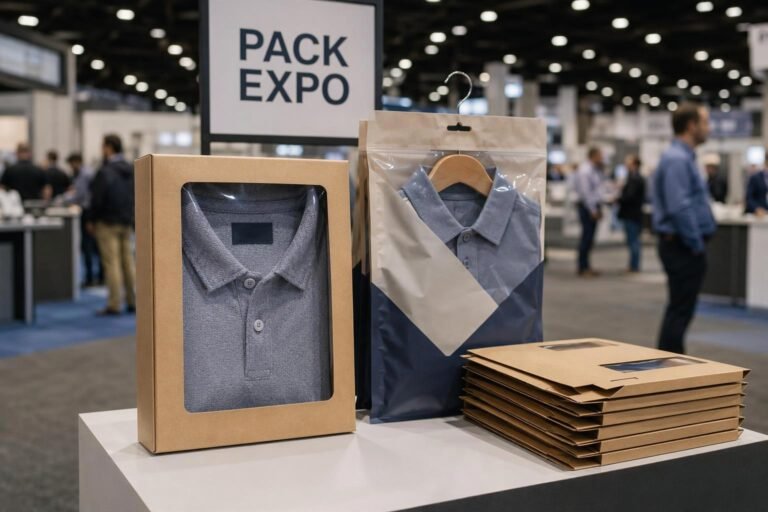
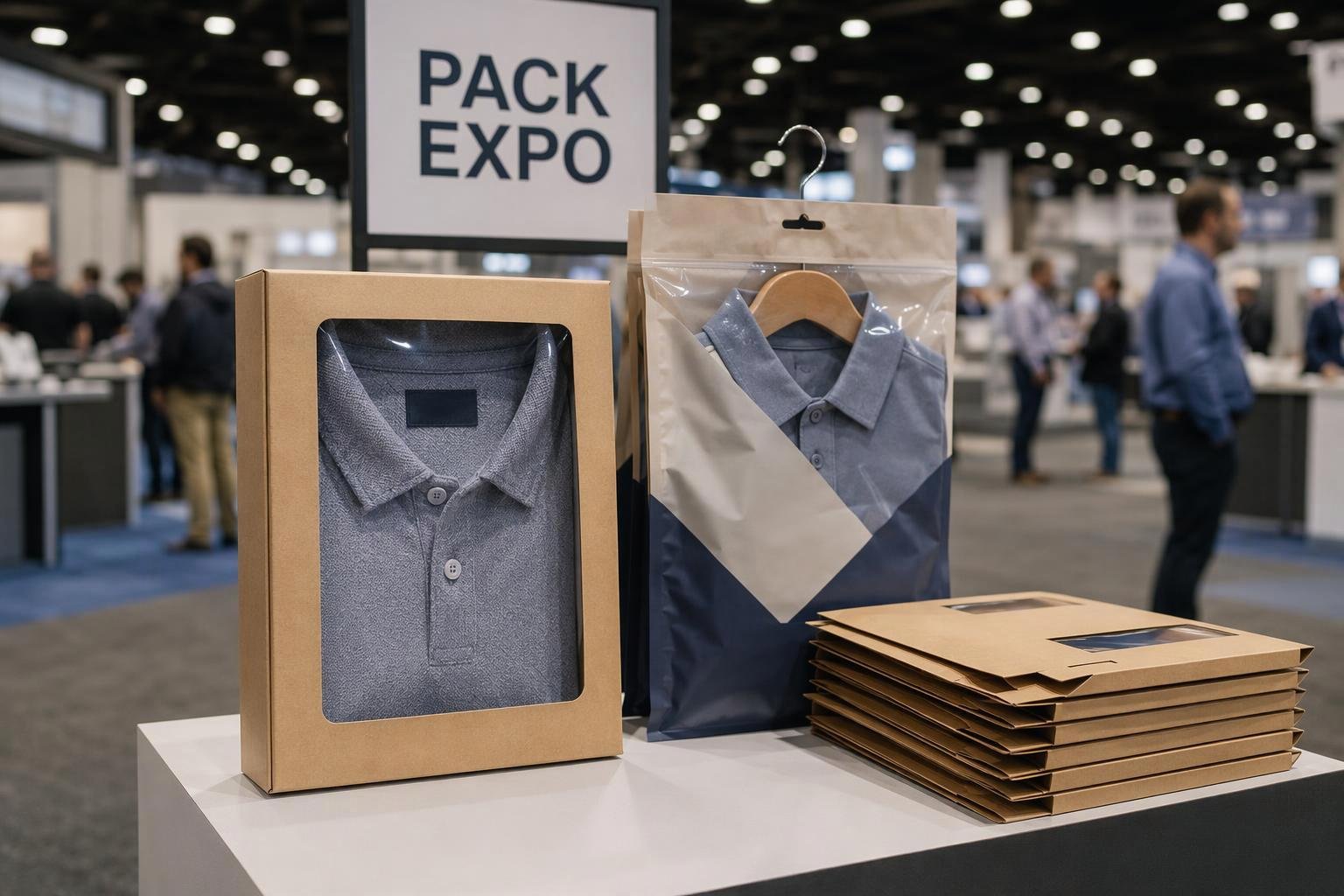
PACK EXPO International 2026 ran October 18–21 at McCormick Place in Chicago and drew 72,000 total packaging and processing professionals, according to PMMI’s post-show recap. If you run a knitwear label shipping 50–300 units per colour to a stockist or a marketplace, you were not the audience for the machinery on that floor. You are not buying a case packer this year.
But four themes that surfaced at the show do reach inside and around a folded sweater: the 2D barcode transition, extended producer responsibility (EPR) fees tied to packaging material, the push to lightweight and eliminate secondary packaging, and the limits of mono-material claims. None of them require capital equipment. All of them change what you specify, what you ask suppliers, and what you pay.
This article treats fold integrity, moisture protection, labeling, unboxing, recyclability and cartonization as one system rather than six separate chores. The same decisions that protect a premium reveal — a right-sized box, a clean fold, a tidy inner wrap — are usually the decisions that cut billable freight volume. Where the two goals genuinely conflict, you will see that too.
What Actually Happened at PACK EXPO ’26
The scale is worth stating precisely, because it explains why the show’s themes carry weight even in categories it does not name.
PMMI reports more than 43,000 attendees plus 29,000 exhibitor personnel, for 72,000 total packaging and processing professionals. More than 2,700 exhibitors occupied over 1.3 million net square feet, showing solutions for more than 40 vertical markets. Jim Pittas, PMMI president and CEO, framed the week around buyer intent: attendees “come with real challenges and investment priorities, and exhibitors are ready with the technologies, expertise, and solutions to move them forward.” The event also handed out its inaugural CPG NexGen Awards to ten young professionals from consumer-packaged goods and end-user companies.
The reported show-floor themes were automation, robotics, artificial intelligence, sustainable materials, processing technologies and packaging machinery. Apparel is not a named vertical, and PACK EXPO did not announce knitwear- or garment-specific packaging standards. Any relevance to a sweater is inference, not an announcement — worth keeping in mind before you cite the show to a retail buyer.
One thread did speak directly to retail-ready labeling. Packaging Dive reported that roughly 2,000 retailers and 1,900 brands have been involved in national pilots or implementations of 2D barcodes, with GS1 presenting the update at the show. GS1 frames Sunrise 2027 as the industry date for retailers to be able to scan 2D codes at point of sale, and notes the transition is voluntary for some sectors.
Why This Show Matters More to a Small Knitwear Label Than It Looks
Three things connect a machinery show to a brand that buys packaging by the hundred rather than the pallet.
Sustainability has moved from materials to operations. At the show, themes like lightweighting, higher post-consumer recycled content, eliminating secondary packaging and reducing pack sizes were described as having a “ripple effect for packaging and processing operations,” per Packaging Dive’s coverage. That is the layer a small brand actually controls. You will not redesign a resin. You will decide whether a sweater ships in a box inside a mailer inside a polybag, and that decision is exactly the operational layer the conversation has moved to.
EPR has a price attached to composition. California, Colorado, Maine, Maryland, Minnesota, Oregon and Washington have enacted EPR packaging statutes, with Illinois, New Jersey, North Carolina and others considering similar laws, according to Mayer Brown. Producer fees are based on the amount of packaging placed into commerce and “often are higher for hard-to-recycle materials and lower for readily recyclable, reusable, or compostable materials.” Oregon’s published 2026 fee schedule, cited in the same analysis, runs from $0 per pound for non-consumer corrugated to more than $1.30 per pound for certain plastic containers and foamed cushions. You do not need to model that today. You do need to know that a packaging material choice is now a cost line with a regulator’s name on it.
The 2D barcode transition touches retail-ready labeling whether or not you buy a machine. If a stockist or marketplace asks for a 2D code on a hangtag, that is a labeling spec change, not a capital project.
What this means for you: the show’s value is directional. It tells you which supplier questions will have better answers in 2027 than they did in 2025 — about recyclability documentation, about component weights, about barcode formats. Ask them now and you will be early rather than late.
The Knitwear Packaging Problem, Stated Plainly
Before resolving anything, name the six constraints in knitwear terms, because generic packaging advice tends to miss what a sweater actually is.
Fold integrity. A folded sweater is a compressible object that wants to recover its shape. Creases set along fold lines under sustained compression, and ribbed cuffs, collars and hems deform when crushed rather than supported.
Moisture. Textiles are strongly hygroscopic and readily absorb moisture, per TIS-GDV cargo guidance. Moisture absorbed from the environment or present at packing “results in mildew-staining, mold growth, mustiness and even decomposition.” Ocean containers combine temperature swings, condensation and long transit.
Labeling. Fibre content, country of origin and care instructions are regulated in the US. Hangtags, size stickers and channel barcodes are brand or channel choices.
Unboxing. The reveal is a brand asset and a source of extra components at the same time.
Recyclability. “Mono-material” describes how a pack is constructed. It does not establish that the finished pack gets recycled.
Cartonization. Carriers bill on dimensional weight, so a box that is mostly air is a box you pay for.
These constraints trade against each other. Airtight moisture protection fights recyclability. A deep gift box fights dim-weight efficiency. The rest of this article shows where they align and where you have to choose.
Fold Integrity: Engineering the Fold, Not Just the Polybag
Labels get specified to the millimetre: end fold, miter fold, loop fold, heat transfer, satin or woven. Garment folding usually gets a verbal instruction. That asymmetry is where variation enters.
Treat the fold as a spec decision. Write down where the fold lines fall for each style. A fold line running through a cable panel, a pointelle section or an embroidered logo will show as a crease or a distorted motif after a week under compression. Place folds in plain ground between design features, and photograph the result.
Set pack height by the garment, not the box. Compression is the enemy. Pack height should be set by the garment’s relaxed thickness — the height of the folded piece after it has been allowed to settle — rather than by filling the carton to capacity. A carton that is cheap per unit because it is a stock size can cost more in pressed-in creases than a slightly deeper box saves.
Protect rib recovery. Cuffs, collars and hems need either a fold that keeps them at the outside of the bundle or a light internal support so they are not crushed under the stack. Rib that has been flattened for a week does not fully recover, and a stockist will see it on the shelf.
Separate the shelf fold from the mailer fold. A garment folded for a shelf stack wants to be flat, stable and edge-labeled so the size and colour read from the side. A garment folded for a mailer wants to be compact and protected at the shoulders, where a light knit takes handling damage. These are different folds for the same sweater.
Note what 3D knitting changes. WHOLEGARMENT and 3D-knitted panels move where seams and shaping sit, which moves where a fold line can safely go. A fold spec copied from a cut-and-sew style may land on a shaped area that has no seam to hide it.
What this means for you: build a fold-and-pack spec sheet with one photo per style, and run a pilot where someone opens a carton, re-folds a garment and re-packs it. If the fold survives that, it will probably survive a stockist’s receiving desk.
Moisture Protection Without Wrapping Everything in Plastic
The honest answer starts with a number from cargo-loss guidance rather than from a bag catalogue.
The International Union of Marine Insurance, in its statement on humidity management, sets the mould threshold this way: to remain under the mould growth threshold, goods must be dried so that a relative humidity of 75% is not exceeded despite day/night fluctuations. That state is called “transport dry” or “container dry,” and for many goods it is reached when the goods hold a water content equivalent to about 60% relative humidity.
That framing matters because it locates the problem in the goods, not the film. IUMI is blunt that moisture damage during transport is generally due to shortcomings in the condition of the goods or the quality of their packaging and protection, absent water ingress from outside.
How desiccants actually work. IUMI describes desiccants as used inside an airtight packaging, where they immediately absorb and bind moisture from the air. Two consequences follow. A breathable or perforated pack gives a desiccant little trapped air to work on. And a sealed film with no desiccant can trap moisture that was already in the garment, holding it against the fibre for the whole voyage.
Practical levers for a small knitwear run:
Confirm the garment is genuinely dry before packing. The factory’s finishing and drying step matters more than the bag choice.
Use desiccant where the pack is sealed and the transit is long or crosses humid climates, and size it to the enclosed volume rather than adding a sachet by habit.
Avoid packing warm garments. Warm air carries more moisture, which condenses as the pack cools.
Treat metal strapping and staples as rust risks near textiles. TIS-GDV notes that metal strapping may corrode and damage fabrics by rust staining.
Watch the pallets and dunnage too. IUMI lists wet, unseasoned wood pallets and packing material as moisture sources at loading.
What this means for you: a polybag is not automatically the answer, and no bag substitutes for dry goods. Ask the factory what drying step or moisture content they can document. If the answer is vague, that is the finding.
Labels: What Is Required, What Is Brand Choice, and What Is Changing
Separate the legal floor from the design layer, because mixing them is how brands either over-comply or miss something that matters.
Required in the US. Fibre content disclosure and country of origin fall under the Textile Fiber Products Identification Act and its rules at 16 CFR Part 303. The regulation requires English, prohibits abbreviations, ditto marks and asterisks, and bars non-required information that is false or misleading or that would “interfere with, minimize, or detract from the required information.” It also specifies placement: a garment with a neck must carry a country-of-origin label affixed to the inside centre of the neck, with the country of origin always on the front side of the label.
Care instructions fall under the FTC’s Care Labeling Rule, which requires instructions that are permanent and legible for the useful life of the item. The FTC notes that failing to provide reliable care instructions is a violation of the FTC Act, with penalties that can reach $16,000 per offence in enforcement actions.
Brand or channel choice. Hangtags, woven versus printed main labels, size stickers, and marketplace prep requirements. If you sell through Amazon, note that its FBA prep guidance asks for a suffocation warning label on any bag with an opening larger than 5 inches, and clear bags unless the product is specified for opaque bagging.
Certification marks are licensed, not free. Woolmark tickets and sew-in labels “can only be used by manufacturers who are licensed by TWC and/or its affiliate companies,” with no design changes without approval and a minimum logo reproduction height of 10 mm, per the brand guidelines. The same licensing logic applies to organic marks: whether you may print a GOTS mark on a hangtag depends on your certification route, which is a question for your certifier rather than an assumption for your printer.
What is changing. GS1’s Sunrise 2027 push moves toward 2D codes carrying a GTIN plus attributes. GS1’s own one-pager on the transition describes a glide path in which dual 1D/2D marking is expected, with trading-partner requirements guiding when dual marking is no longer needed. It also reports that in initial testing, all participating retailers encountered some issues processing GS1 Application Identifier data, and that some image scanners had 2D capability switched off.
What this means for you: a 2D code on a hangtag is not yet a safe substitute for a working UPC at every stockist. Keep the 1D code until the channel tells you otherwise, and keep required information on the permanent label rather than the hangtag so a lost tag does not create a compliance gap.
Unboxing and Cartonization: Where Premium and Efficiency Actually Agree
Start with the mechanics, because they decide the argument.
Illustrative arithmetic, not a rate quote. Billable weight is the greater of actual and dimensional weight; each carton is assumed to hold the same 2 lb folded sweater. Dimensional weight = cubic inches ÷ 139, the divisor FedEx applies to U.S., Puerto Rico and international shipments and UPS applies to Daily Rates (UPS Retail Rates use 166). Carriers round dimensions and any fractional pound upward, so billable figures here are rounded to the next whole pound. Your own carrier rates and service level determine the actual charge.
Dimensional weight is “the amount of space a package occupies in relation to its actual weight,” and FedEx charges on whichever is greater. The calculation: multiply length by width by height in inches, rounding each measurement to the nearest whole inch, then divide by 139 for US, Puerto Rico and international shipments. UPS uses 139 for Daily Rates and 166 for Retail Rates, rounds each measurement up to the nearest whole number, and increases any fraction to the next whole pound.
A folded sweater is light and bulky. That is precisely the profile where dim weight, not scale weight, sets the bill. The box’s internal dimensions drive cost; its decoration mostly does not.
Where premium and efficiency agree:
A correctly sized box needs less void fill. Less void fill means less material the customer has to discard and a tidier reveal — the packing looks considered rather than stuffed.
Tissue wrap and a branded belly band cost volume but almost no weight. They read as premium without moving the dim-weight number much.
A rigid mailer can often be smaller than a folding carton for the same garment, which helps on both counts.
Where they conflict:
A deep gift box with a lift-off lid adds height. On a multi-unit order that extra height can push the parcel into a larger dim bracket, and you pay for the air above the sweater.
A heavy insert card adds weight without adding protection. If the scale weight crosses the dim weight, it starts to matter.
A test you can run this week. Pack the actual folded garment in the candidate box. Close it. Measure to the nearest inch. Multiply the three dimensions and divide by 139. Compare that figure to the scale weight. Whichever is greater is roughly what you are billed on. Then try the next box size down and see whether the garment still arrives presentable.
What this means for you: savings here are a direction and a per-shipment calculation you run with your own carrier rates, not a number anyone can quote you in advance. FedEx itself frames dim-weight pricing as rewarding shippers who pack more efficiently and avoid “literally paying to ship air.”
Recyclability and EPR: Questions That Turn a Claim into Evidence
This section is a question set, not a verdict on materials. Use it when a supplier hands you a specification sheet with a green leaf on it.
The regulatory backdrop. Seven states have enacted EPR packaging statutes, and producer fees are based on packaging placed into commerce, often higher for hard-to-recycle materials, per Mayer Brown. Timelines can move: California’s first rulemaking process ended without final regulations, requiring the state to revise and restart. The same analysis notes that EPR laws can prohibit the sale of packaging by non-compliant businesses — in Minnesota, for example, packaging cannot be introduced into the state after January 1, 2029 absent a PRO-approved stewardship plan.
What data you will be asked to hold. PRINTING United Alliance reported a May 31, 2026 reporting date for six states covering 2025 data. California, Colorado and Oregon require detailed Annual Supply Reports with SKU-level and component-level packaging data, while Minnesota, Maryland and Washington accept Simplified Supply Reports using aggregated material weight. That split tells a small brand exactly what to start recording: material type and weight, per component, per SKU.
The claim-verification questions:
Whole pack or main material? Is “recyclable” assessed for the film, the label adhesive, the hangtag, the ink and the void fill together, or only for the headline material?
Which market’s collection system? A claim written for one country’s sorting infrastructure may not hold in another. Packaging Gateway puts it directly: “Mono-material” describes a pack’s construction, and “on its own, it does not establish that the finished pack will be recycled. Claims should be supported by an assessment of the complete pack and framed for the markets and collection systems concerned.”
What documentation exists? Is there a design-for-recycling assessment, a test report, or only a supplier assertion?
Does the claim cover the components you added? Your tissue, band and sticker are part of the pack the customer receives.
One more reason to keep claim language under review: the Truth in Labeling Act of 2026, focused on recyclability claims, was introduced in August 2026, per PRINTING United Alliance. Claim language is an active area, not a settled one.
What this means for you: ask these four questions before you print a claim on a box. A supplier who can answer them is worth keeping; one who cannot has told you something useful.
What This Means for a 50–300 Unit Run
Small runs change the packaging math in ways that are easy to miss until the invoice arrives.
Packaging MOQs often exceed garment MOQs. A custom printed box at 1,000 units against a 150-unit knit run is a mismatch you will pay for in storage and obsolescence. Favour stock boxes plus branded labels, bands or stickers that can be bought in smaller quantities and changed per season without scrapping inventory.
Components multiply per SKU and per colour. Main label, care label, hangtag, size sticker, polybag, band, box. Six components across eight colourways is forty-eight line items to approve, order and reconcile. Consolidate where legally permissible, and keep required information on the permanent label rather than the hangtag so a single component carries the compliance load.
Write the fold-and-pack spec once and reuse it. Re-briefing a factory per style is exactly where variation enters. A photographed spec per style, held in one document, is cheaper than rework.
Capture packaging data when you write the spec. Material type and weight per component, recorded at the same moment you approve the artwork. EPR reporting will ask for it later, and reconstructing it from memory across a dozen suppliers is far harder than typing it into a spreadsheet once.
The honest trade-off. Small runs pay more per unit for packaging and have less leverage on custom tooling. That argues for simpler packs with better folding rather than complex packs with average folding. A clean fold in a stock box reads more premium than a creased sweater in a custom one.
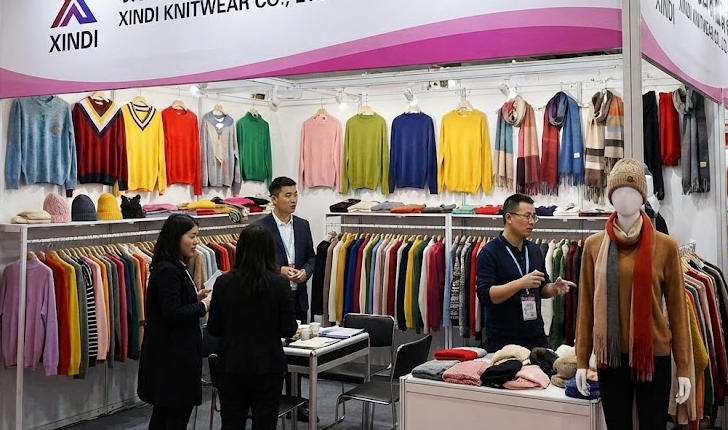
Can Your Knit Factory Handle Retail-Ready Packing?
This is the question worth asking before you assume one supplier covers everything.
Xindi Knitwear, based in Dalang, China, lists full private-label customization including custom branding, labeling and packaging among its capabilities, with label options spanning end fold, miter fold, loop fold, heat transfer and satin or woven labels for OEM knitwear branding. The company’s published case study describes a French mohair sweater client requiring European-standard finishing, multi-component labeling and FBA-compliant packaging for Amazon France warehouse delivery. That is first-party scope as the company describes it — not an audited certification of every packaging format, and not a claim about EPR reporting or recyclability verification.
The usual division of labour. A knit factory can typically handle the sewn-in label, the hangtag attachment, the fold, the polybag and the export carton. It usually cannot supply custom printed retail boxes, and it should not be assumed to hold EPR reporting data or to verify recyclability claims on your behalf.
Three questions to ask before you assume one supplier covers everything:
Which packaging components are produced in-house versus sourced from a third party?
Who owns the artwork approval loop, and who signs off before a print run?
What documentation accompanies each component — material specification, weight, and any recyclability assessment?
A separate packaging supplier is normal and not a sign of a weak factory relationship. What matters is knowing where the handoff sits, so nothing falls between two suppliers who each assumed the other had it.
The Bigger Picture
The through-line from PACK EXPO ’26 is that packaging’s cost and compliance weight is migrating from the material to the data and the cubic inch. 2D codes carry attributes. EPR fees follow material choices and reported weights. Carriers bill the space a box occupies.
For a knitwear label, that means the humble fold-and-pack spec is quietly becoming a compliance and cost document rather than a finishing instruction. The photo of where the fold line falls sits next to the component weight table, which sits next to the barcode format, which sits next to the box dimensions. One document, several audiences: the factory, the stockist, the carrier and eventually the regulator.
What to watch over the next year: whether GS1’s voluntary 2D transition hardens into a stockist requirement for your channel; how state EPR fee schedules end up treating textile packaging components such as polybags and hangtags; and whether recyclability claim rules tighten following the federal labeling bill introduced in August 2026. None of these is settled. All of them are moving in the same direction — toward documented, weighable, scannable packaging.
The practical response is not to wait for certainty. It is to start recording what you already buy, in the units the regulators and carriers already use.
Key Takeaways
PACK EXPO International 2026 ran October 18–21 in Chicago with 72,000 total professionals and more than 2,700 exhibitors; apparel was not a named vertical, so knitwear relevance is inferential.
Fold integrity is a spec, not an afterthought: define fold lines around cables, ribs and embroidery, and set pack height by relaxed garment thickness rather than by filling the box.
Moisture control starts with dry goods; desiccants only work inside a sealed enclosure, and cargo guidance treats 75% relative humidity as the mould threshold to stay under.
US fibre-content and care labeling are legal requirements under 16 CFR Part 303 and the FTC Care Labeling Rule; hangtags, size stickers and barcodes are choices, and certification marks like Woolmark are licensed.
Dimensional weight means a light, bulky sweater shipment is billed on box volume — FedEx divides cubic inches by 139, UPS by 139 for Daily Rates and 166 for Retail Rates.
“Recyclable” and “mono-material” are not the same claim; ask for a whole-pack assessment scoped to the market where the pack will be sold.
Seven states have enacted EPR packaging laws with fees often higher for hard-to-recycle materials, and reporting can require SKU- and component-level data.
At 50–300 units per colour, favour stock packaging plus branded labels or bands over custom-printed boxes whose MOQ exceeds the garment run.
Frequently Asked Questions
How do I keep a folded sweater from creasing between the factory and a stockist’s shelf?
Place fold lines in plain ground, away from cables, pointelle panels and embroidery, and set pack height by the garment’s relaxed thickness rather than by filling the carton. Keep cuffs, collars and hems at the outside of the bundle or lightly supported so rib is not crushed under the stack. Then write a photographed fold spec per style and run a pilot: open a carton, re-fold a garment, re-pack it, and see whether the fold survives.
What protects wool knitwear from humidity in transit without wrapping everything in plastic?
Dry goods come first. Cargo guidance targets staying below 75% relative humidity through day/night cycles, which is a property of the goods, not the film. Desiccants only work inside a sealed enclosure, where they absorb moisture from trapped air; a breathable pack gives them little to work with, and a sealed bag without desiccant can trap moisture already in the garment. Ask the factory what drying step they can document, avoid packing warm garments, and treat metal strapping and wet pallets as moisture and rust risks.
Which labels are legally required for US retail, and which are brand choices?
Fibre content, country of origin and care instructions are the regulated core — the first two under 16 CFR Part 303, the third under the FTC Care Labeling Rule. Part 303 also requires English, prohibits abbreviations and ditto marks, and bars non-required content that conflicts with or detracts from required information. Hangtags, size stickers and channel barcodes are choices, though a marketplace may impose its own prep rules.
How do I size cartons so I’m not paying for air, and does that hurt a premium unboxing?
Measure the closed box to the nearest inch, multiply length by width by height, and divide by 139 for a FedEx-style estimate (UPS uses 139 for Daily Rates and 166 for Retail Rates). Compare that to the scale weight; you are billed on the greater. Right-sizing usually improves the reveal rather than degrading it, because a box that fits needs less void fill and looks more considered. The place it hurts is a deep lift-off-lid gift box, whose extra height can push a multi-unit order into a larger dim bracket.
When a supplier says “recyclable” or “sustainable,” what should I ask?
Four questions: Is the claim assessed for the whole pack — film, adhesive, hangtag, ink, void fill — or only the main material? Which market’s collection system is the claim written for? What documentation exists, such as a design-for-recycling assessment? And does the claim cover the components you added? Mono-material describes construction and does not by itself establish that the finished pack will be recycled.
Can my knit factory handle custom labels and retail-ready packing, or do I need a separate packaging supplier?
A knit factory commonly covers sewn labels, hangtag attachment, folding, polybags and export cartons. Custom printed retail boxes and EPR reporting data usually sit elsewhere. Xindi Knitwear, for example, lists custom branding, labeling and packaging within its private-label scope, including end fold, miter fold, loop fold, heat transfer and satin or woven label options — but confirm component by component rather than assuming one supplier covers the whole pack.
How do packaging choices affect landed cost at 50–300 units per colour?
Through four drivers: dimensional weight, which bills the space a light bulky sweater occupies; packaging MOQs that often exceed garment MOQs; the number of components per SKU and per colour; and EPR fees that vary by material. Run the cubic-size calculation with your own carrier rates rather than relying on a quoted figure, and price stock packaging plus branded components against a custom box at your actual run size.
References and Retrieval Notes
PACK EXPO International 2026 delivers innovation, connections and business opportunities in Chicago — PMMI, October 22, 2026
What is dimensional weight? — FedEx
Shipping dimensions and weight — UPS
Humidity Management during the Transport of Goods — International Union of Marine Insurance
Textiles, fabrics, cloth — TIS-GDV cargo information
EPR Packaging Laws Moving from Concept to Compliance — Mayer Brown, February 2026
Six States Face Packaging EPR Reporting Deadline on May 31 — PRINTING United Alliance, May 7, 2026
Truth in Labeling Act focusing on recyclability claims introduced in Congress — PRINTING United Alliance, August 14, 2026
Rules and Regulations Under the Textile Fiber Products Identification Act, 16 CFR Part 303 — eCFR
Clothes Captioning: Complying with the Care Labeling Rule — FTC
Sunrise 2027 — GS1 US
A New Dimension in Barcodes: Get Ready for Sunrise 2027 — GS1 US
GS1 Sunrise 2027 adoption discussed at PACK EXPO — Packaging Dive
AI, chemicals of concern, EPR pepper Pack Expo discussions — Packaging Dive, October 22, 2026
Can mono-material packaging deliver a premium finish? — Packaging Gateway
Woolmark brand guidelines: Pure New Wool — The Woolmark Company
FBA packaging and prep labeling — Amazon
Xindi Knitwear — first-party company information