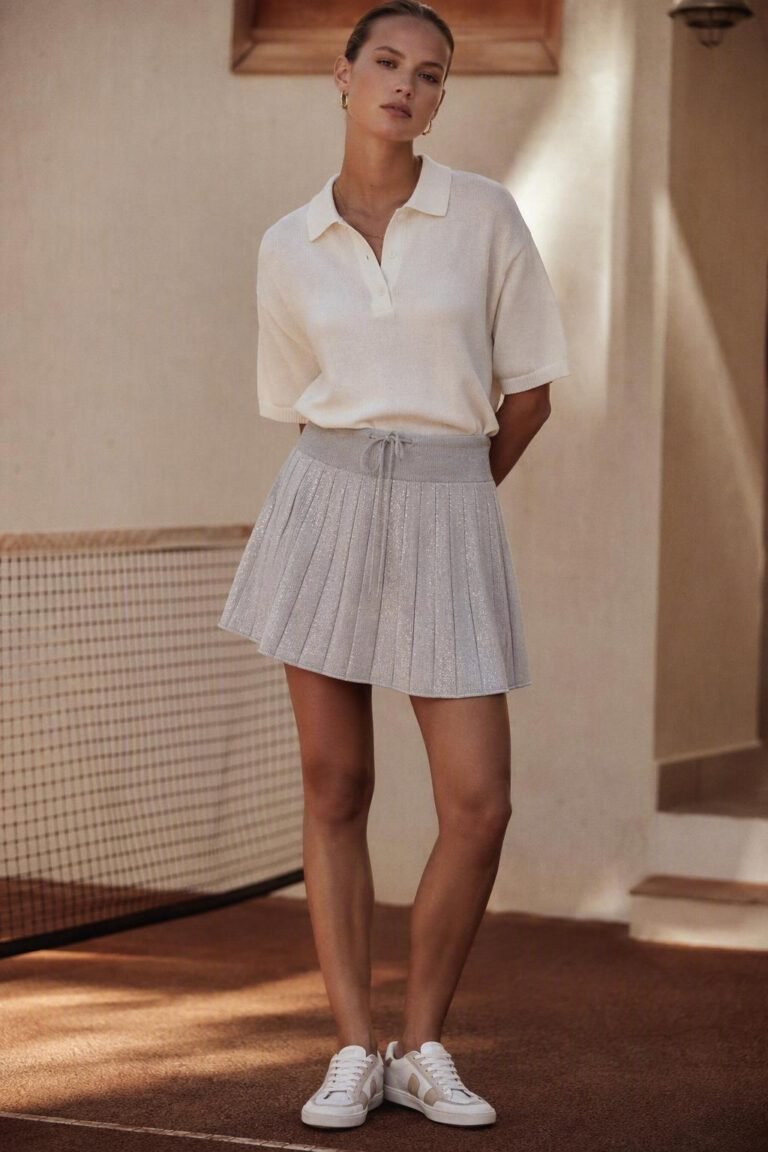

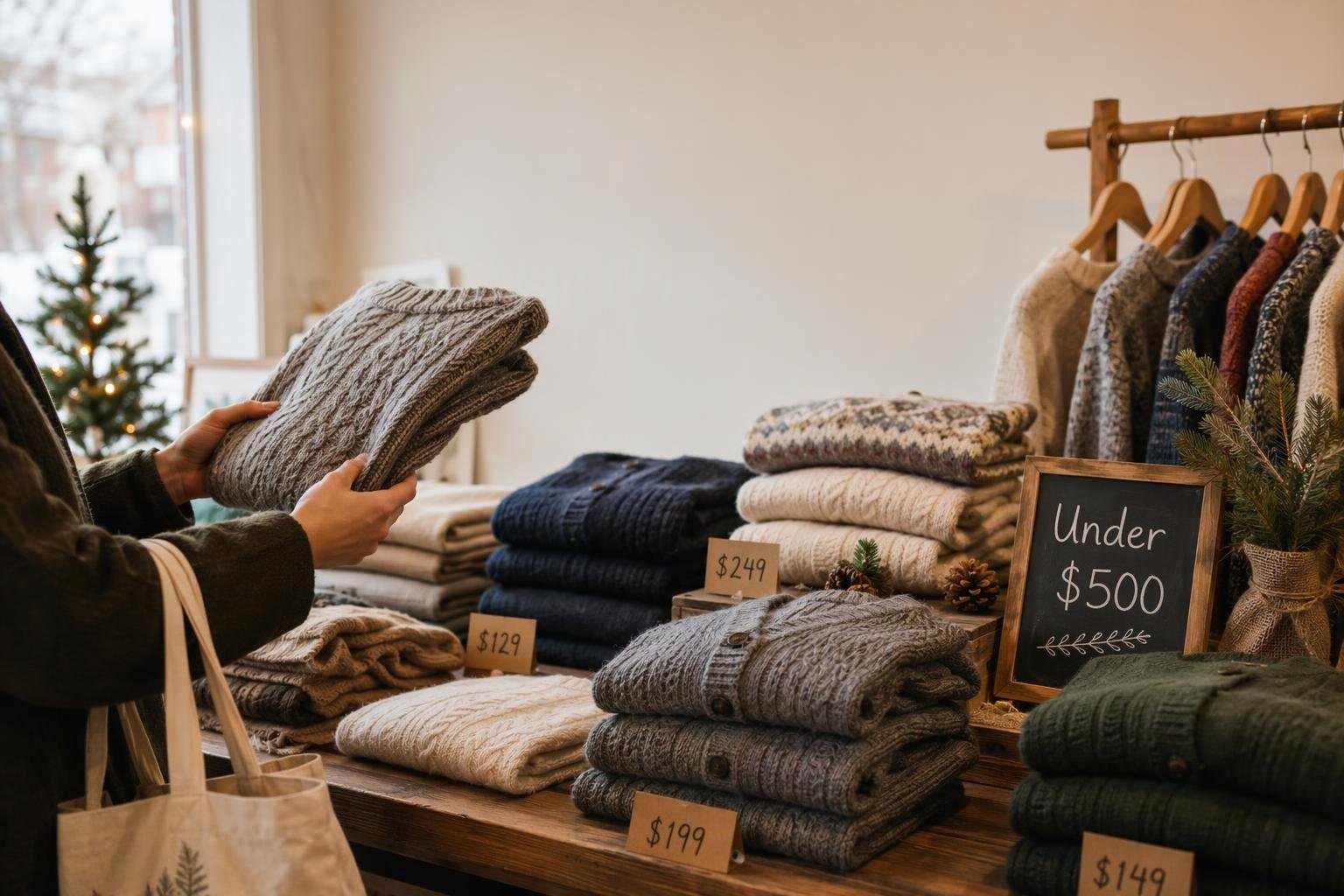
The holiday shopper you are designing for this season is not looking for the cheapest sweater on the rail. She is looking for permission to buy one. Deloitte’s 2026 Holiday Retail Survey puts 38% of surveyed US shoppers in the “holiday value seeker” category — people who run five or more cost-saving behaviors, compare promotions, and check private label alternatives — and yet expects that group to spend 12% more than other shoppers. The finding comes from 4,000 US consumers surveyed online between August 26 and September 10, 2026, with a margin of error of plus or minus 2 percentage points. It describes a national sample, not your customer list, but the shape of the behavior is the one you are pricing against: the shopper who clips, compares and waits is also the shopper willing to pay for something that earns it.
That is a design problem before it is a markdown problem. Once a collection is cut, sampled and landed, the only levers left are discount depth and placement. The decisions that make a knit feel worth its price — how it sits in the hand, whether the stitch reads as deliberate, whether the color completes more than one outfit — are settled in the design room, months before the shopper picks it up.
This piece sets out a design-stage method for emerging labels working under a shopper-facing ceiling: versatile knitwear that carries more than one occasion, a tighter assortment where every style has a job, a deliberate entry/core/halo ladder, and colorways chosen for how many outfits they finish. The aim is a collection that justifies its price without sliding toward disposable. It closes with a pre-production check you can run on a sample and a sequencing plan for MOQ, sampling and machine time.
Key takeaways
Value is judged at the garment before it is judged at the price tag. Hand-feel, stitch and color do the arguing; the number confirms it.
Fewer styles with distinct roles read as more complete than a long range of near-duplicates.
The ladder’s job is to make the core look reasonable, not to sell the halo in depth.
Choose colorways by how many outfits and occasions they complete, not by how they sit on the mood board.
The cheapest place to protect perceived value is yarn, stitch and finishing. The most expensive is decoration that does not survive a second season.
Start With What the Shopper Is Actually Judging
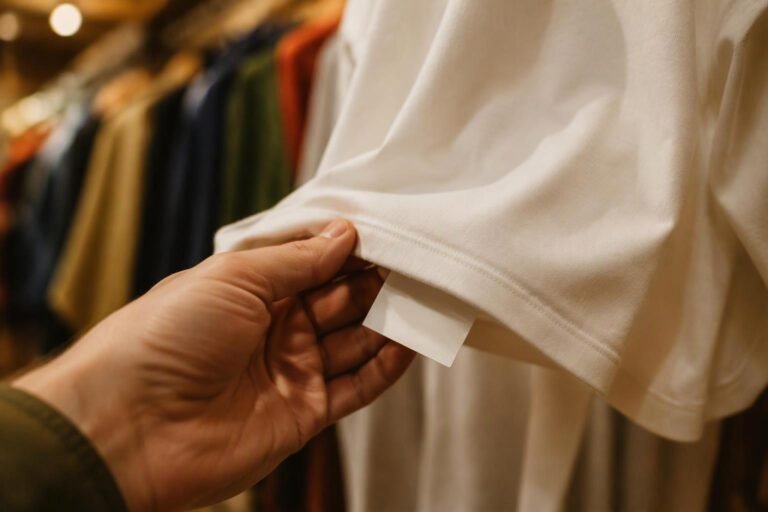
A budget-conscious shopper runs a fairly consistent sequence on a knit, and it happens fast. She takes it off the rail and feels it first — weight, loft, whether the yarn has any substance or reads thin through the fingers. She turns it over and looks at the stitch: is the pattern intentional, are the ribs even, does the surface look engineered or like the machine was left to do something simple. She holds it against herself or a companion piece to judge drape. Then color: does this look chosen for a story, or like the shade left over when the buy was finished. The care label is a smaller, later check — a hand-wash instruction reads as care, a cryptic symbol set reads as risk. Only then does she weigh the ticket against everything else on the rail.
Share of surveyed US holiday shoppers qualifying as Deloitte ‘holiday value seekers’ — those engaging in five or more cost-saving behaviours. Survey of 4,000 US consumers conducted online Aug 26–Sept 10, 2026; margin of error ±2 percentage points for the full sample. A national sample, not a read on any individual label’s customers.
Separate what you control from what you do not. Yarn hand-feel, stitch density, rib and trim quality, finishing, and the internal logic of the palette are yours at design stage. The absolute price point, the markdown calendar, the fixture the piece hangs on, and the store’s own promotional voice are set by the retailer or by the market you are selling into. A small label that tries to win the price comparison loses; one that wins the hand-feel comparison and then prices sensibly against its own range has something to argue with.
What this means for you: the sequence points to four decisions the rest of this article works through — which roles the range must fill, where each style sits on the ladder, which colorways earn their place, and where the marginal dollar goes inside the garment.
Designing a Range That Feels Complete on Fewer Styles
Completeness is a function of role coverage, not style count. A shopper standing in front of eight knits that all do the same thing perceives a thin range with padding. A shopper in front of five knits that each do something different perceives a considered one. The second range is also cheaper to produce, sample and merchandise.
For a small holiday knit range, four roles cover most of what a shopper is actually shopping for:
The layering piece. Worn under a coat, over a shirt, or alone in a warm room. It has to be thin enough to layer without bulk and finished well enough to be seen. Fine-gauge merino, a clean crew or a shallow V.
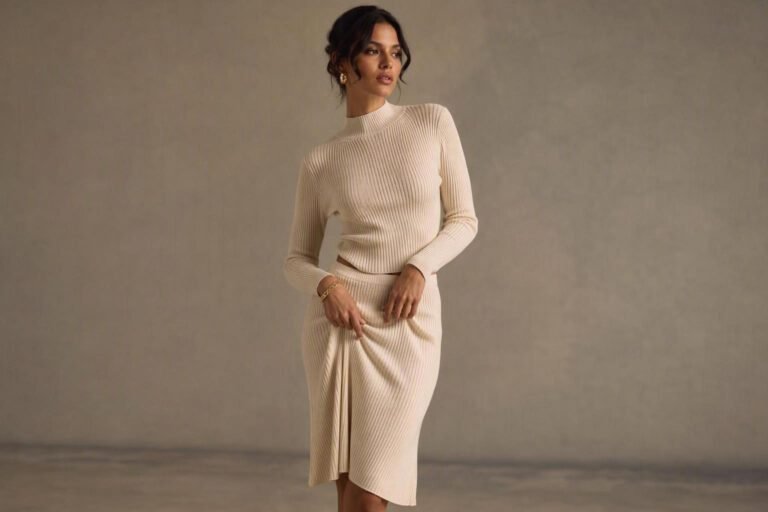
The standalone statement. The piece that is the outfit. It carries more surface interest — a textured stitch, a stronger silhouette, a collar or a longer length — and it justifies a higher price because the construction is visible.
The giftable entry item. A beanie, a scarf, a compact vest, a simple accessory knit. It brings a shopper into the brand at a low ticket and works as a gift or a self-purchase add-on.
The color carrier. One style built to show the season’s shade at its best, so the palette has a hero rather than being spread thinly across everything.
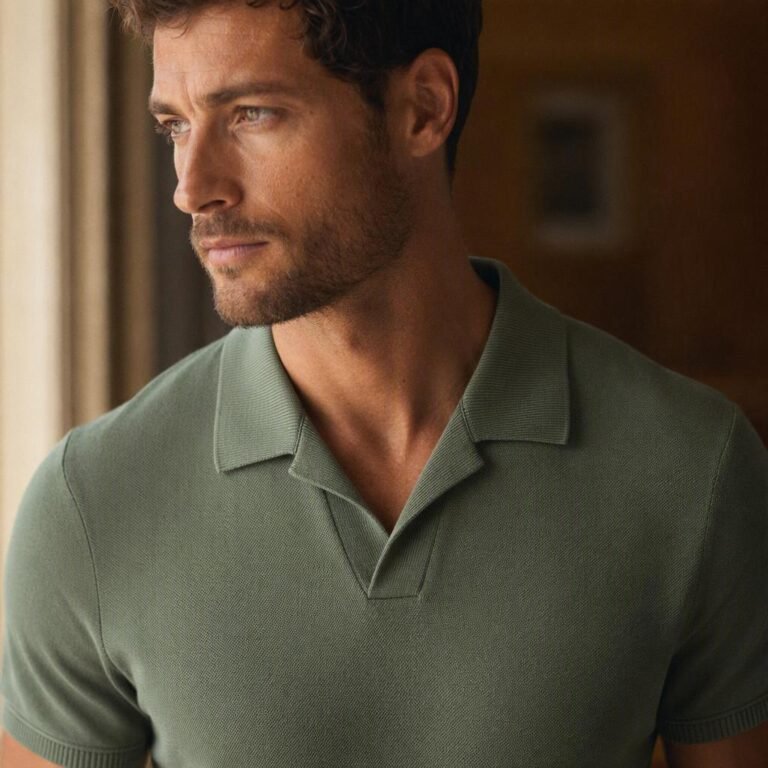
A single style can sometimes hold two roles. Trend coverage has positioned knitted vests as a layering piece that transitions into spring worn alone — Who What Wear’s knitwear trend reporting describes them as easy to wear over a long-sleeved top or button-down and simple to carry into warmer months. That is a descriptive observation about how the market is styling vests, not a rule that a vest will do this job in your range; it is a reason to test the role, not to assume it.
Test the proposed range before you sample anything. Write each style’s role on a card, lay the cards out, and ask two questions. Is any role unfilled? That is a gap, and it will show up as a shopper who wanted to buy but could not find the piece she came for. Do any two cards describe the same job? That is an overlap, and it will show up as two styles splitting one sale and doubling your sampling and MOQ exposure. Cut or merge the overlap before it costs you a sample round.
Building an Entry/Core/Halo Ladder Under a $500 Ceiling
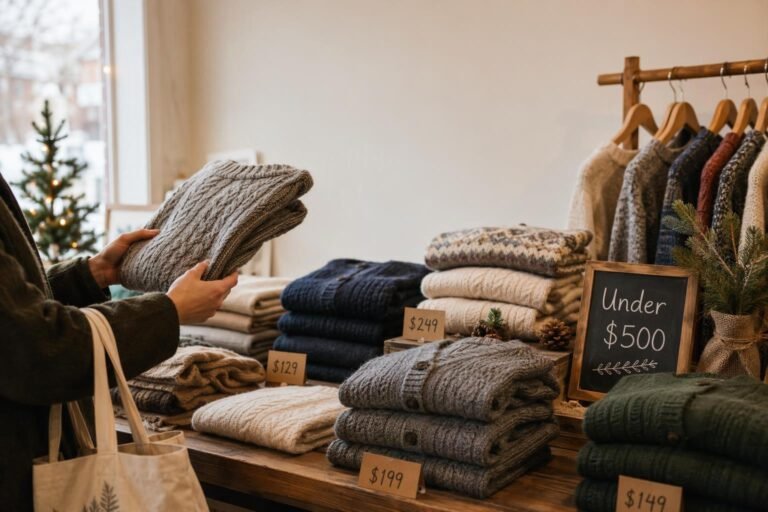
The $500 ceiling in the title is a shopper-facing constraint, not a factory cost. It describes what a frugal holiday shopper will consider for a special knit, and it exists so the range has an upper bound the customer can see. Everything below it is a design decision about where each style sits.
Illustrative structure only, not observed market prices. Bands are a worked example of a three-tier ladder under a $500 shopper-facing ceiling; substitute your own landed cost, duty, freight and margin inputs. The article’s own worked example shows a $120 landed halo landing near $634 at retail under a 2.2 wholesale multiplier and 2.4 retail keystone, which is why the halo needs a lower-cost yarn route or a smaller multiplier to sit under $500.
A three-tier ladder does the work:
Entry. The lowest-priced knit in the range — often the accessory or the simplest fine-gauge piece. Its job is to make the collection accessible and to give a gift shopper a reason to enter the brand.
Core. The pieces that carry volume and margin. These are the layering and standalone styles a shopper will actually wear through the season, priced where the range feels reasonable rather than cheap.
Halo. One piece at or near the ceiling. Its job is not to sell in depth; it is to make the core look sensible by comparison, and to demonstrate what the label can do.
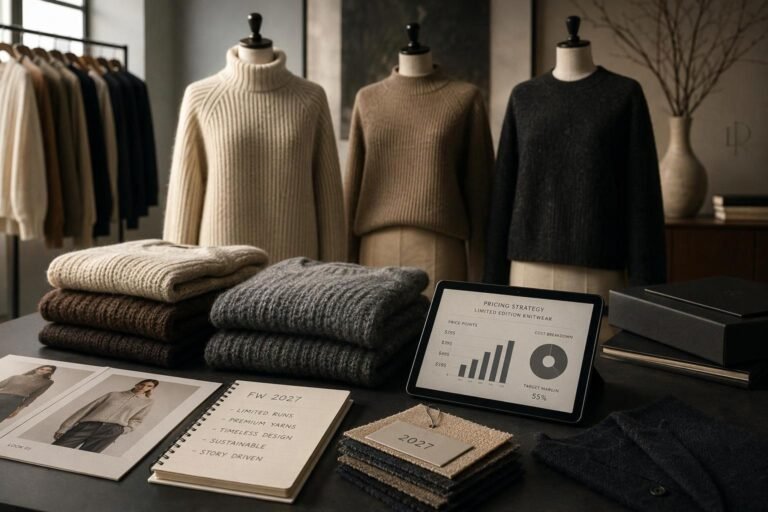
Here is the arithmetic, with illustrative assumptions only. Suppose a core knit lands at a landed cost of $48 per unit after yarn, knitting, finishing, freight and duty, and you apply a wholesale multiplier of 2.2 to reach $106 wholesale, then a retail keystone of 2.4 to reach roughly $254 at retail. An entry accessory at $14 landed becomes about $31 wholesale and roughly $74 at retail. A halo piece with a more expensive yarn and a complex WHOLEGARMENT construction at $120 landed becomes about $264 wholesale and roughly $634 at retail — above the ceiling, which tells you the halo needs either a lower-cost yarn route or a smaller multiplier to sit under $500. Substitute your own cost, duty, freight and margin inputs; these figures are a worked example, not market price data, and the multipliers are conventions you should set for your own channel mix.
The halo has to deliver something the shopper can perceive, not just a higher number. A visible construction difference — a full-fashion shoulder, a WHOLEGARMENT body with no side seams, a heavier gauge, a hand-finished collar — or a yarn the hand can immediately tell apart. If the only difference is the price, the shopper reads the halo as a mistake or the core as overpriced.
The failure mode to watch is a halo priced so far above the core that it reads as a different brand. When the gap between core and halo is wider than the shopper’s sense of what the label does, the halo stops lifting the range and starts explaining that the core is the cheap option. Keep the halo within sight of the core, and let the construction gap do the talking.
Colorways That Travel Across Occasions
A colorway earns its place by the number of outfits and occasions it completes. That is a different test from whether it looks good on a mood board, and it usually produces a smaller, more deliberate palette.
Start with the distinction between cohesive and one-note. A cohesive palette has internal relationships: shades that sit next to each other in value, a neutral that grounds everything, one deeper tone that anchors the season. A one-note palette is what you get when every style shares the same two shades — usually a cream and a black — because each style was designed in isolation and reached for the safe option. The result looks like a uniform, not a collection, and the shopper who already owns a cream knit has no reason to buy yours.
A workable structure for a small holiday range:
A grounded neutral base. One or two shades that carry the layering and core styles and work with most of what a shopper already owns. This is where most of your yarn volume sits.
One deeper seasonal shade. A tone that reads as holiday without being literal — a deep green, a burgundy, a chocolate, a slate. It gives the range its season and appears on the standalone and color-carrier styles.
One accent that appears sparingly. A single brighter or softer shade used on one style or as a trim. It creates the impression of a designed palette without multiplying your yarn commitments.
This structure lets styles share yarns without looking identical. Two styles in the same base shade read as a family when their stitches and silhouettes differ; they read as duplicates only when everything about them matches.
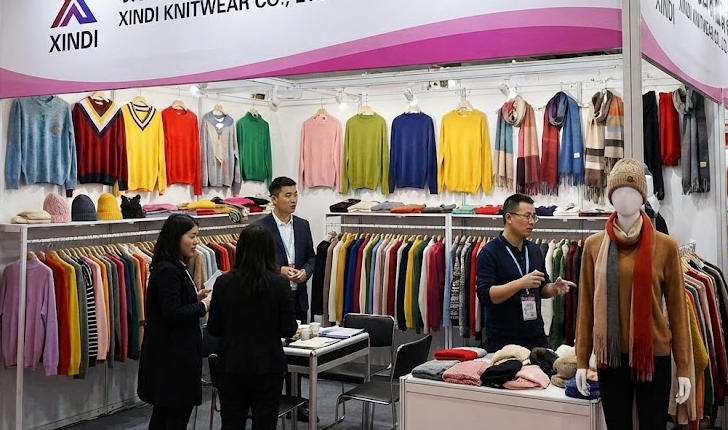
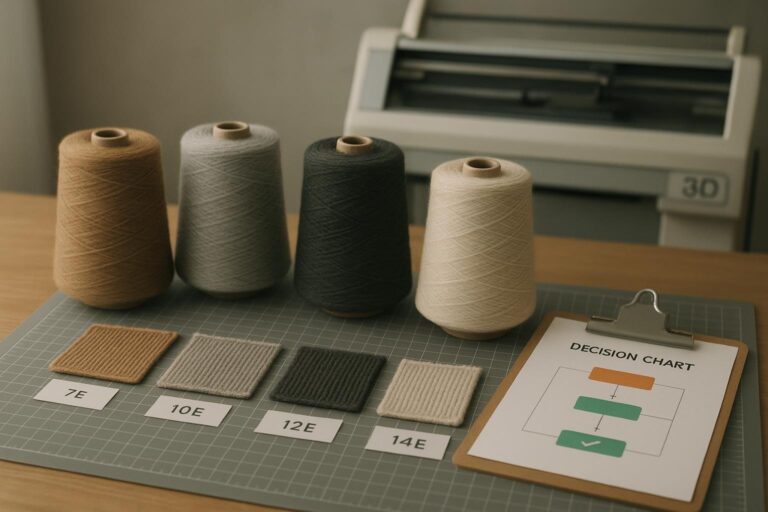
Price the palette against yarn availability before you commit. Custom-dyed shades carry higher minimums and longer lead times than stock colors — Xindi’s color customization workflow notes that custom-dyed yarn generally requires a higher MOQ than stock colors, that lab dips add time but reduce production risk, and that lead time typically increases by 7–14 days for custom colors. That does not rule out custom shades; it means each one has to be worth its minimum. The sequencing section below covers how to decide.
The practical test: lay the proposed colorways against the occasions the range is meant to serve — a workday, a dinner, a family gathering, a travel day, a gift. Cut any shade that only works for one. A shade that finishes three of those occasions is doing more selling than a shade that photographs beautifully and only works in December.
Where Perceived Value Is Actually Built: Yarn, Stitch, Finishing
Perceived value per dollar is built in a fairly short list of places, and most of them are inside the garment rather than on it.
Yarn hand-feel and recovery. The first thing the hand judges and the thing it remembers. Recovery matters as much as softness: a yarn that feels lovely but grows at the cuff or the hem reads as poor quality by the second wear. Ask for the yarn’s composition and how it behaves after washing, and test it on a sample rather than a swatch card.
Stitch density and gauge. A denser stitch reads as more substantial and holds shape better. A loose, thin stitch at a mid-range price is one of the fastest ways to look disposable. Gauge also drives machine time, so this is a cost decision as well as a quality one.
Rib and trim quality. Cuffs, hems and necklines are where a cheap knit announces itself. Ribs that recover, a neckline that holds its shape through try-on, and trims that are proportionate to the body all cost relatively little and read clearly.
Linking and seam finishing. Clean, flat linking and tidy seam allowances are visible to anyone who turns the garment inside out, and they are the difference between a sample that photographs well and a bulk order that holds up.
Buttons and closures. On cardigans and button-through styles, the button is a small, high-visibility object. A thin, sharp-edged button undercuts everything above it.
Label and packaging. The care label, the brand label and the packaging set expectations before the garment is worn. Accurate fiber and care information is also a legal matter in major markets, so treat it as a compliance task rather than a finishing touch.
Set those against decorative costs that do not survive handling or a second season: heavy appliqué that pills at the edges, a novelty yarn that matts after two washes, a print that cracks, a trim that is glued rather than sewn. Decoration is not automatically wrong — a considered textured stitch is decoration that lasts — but decoration that fails is the most expensive thing in the garment because it converts a repeat customer into a returned one.
Xindi’s first-party context is relevant here where it is accurate: low MOQs from 50 units, 3–5 day sampling from tech packs or photos, 3D knitting and WHOLEGARMENT capability, and certified yarn options including OEKO-TEX, RWS, GRS and GOTS. Be precise about what those certifications mean. A certified yarn confirms something about the fiber’s origin or processing chain; it is not a durability guarantee for the finished garment, and no single durability standard applies to a knit as a whole. Durability is a property of the yarn, stitch, finishing and care instructions together, and it is confirmed by testing the actual garment.
What this means for you: spend the marginal dollar where the hand can feel it — a better yarn, a denser stitch, a rib that recovers — before you spend it on surface decoration. The first is felt on the rail; the second is noticed only when it fails.
The Disposability Test: A Pre-Production Check
A knit feels disposable when it looks like it was made to be replaced. The signals are consistent: thin hand-feel relative to the price, a stitch that loses shape after a wear or two, a color that only works for six weeks, a trim that fails before the garment does, or a style that duplicates another in the range so the shopper has no reason to choose between them.
Run this against a sample before you commit to bulk. It is a practical heuristic, not a test method or a standard, and it complements rather than replaces whatever lab testing your factory or your buyer requires.
Check on the sample | What failure looks like | The design-stage decision that prevents it |
|---|---|---|
Hand-feel against price | Feels lighter or thinner than the ticket implies | Yarn and gauge chosen against the target price, not after it |
Stitch and shape | Ribs relax, neckline gapes, body twists after try-on | Denser stitch, better rib, and a fit session on a washed sample |
Color range | Shade only works for one occasion or one month | Palette tested against the occasions the range serves |
Trim and closure | Cuff or button fails before the body shows wear | Trim specified to the same standard as the body |
Range logic | Two styles do the same job | Role map completed before sampling |
Care and labeling | Instructions that make the garment hard to own, or content that does not match | Care route decided at design stage and fiber content verified |
Two of these deserve a note. The stitch and shape check should be done after washing, not on the sample as it arrives — a knit that looks right on the hanger and relaxes after the first wash has not passed. And the range-logic check is the one most labels skip, because it requires looking at the collection rather than the garment. A perfectly made knit that duplicates another style still reads as padding to the shopper.
If a sample fails a check, the fix belongs upstream. Re-cutting the same sample does not solve a yarn or gauge decision, and it consumes a sampling round you will want later.
Sequencing Design Decisions Against MOQ, Sampling and Machine Time
The four design levers — versatility, assortment, ladder and colorway — all collide with production reality at the same point: the per-color minimum. This is where a well-designed range either becomes buildable or becomes a negotiation.
Illustrative arithmetic using the sourcing FAQ’s hypothetical 100-units-per-colour example, not a quote or market survey. Per-colour MOQ varies by yarn route and factory policy (the same source describes a 50–300 unit per colour working band) and must be confirmed with your factory before locking a plan.
Per-color MOQ against a tight assortment. MOQ is commonly set per style per color, and a typical band runs from 50 to 300 units per color. That creates a direct trade-off. Fewer styles in more colors spreads your units across more dye lots and more machine setups; more styles in fewer colors concentrates units but narrows the palette. With a tight assortment, the usual answer is to concentrate color depth on the two or three styles that carry the season and keep the rest in the base neutral. Confirm with your factory whether there is a per-color minimum and any per-size floor, because a two-color, five-size plan can look affordable per style and become expensive per color.
Custom dye against stock service. Stock-service yarn shortens both sampling and bulk because the shade and the inventory already exist. Custom-dyed shades add lab dips and dye-lot scheduling, which extend timelines and raise per-color MOQ pressure. Xindi’s low MOQ and lead-time guidance puts samples at 3–5 business days fast-track or 7–10 standard, and bulk at roughly 21–35 days after approvals for stock-service yarn. The same guidance notes that minimum dye lots in knit sourcing can approach a few hundred kilograms per color, which is why per-color MOQs rise on custom shades. Decide early which shades justify that commitment and which can be met with a nearest stock shade.
WHOLEGARMENT and complex patterning. 3D programming, complex patterns and heavy intarsia add programming time, first-article tuning and machine time. The same guidance suggests planning roughly an extra week when a WHOLEGARMENT program is new to the factory on your style. That is a planning allowance, not a fixed rule — the actual adder depends on the pattern and the machine.
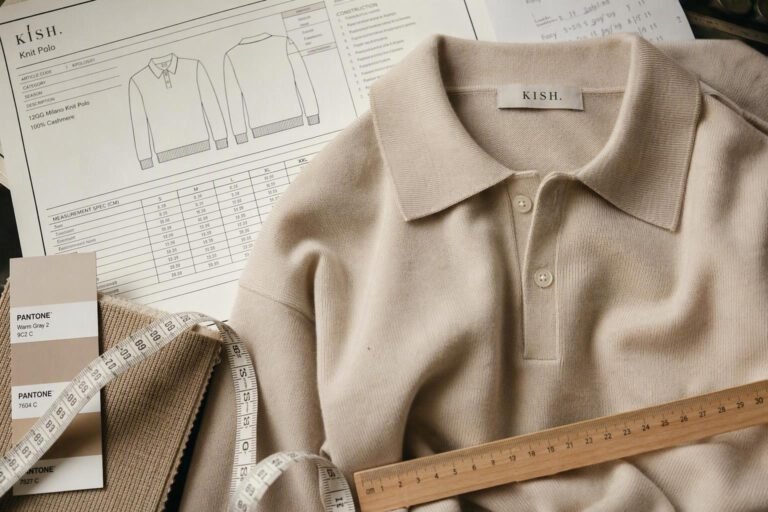
Sampling rounds that each answer one question. The most common calendar failure is a sample round that tries to answer everything and answers nothing. Structure them: the first sample proves construction and general fit; the second confirms corrections; the pre-production sample confirms the final approved standard before bulk knitting. Send a complete tech pack — yarn composition, target gauge, sample size, Pantone or yarn color, trims, label details and fit measurements — and write exact, centimeter-based fit comments. Clear revisions save more time than a rushed sample.
A workable order of operations, adaptable to your calendar:
Lock the role map and cut overlaps before any sampling.
Decide the yarn route per shade — stock service versus custom dye — and confirm per-color minimums and dye-lot sizes.
Approve lab dips for custom shades before sampling in those colors.
Run sample round one for construction and fit; round two for corrections; the pre-production sample for the final standard.
Confirm the quality-control plan — inspection level, pre-shipment inspection timing, and lab tests for pilling, shrinkage and colorfastness relative to your ship date.
Build buffers around peak periods in your production region, and consider splitting the PO into tranches to protect the shelf date and smooth cash flow.
Conclusion
The frugal holiday shopper is not asking for a cheaper collection. She is asking for a collection that justifies its price, and she is willing to pay more for one — the Deloitte finding is a description of that willingness, not a promise about your range. What converts the willingness into a sale is design-room discipline: fewer styles with clearer roles, a ladder that makes the core legible, colorways chosen for how many occasions they serve, and value spent where the hand can feel it.
None of that requires a bigger buy or a longer development calendar. It requires deciding earlier — before the sample round, before the dye lot, before the markdown.
A soft next step, if it is useful: request swatches for the yarns and shades you are considering, confirm the per-color minimums and lead times that apply to your plan, or run a pilot sample against the disposability check before committing to bulk. Each of those answers a question cheaply, while the answer can still change the design.
Frequently Asked Questions
Does a tighter assortment risk looking thin next to larger competitors?
Only if the styles overlap. A shopper judges completeness by whether she can find the piece she came for, not by counting options. Five styles with five distinct roles read as a curated range; twelve styles with four roles read as a range with eight near-duplicates. The risk is real when the range is small and the roles are unclear — that is a merchandising problem, not a size problem.
Is a halo piece worth producing at low volume?
Yes, if it does its job. The halo is not there to sell in depth; it is there to make the core look reasonable and to show what the label can do. At low volume it can still earn its place through editorial, wholesale presentation and the price anchor it provides. It stops being worth it when the construction difference is invisible or when it is priced so far above the core that it reads as a different brand.
Can stock colors carry a holiday story without custom dyeing?
Often, yes. A grounded neutral base plus one deeper seasonal shade from stock service can carry a holiday range, particularly if the stitch and silhouette do the seasonal work. Custom dye earns its minimum when the shade is the reason to buy — a signature color the label will use again, or a tone that no stock option comes close to. If a nearest stock shade would pass the occasion test, it is the cheaper and faster route.
How do I hold a price ceiling when yarn costs move?
Build the ceiling into the design rather than the negotiation. Decide the retail ceiling first, work back through your margin structure to a landed-cost target, and design the yarn, gauge and construction to that target. When yarn costs move, the levers are the yarn route, the gauge and the amount of decoration — not the retail price, which the shopper has already anchored. Keep one style in the range with enough cost headroom that a yarn increase does not force a repricing across the collection.
What should I confirm with a factory before locking a colorway?
Confirm the per-color minimum and any per-size floor; the minimum dye lot by fiber; how many lab-dip rounds are typical and whether a nearest stock shade can be accepted to stay on the faster path; any surcharge for sub-lot orders; and how bulk color will be checked against the approved lab dip, including under which light conditions. Also confirm the lead-time difference between stock and custom shades for your specific yarn, and get the color approval in writing before bulk dyeing begins.