

Introduction
Most emerging knitwear labels face the same bind. To get a decent unit price, you have to commit to volume — and to commit to volume, you have to be confident about a style you have never sold. The usual answer, ordering bigger to bring the unit cost down, takes a question you cannot yet answer and turns it into cash you cannot get back.
This framework reverses that order. It treats the first production run as a test rather than a bet, prices that test through a good-better-best ladder that can carry the small-batch premium, locks the product attributes tightly enough that a reorder does not require rework, and uses demand-based rules to decide what actually gets repeated. The 2027 calendar at the end is a planning device for sequencing those steps — not a forecast of what the market will do that year.
It is written for small to mid-sized labels launching capsule knitwear with limited capital: enough to fund a real run, not enough to absorb a season’s worth of unsold stock.
Why the 2027 Launch Should Start Smaller Than Feels Comfortable
The economics of a short run are not complicated, and it is worth stating them plainly before planning around them. A garment factory does the same technical work whether the order is 40 pieces or 4,000: the pattern is drafted and graded across the size range, fabric is tested for shrinkage and color fastness, the marker is laid out, a sample is made and corrected, machines are set up, and finished pieces are checked against the measurement chart. None of that is skipped because the order is small. What changes is how the fixed cost is spread. On a short run it lands on fewer pieces, so the cost per piece rises.
Fabric adds a second pressure. Mills quote their best conditions on full rolls, and a short run rarely fills one, so your yarn options narrow toward what is available in shorter lengths or in stock colors.
The upside is on the other side of the same ledger. Corrections cost very little when a fit problem shows up on 40 pieces instead of 400. A short run also moves through the floor faster, which buys back calendar time you can spend on selling rather than waiting.
That is why the right objective is not the lowest unit cost. It is the cheapest learning. A style that comes back validated — fit confirmed on real bodies, color confirmed against real light, size break confirmed against real orders — can be reordered at better economics, and you will be committing that larger order to something you have evidence for. You are paying a premium for information. The question this framework answers is how to pay it deliberately rather than by accident.
Sizing the First Batch: Variables, Not a Fixed Number
There is no correct number of pieces for a first knitwear batch, and any article that gives you one is describing a different label’s constraints. What you can do is identify the variables that set the number for your case.
How the factory counts its minimum. This is the first thing to establish, because it changes the arithmetic entirely. Minimums are usually counted per style, and at many plants per color as well — not per order. A 200-piece order split into four styles is four separate production runs, four markers and four setups, and it will not be quoted like a single 200-piece run. Ask the question in exactly that form: per style, per color, or per order?
Yarn availability. Whether the mill sells in shorter lengths, and whether your color exists as a stock shade or requires a dye lot, determines both your minimum and your lead time. A stock color can often be bought in smaller quantity; a custom dye lot usually cannot.
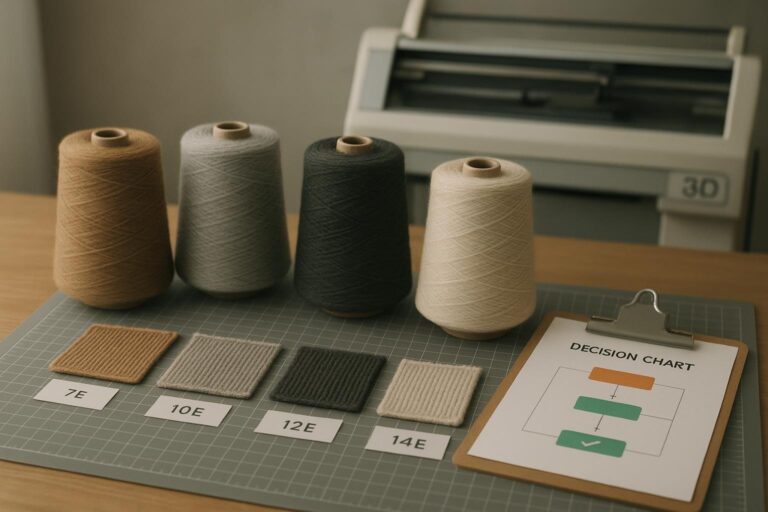
Gauge and construction complexity. A fine-gauge plain knit and a complex cable or jacquard structure do not carry the same setup burden or the same machine time. Complexity raises the cost of each test piece, which argues for testing fewer pieces of a more complex style.
Color count. Each additional colorway can multiply setup work. If a factory’s minimum is per color, then three colorways of one style is three minimums, not one.
Factory capacity windows. A plant running at capacity may only be able to slot a small order into a specific window. That affects timing more than quantity, but it belongs in the same decision.
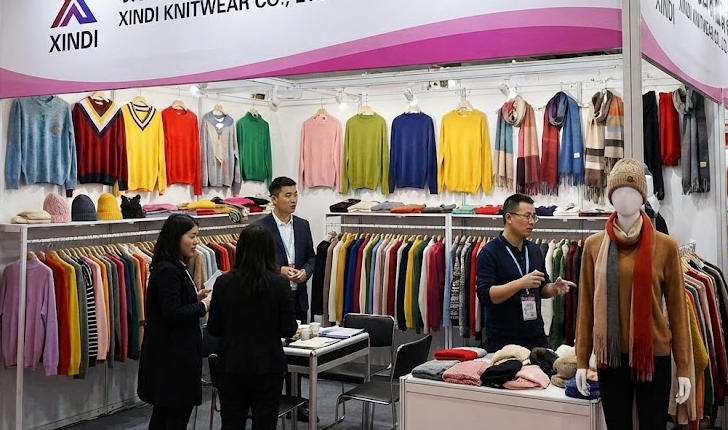
As one data point rather than a benchmark: Xindi Knitwear states a starting MOQ of 50 units, alongside 3–5 day sampling and certified yarn options including OEKO-TEX, RWS, GRS and GOTS. That is one manufacturer’s floor under its own terms. Another plant may quote 30 pieces per style, another 100 or more per style with colorways divided inside that figure. The number only means something once you know how it is counted.
Before comparing any two quotes, write out your count: styles × colorways × sizes. That single line explains most of the gap between a quote that looks cheap and one that looks expensive.
Building a Good-Better-Best Ladder That Maps to Real Spec Differences
Tiered pricing is an established commercial idea: Harvard Business Review’s good-better-best framework describes differentiated tiers serving price-sensitive, core and premium customers, rather than using discounts to reach the first group and leaving the third with no reason to spend more. The framework’s value in knitwear depends entirely on one condition: each tier must differ in something a customer can see and a factory can specify.
A price step with no spec difference behind it is not a ladder. It is a discount with extra steps, and customers tend to notice.
What can actually change between knitwear tiers:
Fiber. A simpler yarn at entry, a softer or more costly fiber at the core, a finer or more distinctive fiber at the top.
Gauge and stitch structure. A plain stitch versus a textured or cable structure; a coarser gauge versus a finer one.
Weight. Measured in GSM (grams per square meter), weight changes hand-feel, drape and warmth — and it is a number you can put in a spec and a customer can feel.
Finishing. Fully-fashioned panels and hand-linked seams cost more than cut-and-sew and show in the garment.
Fit and color range. A fuller size range or a wider color offer at the upper tier is a real, explainable difference.
A workable knitwear ladder might run: entry in a simpler yarn and plain construction with a narrow color range; core in a mid-weight knit with a defined hand-feel and the label’s main color story; best in a finer gauge or more complex stitch with the fullest color range and the most finishing work.
Two merchandising rules keep the ladder honest. First, each tier should be explainable in one sentence — if you cannot say what changes and why it matters without the word “premium,” the difference is not real enough to price. Second, “good” is not inferior quality. It serves a different purchase need: a first-time customer, a lower-commitment gift, a simpler everyday piece. The entry tier should still meet your quality standard.
And the core tier should reflect your actual customer, not your aspirational one. If most of your buyers sit at the middle, that is where the volume and the margin have to come from.
Absorbing the Small-Batch Premium Inside the Ladder
The small-batch premium has to go somewhere. The question is whether you place it deliberately or discover it after the season closes.
The arithmetic below is a template, not a set of recommended figures. Substitute your own numbers; the relationships are what matter.
Start from landed cost, not FOB. FOB is the price of goods at the factory door. Landed cost adds freight, insurance, duties and any import fees — and for a small shipment, freight and duties are spread over fewer units, so they weigh more per piece than they would on a bulk order. A quote that looks acceptable at FOB can look very different landed.
Let L be landed cost per unit for a given tier, and M your target margin as a percentage of selling price. The price that delivers that margin is:
Price = L ÷ (1 − M)
Now the tier problem. Setup cost — pattern, grading, sampling, machine setup — is roughly fixed per style. Call it S. If you spread it evenly across all units in the run, each tier carries the same share. But the entry tier typically sells at the lowest price, so the same absolute setup share consumes a larger percentage of its price. That is why the entry tier is the most fragile part of the ladder: it has the least room to absorb the premium.
There are two honest ways to handle this.
Price the entry tier so it carries its share. Raise the entry price until the setup allocation fits inside your margin. This protects margin but may push the entry price above what the tier is worth to a first-time buyer.
Accept a thinner margin on the entry tier deliberately. Treat the difference as a customer-acquisition cost — you are buying a first purchase and the chance to prove quality. This is a legitimate choice, but only if you have decided it in advance and know what it costs you across the run. It becomes a problem when it happens by accident and the entry tier quietly loses money on every unit.
What you should not do is price the entry tier low enough that it cannot carry any share of setup and then fund the gap from the core tier’s margin without noticing. That works until the core tier sells less than you expected — which is exactly the scenario a test run exists to reveal.
Spec Discipline: The Attributes That Keep Sampling, Costing and Reordering Aligned
A reorder is only as good as the spec it is built from. If the sample and the bulk run are not described by the same locked document, your second order is a new development project wearing the same style number.
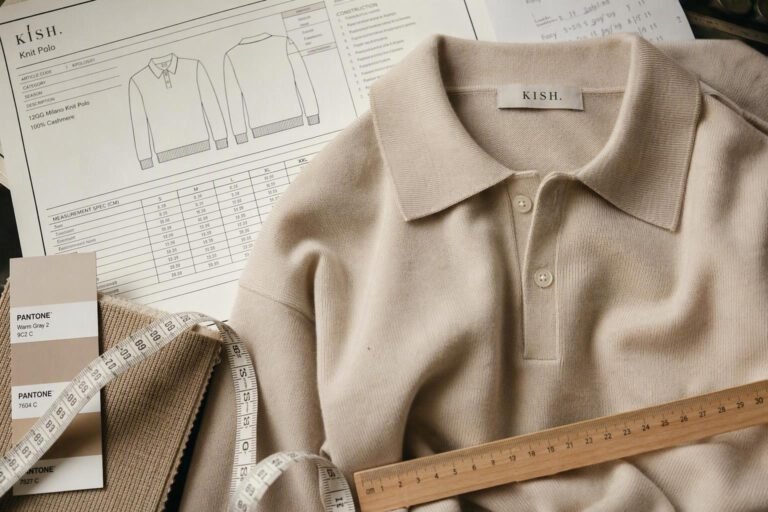
A knitwear spec sheet — the technical document a factory builds from — should pin down at least these categories:
Fiber content and yarn source. Generic fiber names and percentages by weight, plus the specific yarn or supplier reference.
Gauge and stitch structure. The machine gauge and the named stitch, so a substitution is visible rather than silent.
Weight. GSM, with a tolerance.
Measurements and grading. Point-of-measure names, measurement method, sample-size values, tolerances, and grade rules across the full size range.
Color references. Lab dips and Pantone or supplier codes, approved against a physical standard.
Trims and closures. Buttons, zips, drawcords, and their placement.
Finishing. Seam types, stitch density, reinforcements, pressing and any wash or hand-feel treatment.
Labeling and packaging. Label content and placement, folding, bags, hangtags, carton marks.
Tolerances deserve their own line because omitting them causes a specific kind of argument. Exact measurements with no allowance invite a factory to reject an acceptable sample over a few millimeters, or let a real deviation through because there was no benchmark. Every point of measure needs a realistic tolerance so quality inspection knows where the line sits.
Attribute drift is where the money goes. Change the yarn or the gauge between the approved sample and bulk, and you re-sample, re-cost, and possibly end up with a garment that no longer fits the way the sample did. Re-sampling can add weeks and real cost to a development budget before a single production unit is made. On a small run, that delay can cost you the selling window the test was designed to capture.
There is a compliance dimension too. In the US, federal labeling rules enforced by the FTC require most textile and wool products to carry a label listing fiber content, country of origin, and the identity of the manufacturer or another business responsible for marketing or handling the item; care instructions are required separately under the Care Labeling Rule. The FTC’s apparel labeling guidance notes that improperly labeled imports can be held up by Customs. Fiber content claims carry a 3% tolerance for unintended manufacturing variation — which is not permission to label something you know to be different.
What this means for you: spec accuracy is a customs and retail-readiness issue, not only a production one. A locked spec sheet with a change-control step — any substitution documented and re-approved before production — protects your fit, your costing and your ability to clear the border.
Reorder Rules for a 50–300 Unit Run
Once the test batch has sold for a few weeks, you need a rule for what to reorder. Two measures do most of the work.
Illustrative only, using the article’s own worked example: a style selling 10 units a week in stock with a six-week reorder lead. The trigger is set at ten weeks of stock — four weeks of cover to sell through plus six weeks to cover the lead. Change any input and the trigger moves.
Rate of sale (ROS) is units sold per week. Weeks of supply (WOS) is inventory on hand divided by weekly rate of sale — how long your stock lasts at the current pace. Both are standard retail math; Toolio’s guide to WOS sets out the formula as beginning-of-period inventory ÷ weekly rate of sale.
One adjustment matters more than any other for a small run: calculate ROS only over weeks the item was actually in stock. If a style sold out in week three and you kept dividing by six weeks of calendar time, your rate of sale looks half as strong as it was, and you will under-order the reorder. Filter out any week where ending inventory was zero, or below a minimum threshold you define.
The decision inputs, and how they combine:
Sell-through velocity. How fast the style is moving, measured on in-stock weeks only.
Size and color break. Which sizes and colors actually sold, not which ones you assumed would.
Margin floor. The lowest price at which a reorder still makes sense after landed cost.
Weeks of cover. How many weeks of stock you want to hold, given how long a reorder takes.
Reorder lead time. The time from placing the repeat to having it sellable.
The relationship between the last two is the core of the rule. A style selling fast with a long reorder lead needs a higher cover target than a slow, stable basic, because the gap between running out and restocking is longer. A style with a short lead and steady demand can run leaner.
There is no universal WOS target. Toolio’s framework ties the right number to demand variability, supply variability, cost of carry and cost of stockout: higher variability or a higher cost of stockout pushes the target up; higher carrying cost pushes it down. Set your thresholds from your own lead times and your own tolerance for a gap on the shelf.
Illustrative only: if a style sells 10 units a week in stock and your reorder takes six weeks, holding four weeks of cover means you place the reorder when you have ten weeks of stock left — four to sell through plus six to cover the lead. Change any input and the trigger moves.
On the assortment: reorder the sizes and colors that sold. Repeating the original mix because it is easier to specify reintroduces the exact mismatch the test was meant to find. If medium and black carried the run, the reorder is medium and black.
The Honest Trade-offs
This model costs something, and it is worth knowing what before you adopt it.
Higher per-unit cost. A short run spreads fixed work across fewer pieces. You will pay more per unit than a bulk buyer on the same style. That is the price of the information the run produces.
Tier cannibalisation. If the ladder’s differences are not clear, customers trade down to the entry tier or cluster unpredictably. The core tier stops carrying volume, and the margin structure you built the pricing around does not hold. The defence is real, explainable spec differences — not price alone.
Rework and delay from spec drift. A yarn or gauge change between sample and bulk means re-sampling, re-costing and a possible fit mismatch. On a small run, a few weeks of rework can consume the selling window entirely.
Lead time versus lost sales. This is the central tension. If your reorder takes longer than your sell-through, you will either carry more cover than you would like or accept a gap. Going out of stock while waiting for a repeat usually costs more than the extra units would have — but only you can judge that against your cash position.
Administrative overhead. Small runs mean more frequent ordering, more quotes, more shipments and more paperwork per unit sold. The cost is real even when it does not appear on an invoice.
When a larger committed order is the better call: a proven style with stable demand, where you have already learned what the test run was designed to teach. At that point the per-unit saving is worth more than the flexibility, and you should take it.
A 2027 Planning Calendar
The calendar below is a sequence, not a forecast. It says nothing about 2027 market conditions, trend direction or demand levels. Its only job is to force the reorder decision before the stockout.
Map it backward from your selling season. If the season starts in month zero, the reorder decision has to land before your stock runs out — which means the test batch has to be on sale early enough to generate a readable rate of sale first.
Months −4 to −3: Development and sampling. Pattern, grading, yarn selection, first sample. How long this takes depends heavily on how complete your design package is. A finished tech pack with graded measurements sits at the fast end; a sketch and a reference garment sit at the slow end, because pattern, fabric search and fit corrections all have to happen before anything is cut. Xindi, for example, states a 3–5 day sampling turnaround from tech packs or photos — but that is the sample, not the whole development cycle.
Months −3 to −2: Sample approval and spec lock. Approve a physical sample, not a photo. Lock the spec sheet. Confirm the factory’s minimum counting, yarn availability and production window.
Months −2 to −1: Test batch production. Production runs after sample approval. Build in buffer for fabric arrival, which is the variable nobody fully controls.
Month 0: Launch and read. Sell. Track weekly units and stock position from day one, so you can calculate rate of sale on in-stock weeks only.
Month 0 to +1: Reorder decision. Apply the reorder rules while you still have cover. The trigger point is set by your lead time, not by when the stock actually runs low.
Month +1 onward: Reorder production and second read. The repeat arrives, and the cycle repeats with better evidence than the first.
The calendar’s job is to make the reorder decision a scheduled event rather than a reaction to an empty shelf.
Key Takeaways
Size the first batch by variables — how the factory counts its minimum, yarn availability, gauge and construction complexity, color count, capacity windows — not by a fixed rule. One manufacturer’s floor is a data point, not a benchmark.
Build the good-better-best ladder from differences a customer can see and a factory can specify: fiber, gauge, weight, finishing, fit, color range. If a tier cannot be explained in one sentence without the word “premium,” the difference is not real.
Price the small-batch premium deliberately. Work from landed cost, not FOB, and decide in advance whether the entry tier carries its share of setup cost or absorbs a thinner margin as a customer-acquisition cost.
Lock the spec so reorders do not rework. Fiber, gauge, GSM, measurements and tolerances, color references, trims, finishing, labeling — with a change-control step for any substitution.
Set reorder thresholds from in-stock rate of sale and your actual lead time. Calculate ROS only over weeks the item was in stock, and reorder the sizes and colors that sold.
Accept the trade-offs knowingly: higher unit cost, cannibalisation risk, rework risk, and the lead-time-versus-lost-sales tension. A larger committed order is the right call on a proven style with stable demand.
Use the calendar to decide before you run out. Its job is to schedule the reorder decision, not to predict the season.
Frequently Asked Questions
How small should a first knitwear batch be?
There is no universal number. It depends on how the factory counts its minimum (per style, and often per color), whether your yarn is available in shorter lengths or stock colors, how complex the construction is, how many colorways you are running, and what capacity window the plant can offer. One manufacturer’s floor — Xindi Knitwear states a starting MOQ of 50 units — is a starting point, not an industry rule. Count styles × colorways × sizes before comparing quotes.
Can I use a good-better-best ladder if I only have one style?
The ladder works best across comparable products in the same category, because customers can then compare relevant alternatives. A single style can still be tiered by color range, yarn or finish — but the differences have to be real and explainable. If the only difference is price, it is not a ladder.
What if my reorder lead time is longer than my sell-through window?
This is the central tension, and there is no clean fix. You can set a higher weeks-of-cover target so you order earlier, place the reorder on partial sell-through before the pattern is fully clear, or accept a planned gap and manage it. Each trades one risk for another: more cover ties up cash, an early reorder risks committing to the wrong mix, and a gap costs sales. Decide which trade you can live with before the season starts.
Do I need certified yarns for a small test run?
It depends on the claims you make and what your stockists require. Certified options exist — OEKO-TEX, RWS, GRS and GOTS among them, and Xindi lists these as available — but whether you need one depends on the specific claim you intend to put on a label or product page. Confirm the certification against the exact claim before you make it; do not assume any certification is mandatory for a test run.
How do I keep specs consistent between the sample and a reorder?
Work from a locked spec sheet covering fiber, gauge, weight, measurements and tolerances, color references and trims, plus a change-control step so any substitution is documented and re-approved before production. The sample is the contract — approve a physical garment, not a photo, and treat the approved version as the only version.
Conclusion
The framework comes down to a sequence: size the first batch by variables rather than a fixed rule, build a pricing ladder from differences you can specify and a customer can see, price the small-batch premium on purpose, lock the spec so a reorder does not become a rework, and set reorder thresholds from in-stock rate of sale and real lead time. Do those five things and the calendar has something to schedule.
If you are planning a 2027 capsule, the useful next step is small and concrete: request yarn swatches, confirm how your factory counts its minimum and how long sampling and production actually take, and pilot a small run before committing to a season.