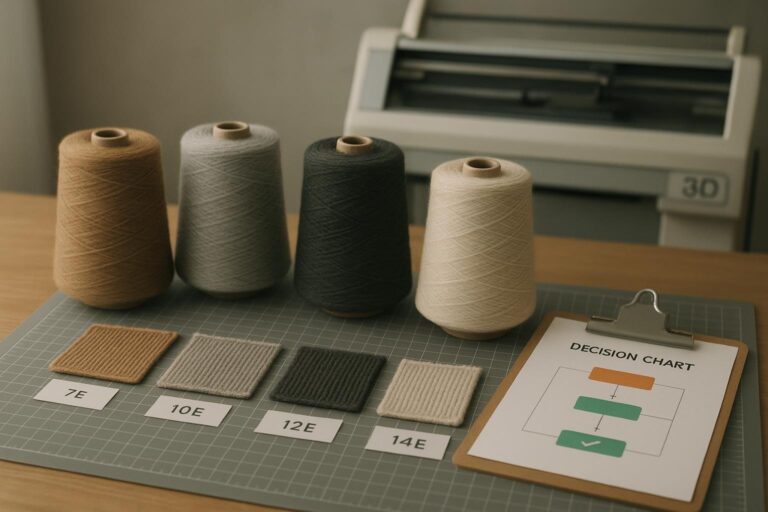

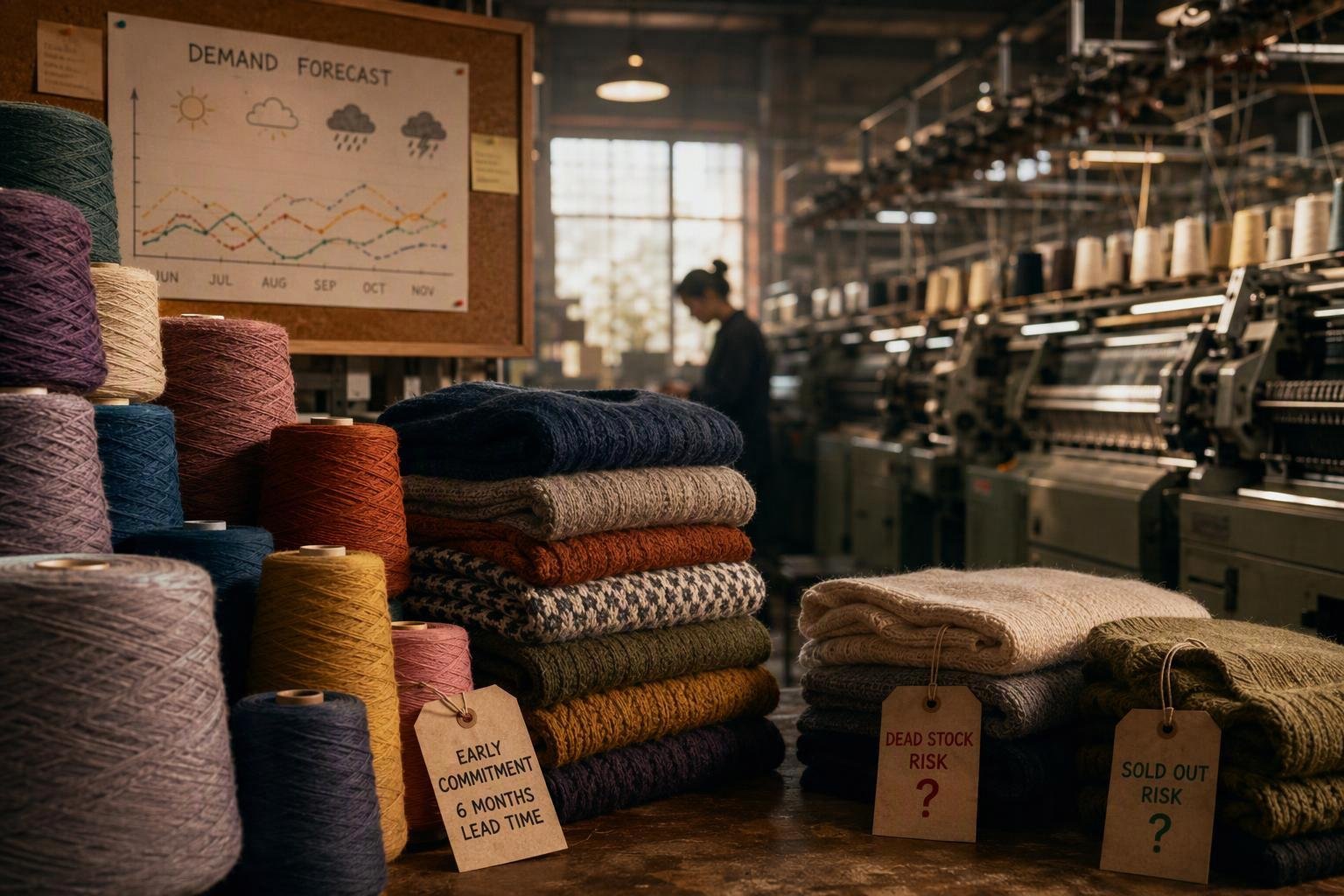
Knitwear is one of the few apparel categories where the money leaves your account before the design is even final. Yarn has to be booked, dyed and delivered before a machine can be programmed; a machine slot has to be reserved before the yarn arrives; and all of it happens months before a single customer sees the style. Guess too high and you carry dead stock through the spring markdown. Guess too low and your hero style sells out in week three, which is a quieter failure but a failure all the same.
This article sets out a stage-by-stage framework for small brands that cannot absorb either outcome. It runs from demand signal through yarn, sampling, capacity, quality control, replenishment and the supplier agreement, and the goal at every stage is identical: cap the money committed before the next piece of evidence arrives. You can run it on a spreadsheet. It will not make your forecast accurate — nothing will — but it will keep a wrong forecast from becoming a wrong season.
Lead-time ranges cited here come from a published knitwear production planning whitepaper and are planning estimates, not guarantees. Your factory’s calendar, your yarn route and your approval speed will move them.
Start With the Commitment Problem, Not the Forecast
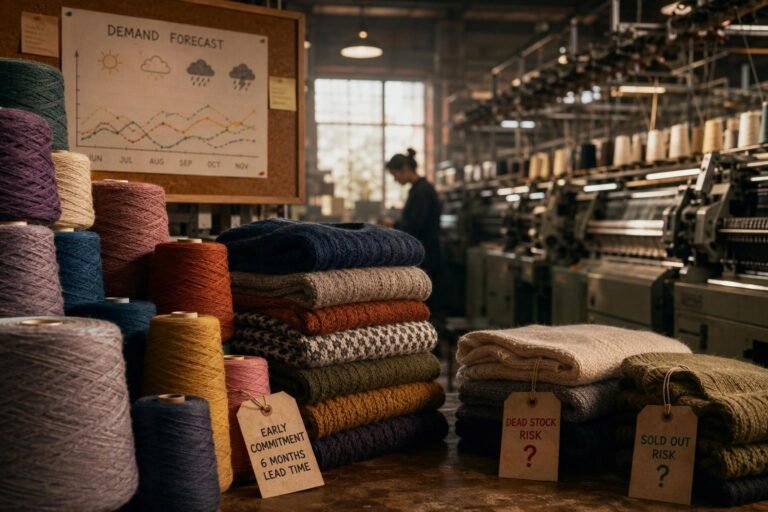
Apparel demand planning is usually framed as a forecasting problem: get the number right and everything downstream works. That framing misleads small brands, because the buy is committed six to twelve months before the demand signal exists, as Uphance’s demand-planning material puts it. By the time you have real sell-through data, the yarn is dyed and the machine slot is gone. Accuracy arrives too late to be useful.
So treat it as a commitment problem instead. You cannot control whether demand shows up; you can control how much money is locked in at each point before you know. A brand with deep pockets can buy accuracy through inventory buffers. A small brand has to buy time through sequencing.
That sequencing is the commitment ladder. Each stage of the supply chain is allowed to release only the money that the previous stage’s evidence justifies:
Demand evidence justifies a forecast, not a purchase order.
A frozen tech pack and approved sample justify a yarn booking.
A yarn booking and confirmed technical inputs justify a capacity reservation.
A capacity reservation and a passed pre-production check justify bulk release.
Sell-through against plan justifies a reorder.
The rest of this article walks up that ladder. At each rung, ask two questions: what evidence do I have, and what is the smallest commitment that evidence supports?
Stage 1: Turn Demand Signals Into a Forecast You Can Commit Against
Most small brands blend every demand input into one number and then plan against it. That destroys the most useful information they have: how much each signal is worth.
Separate signals into three tiers.
Contractual forward signals. Wholesale pre-book is the strongest thing you will get before the season. It is placed six to nine months ahead, it is contractual, it specifies style, color, size and ship window, and it is attached to a named account. It is a commitment, not a prediction — which is exactly why it deserves its own line in your plan rather than being averaged with everything else.
Soft intent. Preorders, waitlists, restock requests and email sign-ups tell you a style has attention. They do not tell you how much of it converts. Treat them as directional: useful for deciding which styles to sample and which colors to launch, not for sizing a yarn booking.
Backward-looking evidence. Sell-through is the only signal that describes what customers actually did. It is also the only one that arrives after you have already committed. Its job is to govern replenishment, not the initial buy.
Two practical rules follow.
First, keep wholesale and direct-to-consumer forecasts separate, with their confidence intact. Averaging a signed pre-book into a speculative DTC number makes the whole plan look more certain than it is, and you will commit yarn against a figure that is half guesswork.
Second, forecast at style, color and size — not at style total. A style can show 90% sell-through while the medium black is out of stock, as Uphance’s replenishment guidance notes. The aggregate number looks healthy; the SKU that drove the revenue is gone. Maintain size curves per category and per channel rather than one brand-wide default, because an oversized chunky knit and a fitted fine-gauge crew do not sell the same size distribution.
What this means for you: commit yarn money only against the confidence tier that justifies it. A signed pre-book can carry a yarn booking. A waitlist cannot.
Stage 2: Map Where Overbuy Risk Actually Sits in Knitwear
Overbuy risk in knitwear is not one number. It is four floors stacked on top of each other, and each is expressed in a different unit — which is precisely why buyers miss them.
Worked illustration, not a quote: a 200-unit, three-colour program at 300 g per garment implies 60 kg of yarn per colour before waste. Bars show the upper end of the cited planning bands for knit piqué dye minimums (100–150 kg at smaller shops, 250–300 kg commonly cited, 300–500 kg at larger mills). The binding minimum is the largest applicable upstream requirement, not the sum. Confirm every figure with your own mill and dyehouse.
Yarn purchase. Bought in kilograms, often against a garment weight estimate that is itself an estimate. A 300-gram sweater at 500 units implies 150 kg of yarn before any waste allowance.
Dye lot minimums. Set by the dyehouse in kilograms of yarn per color, not units of garments. This is the floor that surprises small brands most, because it is invisible in a garment-level MOQ conversation. The low-MOQ piqué polo checklist gives working planning bands for knit piqué: many suppliers cite roughly 250–300 kg per color, smaller shops sometimes advertise 100–150 kg, and larger mills or specialty finishes may quote 300–500 kg. Those are planning bands, not promises — they move with gauge, fiber, finish and season — but the order of magnitude is the point. A 200-unit run in a custom shade can trigger a yarn commitment several times the size of the garment order.
Per-color minimums at the garment level. Many factories apply their MOQ per colorway rather than per style, so one style in four colors costs materially more than one style in one color. The color decision is the multiplier.
Garment MOQ. The number you probably already know — and the least dangerous of the four, because it is the one everyone discusses.
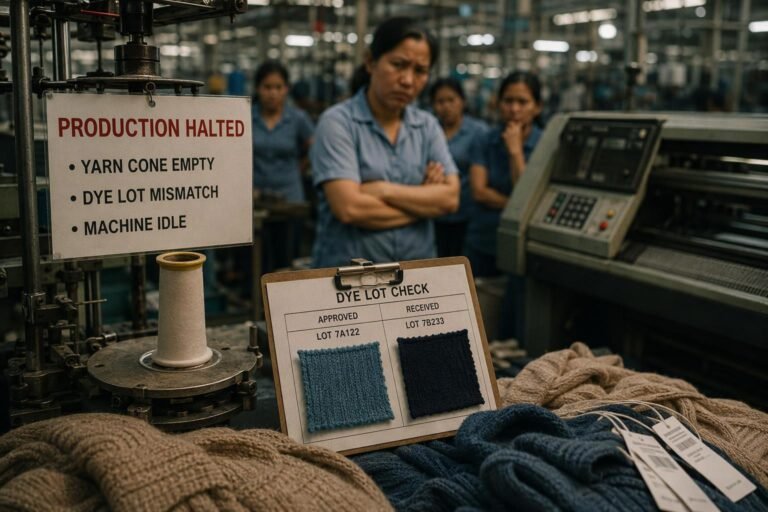
There is a second, quieter risk attached to custom dyeing: lot continuity. If a color was dyed specifically for you, a reorder from a later lot may not match. Record the lot number against the style, as YZR Sweaters’ notes on yarn minimums advise. A replenishment that arrives in a slightly different shade is not a replenishment; it is a second colorway you did not plan.
Capping tactics, one per floor:
Against dye minimums: work from stock yarns or near-neighbor shades where the design allows, and ask the mill which colors are stock before design freeze rather than after.
Against per-color minimums: launch fewer colors with more depth. Four to six colors per style per season, with real size depth, generally outperforms eight to ten colors offered shallow.
Against lot risk: agree a written fallback color before booking, so a failed lab dip does not stall the whole program.
Against garment MOQ: split the buy — a small first drop in the safest color, with a documented option on the rest.
Stage 3: Run Sampling as a Gate, Not a Formality
Sampling is where small brands lose the most calendar time for the least money, because approval is treated as a formality rather than a release decision. It is the opposite: the sample gate is the last cheap place to stop a bad order.
Define what “approved” means before the sample arrives. At minimum, the gate should close on:
Measurements and grading against an approved size specification with stated tolerances.
Construction: stitch structure, seams, linking method and finishing intent.
Color standard: the approved shade band, the light sources used to assess it (D65 daylight and TL84 store light are standard in textile assessment), and any instrument readout such as ΔE tolerance if the supplier provides one.
Yarn and shade frozen — composition, count and the exact recipe version locked for bulk.
Trims, labels and packing, including market-specific legal copy and barcode placement.
A named approver and a comment deadline, with a backup named as well.
That last item is not administrative housekeeping. The bulk-release control framework is explicit that “approved” is not binary. It defines a ladder of release states: hold (evidence missing, nothing proceeds), provisional capacity hold (planning only), material-only release (the buyer accepts the defined risk of buying or dyeing material before every gate closes), limited production release (a defined quantity or operation proceeds while open items stay visible), full bulk release, and shipment release. Using these states lets you move forward on the parts that are safe without pretending the whole order is cleared.
The cost of a slow approval is not the approval time. If a two-day approval target takes eight days, the direct overrun is six days — but the real schedule effect can be longer if the delay causes the project to miss a yarn-dyeing batch, a machine window, an inspection booking or a logistics cutoff. On a small order, missing a dye batch can mean waiting for the next one.
Sampling speed helps, but only if your side of the gate is disciplined. Xindi Knitwear runs a 3–5 day sampling turnaround from tech packs or photos; that compresses the factory’s half of the loop, not your review time. The bottleneck moves to the approver, which is why the named approver and deadline belong in the tech pack.
What this means for you: a sample you have not formally approved is not a green light. It is a hold with good intentions.
Stage 4: Reserve Peak Capacity Without Paying for Capacity You May Not Use
Peak season does not make factories slower. It makes them booked. The processing time for your style is unchanged; the queue in front of it is longer, which is why a slot confirmed in a quiet month can evaporate in a busy one.
The tool for this is the provisional capacity hold: a time-limited reservation against stated assumptions that permits planning but not production. It protects a possible slot, it does not imply a production release, and — critically — it carries an expiry date. Structure it so an unused hold lapses rather than becoming a purchase obligation. A hold that silently converts into a liability is worse than no hold at all.
Confirm live capacity only after the technical inputs are complete: approved measurements, frozen construction, defined yarn direction and a machine that fits the gauge. Reserving before those are settled protects a slot you may not be able to use.
Two calendar effects compress the runway for any brand sourcing from Asia.
The Lunar New Year window. In 2027, Lunar New Year falls on Saturday, February 6 — eleven days earlier than in 2026. Plan on a six-to-eight-week operational window rather than a single holiday week: pre-holiday slowdown begins three to four weeks before, complete shutdown clusters around late January to mid-February, and full workforce capacity typically does not return until four to six weeks after the holiday begins, since a meaningful share of workers do not return to their previous employer. For goods needed in March or April, a purchase order placed in late January simply waits for the line to be staffed again.
The working-day conversion. A factory quoting 30–45 factory working days for a standard style, or 50–75 for a complex one, is quoting production days under its own calendar — not elapsed calendar days. Converted, that is roughly 6–9 calendar weeks for the standard track and 10–15 for the complex one, before buyer approval overruns, testing, transport and customs. A quote that has not been converted through the factory calendar is not a delivery date; it is a number.
What this means for you: reserve early, reserve provisionally, and put an expiry date on the reservation. Then confirm live capacity once the tech pack is frozen, not before.
Stage 5: Place Quality Checks at the Right Stage With Written Acceptance Standards
On a 5,000-piece order, a bad batch is an expensive lesson. On a 150-piece order, it can be the whole season — which is why small brands need written acceptance standards more than large ones do, not less.
Place checks at the stages where defects are still cheap to fix:
Incoming yarn and lab dip. Verify composition, count and shade against the approved standard before knitting begins.
During knitting and linking. Watch stitch density, dropped loops, panel distortion and seam alignment as panels come off the machine, not after assembly.
In-line inspection. Catch measurement drift and finishing faults while the run is still in progress.
Final inspection. Sample against the written standard and classify defects.
Packing. Confirm labels, barcodes, legal copy and carton configuration before release.
The standard itself should be written and shared before production, not argued at inspection. That means defect classification into critical, major and minor, plus the acceptance rule for each class. Final inspection typically uses AQL sampling under ISO 2859-1 (ANSI/ASQ Z1.4 in the US), with apparel commonly applying AQL 2.5 for major and 4.0 for minor defects. At General Inspection Level II, small lots produce small sample sizes — a 150-piece lot is inspected on a handful of units, so the sample is a screen, not a guarantee. That is another reason the written classification matters: it tells both sides what happens when the screen catches something.
Test methods, specimen stage, acceptance criteria, report owner and failure action all belong in the tech pack. If a test fails, the tech pack should already say who decides, what gets reworked, and who pays.
What this means for you: a written standard is what lets a small brand reject a bad lot without a negotiation. Without one, every defect becomes a discussion about taste.
Stage 6: Replenish Proven Styles on Evidence, Not Hope
Replenishment is the operational layer between your forecast and your purchase orders. It governs core carryover styles, basics, replenishment-eligible wholesale styles and any DTC style you intend to keep on the floor for more than one season. Done well, it produces a short, defensible list of orders every week.
The reorder point is roughly average daily demand multiplied by lead time, plus safety stock. The lead time is where most brands lie to themselves. The contract says 45 days; the rolling average is 62. Use the actual. Track on-time delivery, fill rate, quality rejection rate and rolling lead time per factory, because a supplier scorecard is not a procurement nicety — it is a replenishment input.
Trigger on a set of conditions rather than a single number:
Sell-through against the planned curve for that style.
Stock depth by size and color, not style total.
Confirmed account demand, especially reorders from wholesale customers.
Remaining selling weeks in the season.
The supplier’s release cutoff — the date after which a reorder will not make the window.
Then classify the style before you chase it. Core, never-out-of-stock styles are replenished continuously against weeks of supply. Carryover styles are reordered while watching for decay. Seasonal repeats are chased only if the window allows. Fashion drops are read against plan but not reordered. Capsules and collaborations are designed to sell out — chasing one destroys the thing that made it work.
Finally, check lot continuity before you place the reorder. If the original ran on a custom dye lot, a new lot may not match, and the reorder becomes a color risk rather than a stock fix. Where continuity matters, ask what yarn is still available from the original lot before committing.
Stage 7: Write Supplier Clauses That Cap Inventory Risk
Everything above works better when it is written into the supplier agreement, because flexibility you have negotiated is flexibility you can rely on; flexibility you have been promised is a favor.
Clauses worth discussing:
Scope and exact specifications, tied to the approved tech pack and revision number, so “the order” has a defined meaning.
Change control after approval. Any change to measurement, stitch, trim or color should trigger a written cost and date impact before it is accepted. Without this, a small spec change quietly becomes a schedule change.
Confidentiality covering designs, forecasts, launch dates, pricing and supplier contacts, with access limited to workers and subcontractors who need it.
Rework at the manufacturer’s cost, with a clear definition of what counts as a defect.
Acceptance and inspection terms, referencing the written standard and the failure action.
Payment terms tied to milestones and inspection, so final payment can be held against a passed inspection rather than released before the problem is found.
Release-state language matching the commitment ladder — material-only release, limited production release, provisional capacity hold with an expiry date — so partial progress is contractual rather than informal.
This is guidance on what to raise with a supplier, not legal advice. Where the order value or the IP exposure is significant, have a lawyer review the agreement.
Putting the Framework on One Page
Run this view weekly. Each row is a stage, the money it can release, the evidence that permits it, and the cap that keeps it small.
Stage | What it commits | Evidence gate | Cap |
|---|---|---|---|
Demand signal | Forecast only | Pre-book, soft intent, sell-through, kept separate | No purchase commitment |
Yarn | Kilograms per color | Frozen tech pack, approved shade, lot recorded | Stock or near-neighbor shades; fallback color agreed |
Sampling | Sample and lab-dip cost | Measurements, construction, color standard, named approver | Release state: hold until all gates close |
Capacity | A time-limited slot | Technical inputs complete, gauge confirmed | Provisional hold with an expiry date |
Quality | Inspection and rework time | Written defect classes and acceptance rules | Checks placed before defects get expensive |
Replenishment | A reorder | Sell-through vs. plan, size/color depth, remaining weeks, release cutoff | Actual rolling lead time; lot continuity checked |
Contract | Legal commitment | Signed terms matching the ladder | Release states and change control in writing |
The through-line is simple: every stage exists to keep the next commitment smaller than the evidence behind it. When a row has no evidence, the answer is not a bigger buffer. It is a smaller commitment.
Key Takeaways
Commit against confidence tiers, not blended forecasts. Keep wholesale pre-book and DTC estimates separate, and forecast at style, color and size.
Know each overbuy floor. Yarn is bought in kilograms, garments in units, and dye minimums sit in between — a small garment order can still trigger a large yarn commitment.
Treat sampling as a gated release. Name the approver, set the deadline, and use release states rather than a binary “approved.”
Reserve capacity provisionally, with an expiry date. Confirm live capacity only after the tech pack is frozen, and let unused holds lapse.
Write QC standards before production. Defect classes, acceptance rules and failure action belong in the tech pack, not in the inspection conversation.
Replenish on actual lead time and lot continuity. Use the rolling average, not the contract number, and check the dye lot before reordering.
Put flexibility in the contract. Change control, confidentiality, rework terms and release-state language turn a favor into a term.
Conclusion and Next Step
Surviving peak demand is a sequencing discipline, not a forecasting triumph. The brands that come through a peak season intact are rarely the ones that predicted it best; they are the ones that kept each commitment small enough that a wrong guess cost them a style rather than a season.
Start with the stage where your exposure is largest. For most small knitwear brands that is the yarn and dye decision, because it is the earliest and least reversible. Before the next design freeze, ask your supplier which colors are stock, what the per-color minimum is in kilograms, and what the fallback color would be if the lab dip does not converge.
If you want to test the sampling gate before committing a season to it, request swatches or a sample against your tech pack and run your own approval process on it — named approver, written deadline, documented release state. And if your launch date is fixed, confirm current capacity windows before you lock it, since availability depends on your gauge, your finishing route and where your date falls against the factory calendar.
Frequently Asked Questions
How far ahead should a small knitwear brand place a peak-season order?
About three months before you need goods on the shelf as a working minimum, and four if the date is fixed. That breaks down as roughly ten days for sampling, forty to fifty days for production once the sample is approved, and freight on top — about five to eight days by air or three to six weeks by sea. Add your own approval time, which is the part most brands underestimate, and then add two weeks of slack. Complex or custom-dyed programs need longer, and the Lunar New Year window compresses the runway for anything sourced from Asia.
Can I order a small quantity in a custom color, or will dye minimums block me?
Dye minimums are expressed in yarn weight, not garments, so a small garment order can still trigger a large yarn commitment. Working planning bands for knit piqué run from roughly 100–150 kg per color at smaller shops to 250–300 kg commonly cited and 300–500 kg at larger mills, varying with gauge, fiber and finish. Ask the mill which shades are stock, consider a near-neighbor Pantone, launch fewer colors, and confirm the minimum before design freeze rather than after.
What is the difference between a capacity hold and a production release?
A provisional capacity hold protects a possible slot for planning only, against stated assumptions and an expiry date. Production release requires the technical and approval gates to be green — or a defined limited release for a specified quantity while open items stay visible. An unused hold should expire rather than become a purchase obligation.
Which quality standard should I specify for a small production run?
AQL sampling under ISO 2859-1 (ANSI/ASQ Z1.4 in the US), with apparel commonly using AQL 2.5 for major and 4.0 for minor defects. Note that small lots yield small sample sizes at General Inspection Level II, so written defect classifications and a clear failure action matter as much as the AQL number itself.
How do I reorder a proven style without overbuying?
Use your actual rolling lead time in the reorder point rather than the contracted number, and trigger on size and color stock depth, sell-through against the planned curve, confirmed account demand and remaining selling weeks. Check dye-lot continuity so the reorder matches the original shade, and confirm the supplier’s release cutoff before you commit.
What should a supplier agreement include to protect flexibility?
Scope tied to the approved tech pack, written change control with cost and date impact, confidentiality covering designs and forecasts, rework at the manufacturer’s cost, inspection and acceptance terms, and release-state language that lets material or limited production proceed while open items stay visible. For high-value agreements, have a lawyer review it.