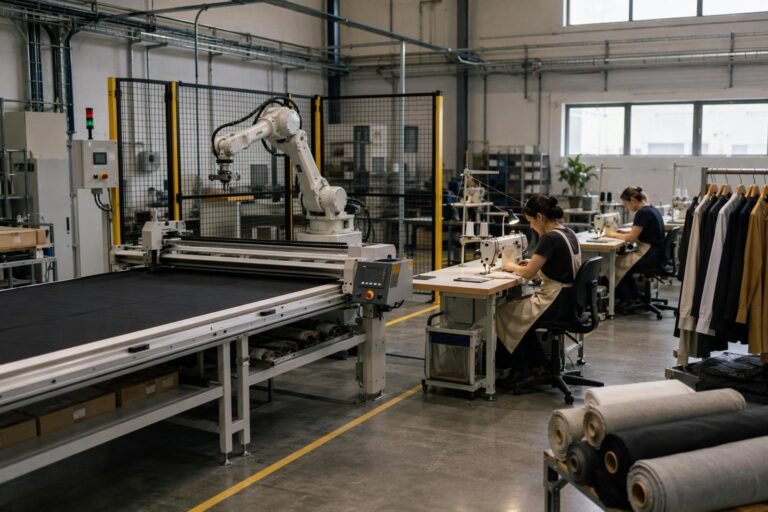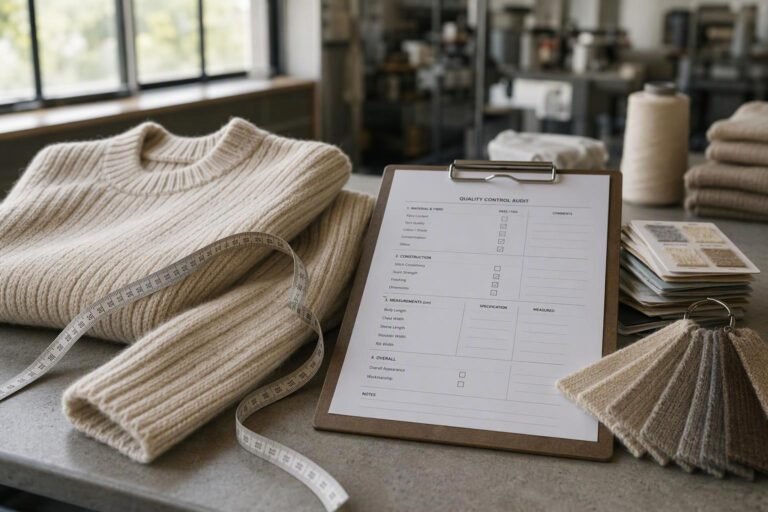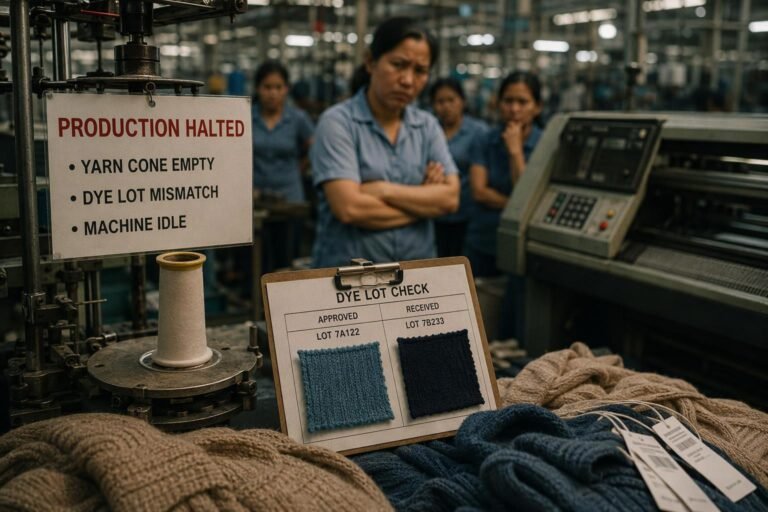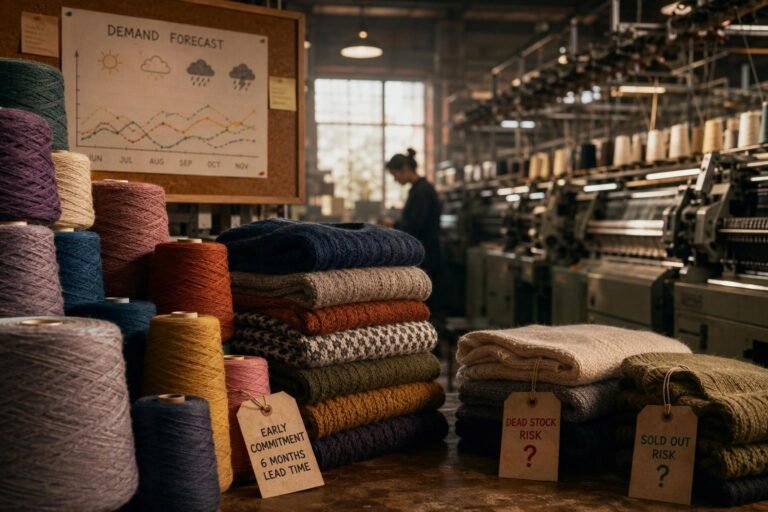

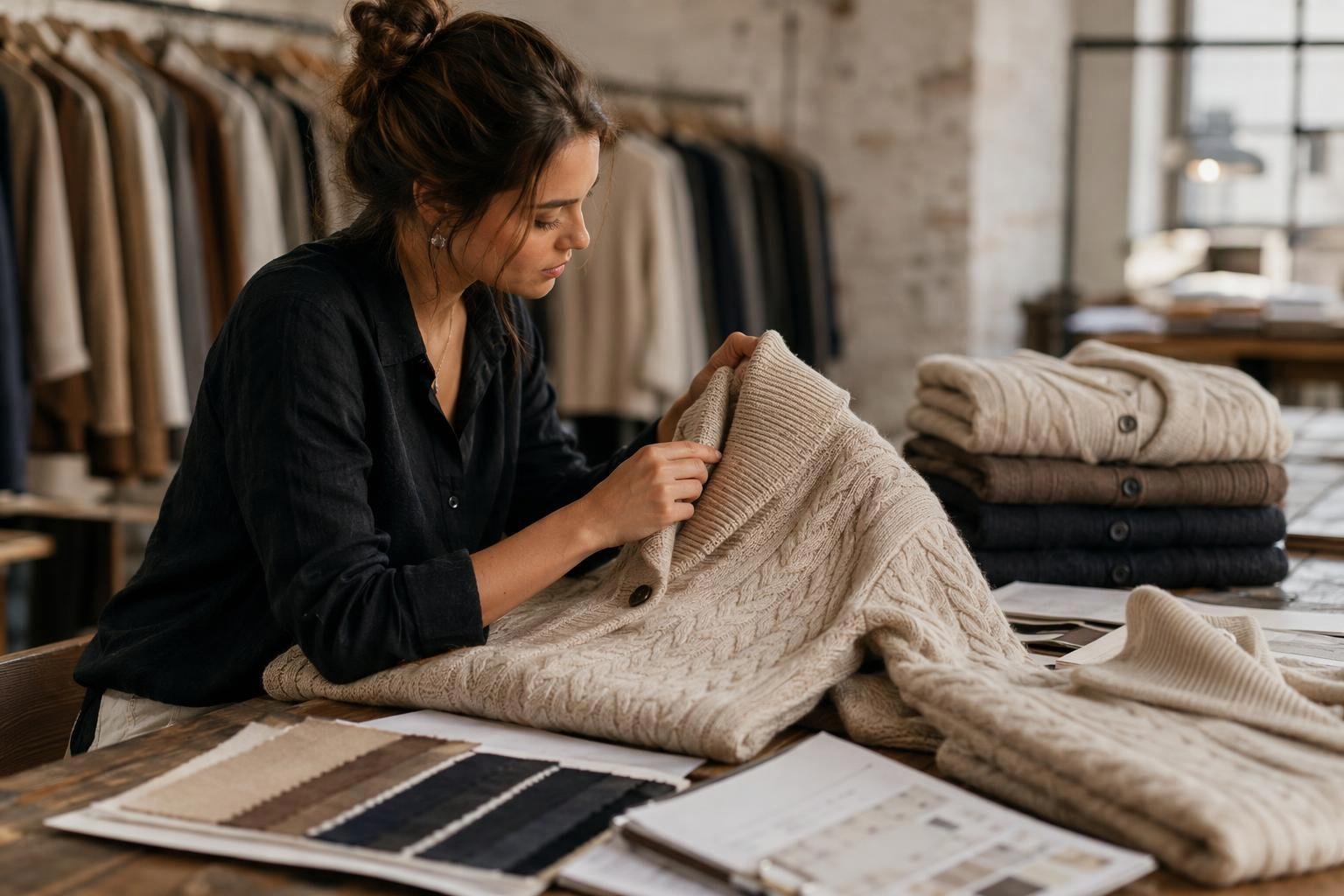
A shawl collar sweater is a bad place to save money on the wrong line item. The body is a straightforward knit; the collar is a piece of engineering. It has to roll evenly from shoulder to shoulder, hold its depth down the front opening, survive a wash and a week on a hanger, and still look intentional at the top button. A factory that can knit a clean crewneck may have no reliable method for any of that.
That is why the shortlist should be built around four things — collar engineering, MOQ structure, certification evidence and labeling responsibility — rather than around the lowest FOB number in your inbox. This guide gives you a repeatable way to evaluate any wholesale shawl collar sweater supplier: what to define before you contact anyone, what to ask, which documents answer each question, and which answers are genuine deal-breakers rather than negotiating points.
Start With Your Own Requirements, Not the Supplier List
Factories quote against what you tell them. Vague briefs produce quotes that cannot be compared, and the supplier that looks cheapest is often the one that assumed the least. Answer these questions in writing before your first outreach.
What is your landed-cost ceiling, not your FOB target? Work backward from the retail price you can actually hold. Landed cost includes freight, duty, testing, labeling and the cost of your own time managing the order. A quote that looks 15% lower but excludes testing and freight is not lower.
How many styles and colorways per drop? One style in three colors is a very different order from three styles in one color each. Color count drives minimums more than unit count does (see the cost section below).
Which size range and which market? A US women’s XS–XL run, an EU 34–44 run and an Asian sizing run need different grading work and different base-size fit approval. Decide which markets you are actually selling into, and say so.
Which yarn family? Wool, merino, cashmere, cotton, or a recycled blend each change the collar’s behaviour, the price and the certification path. A shawl collar in a soft, low-recovery cotton will not hold the same roll as one in a resilient worsted wool.
Is certification a stockist requirement or a nice-to-have? If a retailer or marketplace requires OEKO-TEX or GOTS documentation, that requirement filters your shortlist immediately — some factories can supply it, some cannot.
What is your launch date, and what does it imply? Work backward: bulk delivery date, minus production lead time, minus sample approval and any revision round, minus shipping. If the arithmetic leaves no room for one sample revision, your timeline is the constraint, not the supplier.
What this means for you: every answer above removes candidates. A brand needing certified organic cotton in three colorways at 50 units each is shopping in a much smaller pool than a brand needing a wool-blend sweater in one color. Knowing which pool you are in stops you wasting weeks on factories that were never viable.
Read the Tech Pack Before You Read the Quote
A quote is only comparable to another quote if both are answering the same specification. The specification lives in the tech pack, and for a shawl collar the tech pack has to say more than “shawl collar cardigan.”
Gauge is the needle density of the knitting machine. On V-bed (flat-bed) machines it is expressed as needles per inch; on straight-bar fully-fashioned machines the convention is needles per 1.5 inches. The Woolmark Introduction to Knitwear manual sets out gauge-to-yarn-count pairings for both machine types — for example, a 7-gauge V-bed is paired with Nm 10/2–14/2 yarn, while a 12-gauge V-bed pairs with Nm 24/2–32/2. Gauge and yarn count must match: a yarn too thick for the needle spacing over-stresses the needles and produces dropped stitches, while a yarn too fine gives a loose, flimsy fabric. Because the two conventions differ, your tech pack must state which machine type and which gauge convention it uses, or two factories will quote two different garments.
Knit structures, in one line each:
Jersey — a single-faced plain knit; smooth, relatively lightweight, the default body stitch.
Rib — alternating knit and purl columns; stretchy and elastic, which is why it is the standard choice for a shawl collar band.
Milano — a double-knit structure with a firm, stable hand and less curl; often used where a cleaner, more structured surface is wanted.
Fully-fashioned panels — panels knitted to shape on the machine rather than cut from a rectangle, giving cleaner edges and less waste.
How the collar is made. There are two common routes. In the first, the collar is knitted as an integral extension of the front panels, so the roll is formed by the shaping itself. In the second, a rib collar is knitted separately and linked on at the neckline. Both can produce a good garment; the difference is where the risk sits. An integral collar depends on panel shaping and blocking discipline; a linked-on collar depends on the rib tension and the quality of the join, especially at the centre back.
Roll is how the collar folds back on itself — the curve that gives a shawl its shape. Lapel depth is how far the collar extends down the front opening. Both need a number in the tech pack, measured at defined points, with a tolerance. Without them, “shawl collar” is an opinion.
What this means for you: if your tech pack does not state machine type, gauge, yarn count, collar construction, roll and lapel depth with tolerances, you are not comparing quotes — you are comparing guesses.
Evaluation Criteria: What Actually Predicts a Good Shawl Collar Supplier
Score every candidate against the same questions, and ask for the document or sample that answers each one. A verbal yes is not evidence.
Collar engineering capability. Ask: how do you control rib tension on the collar, and how do you set the roll? Evidence: a photo or sample of a comparable shawl collar they have produced, plus a description of their steam-set or blocking step. Linking equipment matters here — Woolmark notes that a linker is the standard machine for attaching collars and shoulder seams, using stitch-for-stitch linking for a neat, compact seam.
Sampling speed and iteration policy. Ask: how long is a first sample, and how many revision rounds are included? Evidence: a written sampling timeline and a clear statement of what triggers a re-quote.
MOQ structure. Ask: what is the minimum per style, per color and per size? Evidence: a written MOQ schedule, not a single headline number.
Yarn sourcing and dye-lot handling. Ask: which mill supplies the yarn, and how do you handle shade variation between dye lots? Evidence: the mill name and a stated dye-lot policy. A supplier unwilling to name the mill is a supplier you cannot audit.
Measurement tolerance discipline on collar dimensions. Ask: what tolerance do you hold on collar depth and band length? Evidence: a measurement spec with points of measure and tolerances, agreed before sampling.
QC checkpoints and collar inspection method. Ask: at which stages is the collar checked, and against what reference? Evidence: a QC plan naming the checkpoints and the inspection views for the collar.
Communication and change control. Ask: who is my contact, what are their working hours, and what happens if I change a spec after sample approval? Evidence: a named contact and a written change-control step — revised spec, revised quote, revised timeline.
Pricing transparency. Ask: is this FOB or landed, and what is excluded? Evidence: an itemised quote showing yarn, knitting, linking, finishing, trims, testing and packaging separately.
What this means for you: the pattern across all eight is the same. The supplier who answers with documents is the supplier who has done this before and expects to be checked. The one who answers with reassurance is asking you to take the risk.
Understand the Cost and MOQ Drivers
Two quotes for “the same” sweater can differ by a wide margin without either factory being dishonest. Understanding what moves the number lets you read a quote instead of reacting to it.
What drives the minimum order quantity
Color count. Each colorway needs its own yarn dye-lot, and dye-lots have minimums at the mill. Three colors can triple the effective minimum even if total units stay flat.
Size grading. A wider size range means more pattern work and more grading checks; a single-size run is cheaper to set up but rarely sellable.
Machine setup. Each style and gauge combination needs its own machine setup and tension calibration.
Small dye-lots. Below a mill’s standard lot size, you pay a surcharge rather than a discount.
What drives unit cost
Yarn type and micron. Finer micron and specialty fibres cost more per kilo; the collar’s yarn consumption multiplies that.
Gauge and machine time. Finer gauges knit more slowly per panel; heavier gauges use more yarn.
Collar yarn consumption. A shawl collar adds noticeable weight at the front of the garment — it is a second layer of knitting across the chest and neckline, not a trim.
Fully-fashioned versus cut-and-sew. Fully-fashioned panels reduce cutting waste but take longer on the machine because stitches must be transferred to shape the panel; Woolmark notes that this shaping slows knitting compared with plain cut-and-sew panels.
Linking and finishing labour. A linked-on collar and linked shoulder seams are skilled hand-fed operations.
Trims and buttons. Buttons, toggles and plackets are small line items that add up across a run.
Testing and certification. Harmful-substance testing, fibre testing and certificate administration carry real costs, and they are frequently the item quietly missing from a cheap quote.
What this means for you: if a quote is below your other quotes, find out which of the above it has assumed away before you treat it as a saving. And if your budget is tight, restructure the order rather than squeezing the price: fewer colors with more units per color usually lowers the effective minimum and the per-unit cost at the same time.
What Each Certification Actually Covers — and What to Request
Suppliers often list certificates as a block of logos. Each one covers something different, and the document you need is specific.
Scheme rules as published by each certifier; thresholds are minimums for making a claim, not quality grades. A logo on a hangtag is not a certificate — request the certificate number, scope and expiry, and confirm the version in force with the certifier.
OEKO-TEX STANDARD 100 tests finished textiles and their components for harmful substances against a list of over 1,000 substances, and it is organised into product classes by skin contact — Class 1 is the strictest, mandatory for babies and toddlers; Class 2 covers products with direct skin contact; Class 3 covers products without direct skin contact; Class 4 covers home textiles and decoration. Which class applies depends on how the sweater is intended to be worn, so confirm that the class named on the certificate matches your intended use. Request: the certificate number, the product class, the scope (does it name the actual yarn or the finished garment?) and the expiry date. OEKO-TEX also runs a modular system in which testing costs for the finished product can be waived if all components have already been tested — useful to know, but it does not replace the certificate itself.
GOTS (Global Organic Textile Standard) covers certified organic fibre content plus environmental, chemical and social criteria across every certified processing step. Every company involved in processing a GOTS product must be certified, and the standard uses physical segregation and volume reconciliation rather than mass balance. It has two label grades: “organic” requires at least 95% organic fibre content, and “made with (x%) organic materials” requires at least 70%, in both cases excluding accessories. Request: the GOTS licence number of the certified entity, the label grade the finished sweater qualifies for, and confirmation that each processing step in your supply chain is certified.
RWS (Responsible Wool Standard) addresses sheep welfare and land management, with chain-of-custody certification through the supply chain — farms, mills and manufacturers are audited, while retailers selling to consumers are not required to be certified. Products may contain 100% certified wool or blends from 5% to 99%, but only products containing 100% certified wool may carry the RWS logo. Request: the scope certificate for the wool and the transaction certificates linking your yarn back to certified farms.
OEKO-TEX MADE IN GREEN and STeP cover different ground again: MADE IN GREEN identifies products tested for harmful substances and manufactured under sustainable and socially responsible conditions, while STeP certifies production facilities rather than products. Neither substitutes for a STANDARD 100 certificate on the garment.
What this means for you: a logo on a website is marketing. A valid certificate number with a scope that names your yarn or your garment, and an expiry date that covers your production window, is evidence. Ask for the document, not the badge.
US Labeling Obligations for Imported Sweaters
If you are the importer of record, the labeling obligation is yours, not your factory’s. Confirm each item with your supplier before the goods ship.
Fibre content. Under the Textile Fiber Products Identification Act and the Wool Products Labeling Act, the label must state the generic names and percentages by weight of constituent fibres present in amounts of 5% or more, in order of predominance, with any “other fibre” disclosure last. Fibres under 5% are handled under the specific rule for small quantities. Wool, cashmere, mohair, camel, alpaca, llama and vicuna may be named as specialty fibres instead of “wool,” provided the percentage of each is given. See 16 CFR Part 303 and 16 CFR Part 300.
Country of origin. For a wool product with a neck, the country-of-origin label must be affixed to the inside centre of the neck, midway between the shoulder seams or close to another label in that position, and the country of origin must appear on the front of the label. Fibre content and the manufacturer or dealer identity may appear on the same label or on another conspicuous, readily accessible label.
Manufacturer or importer identification. The label must carry the name of the manufacturer, importer or other responsible business, or a Registered Identification Number (RN).
Care labeling is a separate rule enforced by the FTC, so confirm it is handled as its own item rather than assumed to be part of the fibre label.
The FTC’s Threading Your Way Through the Labeling Requirements is the plain-language starting point. Note also that US Customs and Border Protection has country-of-origin marking requirements separate from the Textile and Wool Acts, and both apply.
What this means for you: ask your supplier in writing who holds the importer identity on the label, and get confirmation that the care label rule is being handled separately. Getting this wrong is a customs problem, not a design problem.
Red Flags and Deal-Breakers
Not every friction point is a reason to walk away. Separate the two lists before you start negotiating.
Deal-breakers
No collar-specific measurement spec or tolerance. Question: “Can you send your points of measure and tolerances for collar depth and band length?” Acceptable answer: a spec sheet with defined points and tolerances. Unacceptable: “we make it to your measurements” with nothing attached.
No verifiable certificate documentation. Question: “Can you send the certificate number, scope and expiry for the yarn you are proposing?” Acceptable answer: the documents. Unacceptable: a logo or a link to a certificate that does not name your material.
Unwillingness to name the yarn mill or state a dye-lot policy. Question: “Which mill supplies this yarn, and how do you handle shade variation between lots?” Acceptable answer: a named mill and a stated policy. Unacceptable: deflection.
Quotes that omit testing or freight. Question: “Is this FOB or landed, and what is excluded?” Acceptable answer: an itemised quote. Unacceptable: a single number with “everything included” and no breakdown.
No defined change-control process after sample approval. Question: “If I change a colour or a measurement after approval, what happens to price and lead time?” Acceptable answer: a written process. Unacceptable: “we’ll sort it out.”
Preferences worth negotiating
Sampling fees (often creditable against bulk — ask).
Payment terms and deposit percentage.
Packaging customisation and hangtag production.
What this means for you: the deal-breakers all share one feature — they remove your ability to verify. A supplier who will not let you check the collar, the certificate or the price basis is asking you to carry the risk alone. The preferences are commercial terms; negotiate them, but do not confuse them with capability.
How to Use the Criteria to Decide
With the criteria in hand, the decision becomes a sequence rather than a feeling.
1. Score the shortlist against the must-haves. Use the eight criteria above. A candidate that fails on collar engineering, certificate evidence or change control drops out regardless of price.
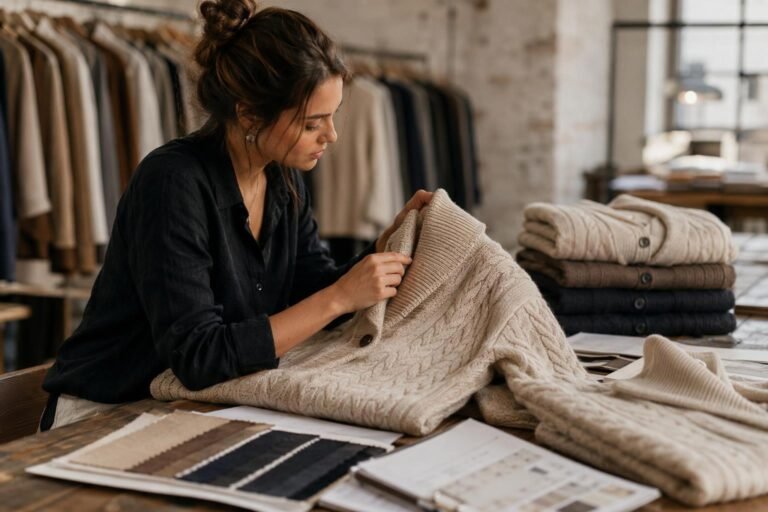
2. Order a sample and let it rest. A shawl collar that looks crisp straight off the press can open up, flatten or twist after a few days on a hanger — the weight of the collar itself contributes, especially in heavier gauges. Evaluate roll and lapel depth after the garment has rested, and compare against the approved spec rather than against a photograph. Agree the washing, drying and rest conditions with the supplier before you compare results, and agree the inspection views and sampling plan for production so a freshly pressed piece is not the only reference.
3. Request the certificates and a labeling confirmation. Certificate numbers, scope and expiry for the actual yarn or garment; written confirmation of who holds the importer identity and that care labeling is handled separately.
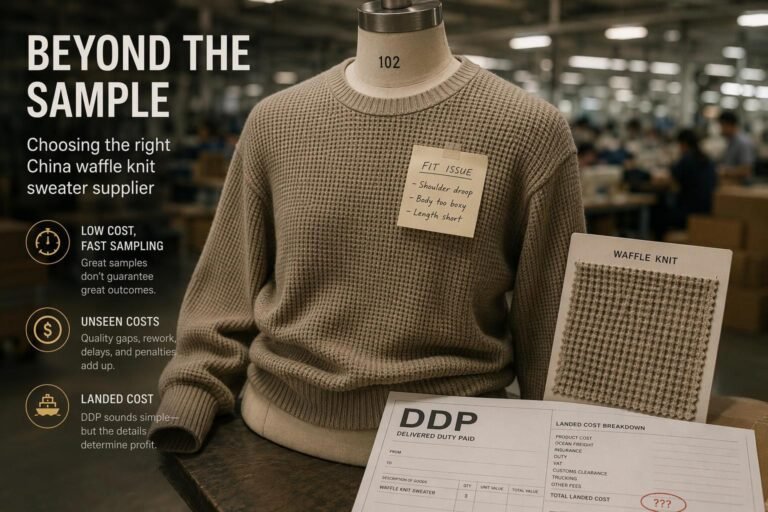
4. Compare landed cost at your real order structure. Not at a hypothetical 1,000 units — at your actual style count, colour count and size range, with freight, duty and testing included.
5. Commit in stages. Swatches in the target yarn, then a sample in the target gauge, then bulk. Each stage is a cheap way to find out something expensive later.
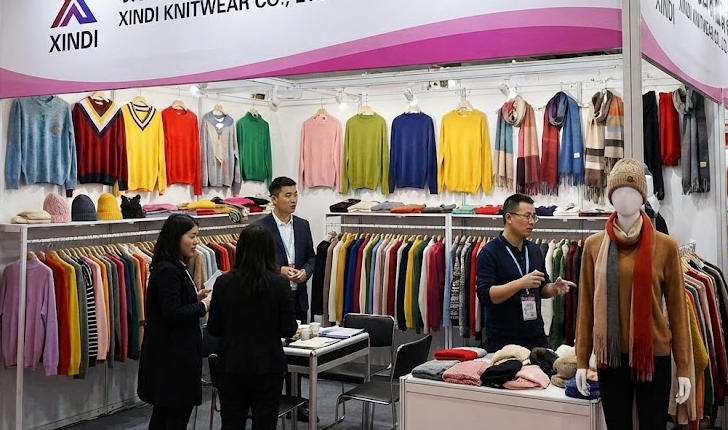
If you are sourcing a shawl collar programme at low volume, Xindi Knitwear (Knitwear.io) runs shawl neck cardigan OEM production from its Dalang factory, with collar engineering built around controlled rib tension and steam-set finishing, gauges from 7G to 12G, and a stated low MOQ of 50 units for startup brands. Its custom cardigan range lists 2–5 day sampling and OEKO-TEX and GOTS certified yarn options. Treat those as claims to verify with the same questions above — request the certificate scope and a rested sample before you commit.
Key Takeaways
The shawl collar, not the body, is where supplier quality shows — evaluate collar engineering first.
Define gauge, knit structure, roll and lapel depth in the tech pack so quotes are comparable.
MOQ and cost are driven by colour count, dye-lots, yarn and collar construction, not by a single unit price.
Ask for certificate numbers and scope, not logos; OEKO-TEX, GOTS and RWS each cover different things.
US fibre-content and origin labeling are the buyer’s obligation to confirm before import.
Frequently Asked Questions
What gauge should a shawl collar sweater be knitted in?
Gauge follows the hand-feel and collar structure you want. Mid-gauge — roughly 7G to 12G on V-bed machines — is common for structured shawl collars, because it gives enough body for the roll to hold while staying wearable. Finer gauges read cleaner and lighter; heavier gauges add bulk and weight. The tech pack must state the machine type as well as the gauge, because V-bed gauge is counted per inch and straight-bar gauge per 1.5 inches.
How is a shawl collar attached, and why does it matter for quality?
Either as an integral extension of the front panels, or as a separately knitted rib collar linked on at the neckline. With a linked-on collar, the join at the centre back and the rib tension determine whether the collar rolls evenly or collapses; with an integral collar, panel shaping and blocking do the same job. Ask which method the factory uses and inspect the centre-back join on the sample.
Which certifications should I ask a shawl collar sweater supplier for?
OEKO-TEX STANDARD 100 for harmful-substance testing on the finished garment (check the product class), GOTS if the fibre is certified organic (check the licence number and label grade), and RWS if the wool is claimed as responsible wool (check the scope and transaction certificates). For each, request the certificate number, scope and expiry, and confirm whether it covers the actual yarn or the finished sweater.
What drives the minimum order quantity for a shawl collar sweater?
Colour count, dye-lot minimums at the mill, size grading and machine setup. Each colourway needs its own dye-lot, so three colours can triple the effective minimum even at the same total unit count. Restructuring the order — fewer colours, more units per colour — usually lowers the effective minimum.
What labeling must an imported sweater carry in the US?
Fibre content by generic name and percentage in order of predominance; country of origin, which for a garment with a neck must be on a label at the inside centre of the neck with the origin on the front; and the manufacturer, importer or RN. Care labeling is a separate rule. See 16 CFR Part 303 and the FTC labeling guidance.
How do I check collar quality on a sample?
Let the garment rest for a few days after pressing, then assess roll and lapel depth against the approved spec rather than against a photo. Agree the washing, drying and rest conditions with the supplier before comparing, check the centre-back join and linking tension, and agree the inspection views and sampling plan so production is judged on a rested piece, not a freshly pressed one.