
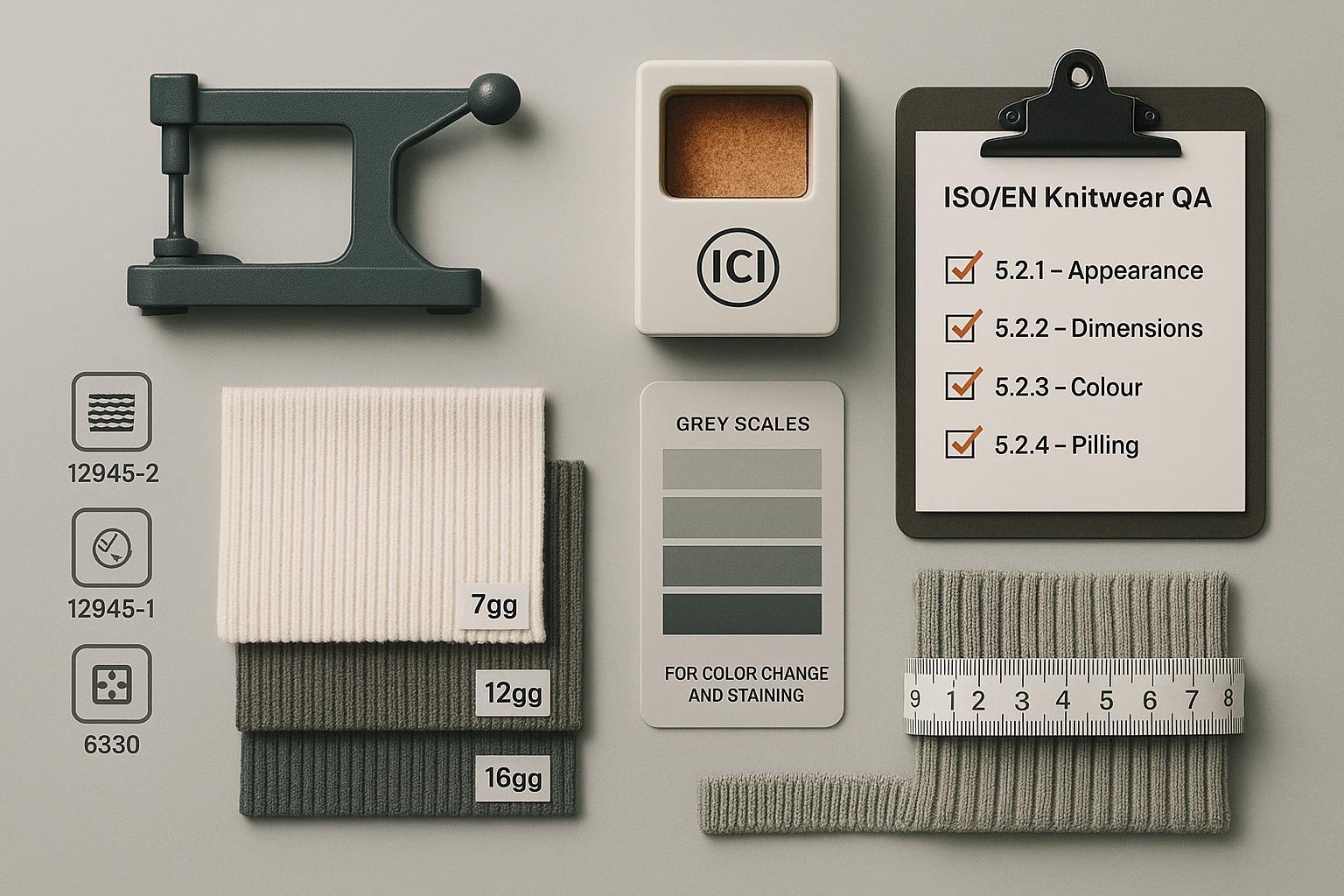
Pilling is the number one reason sweater returns spike. If you’re building a knitwear line, you can prevent most of those headaches by locking down a few ISO/EN lab tests, documenting acceptance thresholds, and carrying them through to your AQL inspections. This checklist prioritizes pilling, then covers colorfastness and dimensional stability, using the EU/UK standard framework.
As a quick refresher, pilling grades run from 5 (no change) to 1 (severe pilling). In practice, many brands target Grade ≥3–4 at the final evaluation point, with premium programs pushing for Grade ≥4 at 5,000 Martindale cycles. Where specific buyer manuals are private, we mark these as typical practice guidance and cite public sources for methods.
Key takeaways
For most sweaters, run the ISO 12945-2 Martindale pilling test at 2,000 and 5,000 cycles; set acceptance at Grade ≥3–4 at the final cycle for mass-market, ≥4 for premium (typical practice; confirm per buyer).
For loose/soft and WHOLEGARMENT knits, include ISO 12945-1 (ICI pilling box) at 2,000 revolutions as a baseline; consider it primary where Martindale under-represents tumbling wear.
Colorfastness minimums commonly used: ISO 105-X12 Dry ≥4; Wet ≥3 for dark-on-light risk; ISO 105-C06 change/staining ≥4 where feasible (or 3–4 for deep shades with approval).
Dimensional change after ISO 6330 laundering: Length/width ≤3% for most knits (≤2% premium, ≤5% some mass-market). Record torque/skew.
Carry lab thresholds into production with ISO 2859-1 sampling; default General II with AQL 2.5 majors/4.0 minors; tighten to 1.5 majors for high pilling risk styles.
Quick checklist — development to bulk
Below is a one-page view of what to test, when, and the working targets most brands align on. Targets labeled “typical practice” must be confirmed by your buyer.
Phase | Test | Method (ISO/EN) | When to run | Acceptance target (typical practice) | Owner |
|---|---|---|---|---|---|
Development | Pilling (flat abrasion) | ISO 12945-2 Martindale | Proto yarn/fabric and 1st proto garment | 2,000 and 5,000 cycles; Grade ≥3–4 at final; premium ≥4 | QA with lab |
Development | Pilling (tumbling) | ISO 12945-1 ICI pilling box | Same as above; especially for loose/soft/WHOLEGARMENT | 2,000 rev; Grade ≥3–4 | QA with lab |
Development | Rubbing colorfastness | ISO 105-X12 | Shade approval for darks/contrasts | Dry ≥4; Wet ≥3 (dark-on-light risk) | QA |
Development | Wash colorfastness | ISO 105-C06 | Shade approval | Change ≥4; Staining ≥4 (deep shades 3–4 with approval) | QA |
Development | Laundering/Dimensional change | ISO 6330 + ISO 5077 | 1st proto, then confirm at SMS | L/W ≤3% (≤2% premium; ≤5% mass) | QA |
Pre‑Production | Pilling confirm | ISO 12945-2 and/or 12945-1 | On PP garment from approved trims/finish | Same as dev targets | QA + merch |
Pre‑Production | Rubbing/Wash CF confirm | ISO 105-X12/C06 | PP garment (dark/contrast) | Same as dev targets | QA |
Pre‑Production | Stability confirm | ISO 6330 + 5077 | PP garment | Within tolerance; no excessive torque | QA |
Bulk | Spot verification | Critical tests above | First bulk lot; then by risk | Match PP benchmarks | QA + inspector |
Bulk | AQL inspection | ISO 2859-1 | Inline + final | General II; AQL 2.5 major/4.0 minor (tighten to 1.5 major for high-risk pilling SKUs) | QA + third-party |
Lock your ISO 12945-2 Martindale pilling test thresholds for knitwear
Pilling is the surface defect that drives the most complaints. For knits, you should specify ISO 12945-2 (Martindale) parameters clearly: abradant wool fabric over felt, conditioning per ISO 139 (20°C ±2°C; 65% RH ±2%), and evaluation at agreed checkpoints. Equipment makers confirm ISO 12945-2 as the standard Martindale pilling method for apparel; see the James Heal Martindale overview in the Martindale Motion brochure and SDL Atlas’s Martindale guide for apparatus details and abradants.
Apparatus and consumables: wool abradant over felt on a Martindale pilling plate; replicate circular specimens; standard light for grading. References: the James Heal Martindale materials in the Martindale Motion brochure and the SDL Atlas Martindale brochure describe the setup and consumables.
Cycles and acceptance: evaluate at 2,000 and 5,000 cycles for most sweaters; accept Grade ≥3–4 at the final stage (premium ≥4). This is typical practice; confirm in the buyer’s manual. A peer‑reviewed study under EN ISO adoption notes Grade 3 as acceptable at 2,000 rubs for knitted fabrics, offering a public benchmark for context.
Grading and records: use 1–5 visual scale with half grades allowed; average across replicates and train graders against photographic standards. Capture photos with grey scales in a light box at each checkpoint.
Authoritative references:
James Heal Martindale Motion brochure (apparatus and 12945-2 positioning): see the manufacturer’s Martindale Motion document in 2025.
SDL Atlas Martindale brochure (abradant/felt notes): the manufacturer’s Martindale brochure explains abradants and maintenance.
Public academic example of acceptable grades: see Sekulska‑Nalewajko et al. (2020), which cites acceptable knit thresholds under PN‑EN ISO 12945-1/‑2.
ICI pilling box (ISO 12945-1) for loose, soft, and WHOLEGARMENT knits
The ICI method simulates random tumbling better than flat abrasion in airy or seamless constructions. Use cork‑lined boxes and mount tubular specimens on polyurethane tubes. Run at 2,000 revolutions as a baseline and target Grade ≥3–4. Replace cork liners regularly and ensure tubes are clean to avoid artificial snagging. Equipment makers like James Heal (Orbitor) and SDL Atlas (RotaPill) provide method-compliant setups and consumables.
Helpful references for setup and consumables:
James Heal Orbitor overview (cork‑lined pilling/snaggings tester) describes the test chamber and accessories.
SDL Atlas pilling tester brochure (RotaPill) outlines method alignment and maintenance tips.
Colorfastness you can’t skip (ISO 105)
For returns tied to dye transfer or shade change, lock these in early:
Rubbing — ISO 105-X12
Most apparel programs require Dry ≥4, Wet ≥3 when dark garments may contact light colors. Method and grading are widely documented by labs; for example, Intertek’s colorfastness testing overview and QIMA’s method guide explain how X12 works and how staining is graded.
Washing — ISO 105-C06 (paired with ISO 6330 procedures)
Simulate household laundering with reference detergents and evaluate color change/staining on the 1–5 grey scales (ISO 105-A02/A03). Aim for Change ≥4 and Staining ≥4 where feasible; deep shades may accept 3–4 with buyer approval. See QIMA’s colorfastness guide and Intertek’s overview for accessible method explanations.
Dimensional stability after ISO 6330 laundering (with ISO 5077)
Shrinkage, growth, and torque turn into poor fit and returns. Use ISO 6330 washing/drying procedures paired with ISO 5077 measurement. As working tolerances: keep length/width change within ≤3% for most knits (≤2% premium, ≤5% some mass-market). Record skew and torque, and agree on blocking/relaxation steps before measurement. For context on the wash standard, see the ISO page for ISO 6330 and the James Heal explainer.
For how finishing and blocking influence stability, see Knitwear.io’s article on Knitwear Finishing & Assembly for practical factory steps.
From lab thresholds to AQL on the line (ISO 2859-1)
Your lab targets only matter if your inspection plan enforces them. Use ISO 2859-1 sampling. Many programs default to General Inspection Level II with AQL 2.5 for majors and 4.0 for minors and then tighten to majors 1.5 for high-risk styles (very soft hand, loose gauge, dark shades).
Map typical lab-related nonconformities like this:
Failure at lab/verification | On-garment manifestation | Defect class suggestion | AQL note |
|---|---|---|---|
Pilling grade below acceptance at specified cycle/rev | Visible pills/fuzz after light wear or hand rub | Major | Count against AQL majors (2.5 default; 1.5 when tightened) |
ISO 105-X12 Wet below buyer minimum on dark-on-light ensemble | Dye transfer to light fabric | Major | Count against AQL majors |
ISO 105-C06 staining/change below acceptance | Shade change/bleeding | Major | Count against AQL majors |
Dimensional change beyond tolerance or excessive torque | Off measurements, twisting seams | Major | Count against AQL majors |
Minor surface fuzz increase but still within grade band | Slight handle change only | Minor | Count against AQL minors (4.0) |
If you’re building or reviewing a production QA plan, this deeper walkthrough on Quality Assurance & Inline Production Control at Knitwear.io details how to combine inline checks and final AQL at the factory.
WHOLEGARMENT and special cases
Seamless and loose-gauge knits behave differently. Think of Martindale as a flat abrasion proxy and ICI as a tumbling proxy. For very open stitches or 3D structures, ICI often better mirrors real use. Agree the primary method with the buyer, specify pre‑conditioning (ISO 139) and whether to test pre‑ and/or post‑wash, and document any anti‑pilling finish. When you choose finishes, pair pilling tests with colorfastness verification so finishes don’t inadvertently reduce dye fastness. For fiber and yarn decisions that reduce pilling risk upfront (long-staple, higher twist, balanced blends), see Knitwear.io’s Cashmere Yarn Guide & OEM Production Requirements.
Example: masked lab report → final AQL pilling check
Disclosure: Xindi Knitwear (Knitwear.io) is our product.
A typical workflow we see: a masked third‑party lab report for ISO 12945-2 shows 5,000 cycles with mean Grade 3–4 on a 12gg wool/nylon blend; photos at 2,000/5,000 confirm consistent grading. The PP seal references the same target and sets an inline “hand rub” visual checkpoint. At final inspection, the AQL plan (General II; majors 2.5) classifies any observed pilling equivalent to <3 at the agreed wear proxy as a major defect. This aligns the sealed lab benchmark with the on‑floor decision rule, reducing interpretation gaps. For a broader view of checkpoints you can embed, see the Knitwear QC Guide on Knitwear.io.
Troubleshooting quick notes
Failing Martindale at 2,000 cycles (Grade 2–3): review yarn twist and blend; add or optimize anti‑pilling finish; re‑test both Martindale and ICI to confirm no colorfastness trade‑offs.
Passing Martindale but failing ICI: loosened structure sensitivity—consider knit density or switch primary method to ICI for approvals.
Wet rubbing failures on darks: adjust dye/after‑wash; target ISO 105-X12 Wet ≥3 for dark-on-light risk.
Shrinkage over tolerance: revisit relaxation/blocking, washing parameters (ISO 6330 type and drying), and stitch density; confirm with ISO 5077 measurements.
Inconsistent grading across replicates: re‑condition per ISO 139 and retrain graders; replace worn abradants or cork liners.
References (selected)
Apparatus and ISO 12945-2 scope: see the manufacturer’s Martindale Motion overview from James Heal and the SDL Atlas Martindale brochure for abradant/felt notes.
Public method explainers: Intertek’s overview of colorfastness testing and QIMA’s guide to ISO 105-X12/C06 provide accessible summaries of procedure and grading.
Laundering procedures: ISO’s page for ISO 6330 describes domestic washing and drying procedures; James Heal’s explainer offers practical context.
Academic example of acceptable pilling grades under EN ISO: Sekulska‑Nalewajko et al. (2020) outlines knit thresholds at specific rubs/revs.
AQL methodology context: QIMA’s AQL explainer summarizes ISO 2859‑1 sampling in apparel.
External references (inline anchors in article text):
James Heal Martindale Motion brochure (2025)
SDL Atlas Martindale brochure
Intertek colorfastness overview
QIMA colorfastness guide
ISO 6330 page
Sekulska‑Nalewajko et al., 2020 (PMC article)
QIMA AQL explainer
Closing — want the templates we referenced?
If you’d like a sample masked lab report (ISO 12945‑2/12945‑1, ISO 105‑X12/C06, ISO 6330 + ISO 5077) and a matching inbound/final QC checklist with AQL targets, request the pack from Xindi Knitwear. We’ll share a redacted set you can adapt to your program.
Quality Assurance & Inline Production Control | Knitwear Finishing & Assembly | Cashmere Yarn Guide & OEM Production Requirements
Sources cited inline:
James Heal — Martindale Motion brochure (apparatus; ISO 12945‑2 positioning): https://performance.james-heal.co.uk/sites/default/files/brochures/2025-04/00822_MARTINDALE_MOTION_STK-12-20250430.pdf
SDL Atlas — Martindale brochure (abradants/felt): https://sdlatlas.com/public/content/product_brochures/Martindale_ENG_NEW_lowres.pdf
Intertek — Colorfastness testing overview: https://www.intertek.com/textiles-apparel/colorfastness-testing/
QIMA — Colorfastness methods (ISO 105-X12/C06): https://blog.qima.com/textile/colorfastness-test-methods-for-textiles-guide
ISO — ISO 6330 page: https://www.iso.org/standard/75934.html
Sekulska‑Nalewajko et al., 2020 (public, peer‑reviewed): https://pmc.ncbi.nlm.nih.gov/articles/PMC7374317/
QIMA — AQL acceptable quality limit (ISO 2859‑1): https://www.qima.com/aql-acceptable-quality-limit