
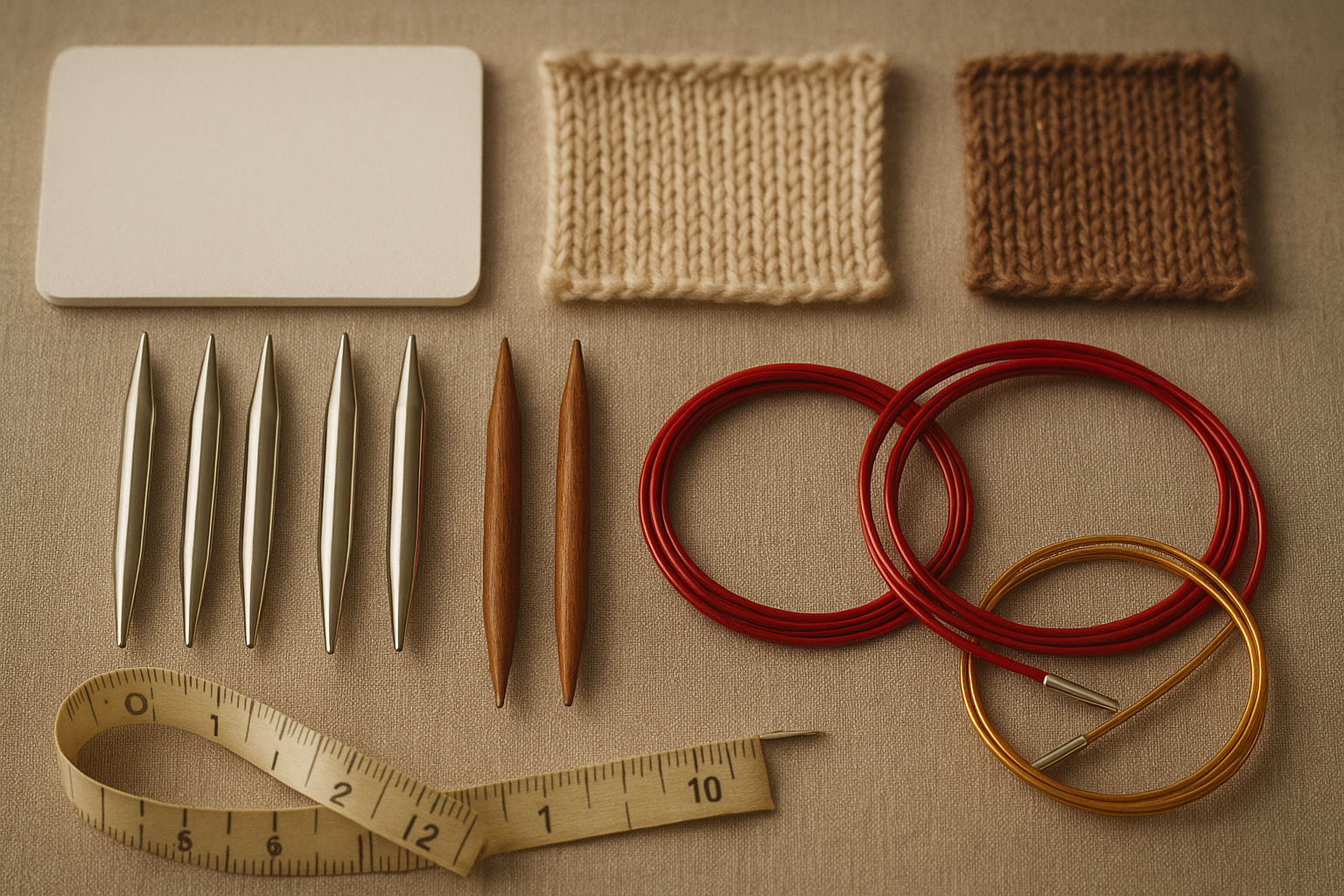
If you knit DK and worsted swatches to lock a spec (stitch pattern, hand feel, washed gauge), your needle system isn’t a cute accessory—it’s part of your process control.
When joins loosen, cables kink, or tip length is wrong for the circumference, your tension drifts. That drift turns into a brutal waste: swatches that should’ve been “measure → approve → move on” become “re-knit → re-measure → argue about what changed.”
This ranked list is built for one job: help you buy a system that covers 3.5–8.0 mm, includes short tips, and supports a 24–60 inch cable kit you can actually use in real-life sampling.
Key takeaways (read this before you spend):
The fastest way to reduce re-swatch cycles is choosing a system with stable joins + low-memory cables. Those two variables affect tension more than most people admit.
Short tips are not just “short needles.” They often require short cords, and some brands label cord length as finished circular length including tips.
If you want one system to span 3.5–8.0 mm, check whether the brand splits sizes across different join families (you may need two cable families).
Terms I’m using (so we don’t talk past each other):
Short tips: usually ~3″–3.5″ tip length, for smaller circumferences (sleeves, necklines, hats).
Cable length: some brands sell the cable length itself; others label the total finished circular length (cable + 2 tips).
SEO note (because people search this way): if you’re specifically hunting for a “short tip interchangeable needle set” and want “interchangeable knitting needles 3.5mm to 8mm” with a “24 inch 32 inch 40 inch 60 inch knitting needle cable” kit, this guide is written for that exact coverage window.
How this list is ranked (so you can trust it):
Coverage (3.5–8.0 mm)
Short-tip path
Cable kit reality (24–60″)
Consistency factors (memory + join security)
US availability for replacements
Rank | System | Best for | 3.5–8.0 mm coverage | Short tips | 24–60″ cables | Join style | Biggest watch-out |
|---|---|---|---|---|---|---|---|
1 | ChiaoGoo TWIST | Lowest cable “fighting” + repeatable gauge | Yes (Small + Large join families) | Yes (Shorties/short options) | Yes (example math supports 60″) | Screw + tightening key | Learn join families (Small vs Large) |
2 | Addi Click | Fast setup + join security | Yes (by set selection) | Yes (Rocket short tips) | Yes (short cords sold up to 60″) | Click-lock | Cord length labels include attached tips |
3 | KnitPro / Knitter’s Pride | Value + huge ecosystem | Often yes (verify set) | Often yes (line-dependent) | Often yes (verify cable SKUs) | Screw + key | More cable memory in some lines |
4 | Knit Picks Options | Budget entry + easy US replacements | Often yes (verify set) | Varies by set | Often yes (verify long cords) | Screw + key | Needs routine tightening |
5 | LYKKE (short-tip wood sets) | Warm wood feel + small circumference | Partial (set-dependent) | Yes | Mixed (great at 16–24″ out of box) | Screw + key | Confirm long cables before committing |
Pro Tip: If your workflow involves measurement gates, treat “cable behavior” like a spec variable. Changing cables mid-development can change your tension enough to trigger a re-swatch.
1) ChiaoGoo TWIST Interchangeable System
Best for: the most repeatable swatching experience—especially if you do lots of magic loop, long-cable work, and you hate fighting coil memory.
Why it ranks #1 for DK + worsted coverage
Two things make ChiaoGoo a strong “process tool” choice:
The system is unusually transparent about how lengths work. A retailer chart shows the math for finished circular lengths—for example, a 50″ TWIST cable can produce a 60″ circular with 5″ tips. That’s exactly the range you want when you’re doing body swatches, long tubes, or extended magic loop: TWIST cable lengths and finished circular sizes (example chart).
ChiaoGoo documents its join families and adapters clearly on the official site, which matters when you’re trying to cover a wide size range without ordering the wrong parts: ChiaoGoo’s TWIST interchangeable system (official specs).
Size coverage check (3.5–8.0 mm)
ChiaoGoo splits tips/cables by join family:
Small: covers your core DK-to-worsted work up through 5.0 mm.
Large: picks up at 5.5 mm and runs into heavier sizes.
So yes, you can cover 3.5–8.0 mm in one ecosystem—but you may own two cable “families.” That’s not bad. It’s just a buying reality you want to understand before you build your kit.
Short-tip path
ChiaoGoo offers short-circumference options (Shorties/short combos). That’s useful for sleeves, necklines, and any swatch that needs you to stay close to the final knitting ergonomics.
Cable kit path (24–60″)
If your cable kit needs to span 24–60″ in a predictable way, ChiaoGoo is one of the easiest systems to build because the length math is well-published.
What could go wrong (and how to prevent it)
Join-family confusion: if you order random cables without checking Small vs Large, you’ll end up with parts that don’t match.
Screw joins still need tightening: use the key, and re-check before you start any swatch you plan to measure and lock.
Why it helps reduce re-swatch cycles
If your swatch is going to be measured, photographed, archived, and referenced, you want “boring” repeatability. A stable cable + secure join reduces micro-variables that show up as inconsistent tension.
2) Addi Click (Rocket + short tips)
Best for: designers who want a secure connection without tightening keys—and don’t want to stop mid-swatch to troubleshoot a loosening join.
Why it ranks #2
Addi’s Click system is built around a click-lock connection. The big win is fewer “my join loosened halfway through” moments—one of the most common causes of tension drift.
The other win is clarity around labeling. Addi cord packaging typically reflects the total finished circular length including tips, and Addi sells cords specific to tip length (short vs regular). That explanation is laid out clearly in how Addi Click cord lengths are labeled (includes tips).
Size coverage check (3.5–8.0 mm)
Many Addi Click sets live in the DK-to-worsted zone. Confirm the exact sizes in the set you’re buying; the system can cover your target range, but set contents vary.
Short-tip path
Addi short tips are a real system choice, not an afterthought.
Cable kit path (24–60″)
A major plus: Purl Soho sells Addi Rocket short cords in lengths from 16″ to 60″, and notes that the labeled length includes attached tips: Addi Click short cords (16–60 inches).
What could go wrong
Cord compatibility: short cords are designed around short tips. Don’t assume every cord works with every tip length.
Why it helps reduce re-swatch cycles
If you eliminate “connection drama,” you eliminate a frequent reason swatches come out inconsistently even when yarn and pattern didn’t change.
3) KnitPro / Knitter’s Pride (choose the line you actually like using)
Best for: solid value, a huge ecosystem, and easy add-ons—especially if you’re buying for a small team and want replaceable parts without overthinking it.
Size coverage check (3.5–8.0 mm)
Many sets cover the full 3.5–8.0 mm band, but not all. Verify contents before you buy.
Short-tip path
Short tips exist in some lines, and some shops carry them more reliably than others. Treat “short tips available?” as a pre-purchase gate.
Cable kit path (24–60″)
KnitPro/Knitter’s Pride typically offers multiple cable styles, including swivel variants. Long-cable availability depends on the specific cable product line and the retailer.
What could go wrong
Cable memory: some cable types retain curl more than steel-core systems, which can subtly change your tension.
Screw joins loosening: it’s not a deal-breaker—just a habit. Tighten at setup and before measurement-critical swatches.
Why it helps reduce re-swatch cycles
The main advantage here is operational: parts are easy to replace and expand. If a cable fails mid-development, you can keep your tooling consistent rather than swapping to a totally different system.
4) Knit Picks Options (budget-friendly, very serviceable)
Best for: a low-friction entry into interchangeables with easy US replenishment, especially if you want a “good enough” system that you can upgrade later.
Size coverage check (3.5–8.0 mm)
Many Knit Picks Options sets cover most of this range; confirm your exact set.
Short-tip path
Short-tip offerings vary. Confirm availability before you assume sleeves/necklines will be comfortable.
Cable kit path (24–60″)
Longer cords may be available, but treat it as “verify before buying” if 60″ is a hard requirement.
What could go wrong
Screw-join systems can loosen if you don’t tighten them properly. If you’re swatching to measure, build a simple routine: tighten → knit → re-check → measure.
5) LYKKE short-tip wood sets (comfort pick)
Best for: knitters who want warm, grippy wood tips—especially if metal makes your hands tense up and that tension affects your stitch size.
Why it’s ranked lower for strict “coverage” needs
Lykke short-tip sets can be great for small circumferences. The risk is the long-cable side: if your kit needs 32–60″ regularly, confirm availability before you commit.
If you’re buying for a development workflow, lack of replacement parts (or long cords) forces you to switch tools—exactly the kind of change that triggers re-swatching.
How needle material changes gauge (and why it matters for swatches)
Needle material changes friction, and friction changes tension. Modern Daily Knitting explains this clearly in How Needle Material Affects Gauge.
Practical translation for DK/worsted sampling:
If your yarn is slippery (silk blends, some superwash): wood can stabilize tension and reduce accidental loosening.
If your yarn is grippy or hairy: slicker metal can reduce drag and make stitch size more consistent.
If you do lots of cables/increases/decreases: a sharper tip can reduce split-yarn mistakes that distort stitches.
Key Takeaway: The most “repeatable” needle is the one that makes your tension boring. Boring is good when you’re locking a spec.
Next steps with the best interchangeable knitting needle set for DK and worsted coverage
If you’re trying to reduce sampling churn, pair consistent tools with a simple spec discipline:
Pick your base system (ChiaoGoo TWIST for cable behavior, Addi Click for join security, or an ecosystem/value system).
Confirm the full 3.5–8.0 mm band is actually covered in the set(s) you’ll buy.
Add short tips if you knit sleeves/hats/necklines.
Build a cable kit that includes 24, 32, 40, and 60 inches (or the equivalent using that brand’s labeling rules).
Make join checks part of the routine before you knit and before you measure.
If you want to reduce swatch rounds for a collection, it also helps to lock “what counts as approved” early (target gauge, yarn spec, finishing method, and measurement conditions). That’s the same mindset behind Xindi Knitwear’s quick sampling workflow.
And when you’re ready to move from hand swatches into a production plan, Xindi’s tech pack, gauge, and fit approval checklist and sampling timeline and freeze packet can help you prevent last-minute rework.
Soft next step: If you share your target gauge, yarn spec, and the stitch patterns you’ll test (e.g., rib + cable + jersey), Xindi Knitwear can suggest a sampling plan that minimizes avoidable re-swatches—without changing your design intent.