
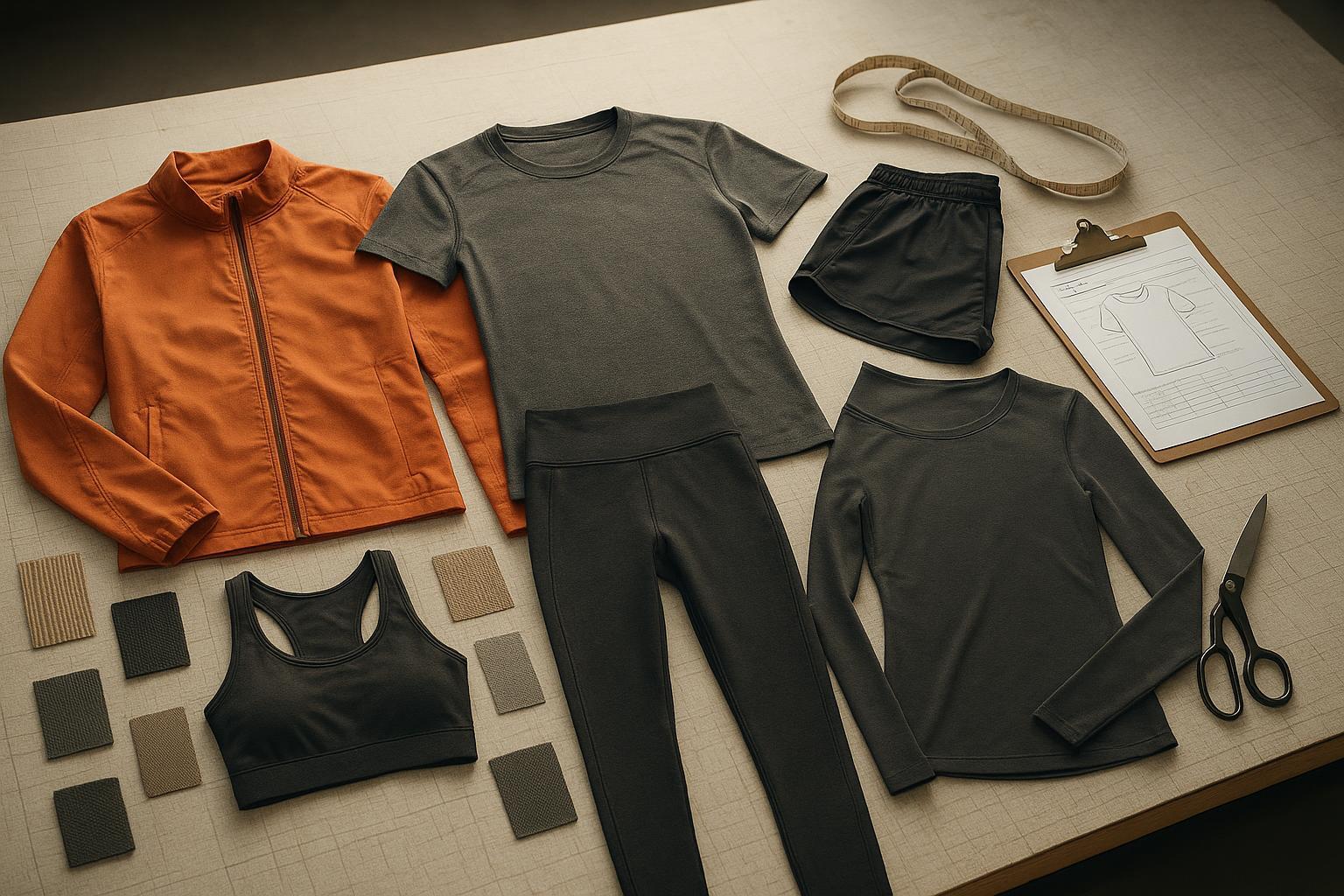
If you’re building a sportswear line, “types of sportswear” isn’t just a list of leggings and tees. It’s the category system you’ll use to:
build a clean assortment plan (so your line sheet makes sense)
brief your factory (so sampling doesn’t turn into 4 rounds of preventable edits)
cost consistently (so you can compare styles without guessing)
Below is a practical taxonomy you can copy into your PLM, plus a manufacturing lens (knit vs woven, seams, finishes) that helps you spec products clearly.
Key takeaways
Sportswear is easiest to organize in two layers: by garment type and by use case (this is the most practical way to map different activewear categories).
Most close-to-body performance pieces are knits; most shell/outer pieces are wovens.
If you standardize a few spec attributes (fabric construction, stretch/recovery, seam type, finishes), your sampling loop gets dramatically cleaner.
Types of sportswear: two ways to classify the category
Most brand teams end up using both systems—because they answer different questions.
1) Classify by garment type (how your product line is built)
This is your merchandising backbone:
Tops
Bottoms
Base layers
Outerwear
Accessories
2) Classify by use case (why the customer buys it)
This is how customers shop and how you story-tell drops:
Training
Running
Team sports
Outdoor/adventure
Swim
Winter sports
Key Takeaway: Use garment type for PLM and costing. Use use case for collection naming, merchandising, and PDP language.
The core sportswear categories (by garment type)
According to the general definition, sportswear is athletic clothing worn for sports and exercise—ranging from tees and tracksuits to sport-specific garments like swimsuits and ski suits.
Here’s the practical breakdown you can actually build from.
If you’re setting up your PLM, you can literally use these as your top-level sportswear categories.
Tops
Common subcategories (US-friendly naming):
Performance tees (short sleeve / long sleeve)
Tanks
Jerseys (team or training)
Hoodies / sweatshirts (performance fleece, French terry, etc.)
Half-zip / quarter-zip pullovers
Sports bras (women’s)
Compression tops
What this means for you: tops are where your “handfeel” and brand identity show up first, but they’re also where pilling, shrinkage, and seam irritation can quietly kill reviews.
Bottoms
Common subcategories:
Leggings / tights
Bike shorts
Training shorts
Running shorts (often with liner)
Joggers / sweatpants
Track pants
Skorts (women’s)
Compression bottoms
What this means for you: bottoms are where fit tolerances, stretch recovery, and seam placement matter more than clever design details.
Base layers
Base layers are usually close-to-skin pieces designed to manage moisture and temperature:
Thermal tops
Thermal leggings
Compression base layers
Base layers are often treated as their own category in outdoor/winter systems.
Outerwear
Common sportswear outerwear subcategories:
Lightweight shells (windbreaker / rain shell)
Training jackets
Insulated jackets (puffer, synthetic fill)
Vests
Outerwear is where woven fabrics often dominate (more on that below).
Accessories
Depending on your brand scope, this can include:
Socks
Hats / caps / beanies
Gloves
Headbands
Bags
If you plan to private label accessories, define whether accessories are “soft goods only” (socks, beanies) or includes bags.
Types of athletic wear (sportswear by use case)
Consumer guides commonly group sportswear by activity—for example, team sportswear, compression wear, swimwear, and winter sportswear (see one example list at ApparelnBags: Types of Sportswear). That’s useful, but emerging labels need one extra step: translating “use case” into repeatable product specs.
Training (gym + studio)
Typical assortment:
tees/tanks
leggings/bike shorts
sports bras
hoodies/joggers (warm-up)
Spec priorities:
squat-proof opacity (for bottoms)
seam comfort (no chafe)
stretch + recovery (does it bag out?)
Running
Typical assortment:
performance tees
lightweight shorts (often woven) + liner (often knit)
tights (knit)
shells/windbreakers (woven)
Spec priorities:
ventilation mapping (mesh panels)
secure pocketing (bounce-proof)
reflectivity placement
Team sports
Typical assortment:
jerseys
shorts
warm-up sets (tracksuits)
socks
Spec priorities:
abrasion resistance
colorfastness (numbers/logos)
repeatability for reorders
Outdoor/adventure
Typical assortment:
base layers
mid-layers
shells
Spec priorities:
layering compatibility (don’t spec bulky seams)
weather resistance expectations (be precise: “water repellent” vs “waterproof”)
Swim
Typical assortment:
swimsuits/bikinis
rash guards
wetsuits (if you go that technical)
Spec priorities:
chlorine/salt resistance
stretch recovery
lining and opacity
Winter sports
Typical assortment:
thermal base layers
insulating mid-layers
outer shells
Spec priorities:
warmth-to-weight
moisture management
wind resistance
Knit vs woven sportswear: the decision rule that saves time
If your team keeps debating “is this knit or woven?”, make it simpler:
Choose knit when you need stretch, comfort, and movement.
Choose woven when you need structure, shape retention, and abrasion resistance.
A clear overview of the core differences is summarized in sources like Taas: Woven and knit fabrics and a sportswear-specific framing like Sportek’s knit vs woven sportswear comparison.
Quick mapping: what’s usually knit vs woven
Usually knit: leggings, tights, base layers, compression tops, sports bras, performance tees
Usually woven: running shorts, windbreakers, shells, many training pants, outer layers
Reality check: plenty of categories mix both. Running shorts are a classic example (woven outer short + knit liner).
The spec attributes to standardize (so sampling doesn’t spiral)
If you’re an emerging label, your biggest enemy isn’t “bad factories.” It’s ambiguous specs.
Here are the attributes that prevent endless revisions.
1) Fabric construction (not just fiber content)
Don’t stop at “nylon/spandex.” Add the construction:
Jersey
Interlock
Rib
Tricot
Mesh
French terry
Fleece
What this means for you: two fabrics with the same fiber blend can behave completely differently if the construction changes.
2) Stretch + recovery (how it behaves after wear)
Write it down in measurable terms (even simple ones):
stretch direction (2-way / 4-way)
target feel (compressive vs soft)
recovery expectation (e.g., “should not bag out at knee after wear”)
3) Seam construction (comfort vs durability vs finish)
Activewear seams aren’t decoration—they’re performance.
Flatlock/flatseam: reduces bulk and chafing; great for close-to-skin seams
Coverstitch: strong, stretchy hems and topstitching
Overlock/serged: fast construction and edge finishing
Bonded/welded: minimal bulk and fewer needle holes (good for clean finishes and some technical outerwear)
Pro Tip: For close-to-skin bottoms (leggings, tights), seam placement matters as much as seam type. If a seam crosses a high-friction zone, even “premium” stitching can still irritate.
4) Performance finishes (and how you’ll prove them)
Common claims include moisture-wicking, quick-dry, UPF, DWR, and anti-odor. The mistake is treating these as vibes instead of testable properties.
A practical reminder of why testing matters (especially for moisture-wicking) is discussed in Backpacking Light’s testing-focused explanation.
How to keep your claims honest:
match each claim to a test report (fabric or finished garment)
document what was tested, when, and under what conditions n- avoid absolute language like “odor-free” or “waterproof” unless you can support it
A factory-brief checklist for sportswear sampling
If you send this before sampling, you reduce “guesswork sampling” (and the cost that comes with it).
Tech pack with measurements + graded spec
Fabric construction + GSM + composition
Trim package (elastic, drawcord, zipper, labels)
Seam construction callouts (where flatlock/coverstitch/bonding applies)
Artwork files + placement (and how they’re applied: print, heat transfer, embroidery)
Performance finish requirements + what documentation you expect
Fit notes + wearer intent (compressive vs relaxed)
Change control: one place to track revisions and approvals
What this means for you: most sampling delays aren’t “slow factories.” They’re unclear decisions made too late.
FAQ
What’s the difference between sportswear and activewear?
In practice, people use the terms interchangeably—especially in the US. Sportswear is often defined broadly as clothing worn for sports and exercise (plus sport-specific items), while “activewear” sometimes implies modern performance fabrics and athleisure styling. The important part for development is choosing the right category system and specs.
If you’re building a line, treat “sportswear vs activewear” as a labeling choice, not a product-development decision: your fabric, fit, construction, and testing plan should be driven by use case.
Is athleisure a type of sportswear?
It’s a styling direction more than a construction category. Athleisure often borrows sportswear silhouettes but may prioritize everyday comfort and aesthetics over sport-specific performance.
What are the most common sportswear categories for a small brand to start with?
Start with 1–2 hero use cases (often training + running) and build a tight assortment across tops and bottoms. Add outerwear and accessories only when you can support consistent reorders.
Next steps (if you’re building a knit-based sportswear line)
If your sportswear assortment includes knit-heavy pieces (base layers, warm-ups, engineered knits), it helps to align early on construction and sampling expectations.
For sourcing and evaluation, start with a clear OEM checklist like this guide on Xindi Knitwear.
If you’re exploring seamless or engineered knits for performance or warm-up layers, see how 3D knitting and WHOLEGARMENT can change construction choices.
If you need a reference point for fabric behavior, this overview on knit vs woven fabric is a useful internal explainer.
Soft CTA: If you share your planned categories (tops/bottoms/outerwear) + 3 hero styles, we can turn it into a spec-ready sampling plan (with the exact attributes your factory needs to quote accurately).