
If you’re an emerging label trying to launch a chunky-knit capsule, you’re usually balancing three constraints at once (especially if you’re comparing a chunky knit sweater manufacturer low MOQ options list):
You need speed (sampling that doesn’t eat your season).
You need small, sane minimums (so you don’t tie up cash in inventory).
You need proof (especially if you’re making certified claims).
This review looks at whether Xindi Knitwear (Knitwear.io) is a fit when your brief includes low MOQs, certified yarn pathways (OEKO‑TEX / RWS / GRS / GOTS), and chunky gauges that can swing both yield and cost. If you’ve searched for an OEKO-TEX GOTS GRS RWS knitwear manufacturer, this is the kind of proof-first checklist you want to run.
Verdict: strong fit if you value speed + documentation, with constraints to plan around
Xindi Knitwear is a good option for brands that want a 50-unit starting point, a fast sampling loop (3–5 business days), and an evidence-forward certification workflow — as long as you’re realistic about MOQ-per-color, custom color dye lot minimums, and how “chunky” changes yarn consumption.
Best for
Emerging labels doing 50–300 units per color and needing a repeatable sampling → approval → bulk playbook.
Teams that need audit-ready documentation to support sustainability/chemical safety claims.
Founders/production managers who prefer timeline-driven execution over endless open-ended revisions.
Not ideal for
Brands that need tiny MOQ per color across many colors.
Teams that can’t lock a tech pack (or at least clear photo references + measurement spec) early.
Ultra price-driven projects where you’re optimizing only for the lowest possible yarn cost.
Evaluation checklist for any low MOQ knitwear manufacturer (use this to compare suppliers)
This is the frame I’d use to evaluate any supplier (Xindi included):
Sampling SLA — Is “3–5 days” realistic for your stitch type (cables, jacquard, intarsia) and your yarn route?
MOQ definition — Is MOQ per style, per color, or can it be aggregated? Is there a minimum per size-per-color?
Certification scope — Are certifications tied to the yarn/mill/dyehouse route you’ll actually use? What documents do you get per lot?
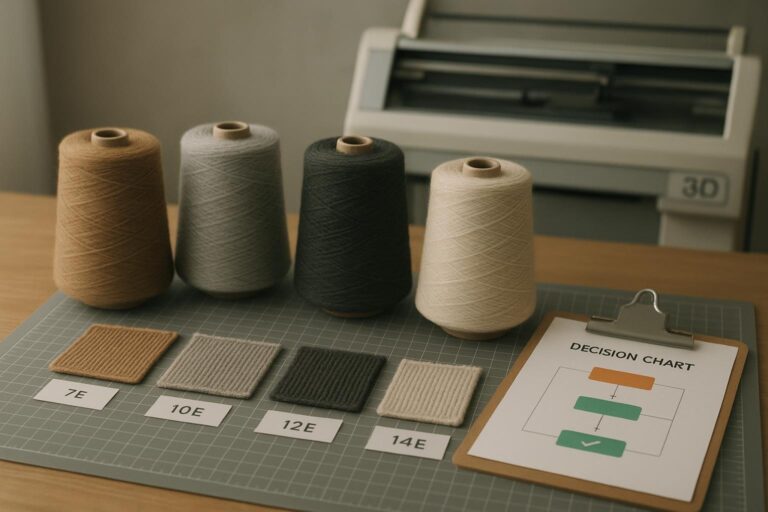
Yield sensitivity — Do they help you plan consumption by gauge (3GG vs 5GG) and stitch pattern (cables/ribs add weight)?
Lead-time milestones — What approvals trigger bulk? What changes reset the clock?
Change control + IP protection — How are revisions tracked (versioning, approval checkpoints, sign-off)?
Bulk QA plan — What tests are run pre-ship (pilling, shrinkage, colorfastness) and when?
Sampling SLA: what 3–5 day knitwear sampling really means
Xindi is unusually specific about inputs and complexity factors on its Quick Sampling page.
In plain terms:
3–5 days is realistic for simpler builds (e.g., jersey/rib structures) when you’re using available yarn.
They accept tech packs, sketches, photos, reference garments, and even CLO3D/Browzwear files.
Complexity stretches the clock: cables/pointelle can land around 6–7 days, and jacquard/intarsia can push to 7–8 days because programming is the bottleneck.
A practical way to protect your timeline without killing creativity: run two samples.
Sample A: fit + construction in an “available” yarn route.
Sample B: final yarn route + color confirmation once the build is locked.
MOQ reality: per style, per color, and how to plan size ratios
Low MOQ is rarely one number. It’s a set of rules.
Xindi lays out the logic (including trade-offs) in Low MOQ Knitwear Lead Times & MOQs — Practical FAQ. If your search intent is basically “knitwear lead time 50 MOQ,” this page is the kind of operator-level detail you want. The parts that matter most for emerging labels:
MOQ is often per style per color.
A common working band is 50–300 units per color, depending on yarn route.
Lower per-color MOQs may be possible with a price premium, especially when using stock-service yarn.
Custom colors are where many low-MOQ plans break: dye-lot minimums can force higher economic MOQs.
If you only do one planning move, do this: start with one hero color at MOQ and keep your size ratio stable.
Certified yarn for private label knitwear: what “proof” should look like
If you’re selling “certified,” you need more than a badge. You need documentation that survives a retailer or platform audit.
Xindi’s Sustainable Knitwear certification library spells out the certification set they can support (OEKO‑TEX Standard 100, GRS, RWS, and GOTS/OCS) and positions documentation as part of the delivery.
Here’s the buyer-side way to translate that into action:
What to request (so claims stay compliant)
Certificate copies for the exact yarn route you’ll use
Lot/traceability information tied to production
Clear documentation expectations for your product-page copy and audits
Xindi also explains the chain-of-custody mindset in its Recycled & sustainable knitwear yarns guide (supplier certificates, lot traceability, and transaction-document workflows).
⚠️ Warning: “We can source certified yarn” isn’t the same thing as “your specific lot is covered.” Make scope + documentation part of your PO terms.
Cost model: price per kg bands (planning ranges) and what drives the quote
You requested price-per-kg bands. The honest way to publish this is as planning ranges + drivers, because the number changes with micron, blend, certification route, and dyeing.
If you need a headline planning range for chunky wool yarn, many supplier listings cluster in the single-digit to teens USD per kg for bulk wool yarn routes, with premiums for finer merino and specialty blends. Treat this as planning context, not a quote.
The drivers that actually move your number:
Fiber quality (micron): finer wool costs more.
Blend and performance: nylon blends for durability; anti-pilling finishes.
Certification pathway: verification + traceability overhead.
Color route: stock shade vs custom lab dips / dye-lot scheduling.
MOQ per color: small-batch premiums are real.
If you want the pricing section to be decision-useful for consideration-stage readers, ask suppliers to state the yarn route in the quote so you can compare apples-to-apples.
Yield planning at 3GG vs 5GG: how to talk about it without overpromising
Chunky gauges can look similar in photos but behave differently in cost.
A safe planning statement:
3GG and 5GG change stitch density and yarn thickness; consumption is driven by yarn meters/kg, size + fit, stitch pattern, and finishing shrinkage.
Because consumption depends on the exact yarn spec, treat yield as a range, not a guarantee.
A publishable planning range for adult pullovers is often described as roughly 0.8–1.5 kg per sweater, depending on size, ease, stitch pattern, and yarn thickness. Interweave’s guide on how much yarn you need for a knitted sweater is a good reference point for why ranges are normal.
For a quick internal definition of “chunky,” guides like Sheep & Stitch’s yarn weight chart help show typical gauge ranges for bulky and super bulky yarn categories.
The 60-day delivery playbook (sample → approvals → bulk → QC → ship)
Even if a factory can run bulk quickly, your calendar is protected by milestones.
A practical 60-day model:
Days 0–5: submit spec + lock sampling target
Days 3–10: sample build + fit/hand-feel approval loop
Days 10–14: PP approval + change control (freeze gauge/yarn route/measurements)
Days 14–49: bulk production window
Days 49–60: QC, packing, and shipping execution
What this means for you: if your launch date is fixed, don’t compress everything. Decide which variables can move (color) and which can’t (fit/gauge).
Mini case study (anonymized): what a small-batch timeline can look like
A real example you provided (anonymized):
Product: cotton knit style
Gauge: 1.5GG
Quantity: 100 pcs
Production time: 18 days
Use this the right way: ultra-chunky gauges can compress knitting time per piece, but they also increase sensitivity to yarn route and finishing. The win condition is stable tension, consistent finishing, and tight measurement control.
Pros and cons summary
Pros
Clear proof pages for sampling and lead times (easy to align your internal calendar).
Evidence-forward certification positioning and documentation expectations.
Private label finishing (labels, hang tags, packaging) is part of the same workflow.
Cons / constraints
Low MOQ is usually per color, and custom colors can force higher economic minimums.
The chunkier you go, the more yield can swing — you’ll need a consumption estimate tied to your exact yarn meters/kg.
For jacquard/intarsia, programming and iteration time can dominate sampling.
Next steps: request a spec-based answer (not a vague “yes we can”)
If you want a supplier comparison you can act on, send one package:
tech pack (or photo set + measurement spec)
target gauge (3GG or 5GG)
yarn requirements (wool type, certification requirements)
target MOQ per color + size ratio
target ship date
If you’re considering Xindi, the cleanest entry point is to share your spec via Xindi Knitwear (Knitwear.io) so the reply includes sampling timeline, bulk window, MOQ definition, and the certification documents you’ll receive.
Key takeaways
Xindi is a strong fit when you need low-MOQ execution and documentation, not just manufacturing.
Treat MOQ as a rule set (per style, per color, plus dye-lot constraints), not a single number.
For certified yarn, request the documents that match your claim type.
For 3GG vs 5GG, publish planning ranges and drivers — then confirm consumption before you lock landed cost.