
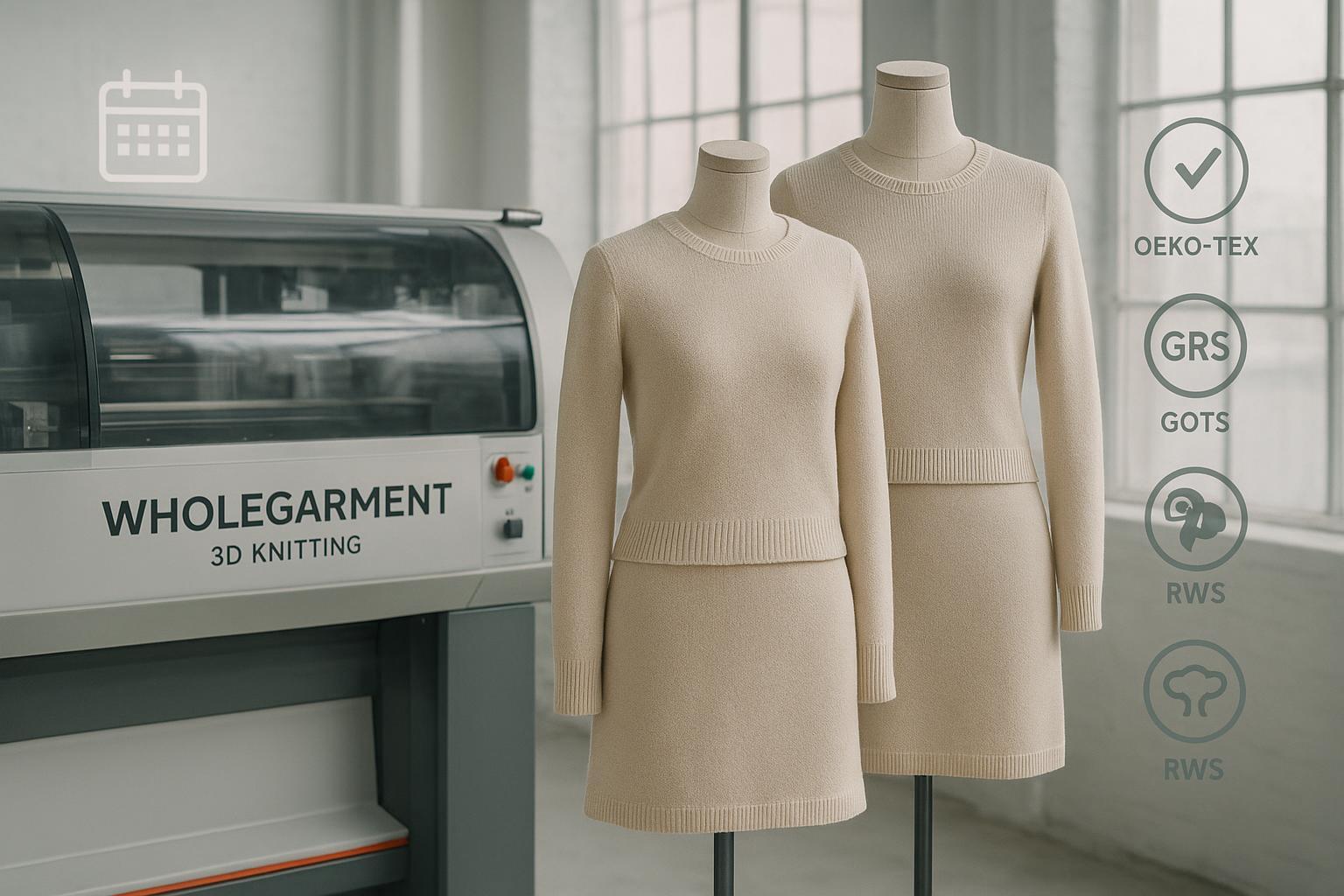
Planning a small run of coordinated knits (top + bottom) shouldn’t feel like guesswork. Below is a straight‑talk FAQ that defines what counts as a knit set, how MOQ really applies, when a 3–5 day sample and a 6–8 week bulk timeline are realistic, which certified yarns we can support, and how FOB pricing ties to production milestones.
Key takeaways
“Knit set” refers to a coordinated two‑piece outfit (e.g., sweater + skirt/pants). MOQ applies per style per color, with sizes graded inside the lot.
3–5 day sampling is achievable when tech packs are complete and yarn is on hand; otherwise expect more time.
A realistic 6–8 week bulk window starts after PPS approval and deposit, with yarn in‑house. Custom dyeing and rare yarns extend timelines.
Certified yarn options (OEKO‑TEX, GRS, RWS, GOTS) are available; certificate license numbers and shipment TCs are provided upon request and verified via official registries.
FOB pricing is tiered by gauge/complexity and yarn/certification; payments are linked to milestones (PO deposit → PPS pass → pre‑shipment).
What exactly counts as a “knit set,” and how does MOQ apply for low MOQ knitwear sets?
In this FAQ, a knit set means a coordinated two‑piece knit ensemble sharing the same design intent, yarn, and gauge—commonly a sweater with a matching skirt or pants. In production terms, we treat the set as one style for planning, but MOQ is applied per style per color with size splits inside that MOQ. This aligns with industry practice for small‑batch knitwear. For additional context on our low‑minimum approach, see the overview of low‑minimum production in the article titled the Low MOQ Production guide on our site.
Here’s a compact rules matrix you can use during costing:
Topic | How it typically applies |
|---|---|
Definition | Set = coordinated two pieces sharing yarn/gauge (e.g., sweater + skirt) |
MOQ base | Per style per color (typ. 50–100 units depending on yarn/gauge availability) |
Sizes | All sizes can be graded within the MOQ; no per‑size MOQ |
Colors | Split across 1–2 colors at low MOQs; additional colors usually raise totals |
Yarn constraints | Custom dyeing or niche certified yarns can raise MOQs due to spinner minimums |
Note: If your palette requires lab‑dip approval or fiber‑dyed lots, plan extra time and a higher floor for yarn ordering.
Can you really sample in 3–5 working days? What’s included?
Yes—when three conditions are true: your tech pack is complete, the yarn is on hand (or pulled from stock), and the first proto doesn’t require structural re‑engineering. Our public guide explains how we approach sampling; see the section on fast prototyping in the article titled the Custom Knitwear Manufacturer Guide. In broader industry context, some OEMs quote 7–15 days for a first physical proto when sourcing is included, which shows why readiness matters.
Scope and expectations (guidance, not a guarantee):
What’s included: one first‑proto sample; minor adjustments (e.g., measurements) as a revision round; courier photos/video for quick checks.
What may add time: stitch architecture changes; switch of yarn count/fiber; custom trims/labels; missing graded measurements.
PPS timing: After proto sign‑off, a PPS is knitted to your approved spec for final confirmation before bulk.
For external context on typical proto ranges you may see elsewhere, compare an OEM timing note like Onward Cashmere’s 7–15 day prototype range in its service overview: Prototype windows explained.
Is a 6–8 week bulk timeline realistic for knit sets?
It’s realistic when measured from a precise start point: PPS approval and deposit received, with yarn already in‑house. In that scenario, most small‑batch knit programs finish in approximately 6–8 weeks, including knitting, linking or WHOLEGARMENT knitting where applicable, washing/blocking, finishing, QA, and pre‑shipment processes. Trade references show similar orders of magnitude; for example, one specialist outlines bulk windows around 8–13 weeks if materials are already in the factory, which supports the same ballpark for small runs when approvals flow smoothly; see Albion Knit’s production overview: Bulk windows with materials ready.
When timelines stretch beyond 8 weeks:
Custom dyeing: lab dips, dye queues, and minimum lot sizes add weeks.
Rare/certified yarn sourcing: longer spinner or certification checks.
Peak capacity windows: pre‑season loading can extend the queue.
Re‑approvals: PPS or lab test failures reset the clock.
For how we define milestones from proto to shipment, the article titled our OEM/ODM process page offers a step‑by‑step view.
Which yarns and certifications are available? How do you verify claims?
Available options typically include OEKO‑TEX STANDARD 100 yarns and, where supplier scope allows, GRS (recycled), RWS (responsible wool), and GOTS (organic) yarn inputs. Because certification scope sits with each supply‑chain actor, we disclose license/scope numbers, the certifying body, validity dates, and the applicable process scope upon request. For shipments made with certified content, Transaction Certificates (TCs) can be provided (GOTS/GRS/RWS) to document the chain of custody.
How you can verify:
GOTS/GRS/RWS: Review the supplier Scope Certificate and the shipment TC (lists inputs, references, and dates). The GOTS Implementation Manual explains Scope Certificates and TCs in detail: How SCs and TCs work in practice.
OEKO‑TEX: Validate certificate numbers and scope via the official Label Check: Confirm STANDARD 100 certificates.
If you need certificate numbers for a quote or compliance pack, request the current list; we keep them on file and share redacted scope pages as needed.
How does FOB pricing work for small batches? What are the tiers and milestones?
FOB pricing quotes the unit price ex‑factory with handoff at the named port. For small batches, tiering is driven by technical complexity and materials rather than arbitrary volume breaks. The practical drivers are:
Gauge and construction complexity (e.g., intarsia/jacquard vs. plain jersey; WHOLEGARMENT knitting vs. cut‑and‑link).
Yarn type and certification (commodity vs. niche fibers, certified inputs).
Color count and finishing (washing/blocking steps, special treatments).
Milestone‑linked payments improve predictability:
PO and deposit to book yarn and machine time.
PPS approval releases the bulk start; some buyers split a progress payment here.
Final balance after pre‑shipment inspection (AQL) and before dispatch; LC or escrow for larger orders can be arranged.
What QA and testing should I expect on knit sets?
Final quality is typically controlled with an AQL framework (often General Level II, AQL 2.5 for major, 4.0 for minor) plus knit‑specific lab tests. If you’d like a primer, QIMA’s guide explains how AQL sampling and accept/reject levels work in apparel inspections: Understanding AQL in practice.
Common knitwear test targets (buyer specs vary):
Dimensional stability: target ≤3–5% shrinkage after laundering (AATCC/ISO methods).
Colorfastness to washing: aim for Grade 4–5 for premium programs (AATCC 61 or ISO 105‑C06).
Pilling resistance: target Grade 3–4 minimum (ISO 12945‑2/ASTM D4970).
If you need finishing details (washing/blocking and stabilization), we outline our approach in a technical explainer on our site.
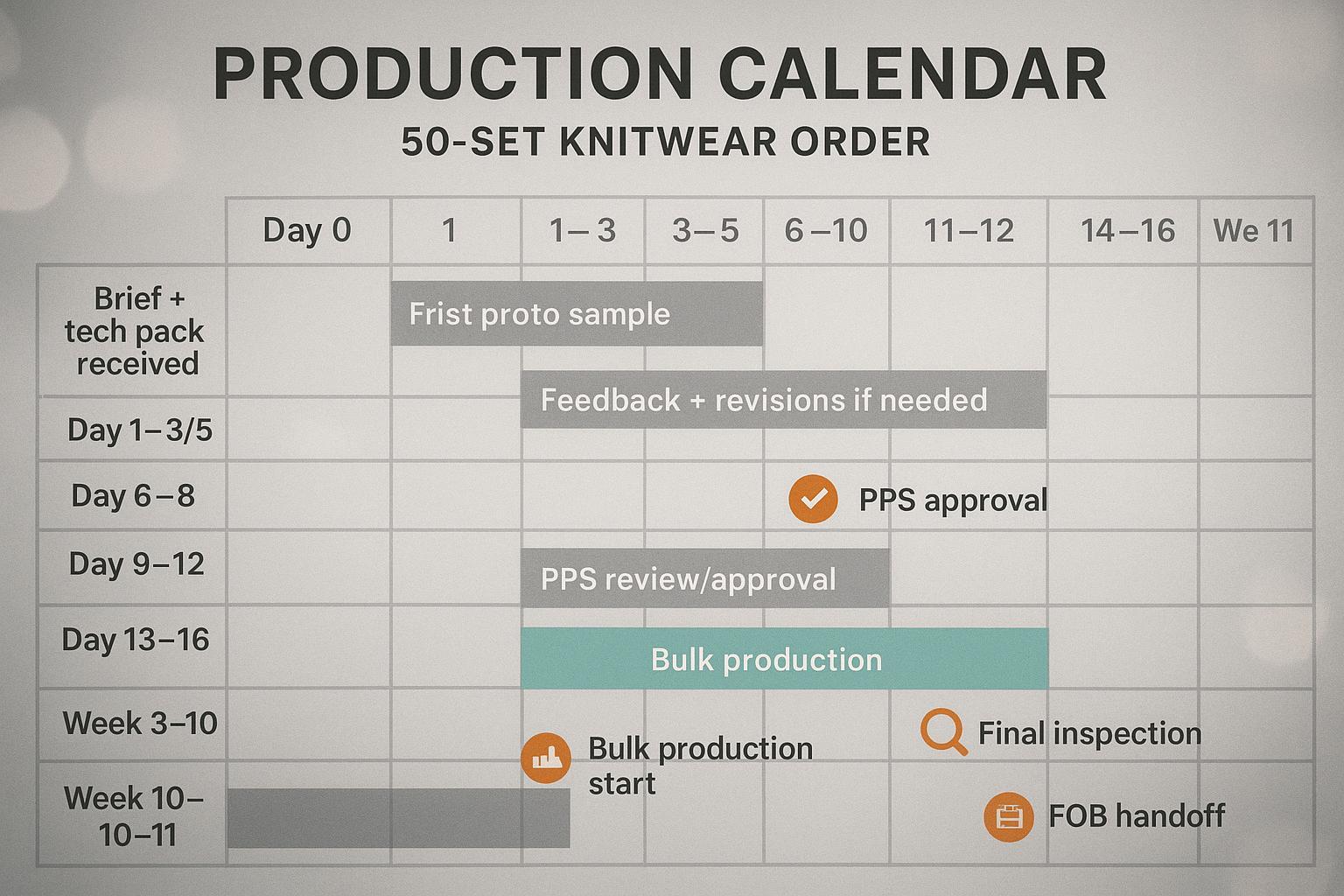
Practical example: a 50‑set pilot from brief to shipment
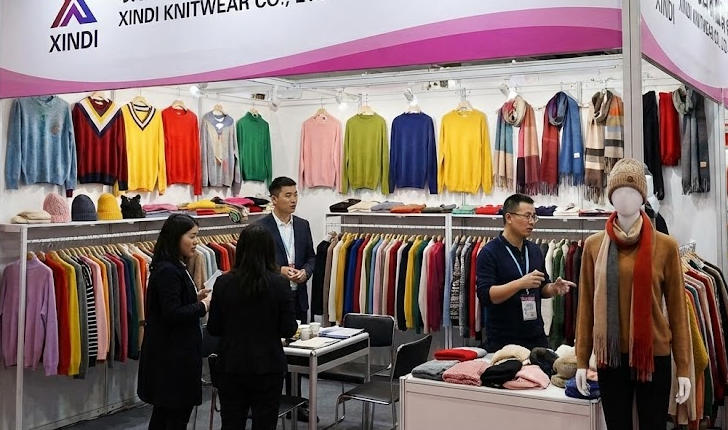
Disclosure: Xindi Knitwear (Knitwear.io) is our product.
Here’s how a straightforward pilot can run when the yarn is in stock and the tech pack is complete:
Day 0: Brief and tech pack received. Materials and gauge confirmed.
Day 1–3/5: First proto knitted; quick photo/video check to catch obvious issues.
Day 6–8: Feedback incorporated; PPS prepared to approved spec.
Day 9–12: PPS couriered for hand‑feel and measurements; buyer signs off.
Week 3–10: Bulk production window (6–8 weeks counted from PPS approval + deposit + yarn in‑house).
Final week: AQL inspection, packing, and FOB handoff at the named port.
Final notes and what to request
Current season machine availability: available upon request; we can share a redacted snapshot for your target window.
Certificate/license numbers: available upon request with validity and certifier noted; shipment TCs provided for certified orders.
Want the editable sample calendar? Ask for the 50‑set pilot template and we’ll send a copy.
Have a set you want to pilot? Send your tech pack, target gauge, and yarn preference, and we’ll map the precise MOQ, sampling window, and bulk plan.