
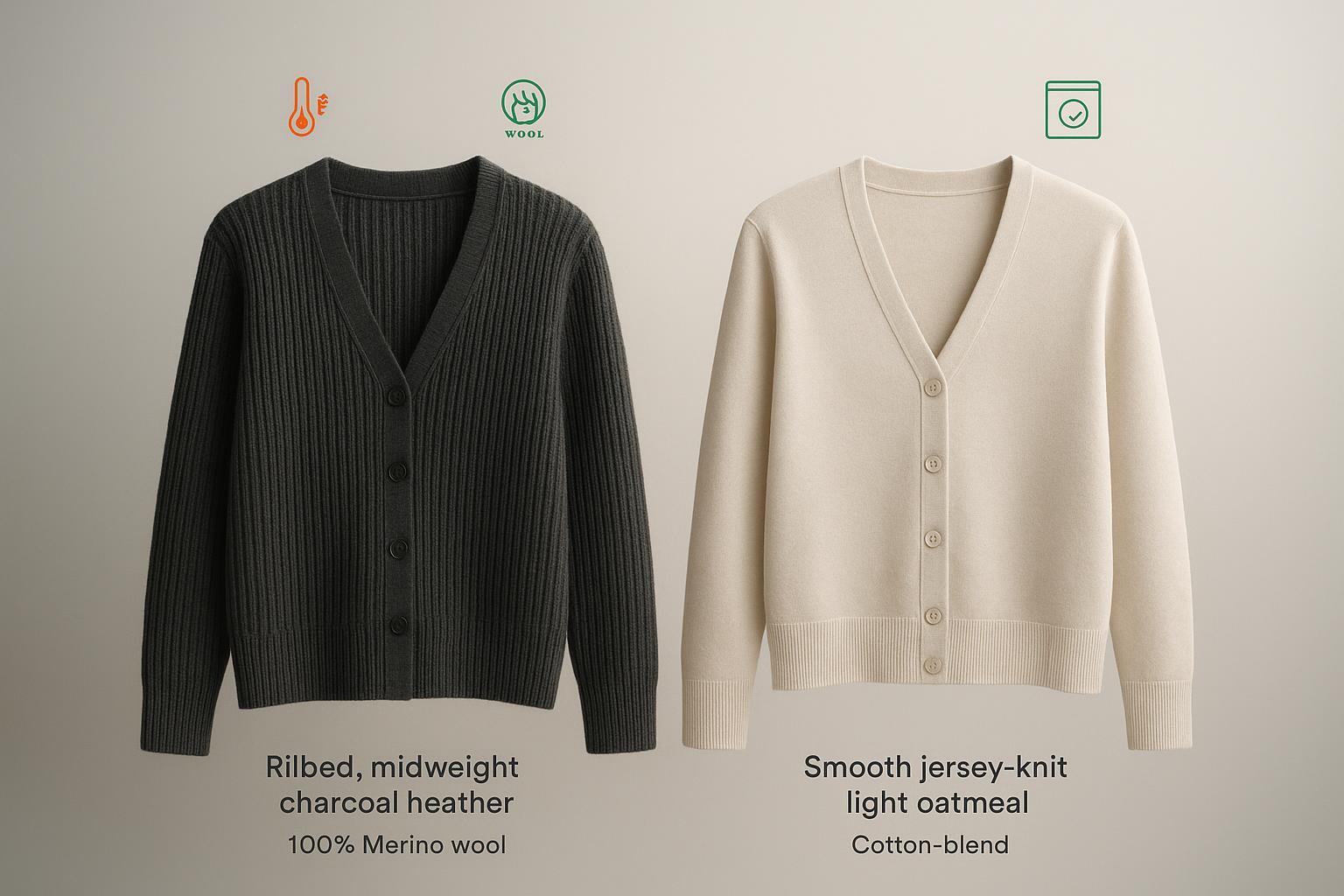
Updated Feb 2026 — Version scope: Comparing 100% extrafine Merino (18.5–19.5 μm) in 12GG half‑cardigan/rib at 240–280 GSM vs a representative 60% cotton / 30% nylon / 10% wool cardigan in 12GG jersey (220–240 GSM). Care permissions and energy prices vary by brand, machine, and region; follow sewn‑in labels.
Choosing a women’s cardigan material isn’t just about feel—it sets your day‑to‑day care burden and how warm you’ll be on a cold platform or in an over‑heated office. This guide compares 100% Merino versus a representative cotton‑blend (60% cotton / 30% nylon / 10% wool). We focus on maintenance TCO (wash/dry energy and time), care risks (shrinkage, pilling), and practical warmth at similar gauge/GSM baselines.
Key takeaways
For long winter commutes, Merino’s crimp and odor resistance deliver better warmth‑to‑weight and fewer washes; flat‑dry care is the main trade‑off.
For mild, damp, machine‑care‑first routines, the 60/30/10 cotton‑blend tolerates standard cold cycles and sometimes low‑heat tumble; warmth is fine when layered.
Maintenance TCO swings on two levers: wash cadence and tumble‑dry use. Merino’s re‑wearability often beats extra wash convenience.
Shrinkage/felting risk is higher on Merino if labels are ignored; the blend loses insulation when wet and can pick up odor faster.
Quick scenario verdicts (who wins where)
Scenario | Winner | Why it wins |
|---|---|---|
A) North America/Nordic long‑winter commute | Merino | Insulates even when damp; regulates heat indoors; fewer washes between wears. |
B) UK/West Coast mild & variable | Cotton‑blend 60/30/10 | Easier machine care; some labels allow tumble‑low; adequate warmth layered. |
C) Urban four‑season office layering | Cotton‑blend 60/30/10 | Fast, predictable laundering; good drape in fine gauges; lower day‑to‑day care friction. |
Note: Always follow sewn‑in care labels. Verdicts assume baseline specs below.
Merino vs cotton blend cardigans: side‑by‑side specs
Dimension | 100% Merino (baseline) | Cotton‑blend 60%C / 30%N / 10%W (baseline) |
|---|---|---|
Fiber spec | Extrafine Merino, 18.5–19.5 μm | Combed cotton + nylon + wool |
Gauge / knit | 12GG half‑cardigan/rib mix | 12GG jersey body; 2×2 rib trims |
GSM (typical) | 240–280 GSM | 220–240 GSM |
Warmth‑to‑weight | Higher, thanks to crimp/loft; stays warmer damp | Moderate; can feel cool if damp |
Moisture behavior | Absorbs vapor, remains insulating when damp | Lower moisture regain; loses warmth when wet |
Care label (typical) | Wool/delicate program; cool; flat dry; tumble only if permitted | Machine wash cold gentle; flat dry recommended; some labels allow tumble‑low |
Wash cadence | Every 3–5 wears (air out between) | Every 1–2 wears typical |
Shrinkage risk | Low under wool program; high if hot/agitated (felting risk) | Low–moderate under cold/gentle; structure may relax; tumble‑low permitted on some styles |
Pilling/abrasion | Good with long‑staple Merino; knit‑dependent | Nylon improves abrasion; pilling varies by yarn/structure |
Odor control | Naturally odor‑resistant; fewer washes | Picks up odor faster; needs more frequent washing |
Best for | Cold commutes; travel capsules; odor‑sensitive users | Easy‑care office wear; quick turnarounds; heavier abrasion contexts |
Baselines referenced from Woolmark care guidance on wool drying and tumble permissions—tumble only when the label allows and defaulting to flat‑dry, as outlined in the Woolmark care hub’s articles on can I tumble dry wool and how to dry wool. Representative 60/30/10 cardigan care shows machine‑wash‑cold with a mix of flat‑dry and occasional tumble‑low allowances on Gap women’s sweaters, for example this cotton‑blend wrap cardigan care note and this cardigan coat with tumble‑low permission.
Maintenance TCO: a simple, editable calculator
Short answer: Fewer washes and flat‑drying make Merino surprisingly cheap to maintain; frequent machine cycles and occasional tumble‑dry make the cotton‑blend cost add up.
TCO formula (2‑year horizon):
TCO = (Wash_Loads × kWh_per_Wash × Price_per_kWh)
    + (Dryer_Loads × kWh_per_Dry × Price_per_kWh)
    + (Care_Consumables)
    + (Amortized_Replacement * if lifespan < 2 years)
Suggested defaults (edit to your region and habits):
Price_per_kWh: $0.17 (U.S. 2026 projection from the EIA residential outlook).
kWh_per_Wash: 0.3–0.6 (cold/delicate) vs 0.5–1.0 (40°C cotton cycle). UK testing shows cooler programs cut energy; see Which? guidance on washing‑machine energy.
kWh_per_Dry: 1.5–2.5 (heat‑pump) or 3–4 (vented). Heat‑pump savings of roughly half are reflected across consumer testing; ENERGY STAR notes substantial reductions in U.S. framing—see the laundry factsheet.
Wash cadence: Merino every 3–5 wears; Cotton‑blend every 1–2 wears.
Worked example (2 years, 52 wears/year):
Assumption | Merino | Cotton‑blend |
|---|---|---|
Wears between washes | 4 | 1.5 |
Wash loads/year | 13 | 35 |
Dryer share | 0% (flat‑dry) | 50% of loads |
kWh/wash | 0.4 | 0.6 |
kWh/dry | 0 | 1.8 (heat‑pump) |
Electricity ($/kWh) | $0.17 | $0.17 |
Energy cost per year | ~$0.88 (13×0.4×0.17) | ~$8.87 ([35×0.6×0.17] + [17.5×1.8×0.17]) |
Two‑year energy cost | ~$1.76 | ~$17.74 |
Sensitivity: If the cotton‑blend is always flat‑dried (0% dryer), its two‑year energy cost drops to about $7.14. If you tumble‑dry Merino on low (label‑permitting) for 25% of loads, its two‑year energy cost rises to about $2.64. Care choices matter more than fiber price tags.
Disclaimers: Appliance efficiency, load size, spin speed, and local prices vary. Follow labels. TCO excludes your time cost.
Warmth and damp‑warmth behavior (why Merino often feels warmer)
Merino’s 3D crimp traps still air and its hygroscopic fibers absorb vapor and can release small amounts of heat—helping it feel warm even when the air is damp. Cotton has lower moisture regain and tends to feel clammy when wet, losing insulation until it’s fully dry. That’s why, at similar GSM, ribbed/half‑cardigan Merino often outperforms smooth jersey cotton‑blends for cold commutes. Technical explainers from Woolmark describe wool’s breathability and thermal mechanisms—see the wool breathability factsheet—and REI’s overview of what Merino is and why it’s comfortable reinforces real‑world behavior in variable conditions. Direct garment‑to‑garment CLO data at identical specs is scarce, so treat this as mechanism‑based guidance rather than a fixed number.
Care complexity, shrinkage, and pilling risk (the real‑world traps)
Wool care and drying: Wool garments should be washed on a wool/delicates program with wool‑approved detergent and dried flat; tumble‑dry only if the label explicitly allows a low‑heat or wool setting, per Woolmark’s consumer care guidance on tumble permissions and drying wool. Ignoring those rules risks felting and large, irreversible shrinkage.
Cotton‑blend care: Representative 60/30/10 sweaters commonly specify machine wash cold on gentle and lay flat to dry; a subset explicitly permits tumble‑dry low, as seen on these Gap examples: wrap cardigan and cardigan coat.
Shrinkage framing: ISO 6330 defines standardized home‑laundering test programs to measure dimensional change; many brands target around ±5% on knits after recommended programs, but tolerances are buyer‑defined. See an industry testing explainer on fabric shrinkage tests for context.
Pilling/abrasion: ISO 12945 covers pilling assessment; nylon in a blend typically boosts abrasion resistance, though pilling outcomes depend on yarn length/twist and the knit structure. Expect variation by yarn and stitch, not just fiber label.
Practical rule of thumb: If you need predictable, machine‑friendly care every week, the cotton‑blend is forgiving. If you prioritize warmth with minimal wash cycles and are comfortable with flat‑drying, Merino shines.
Seasonal use guidance (A/B/C)
A) Long winter commute (cold outdoors, heated indoors): Choose mid‑to‑heavy GSM Merino in rib/half‑cardigan. It stays warm when damp and won’t smell after a few wears if aired out.
B) Mild, damp, variable (UK/West Coast): Choose the 60/30/10 cotton‑blend for machine‑care convenience and occasional tumble‑low (when labels permit). Layer with a windproof shell when needed.
C) Urban four‑season office layering: Choose cotton‑blend at lighter GSM and fine gauge for easy laundering and clean drape. If you’re odor‑sensitive or travel often, keep a Merino layer for re‑wear between washes.
FAQs
Which is warmer for a cold commute: Merino or a cotton‑blend cardigan?
Merino, at similar GSM and a lofted rib, typically feels warmer and stays comfortable when damp; cotton‑blends in smooth jersey can feel cool when wet.
Can I tumble‑dry a Merino cardigan without shrinking it?
Only if the sewn‑in label explicitly permits a low‑heat wool setting. Otherwise, follow flat‑dry. Heat and agitation can cause felting and major shrinkage.
How often should I wash Merino vs cotton‑blend cardigans?
Many wearers can re‑wear Merino 3–5 times if aired; cotton‑blends usually need laundering every 1–2 wears due to odor pickup.
Which costs less to maintain over two years?
Often Merino—because you wash it less and usually flat‑dry. Dryer energy dominates costs when used frequently.
What should I do if my Merino cardigan shrank?
If it’s felted, recovery is limited. Try lukewarm water with wool conditioner, gentle re‑blocking to measurements, then flat‑dry. Future washes: wool program only.
Methods and disclosure
Methods: Care guidance is grounded in consumer care pages from Woolmark (drying and tumble permissions), standardized laundering context from ISO 6330, and pilling context from ISO 12945. Energy assumptions draw on Which? washing‑machine energy comparisons and U.S. EIA electricity price references. Odor/wear‑between‑washes is supported by REI education and a peer‑reviewed review of wool’s antibacterial properties (2022 open‑access review). Where direct garment‑matched lab numbers (e.g., CLO) were unavailable, we present mechanism‑based reasoning with clear caveats.
TCO calculator: Defaults reflect directional ranges; edit to your own machines (heat‑pump vs vented), local $/kWh, and wash cadence.
Disclosure: Xindi Knitwear (Knitwear.io) is our product and manufacturing/testing partner for methodology alignment. We remain neutral in verdicts and do not promote specific SKUs. Learn more in our knitwear QC guide and practical drying care checklist. For fiber background, see the Merino yarn guide.
How to choose, in one minute
Prioritize warmth with fewer washes and you’re okay with flat‑dry? Choose Merino. Need easy machine care and predictable turnaround? Choose a 60/30/10 cotton‑blend. Still unsure? Match your climate first, then run sample care tests before committing to bulk.