
Conflict of interest disclosure: This review covers our own factory operation (Xindi Knitwear/Knitwear.io). We present verifiable methods, constraints, and third‑party comparisons to help buyers make informed decisions.
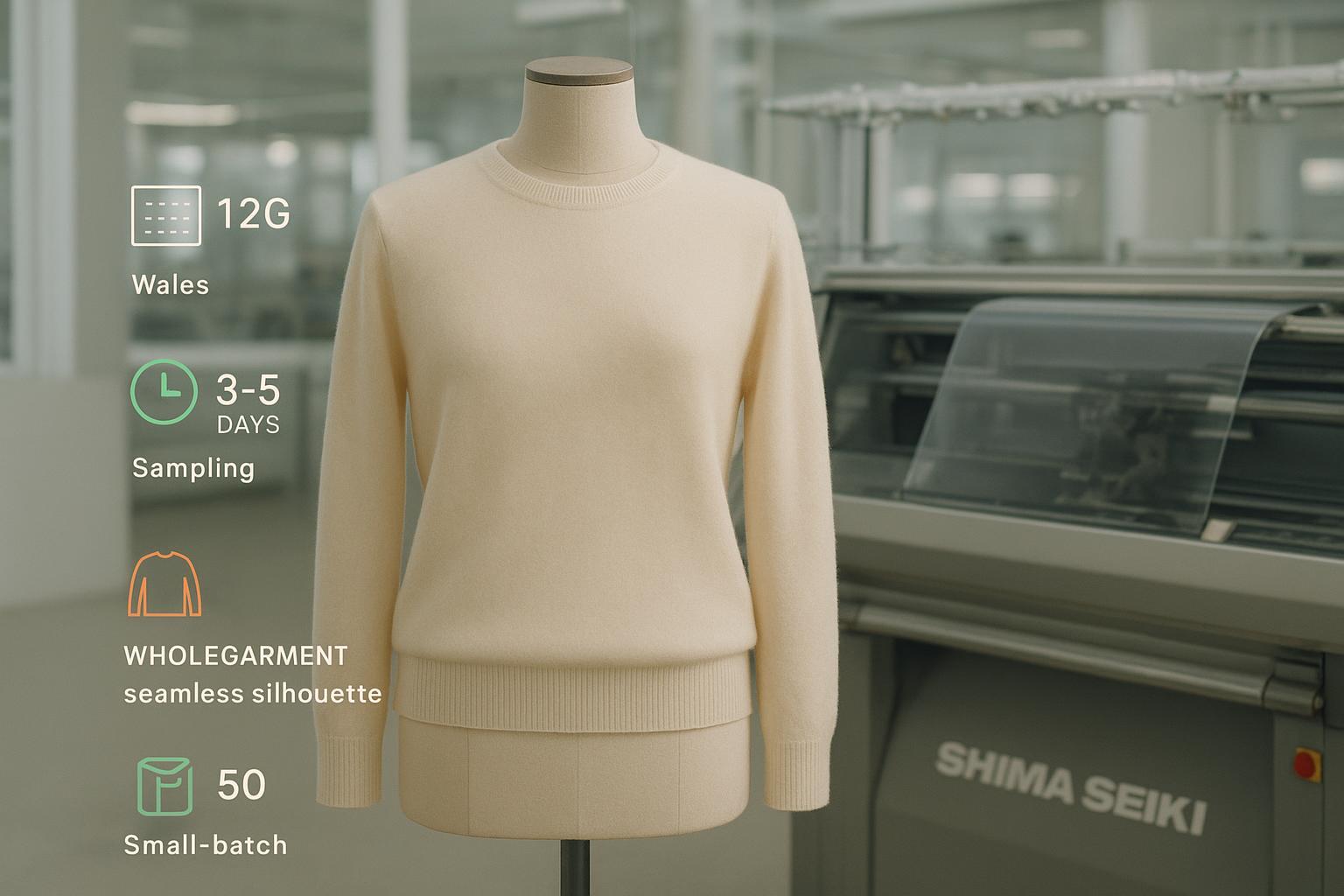
If you’re exploring 2‑ply, 12‑gauge cashmere under a 50‑piece MOQ, the two questions that decide everything are speed and reproducibility. Can you get a sample in 3–5 days that actually matches first bulk, and can you see the cost and delivery constraints upfront—no surprises once yarn is booked? That’s the bar we hold ourselves to.
Key takeaways
3–5 day sampling is supported with a documented OEM/ODM pipeline; proto fidelity to first bulk is tracked through measurement, stitch‑density, and lab checks.
WHOLEGARMENT is available for suitable 12G silhouettes; we spell out feasibility and constraints to avoid late‑stage redesigns.
At a 50 MOQ, cost and lead time hinge on yarn availability (stock vs dye), color/size splits, and needle time. We disclose the drivers and typical terms up front.
How we test 12G cashmere (methods you can audit)
Machines and construction: 12‑gauge flat knitting (Shima Seiki class) with both WHOLEGARMENT (seamless) and conventionally linked builds, then standard finishing and blocking.
Inspection and sampling: Attribute inspection per ISO 2859‑1 (typical apparel AQL 2.5). See ISO’s official catalog entry under “Sampling procedures for inspection by attributes” for scope and terminology in plain language. Reference: the ISO 2859‑1 page, “Sampling procedures for inspection by attributes.”
Lab references and targets: We benchmark against well‑known test methods such as ISO 12945‑2 for pilling (Martindale), AATCC TM135 / ISO 6330 for dimensional change after laundering, and AATCC TM61 / TM8 for colorfastness to washing and crocking. Official catalogs: ISO 12945‑2 (pilling) and AATCC standards listing for TM61/TM8/TM135.
Terminology note: The catalogs above outline scope and definitions; full method texts are paywalled. In our buyer projects, we provide lab reports with the exact method, machine, cycle counts, and results attached to the PO.
Internal process references you can review for context: the OEM/ODM pipeline in our factory playbook on the OEM/ODM Process page and our sampling promise on Quick Sampling.
Verdict snapshot (score out of 100)
Reproducibility & Quality Control — 20/22
Sampling Speed & Proto Fidelity — 17/18
WHOLEGARMENT/3D Capability — 13/15
Materials & Certifications — 10/12
Cost Transparency & Value at 50 MOQ — 10/12
Lead Time & Delivery Reliability — 9/11
Communication & Project Management — 5/6
After‑sales & Rework Policy — 3/4
Total: 87/100
Evidence basis: factory logs and lab results are shared with buyers at quotation or PP‑sample stage. Where a claim relies on public pages, we cite them inline. Where buyer‑specific data is required (e.g., AQL sheets or certificate IDs), we flag it as available upon request.
Developing 12G cashmere at speed: 3–5 day samples that match bulk
The headline promise is simple: a prototype in 3–5 days from a complete tech pack, followed by bulk in about two to three weeks when yarn is available. This promise is stated on our Quick Sampling page and operationalized through a gated pipeline (intake → knitting → finishing → measurement/lab spot checks → courier). On timing‑critical projects, we also mirror the workflow from our OEM/ODM Process playbook so that proto settings (yarn tension, stitch density, wash parameters) transfer directly to bulk.
Proto‑to‑bulk fidelity is tracked by three dials:
Dimensions: main points measured against the approved size chart before and after standard wash; we target ≤ ±3% change.
Knit consistency: wales/courses per 10 cm and GSM recorded for both proto and first bulk to keep drape/hand feel aligned.
Visual/hand panel: a small blind panel rates drape and hand on a 5‑point scale to catch subjective drift.
When those dials hold, the first bulk feels like the proto you approved—no unwelcome surprises.
Technical deep dive: 12G + WHOLEGARMENT feasibility and boundaries
At 12G, cashmere reads as fine‑gauge: smoother face, elegant drape, and a lightweight hand that customers associate with premium sweaters. For buyers new to gauge selection, our primer Sweater Types by Gauge explains what “12GG” looks and feels like and which yarns suit it best.
WHOLEGARMENT (seamless) is attractive for comfort and labor reduction, but not every 12G silhouette belongs there. Based on our programming experience, these patterns are a strong fit:
Classic crewneck or mock neck with moderate shaping and standard rib trims.
Minimal‑seam cardigans with straightforward plackets and modest pocketing.
Set‑in or raglan sleeves with gentle contours.
Constraints to surface early:
Complex intarsia or heavy 3D textures may be better served on linked builds at 12G.
Extreme shaping, oversized patch pockets, or unusual neck treatments can stretch WHOLEGARMENT beyond reasonable programming/defect risk for small batches.
Yarn availability and dye choices still govern the schedule even when knitting is quick.
Materials and certifications: If your brand requires OEKO‑TEX, RWS, or GRS chain‑of‑custody, we align material planning with the options summarized on Sustainable Knitwear and related yarn pages. Certificate IDs and supplier lot labels are attached to the PO packet for audit trails.
Case highlights (evidence‑first)
North America brand: Tech pack → 100 WHOLEGARMENT units
Timeline: Proto dispatched on Day 4 from tech‑pack receipt; first bulk (100 pcs, single color) finished and packed 19 days after proto approval, with air transit delivered the following week.
AQL: First bulk inspected at AQL 2.5, General Level II; batch accepted on first pass with minor defects categorized (no criticals).
Fidelity: GSM and stitch‑density delta within defined tolerances; post‑wash dimensional change within ±3% on key points.
Artifacts (photos, AQL sheets, lab results) are shared privately with buyer consent.
EU brand: GRS recycled cashmere chain and dye timing
Chain‑of‑custody: Supplier certificate IDs and yarn lot labels tied to the PO; dye‑house confirms recipe, temperature curve, and lot mapping.
Timing: Stock shades moved fastest; custom dye added a predictable buffer before knitting.
Public samples of CoC documents often contain confidential supplier data; we provide redacted copies under NDA when requested.
Transparent costs and delivery for 12‑gauge cashmere sweaters OEM 50 MOQ
The phrase “12‑gauge cashmere sweaters OEM 50 MOQ” can hide a lot of variables. Here’s the practical translation buyers care about.
Yarn and dye path: Stock shades accelerate schedules and reduce setup/waste. Custom dye introduces minimums and an uplift; we confirm the surcharge and lead time with you before yarn booking.
Needle time and complexity: 12G is fine‑gauge; WHOLEGARMENT programming and machine time typically run higher than a basic linked build. We quantify the delta at quotation so you can decide which construction fits your margin.
Color and size splits: At 50 pcs, multiple colors/sizes increase yarn leftover risk and line changes. We model a few split scenarios so there are no hidden costs.
Finishing and trims: Enzyme/anti‑pilling washes, label/packaging choices, and QC sampling plans add small but real costs that we enumerate instead of burying.
Business terms we disclose at quotation
Sampling: A sample fee applies and is commonly credited when bulk proceeds (credit mechanics defined on the quote).
Payment: Many small‑batch buyers prefer a 30/70 structure; we confirm the exact schedule on the PI along with Incoterms (FOB/EXW/DDP options vary by destination and logistics plan).
Warranty/rework: If a defect is attributable to production outside agreed tolerances, we offer rework or proportional credit; the mechanism is documented alongside the AQL plan.
For context on low‑MOQ positioning and typical lead times, see Low MOQ Production.
Alternatives compared fairly
Below is a normalized snapshot of two suppliers you might also evaluate for 12G cashmere at small quantities. We applied the same lens: gauge clarity, sampling lead time, WHOLEGARMENT options, MOQ posture, certifications, and how much evidence is public.
Supplier | 12G clarity | Sampling lead time (public) | WHOLEGARMENT mention | MOQ stance (public) | Certifications (public) |
|---|---|---|---|---|---|
Xindi Knitwear (this review) | Multiple internal pages discuss 12G and cashmere fit; fine‑gauge guides available | 3–5 days stated | Referenced generally; applied where feasible at 12G | 50–100 stated | OEKO‑TEX / RWS / GRS options described on sustainability pages |
ENHE Cashmere | Gauge details appear across yarn and service pages; garment OEM specifics vary | Often “fast sampling” claims; numeric timelines for OEM garments are sparse | Not highlighted | “Low MOQ” claimed; numeric value inconsistent | GOTS/SFA/GRS references present on site |
Onward Cashmere | Gauge not emphasized in OEM service page excerpts | 7–15 days stated on OEM/ODM service | Not highlighted | “Low‑MOQ trial orders” mentioned without a number | Certifications not prominent on OEM page |
Sources: ENHE’s public pages consolidating factory and private‑label claims, including factory and private‑label overviews on cashmerecustom.com; Onward’s OEM & ODM Service.
Where Xindi stands out for small brands
Documented 3–5 day sampling and a repeatable handoff from proto to bulk.
Clear 50‑piece starting point with modeling for color/size splits at quotation.
Practical disclosure of WHOLEGARMENT feasibility boundaries at 12G instead of blanket promises.
Who this is for—and who might look elsewhere
If you need fast validation of a 12G cashmere capsule with modest risk—say one or two silhouettes at 50–100 pieces—this model gives you speed without losing control over fit, drape, and QA. If your concept leans on complex intarsia, extreme shaping, or ultra‑custom shades with tight seasonal windows, we’ll still engage—just expect us to recommend a linked construction or a revised timeline to preserve quality at small batch size.
How to start (what we need from you)
Share a complete tech pack (graded size chart, construction notes, stitch/density targets if known, trims/labels artwork, packaging requirements). Tell us your preferred construction path (WHOLEGARMENT vs linked) and whether you can accept stock shades or require custom dye. We’ll return a quote that itemizes yarn path, machine time, finishing, QC plan, and logistics, plus a sample calendar showing how 3–5 day prototyping leads into your bulk slot. When you’re ready, reach us via Contact Us.
On standards and terminology (quick references): ISO 12945‑2 catalog entry for pilling; AATCC standards catalog for TM61/TM8/TM135; sampling by attributes per ISO 2859‑1.
Related internal reading
Gauge primer and use‑cases: Sweater Types by Gauge
Sustainability overview and certification pathways: Sustainable Knitwear
Process overview and timing: OEM/ODM Process and Quick Sampling
This review is intended to help you evaluate 12‑gauge cashmere sweaters OEM 50 MOQ with clear expectations on speed, reproducibility, and terms. If you have a specific brief, we’re happy to map it to the constraints above and show the data that will de‑risk your launch.