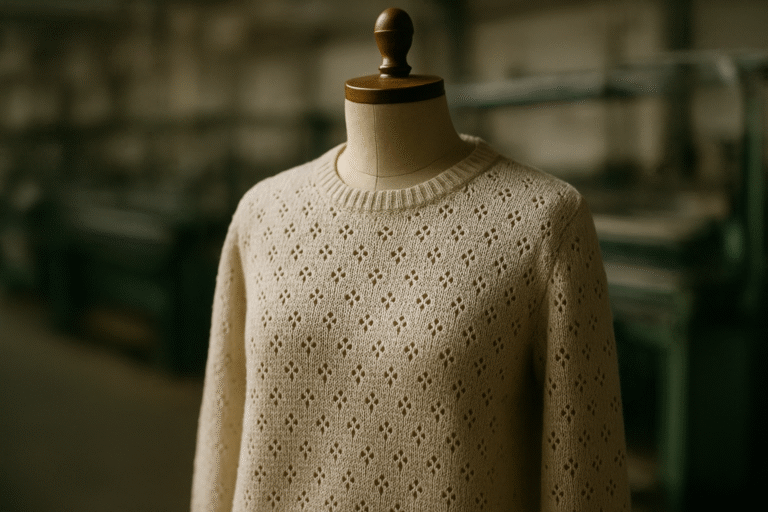

Drying is the quiet step that decides whether a sweater keeps its shape or misses size tolerances. A shared symbol system turns that risk into a repeatable routine. This training-oriented knitwear drying care chart aligns ISO 3758/GINETEX symbols with fiber behavior so factory teams and brand partners can make consistent, defensible calls on wool, cotton, and acrylic.
Key takeaways
Use ISO 3758/GINETEX drying symbols as the baseline and remember the maximum-severity rule: labels show the strongest treatment allowed; anything gentler is fine. For the U.S. market, keep ASTM notes and plain-English support text when needed.
Wool prefers flat dry and reshaping; cotton tolerates low tumble when permitted; acrylic needs low heat and minimal mechanical action to avoid deformation and pilling.
Prioritize dehydration and airflow over heat, use mesh racks and blocking templates, and document symbol-to-program mappings per lot.
Post-dry QA checks should confirm dimensional change and spirality within agreed tolerances and record settings for traceability.
Keep a versioned chart, controlled icon pack, and a short onboarding module so new team members get up to speed quickly.
Standards and symbol legend for drying
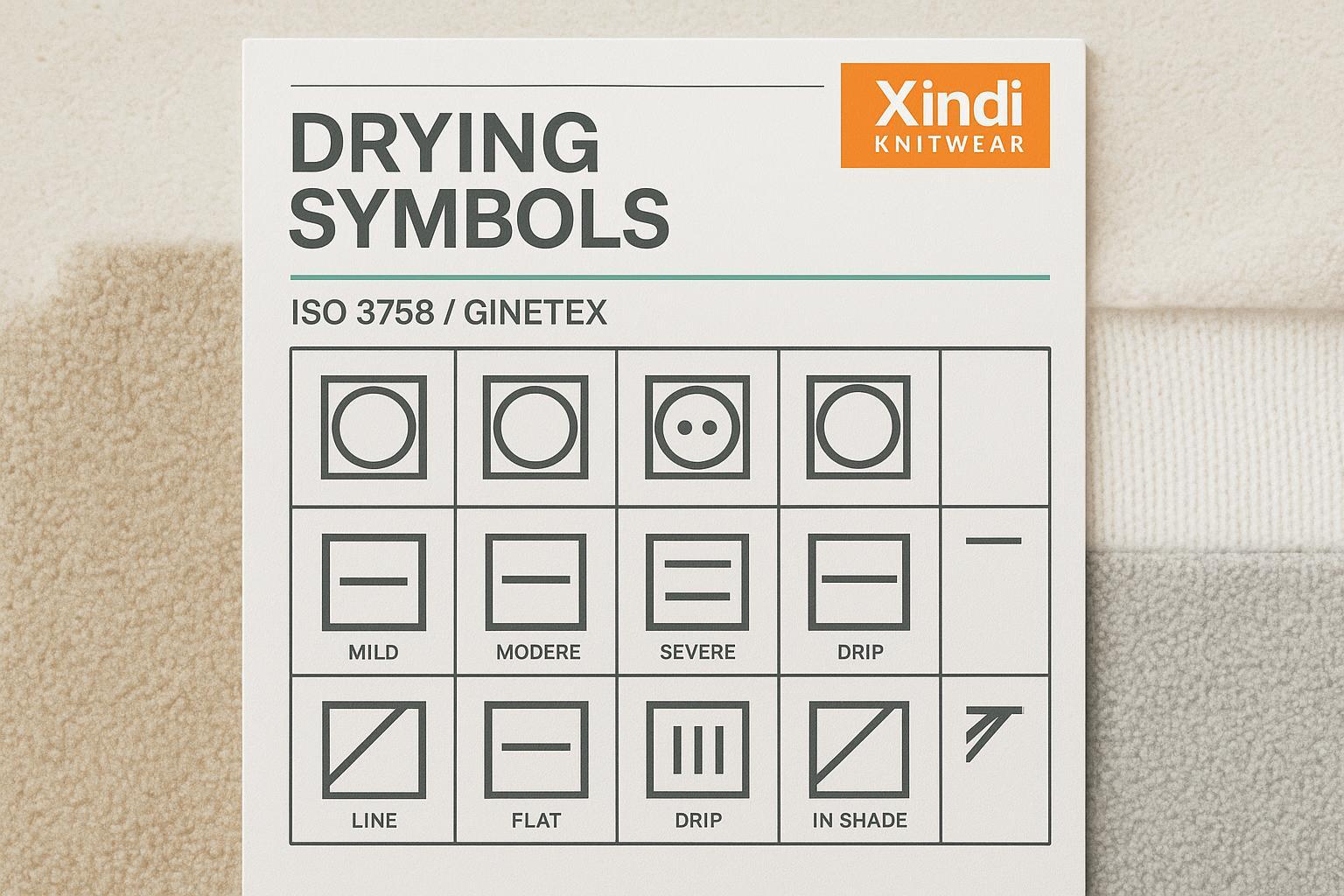
ISO 3758:2023 defines the global care labelling symbols, with GINETEX stewarding usage and education. In this system, a square denotes drying; a circle inside a square denotes tumble drying. Dots indicate temperature; bars under the symbol indicate milder mechanical action; an X means “do not.” This knitwear drying care chart uses ISO/GINETEX as the primary reference. For the United States, the FTC Care Labeling Rule permits symbols and expects conformance to ASTM D5489 when labels rely on symbols; many brands pair symbols with English text to stay unambiguous. See the ISO overview and GINETEX guidance, and the FTC and ASTM pages for U.S. specifics.
ISO baseline and symbol logic: see the ISO 3758:2023 overview and GINETEX explanations in the references below.
Public temperature cues for household tumble categories are summarized in the Canada OCA guide to help training communication.
Symbol form | Meaning | Temperature dots | Bars for mildness | Prohibitions | Natural drying variants | Shade modifier |
|---|---|---|---|---|---|---|
Square with circle | Tumble dry permitted | One dot = low, two = medium, three = high | One bar = mild, two bars = very mild | X across symbol = do not tumble | — | — |
Square only | Drying treatment family | — | One/two bars under square = reduced action | X across symbol = do not dry by this method | Line dry, drip dry, flat dry | Small diagonal fill/mark indicates “in shade” |
Line under symbol | Reduced mechanical action | — | Indicates milder process vs. no bar | — | — | — |
Two lines under symbol | Very mild process | — | Indicates very mild process | — | — | — |
ISO 3758:2023 overview PDF for symbol set and modifiers: see the official overview.
GINETEX care symbols and sustainable care notes provide helpful context on symbol intent.
Canada OCA guide offers a public explainer with temperature bands and natural-dry variants for consumer training.
According to the ISO/GINETEX rule, if the label shows “one-dot tumble,” “no-dot line dry,” or “flat dry in shade,” you may always choose a gentler option. That principle is the safest way to reduce preventable damage while keeping within label permissions.
References for this section:
ISO: see the ISO 3758:2023 overview PDF, “Textiles — Care labelling code using symbols.”
GINETEX: care-labelling and symbol explainers.
FTC Rule and ASTM landing for U.S. usage notes.
Canada OCA public-care guide for temperature and natural-dry variants.
Fiber-specific drying SOPs for wool, cotton, and acrylic
Wool
Default to flat dry on a towel or mesh screen at room temperature. Reshape to garment measurements during dry-down. Avoid direct heat and sunlight. Only use a dryer’s wool/delicates program at low heat if the care label explicitly permits tumble; otherwise, do not tumble dry. Authoritative wool-care guidance underscores that heat plus agitation risks felting and irreversible shrinkage. See Woolmark resources referenced below.
Cotton
For knit garments, line or flat dry is safest. If the label permits tumble, use low heat and remove slightly damp to finish flat, which helps reduce torque/spirality and over-dry shrinkage. Production teams often stabilize cotton in controlled processes; for consumer-aligned training and label interpretation, emphasize gentle handling and size control. Cotton Incorporated technical notes support these practices around relaxation and torque reduction.
Acrylic
Acrylic knits are thermoplastic and can deform under heat; they’re also prone to pilling with excessive mechanical action. Prefer flat or line dry. If tumble is allowed on the label, choose the lowest temperature with a short, gentle cycle. Keep monitoring for softening or sheen changes that indicate overheating. Present these as best practices aligned with symbol permissions; there is no single acrylic-only drying standard, so avoid claiming one.
Production-floor controls for consistent drying
Drying starts with good dehydration. Gently extract water without wringing. For delicate wool, a light spin or towel press before flat laying helps. Mesh racks promote airflow without adding heat. Keep the focus on airflow and time over high temperatures; where tumble is permitted, match the dots and bars to your machine program names and reduce action accordingly. Reshape on blocking boards or templates to maintain dimensions until the fabric is stable.
If you want a deeper walkthrough of dehydration, flat drying, and stabilization steps, see the Washing, Blocking & Stabilization overview on our site for broader finishing context.
Internal reading: Washing, Blocking & Stabilization (process context and reshaping guidance) — https://knitwear.io/knitwear-washing-blocking-stabilization/
Traceability matters. Record the symbol set on the care label, the dryer program used, airflow or temperature setting, cycle length, and the lot/size run. Why does this help? Because when a dimension drifts, you can pinpoint which combination of settings drifted with it and correct it on the next cycle.
Post-dry QA and records
Confirm dimensional change and spirality against agreed tolerances after the garment rests at room conditions. AATCC and ISO publish test methods relevant to home-laundering simulations and skew; use them as reference standards for your internal SOP wording and acceptance criteria.
AATCC TM150 addresses garments after home laundering; AATCC TM179 and ISO 16322-3 cover skew and spirality in fabrics and garments. In all cases, the drying step in those methods is integral to the outcome, which is why the symbol-to-program mapping you record is valuable.
For a practical QA cadence: measure length and width on a grid, check skew visually against a straight axis, assess surface appearance and hand feel, and log results alongside the exact program used. For a broader QC playbook, see our Knitwear QC Guide.
Internal reading: Knitwear QC Guide (shrinkage control and defect prevention context) — https://knitwear.io/knitwear-qc-guide/
Labeling and market alignment
Globally, ISO/GINETEX symbols remain the common visual language for care instructions. In the U.S., the FTC Care Labeling Rule requires clear, reasonable care directions; symbol systems are allowed, and symbol-only labels should follow ASTM D5489 as recognized by the FTC. Many brands choose symbols plus English text to reduce ambiguity, especially when current ISO icons are used in a U.S. context. Review the authoritative sources when deciding your label policy for North America.
FTC Care Labeling Rule overview — https://www.ftc.gov/legal-library/browse/rules/care-labeling-textile-wearing-apparel-certain-piece-goods
ASTM D5489 landing — https://www.astm.org/d5489-18.html
Practical example of mapping symbols to programs
Disclosure: Xindi Knitwear (Knitwear.io) is our product.
A buyer’s tech pack specifies flat dry for wool and tumble dry low for cotton tees. On the floor, the finishing team decodes the symbols, then maps them to machine programs: the one-dot tumble icon becomes “Low Heat Delicates,” while flat dry is executed on mesh racks with blocking templates. Wool sweaters are gently blotted, shaped to spec, and dried in shade; cotton knits approved for tumble are removed slightly damp and finished flat to control torque. Each lot’s drying settings, run time, and resulting measurements are logged against the care symbols. Over two weeks, size variance tightens and rework falls because the team can trace and repeat the settings that hold dimensions. The same mapping is distilled into a brandable A3 poster and an SVG/PNG icon pack for labels and e‑commerce, so factory and brand teams talk in the same, symbol-led language.
Onboarding kit, icon pack, support, and versioning
What assets should a small brand or factory keep on hand to make this knitwear drying care chart operational?
A3/A4 printable poster with the drying symbol legend, fiber quick rules, and a QR pointing to the live chart.
SVG/PNG icon pack covering ISO 3758 drying symbols and natural-dry variants, with U.S. notes for teams working across regions.
A 5–7 minute slide deck and micro-lesson script summarizing symbol decoding, fiber SOPs, and QA checkpoints.
A simple QA log template to capture symbol-to-program mapping, lot IDs, and results.
Support routing: use the website to reach the team via the contact form — https://knitwear.io/ — with timezone coverage UTC+8.
Versioning and updates
Version ID and release date on every poster and PDF.
Standards reference line (ISO 3758:2023; U.S. labelling notes referencing the FTC Rule and ASTM D5489).
Change owner and review cadence (for example, a scheduled annual review or on any ISO/FTC update).
A short change log tracking edits to symbol legend, fiber notes, or QA steps.
Where does drying sit in your overall production flow? For context on upstream and downstream steps, see the OEM/ODM Production Process overview.
Internal reading: OEM/ODM Production Process — https://knitwear.io/oem-odm-knitwear-production-process/
References
ISO care symbols and drying modifiers — see the ISO 3758:2023 overview PDF: https://cdn.standards.iteh.ai/samples/74401/d74a3840888f4d9d9f05897919652200/ISO-3758-2023.pdf
GINETEX explanations of care symbols and sustainable care — https://www.ginetex.net/GB/labelling/care-labelling.asp and https://www.ginetex.net/userfiles/files/Textile_care_symbols_en.pdf
Canada Office of Consumer Affairs care symbols explainer (public training context) — https://ised-isde.canada.ca/site/office-consumer-affairs/en/product-safety-recalls-and-labelling/guide-apparel-and-textile-care-symbols
FTC Care Labeling Rule overview — https://www.ftc.gov/legal-library/browse/rules/care-labeling-textile-wearing-apparel-certain-piece-goods
Federal Register update confirming Rule retention and review — https://www.federalregister.gov/documents/2023/12/08/2023-26966/care-labeling-rule
ASTM D5489 landing — https://www.astm.org/d5489-18.html
Woolmark training pages for flat drying and reshaping guidance — https://www.woolmark.com/care/how-to-dry-a-wool-sweater/
Cotton Incorporated notes on relaxation drying and torque reduction — https://www.cottoninc.com/wp-content/uploads/2017/12/TRI-2002-Knit-Fabrics-and-the-Reduction-of-Torque.pdf
Still wondering when to allow tumble vs. flat dry for a specific knit? Think of the symbol as the ceiling and your fit tolerance as the floor; choose the gentlest path that protects both.
Looking for a brandable knitwear drying care chart and a short training to roll out across your vendors? Request a customized chart and a 5–7 minute onboarding module from our team at Knitwear.io; we’ll align the icon pack and poster to your label policy and QA tolerances so every vendor speaks the same language.