
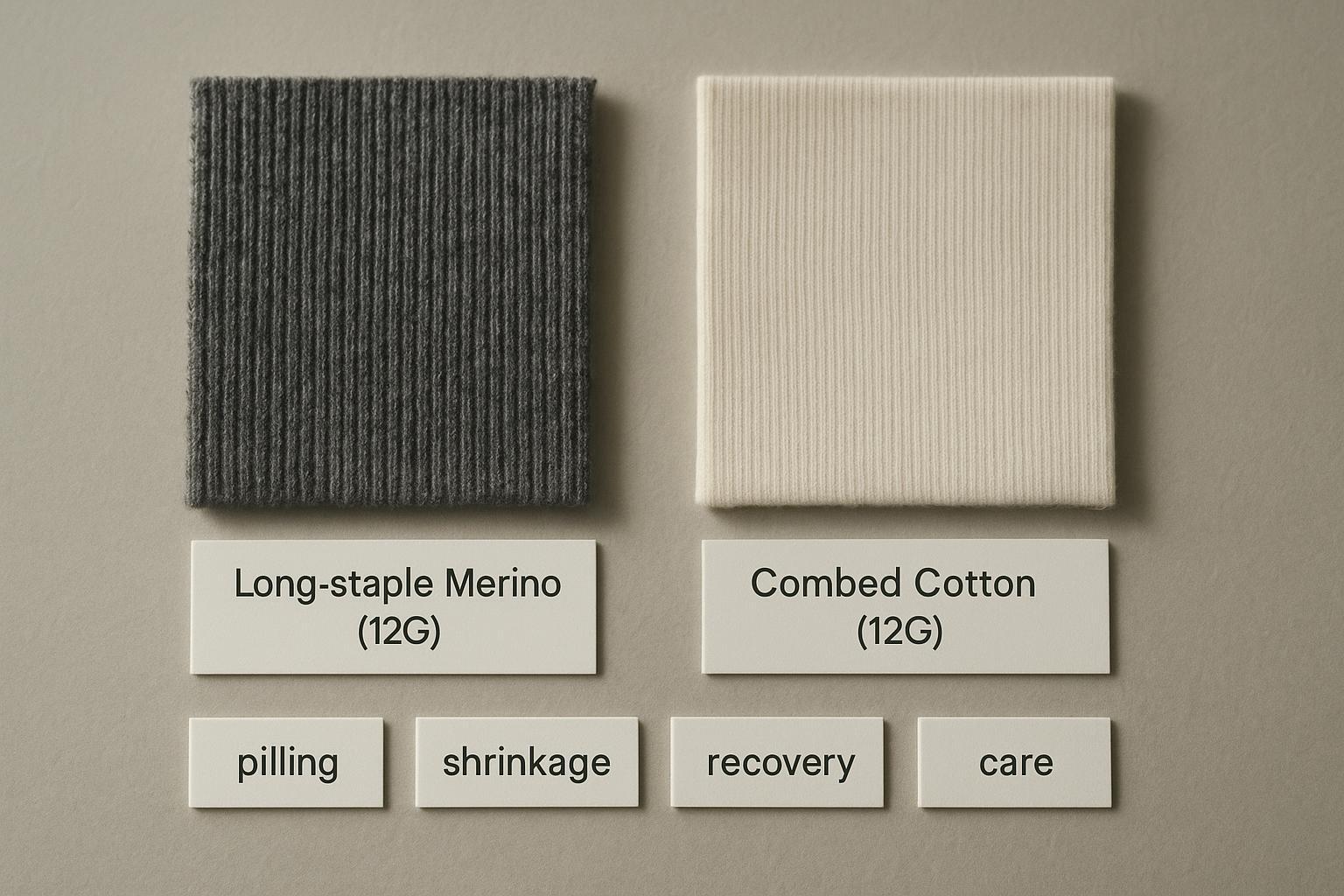
Mid‑gauge sweaters in the 7–12G range have to survive elbow rub on commutes, frequent chair‑back friction, and home laundering without losing shape. This comparison focuses on durability you can verify in the lab, not just marketing claims. We frame long‑staple Merino wool and combed cotton through four core KPIs you can test on swatches and then scale from sample to bulk.
Key takeaways
For frequent home washing with lower care burden, combed cotton in tight constructions and pre‑shrink finishing tends to be the safer choice, while long‑staple Merino narrows the gap when it is superwash treated and blocked properly.
For shape recovery, odor resistance, and balanced warmth‑to‑weight, long‑staple Merino usually has the edge thanks to fiber crimp and moisture management.
Neither fiber wins everywhere. Abrasion and pilling depend strongly on yarn engineering, gauge, and finishing, so verify with ISO and ASTM methods before you lock specs.
Use a “Core 4” test matrix for swatches: pilling, dimensional stability after home laundering, bursting strength for knits, and Martindale abrasion. Add colorfastness and recovery as secondary checks.
Methods and test matrix you can replicate
Here is the standards‑anchored test plan we recommend for mid‑gauge sweaters. Report exact parameters so results are repeatable between labs and lots.
Pilling resistance by ISO 12945. Use the modified Martindale method for knits and grade on the 1–5 visual scale after set checkpoints such as 2,000 and 5,000 rubs. See the grading approach in the Testex explainer in the article titled “Fuzzing and pilling resistance of fabrics — how to test and enhance it” (2022) for a plain‑English overview of apparatus and grades: pilling grading and apparatus explained.
Abrasion resistance by ISO 12947 Martindale. Record load, abradant, backing felt, and your endpoint. SATRA’s bulletin on Martindale materials explains compliant felt specs aligned to EN ISO 12947‑1: Martindale apparatus materials context.
Dimensional change after domestic laundering by ISO 5077 with ISO 6330. Mark per ISO 3759, run 5 and 10 home‑wash cycles on the program that matches your care intent, and report % length and width changes.
Strength for knits by ASTM D3786 diaphragm bursting. Report burst pressure and distension; this captures multidirectional knit behavior better than grab tensile for most sweater fabrics. See the ASTM scope here: ASTM D3786 bursting strength for textile fabrics.
Extended colorfastness checks by AATCC 61 for laundering plus AATCC 8 for crocking and AATCC 15 for perspiration. Intertek’s overview summarizes grading with AATCC gray scales: AATCC colorfastness methods overview.
If you need more detail on how to embed these tests into sampling‑to‑bulk workflows, see the process overview in the article “Custom Knitwear Manufacturer Guide” for QC planning and testing cadence: custom knitwear manufacturer guide.
Core 4 KPI comparison table for mid‑gauge sweaters
Below is a qualitative, methods‑first table for long‑staple Merino versus combed cotton in 7–12G sweater constructions. Use it to plan tests and anticipate tendencies. Replace with your own lab numbers when available.
KPI | Method and what to record | Long‑staple Merino swatch notes | Combed cotton swatch notes | Practical notes |
|---|---|---|---|---|
Pilling resistance | ISO 12945 modified Martindale; checkpoints at 2,000 and 5,000 rubs; grade 1–5 with lighting and viewer | Often strong in worsted, tighter‑twist yarns. Natural scale + finishes can reduce fuzzing. Superwash and tighter gauge help. | Risk rises in softer, lower‑twist ringspun yarns at looser gauges. Compact yarns and tighter stitches improve grade. | Pre‑finish and de‑pilling shears can mask early differences. Always report pretreatments. |
Dimensional stability after home washing | ISO 5077 with ISO 6330; show program code and drying; report %L/%W after 5 and 10 cycles | Without superwash, risk of felting/shrink if mishandled; with superwash and flat dry, can stay within retailer tolerances | Pre‑shrink compaction and tight constructions can stay within typical ±3%. Tumble drying raises risk unless compaction is optimized | State the care label and replicate it in testing. Flat dry vs tumble materially changes outcomes. |
Bursting strength for knits | ASTM D3786; report burst kPa and distension; note failure mode | Often robust relative to weight due to elastic loop structure; blends can lift values further | Compact, high‑count ring yarns can be very strong; construction density matters as much as fiber | Use the same swatch mass and gauge when comparing. |
Abrasion resistance | ISO 12947; record load, abradant, backing, endpoint definition; cycles to endpoint mean ± SD | Good when yarns are tightly spun and stitches dense; elbows and cuffs still high‑risk zones | Strong in dense jersey and ribs; softer, airy knits wear faster under chair‑back rub | Define endpoint consistently. Chair‑back and bag‑strap zones should drive acceptance thresholds. |
What side‑by‑side swatches tell you beyond the lab numbers
Handfeel. Long‑staple Merino typically reads softer and more temperature‑adaptive in wear, especially in 1×1 ribs or compact jerseys. Combed cotton reads cleaner and drier to the touch with a crisp surface in tight stitches. Both can be engineered for luxury hand with finishing, but Merino’s moisture regain and fine micron grades bring a comfort edge for many wearers.
Recovery and shape retention. Merino’s natural crimp supports better recovery after light set stretch at elbows and cuffs. Cotton improves markedly with tighter ribs, higher stitch density, or a small elastane content, though that can change breathability and care.
Shrinkage risk. For Merino, the difference between superwash with flat dry and untreated with agitation is night and day. For cotton, preshrink compaction, overfeed, and knit density control most of the risk, but high‑heat tumble can still push dimensional change beyond target ranges.
Care burden. Machine‑washable combed cotton sweaters are familiar to consumers and tolerant of mainstream cycles. Machine‑washable Merino is common now too, but still benefits from wool/delicates cycles and flat drying to keep the face neat and the fabric balanced. Woolmark’s care guidance notes that machine‑washable wool performs best on wool‑appropriate programs with mild detergents and flat dry to reduce deformation, which aligns with ISO 6330 domestic laundering conventions: washing wool in the machine explained by Woolmark.
Cost to spec. Raw yarn cost generally favors combed cotton at like‑for‑like quality levels; Merino costs climb as micron counts drop and when superwash finishing is added. The counter‑argument is cost per wear if Merino’s recovery, odor control, and low‑wash habits reduce laundering and help the sweater look newer longer. Your lab results and wearer trials should inform this narrative.
Scenario picks and a simple decision path
If you prioritize frequent home washing with minimal care burden for commuter wear, start with combed cotton in a tight, compact jersey or rib and a robust pre‑shrink program. Verify dimensional change within your brand tolerance after 10 home‑wash cycles.
If you prioritize low‑wash, odor‑resistant use with superb shape recovery for travel or capsule wardrobes, choose long‑staple Merino, ideally in a compact worsted yarn and appropriate superwash finish. Validate pilling grade and abrasion at elbows and cuffs.
If sensitive‑skin comfort is a must, choose superfine long‑staple Merino with a soft finish and run gentle‑care tests for shrink and appearance under wool programs and flat dry.
If you need balanced warmth‑to‑weight and packability, long‑staple Merino offers better thermal comfort when damp versus cotton, which is relevant for shoulder seasons and mixed‑climate commutes.
Care and risk controls that keep sweaters durable
Map your care label to the test program. For Merino, use wool or delicates cycles with mild detergents and flat drying, per Woolmark recommendations, to minimize felting and deformation. For cotton, align lab programs with the label’s normal or mild wash and your chosen drying method; if you allow tumble, verify stability at the same setting you specify on the label. For a deeper explainer on stabilization steps like washing, blocking, and compaction, see the process guide in the article “Knitwear Washing, Blocking and Stabilization” for production teams: washing, blocking and stabilization guide.
FAQ on merino wool vs combed cotton durability
Which is more durable for everyday mid‑gauge sweaters
It depends on the stress you care about. For frequent home washing and low‑maintenance care, combed cotton with tight constructions and pre‑shrink finishing often holds size more predictably. For shape recovery, thermal comfort, and odor‑resistant wear that reduces wash frequency, long‑staple Merino usually performs better. Verify with ISO 12945 pilling, ISO 12947 abrasion, ISO 5077 shrinkage, and ASTM D3786 bursting.
How much shrinkage should I expect after five to ten home washes
Treat this as a testable KPI, not a guess. Run ISO 5077 with ISO 6330 on the program that matches your care label and record % length and width change after five and ten cycles. Many brands target within ±3% for sweaters, but your acceptance should reflect your construction and care claims.
What pilling grade should I target for mid‑gauge sweaters
Use ISO 12945 modified Martindale and set checkpoints at 2,000 and 5,000 rubs. Many commercial programs consider grades around the mid‑range acceptable for everyday wear, with higher targets for premium lines. The Testex explainer provides grading visuals and apparatus context: how ISO 12945 pilling is graded.
Should I test bursting strength or grab tensile for knits
For sweaters, prioritize ASTM D3786 diaphragm bursting because it reflects multidirectional knit behavior better than linear grab tensile. See the ASTM scope for applicability to textile knits: bursting strength for textile knits.
Will color rub off or fade differently between Merino and cotton
Dye class and processing dominate. Validate with AATCC 61 laundering, AATCC 8 crocking, and AATCC 15 perspiration. Intertek’s overview summarizes grading and adjacent staining so you can specify thresholds in your tech pack: AATCC colorfastness grading overview. For additional troubleshooting and common buyer questions on pilling and shrinkage, see the Q&A hub: knitwear questions and answers.
Also consider for sampling and bulk replication
Disclosure: Xindi Knitwear (Knitwear.io) is our product. If you need a factory partner to run the Core 4 tests during sampling and replicate KPIs in bulk, the process overview in the manufacturer guide shows how to structure QC gates and documentation so results are consistent swatch‑to‑sweater: custom knitwear manufacturer guide.
Notes on sources mentioned in this article
ISO 12945 pilling methods and the 1–5 grading framework are summarized in Testex explainers from 2022.
Martindale apparatus materials and felt alignment to EN ISO 12947‑1 are discussed by SATRA in a 2021 bulletin.
ASTM D3786’s scope confirms bursting strength suitability for textile knits.
AATCC 61, 8, and 15 are the standard colorfastness methods used by major labs; Intertek’s overview outlines grading with gray scales.
Woolmark care guidance for machine‑washable wool aligns with domestic laundering programs and flat dry recommendations.