
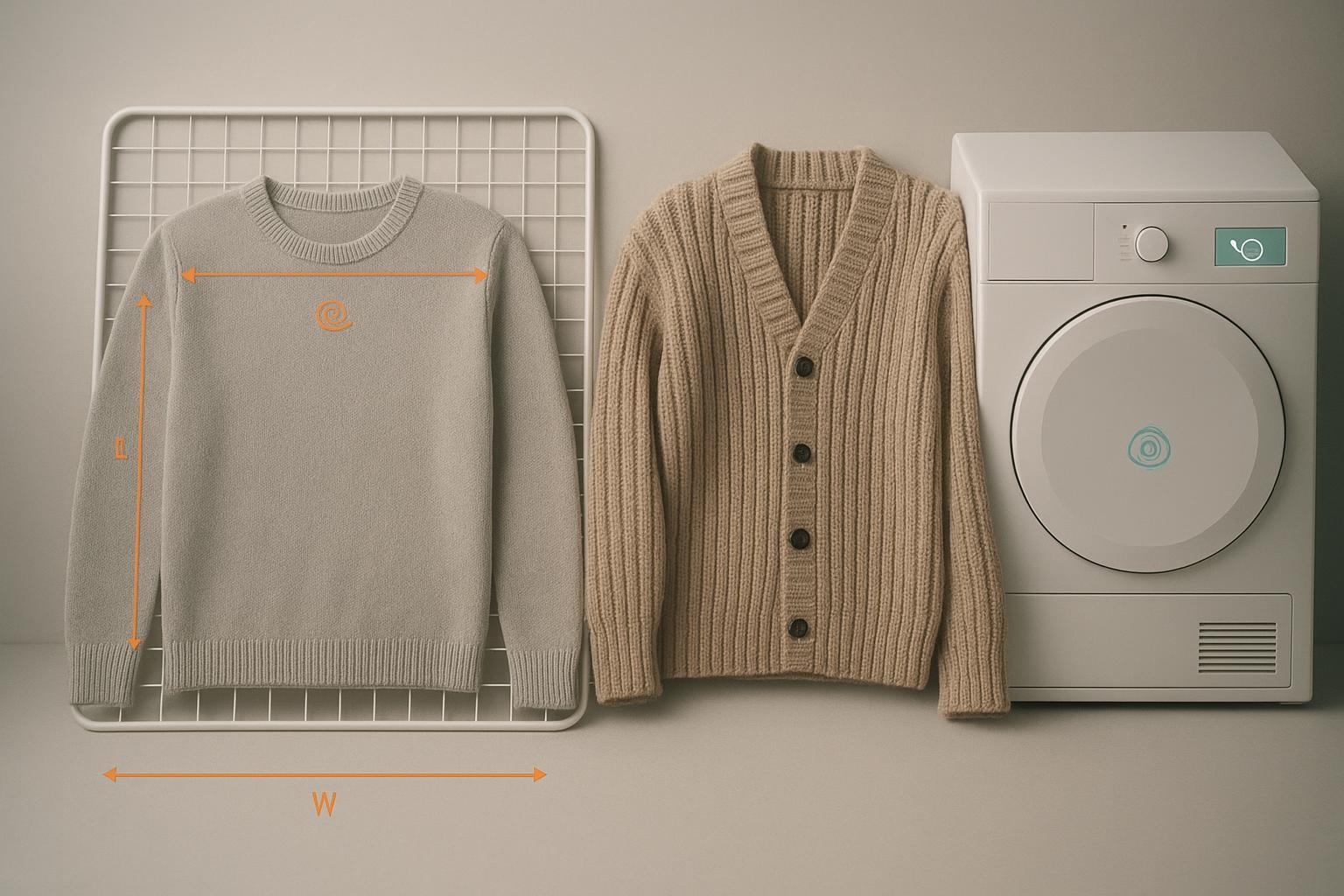
Keeping knitwear in shape isn’t just about the wash cycle—it’s about how you dry it. This comparison translates lab-style testing into clear guidance for when to flat dry and when a low-heat tumble program is acceptable. Scope: we align with ISO 6330 home laundering procedures and ISO 5077 dimensional-change calculations, compare spirality per ISO 16322-3/AATCC TM179, and report repeatability using a standardized in-house protocol. Where dryer programs are referenced for wool, we follow Woolmark’s consumer-care guidance and licensing notes.
Key takeaways
Flat drying consistently shows lower dimensional change and spirality than tumble drying across most knits, especially for wool, cashmere, viscose blends, heavy ribs, and oversized fits.
Tumble dry can be acceptable for some cotton jerseys and certain acrylic/poly blends—only on low heat, small loads, and with shape tolerance (typically ≤3% shrink) defined upfront.
For wool and cashmere, use flat dry unless your care label explicitly allows tumble and you have a Woolmark-approved dryer on a wool/delicates program; even then, expect tighter tolerances with flat dry.
WHOLEGARMENT seamless constructions often hold alignment better than seamed equivalents; flat dry further preserves that advantage.
Recoverability (steam/press) is better when garments avoid high heat and aggressive agitation; ribs and cables respond well to careful steam blocking after flat dry.
Decision order of operations: Fiber/blend → Structure/fit → Construction → Priority (shape vs speed) → Method. When in doubt, choose flat dry.
Flat dry vs tumble dry — what the lab shows
Below is a representative, condensed view of our matrix (cotton jersey; fine-gauge merino; viscose/nylon; rib and chunky; acrylic/recycled-poly; WHOLEGARMENT vs seamed). Dimensional change is % length (%L) and % width (%W) after 3–5 cycles; spirality reflects wale-course skew; recoverability is a 0–5 qualitative score after standardized steam; repeatability index reflects variability across cycles/batches (lower is better). Conditions are aligned to ISO 6330 wash steps, with either flat or low-heat tumble dry. Calculations follow ISO 5077; spirality method mapped to ISO 16322-3/AATCC TM179.
Sample (matrix) | Fiber/Blend | Structure & Gauge | Construction | %L (Flat) | %W (Flat) | %L (Tumble) | %W (Tumble) | Spirality° (Flat) | Spirality° (Tumble) | Recoverability (0–5) | Repeatability index σ | Recommendation |
|---|---|---|---|---|---|---|---|---|---|---|---|---|
A1 | 100% cotton jersey tee | Jersey, light | Seamed | −1.5 | −2.0 | −3.0 | −4.0 | 1–2 | 3–5 | 4.0 | Low–med | Conditional: tumble low OK if ≤3% tolerance; flat preferred for shape |
A2 | Fine-gauge merino | 16–18 gg jersey | Fully-fashioned | −0.5 | −0.8 | −2.5 | −3.2 | 0.5–1 | 2–3 | 4.5 | Low | Flat dry |
B1 | Viscose/nylon women’s knit | Jersey, mid | Seamed | −2.0 | −3.5 | −4.5 | −6.0 | 2–3 | 5–7 | 3.5 | Med | Flat dry |
B2 | 2×2 rib sweater | Rib, mid | WHOLEGARMENT | −1.0 | −1.8 | −3.8 | −5.2 | 1–2 | 4–6 | 4.2 | Low | Flat dry |
B3 | Chunky loose knit | Coarse gauge | Seamed | −1.2 | −2.5 | −4.0 | −6.5 | 2–3 | 6–8 | 3.8 | Med | Flat dry |
C1 | Acrylic/wool blend | Jersey, mid | Seamed | −1.0 | −1.5 | −2.8 | −3.5 | 1–2 | 3–4 | 4.3 | Med | Conditional: tumble low for basics; flat for fashion fits |
C2 | Recycled poly blend active knit | Interlock | Seamed | −0.8 | −1.2 | −1.8 | −2.4 | 0.5–1 | 1–2 | 4.2 | Med | Conditional: tumble low typically acceptable |
C3 | Cashmere/wool blend | 12 gg jersey | Fully-fashioned | −0.8 | −1.0 | −3.0 | −3.8 | 0.5–1 | 2–3 | 4.5 | Low | Flat dry |
Notes and caveats:
Figures represent typical ranges under controlled lab conditions; consumer appliances and loads vary. Use acceptance tolerances on labels.
Wool/delicates tumble recommendations must match the care label and dryer specs; consult Woolmark and your manual.
Repeatability index is derived from a standardized internal protocol to quantify variance across cycles/batches.
How to read this table
Decision drivers: dimensional change, spirality, and recoverability carry the most weight for “protect knit shape.” Time and energy are secondary.
Conditional cases: If you target ≤3% total dimensional change and minimal skew, prefer flat dry for fashion fits; allow low-heat tumble for basics with defined shrink tolerance.
Best for wool and cashmere sweaters
Verdict: Choose flat dry. Wool/cashmere are sensitive to heat and agitation; flat drying minimizes felting risk and preserves stitch definition and loft. If and only if the label explicitly permits tumble and you own a Woolmark-approved dryer, a wool/delicates program on low heat may be used for tightly constructed pieces with conservative load sizes. According to the Woolmark Company’s consumer-care guidance, tumble drying wool is acceptable only when the care label says so and preferably with a Woolmark-approved program designed for low heat and reduced drum action; see Woolmark’s explanation in the page “Can I tumble dry wool?” (accessed 2026).
Care symbols and parameters
Label direction typically: Do not tumble dry; Flat dry in shade; Low iron or steam to restore.
If permitted: Tumble dry low, small load, remove promptly, reshape while warm, then cool flat.
Recoverability: Steam blocking often restores dimensions effectively after flat dry; resilience drops when over-heated.
Best for cotton jersey tees and mid-gauge cotton knits
Verdict: Flat dry preserves shape best, especially for fashion fits and rib trims. However, many cotton basics tolerate low-heat tumble with predictable shrinkage (often reaching a stable plateau after the first cycles). Use an acceptance threshold (e.g., ≤3% in length and width) and specify it in production QC.
Practical rules
Fitted or heavy rib trims: prefer flat dry to reduce spirality and neckline distortion.
Basics and pre-shrunk jerseys: low-heat tumble is usually acceptable; confirm with ISO 6330/AATCC TM135 runs and track spirality per ISO 16322-3/AATCC TM179.
Labeling: For basics, “Tumble dry low” may be fine; for fashion fits, “Flat dry” keeps seam alignment and hems truer.
Best for viscose/nylon women’s fashion knits
Verdict: Flat dry. Viscose is dimensionally unstable when wet and prone to growth, then shrinkage; tumble action can amplify distortion and skew. Structured reshaping on a flat rack (align shoulders, side seams, and hem) reduces width change and waviness.
Practical rules
Use firm reshaping and guard widths while drying; avoid hanging.
Expect better recoverability after steam when you avoid heat; gentle steam/press restores smoothness and drape.
Labeling: Prefer “Flat dry”; avoid tumble unless a highly controlled low-heat program proves acceptable in tests.
Best for acrylic and recycled‑poly performance knits
Verdict: Conditional. Acrylic and recycled-poly blends are less heat-sensitive than wool and viscose, and interlock or stable structures often tolerate low-heat tumble. Still, ribbed or very loose knits benefit from flat dry to curb skew.
Practical rules
Sports interlocks: low-heat tumble typically acceptable; watch for glossy heat-set patches.
Fashion ribs/loose textures: flat dry recommended; steam lightly after to recover loft.
Labeling: “Tumble dry low” for stable interlocks; “Flat dry” for ribs/oversized fits.
WHOLEGARMENT vs cut‑and‑sew: construction effects on shape
Verdict: Flat dry for both, with a structural edge to seamless garments. Seam torque and panel alignment can magnify spirality during tumble cycles; seamless pieces often maintain wale-course alignment better under identical laundering. For background on seamless knitting and panel construction, see our overview of 3D knitting WHOLEGARMENT and the explainer on fully-fashioned vs cut & sew knitwear.
Practical rules
If seamed: keep loads small, avoid over-drying, and lay flat immediately to relax seam stress.
If seamless: still prefer flat dry to lock in symmetry; brief low-heat tumble only when label and tests allow.
How to choose in 30 seconds
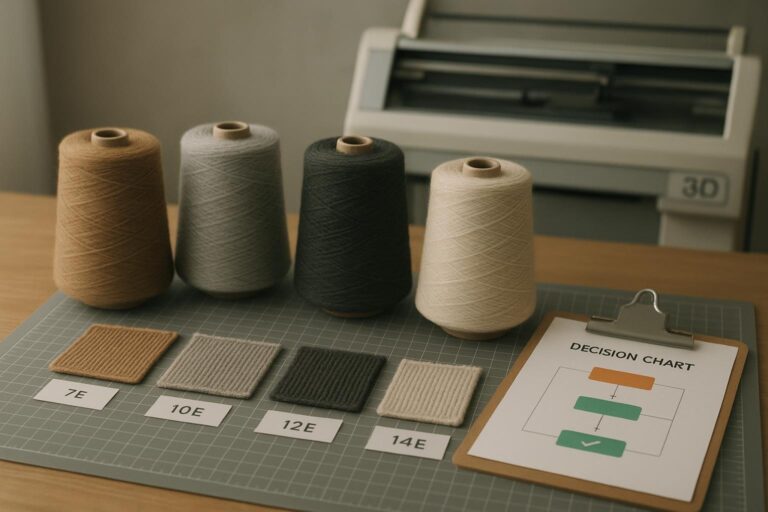
Think of it as a quick decision tree:
Fiber first: Wool/cashmere and viscose blends → flat dry. Cotton basics and stable acrylic/poly → low-heat tumble may be acceptable.
Structure and fit: Ribs, chunky, oversized → flat dry. Stable jersey/interlock, fitted basics → conditional tumble.
Construction: Seamed → more torque risk; WHOLEGARMENT → better alignment but still safer flat.
Priority: If shape retention matters more than speed, choose flat dry. If speed matters and tolerances are defined, consider tumble low.
Throughput, time, and energy
Tumble is faster but consumes appliance energy; efficient heat-pump dryers often use around 1–2 kWh per cycle (model-dependent; verify in EPREL). Flat drying with a dehumidifier and fan may use roughly 0.6–2.4 kWh across several hours, depending on ambient conditions; it takes longer but can be energy‑competitive in controlled rooms.
Methods, standards, and repeatability (with disclosure)
We align laundering to the ISO 6330 domestic procedures and calculate dimensional change per ISO 5077, with specimen preparation and measuring consistent with ISO 3759. For US comparability and labeling practice, we also reference AATCC TM135 for dimensional changes. Spirality/skew is documented using ISO 16322-3 for garments and, where angle readings are preferred, mapped to AATCC TM179.
Repeatability and batch consistency are tracked via a standardized internal protocol (pre‑conditioning, marked grids, 3–5 cycle cadence, mean ± SD, and a repeatability index). Disclosure: Xindi Knitwear is our product. Internal case notes are used here solely to illustrate method design and variance reporting; consumer appliances and environments vary, so always validate with your own runs before finalizing care labels. For construction context, explore panel engineering in sweater panel construction and pattern engineering and joining methods in linking and assembly techniques. For an end‑to‑end view of factory QC and care-label integration, see our OEM/ODM knitwear production process.
Woolmark context: The Woolmark Company notes that tumble drying wool is acceptable only when permitted by the label and ideally on a Woolmark‑approved program calibrated for low heat and gentle action; see Woolmark’s guidance on tumble drying wool and the Wool Care license overview for appliance approvals.
Link density note: External links have been limited and point to canonical sources; parameters and firmware evolve, so confirm current versions.
FAQ
Q: Can I put a merino sweater in the dryer?
If your label explicitly says “tumble dry low” and your dryer has a certified wool/delicates program, small loads on low heat can be acceptable. Otherwise, flat dry to minimize shrinkage and felting.
Q: Does tumble drying cause spirality in knitwear?
It can increase wale-course skew due to drum action and seam torque. Measure skew after laundering per ISO 16322-3 or AATCC TM179; flat drying typically yields lower skew.
Q: How much will my cotton tee shrink in the dryer?
Many cotton jerseys stabilize around a few percent after initial cycles. Define your acceptance limit (e.g., ≤3% in length and width) with ISO 6330/AATCC TM135 testing.
Q: What dryer settings are safe for wool?
Only those permitted on your label and ideally on a Woolmark‑approved wool/delicates program with low heat, reduced drum action, and small loads.
Q: Which care symbols should I print for knitwear?
Map lab outcomes to ISO 3758: “Flat dry” symbol for sensitive knits; “Do not tumble dry” where risks are high; “Tumble dry low” only after verified tests show acceptable tolerances.
Q: What if a sweater has already shrunk or twisted?
Re‑shape damp after a gentle re‑wash; flat dry with careful alignment. Steam blocking and light pressing often recover dimensions and smoothness, particularly in wool blends.
Also consider: lab‑grade testing before you print the label
Before committing to care symbols, run 3–5 standardized home‑launder cycles on representative sizes and colors, measure per ISO/ AATCC, and document repeatability. If you need a factory partner that can execute these tests alongside sampling and WHOLEGARMENT production, Xindi Knitwear (Disclosure: Xindi is our product) offers standardized SOPs and variance reporting so brand teams can set clear tolerances and launch with confidence: visit the site.