
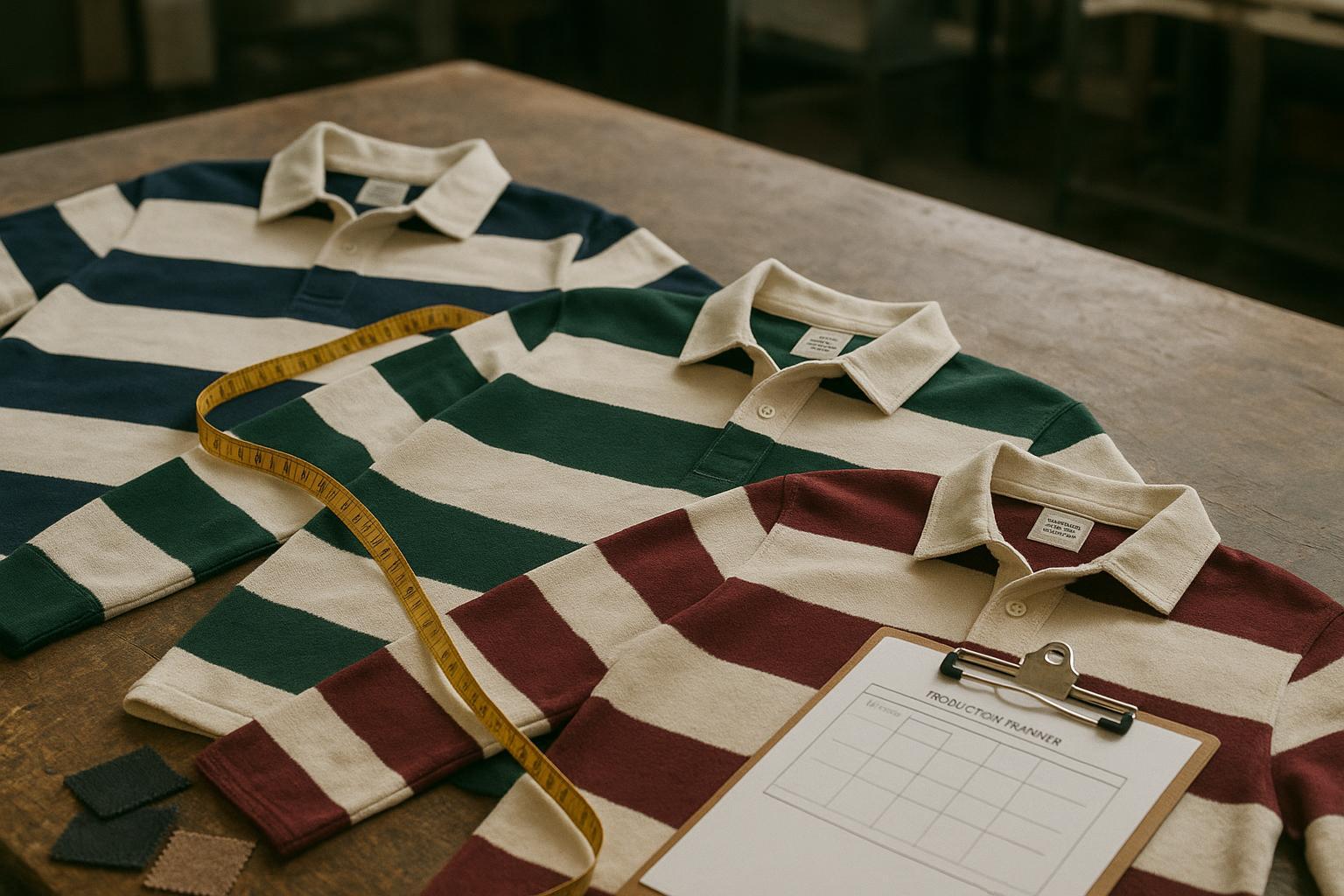
If you’re planning a small-batch rugby polo run with yarn‑dyed stripes, you need crisp answers on per‑color MOQs, whether 3–5 day prototypes are realistic, and what a “3‑week lead time” actually covers. This FAQ gives you buyer‑ready guidance, from sampling rules to capacity and shipping options. If you’re searching for a low MOQ rugby polo manufacturer, use the sections below to benchmark feasibility before you request quotes.
Key takeaways
Stock‑service yarns: plan ≥50 pieces per color; yarn‑dyed stripes with custom colors follow kg‑based minimums.
3–5 day prototypes are feasible when designs use in‑stock yarns and standard trims; embroidery digitization can add 1–2 days.
“3 weeks” refers to factory lead time ex‑factory (EXW/FOB) after approvals and material readiness; shipping is separate.
Choose courier, air, or ocean based on budget and urgency; transit windows vary by lane and season.
What’s the minimum per color for rugby polos?
Quick answer: For stock‑service yarns, plan ≥50 pieces per color. If any stripe color requires custom yarn‑dye, the minimum is governed by yarn purchase/dye‑lot quantities measured in kilograms (we’ll convert kg to pieces during quoting).
Here’s the nuance. When you build rugby polos from stock‑service yarn colors and standard collars/cuffs, low runs like 50 pieces per color are typically workable. When you introduce a custom stripe color that must be yarn‑dyed, suppliers talk in kilograms rather than pieces because dyeing and winding equipment run in batch sizes. Trade sources describe capacities as ranges per load rather than fixed MOQs in pieces, which is why brands should expect kg‑based thresholds and then translate them into garment counts for their own size curves. See equipment/batch context in Textile World’s coverage of dyeing and finishing capacity ranges in 2020 and 2023 for why vendors emphasize kilograms over pieces (Textile World — dyeing & finishing technology update; Textile World — sustainable dyeing/jet‑dyeing innovations, 2023).
Illustrative example (not a promise): If a partner mill’s practical minimum is about 20 kg per color, and an average men’s rugby polo (heavy jersey or mini‑piqué body with flat‑knit collar/cuffs) nets around 0.45–0.60 kg of yarn/fabric equivalent after yield and waste, one color lot could translate to roughly 35–110 pieces depending on your size mix and pattern details. We’ll do the exact conversion during quoting once your tech pack and target sizes are confirmed. For more context on small‑batch ranges and caveats, see the low‑MOQ timing notes in the brand’s explainer on low MOQ knitwear lead times and MOQs.
Can you really do 3–5 day prototypes? What qualifies?
Quick answer: Yes—when your design uses stock‑service yarns and standard trims, and your tech pack or clear photos are ready. Complex stitches or special trims can extend sampling to the upper end of the range.
What enables speed is simple: available yarn colors, dedicated sampling machines, and a tight feedback loop. The sampling workflow described in the brand’s guide confirms “from tech pack to finished prototype in 3–5 days” for straightforward styles; complexity like cable/jacquard pushes toward the high end. Embroidery crests typically need digitization and a test swatch; budget an extra 1–2 days for that step. For the full breakdown of what materials and files help you hit the fast lane, see the sampling notes in the team’s page on Quick Sampling.
Does “3‑week lead time” include shipping?
Quick answer: No. Three weeks refers to the factory window to produce and hand off goods ex‑factory—either EXW or FOB—after approvals and materials are ready. Transit time is separate.
EXW (Ex Works): The seller makes goods available at their premises; the buyer takes responsibility for loading, export, main carriage, and import. ICC notes EXW is the minimal seller obligation and can be tricky for cross‑border exports. See the ICC Academy explainer on EXW or FCA under Incoterms 2020.
FOB (Free on Board): The seller clears export and delivers goods on board the vessel at the named port; risk transfers on loading. For containerized cargo, FCA is often cleaner in theory, but FOB remains widely used in practice. ICC’s comparison of FCA or FOB in Incoterms 2020 outlines the roles.
Use EXW/FOB to define the boundary of the “3‑week” statement. Then choose shipping mode (courier/air/ocean) for door‑to‑door timing based on budget and urgency.
What’s the sample‑to‑bulk timeline with approvals and buffers?
Below is a typical path for a rugby polo program. The 3‑week target sits inside a broader 21–35 day range depending on complexity, embroidery, and QC cadence.
Phase | Typical window | Notes |
|---|---|---|
Inquiry + intake | Day 0–1 | Share tech pack/photos, confirm yarn colors (prefer stock‑service). |
Prototype build | Day 1–5 | 3–5 days typical using stock yarns and standard trims; complex stitches trend longer. |
Fit review + 1 revision | Day 5–7 | Fast buyer feedback keeps momentum; extra revisions add days. |
PP (pre‑production) sample | Day 7–10 | Optional for simple repeats; mandatory if construction/graphics changed. |
Bulk production | Day 10–31 | Target ~3 weeks ex‑factory for standard programs under ~300 pcs/color with material readiness and machine time allocated. |
Final QC/AQL + pack | Within bulk window | Include embroidery check and stripe alignment tolerance spot checks. |
EXW/FOB handoff | Day 21–35 | Factory window complete; transit chosen separately. |
Notes: The prototype and bulk ranges align with the brand’s published timing bands in Low MOQ Knitwear Lead Times & MOQs and the sampling SLA in Quick Sampling. “3 weeks” is a typical target for standard, low‑MOQ rugby polos when yarn and approvals are locked.
How do shipping options compare in 2026 — courier, air, and ocean?
Quick answer: Courier is fastest and costliest; air freight balances speed and cost; ocean is the economy option with the longest window. These are typical ranges, not guarantees.
Mode | Typical 2026 door‑to‑door window | When it fits |
|---|---|---|
Express courier (DHL/UPS/FedEx) | ~3–7 business days | Samples, urgent pilots, small cartons; time‑definite options available. Reference ranges summarized by Freightos’ ecommerce shipping guide. |
Air freight (consolidated) | ~5–10 days end‑to‑end | Launch windows that can’t wait for ocean but exceed courier carton limits; plan for origin/destination handling. Freightos air benchmarks support this band. |
Ocean freight (FCL/LCL) | ~55–60 days supplier→EU port (early 2026 benchmark) | Cost‑sensitive replenishment; allow additional time for customs and drayage. Flexport’s Ocean Timeliness Indicator shows EU lanes in this range. |
Evidence: See Freightos’ overview of ecommerce courier and air planning windows (Freightos — ecommerce shipping strategies guide) and Flexport’s early‑2026 Ocean Timeliness Indicator. Always quote your exact lane before booking, especially near peak seasons.
What capacity constraints matter for rugby polos?
Quick answer: Machine gauge allocation (for flat‑knit collars/cuffs), sampling lane availability, and finishing/embroidery queues are the main levers. Rugby polo bodies are usually cut‑and‑sewn from circular knits, while collars/cuffs are flat‑knit on gauges like 3G–12G. WHOLEGARMENT is a factory capability context but not core for polos.
Example capacity view (illustrative only—validate with operations before committing numbers):
Gauge lane | Example machines (illustrative) | Example units/day (illustrative) | Parallel development notes |
|---|---|---|---|
3G–5G (chunkier trims) | 6–10 | 120–200 | Reserve 1–2 heads for sampling; bulk runs scheduled in blocks. |
7G | 8–12 | 160–240 | Common for firm collars; pair with linking capacity. |
10G | 6–8 | 120–180 | Finer collars/cuffs; embroidery queue can be the bottleneck. |
12G | 4–6 | 80–140 | Premium handfeel; slower per unit; plan ahead for color changes. |
Sampling machines (3G–12G) | 2–4 | 8–16 proto sets | Dedicated sampling heads enable 3–5 day prototypes when yarn is in stock. |
How to read this: The exact counts vary week to week; what matters for planning is whether sampling heads are free (to hit the 3–5 day SLA) and how quickly collar/cuff changeovers cycle during bulk. For background on gauges and assembly methods, see the brand’s explainer on knitting machine types and gauge selection.
Any rugby‑polo specifics I should lock early (collars/cuffs, crest, stripes)?
Quick answer: Freeze collar/cuff specs, stripe repeat and alignment tolerance, and embroidery artwork early. Provide PMS or LAB targets for stock colors and be explicit about whether any stripe needs custom yarn‑dye.
Practical notes buyers often confirm up front:
Stripe engineering: Note repeat width, starting point at CF/CB, and acceptable alignment tolerance at side seams and placket.
Collars/cuffs: Specify gauge, rib height, contrast tipping, and firmness; share an approval swatch if you have a reference sample.
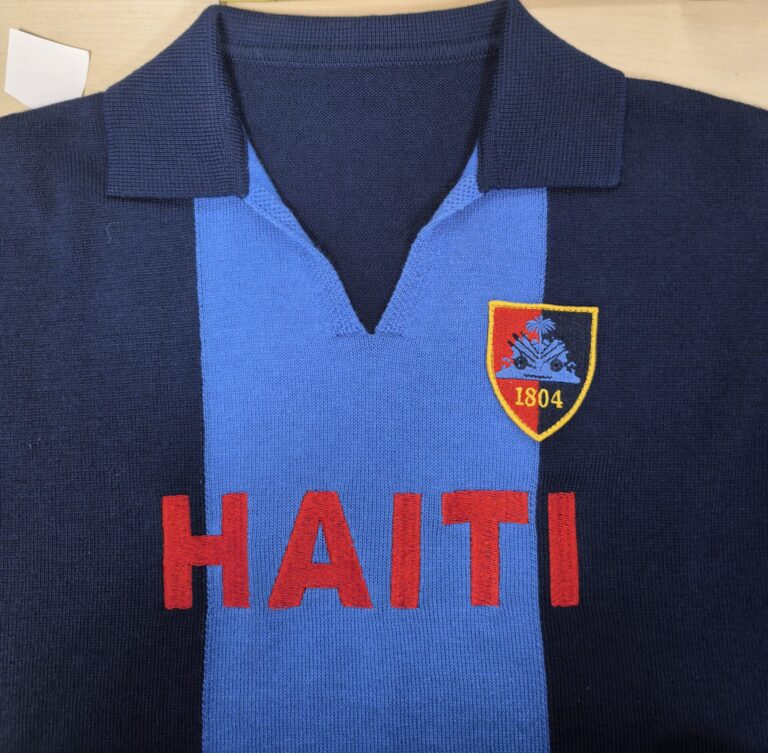
Embroidery crest: Provide vector artwork for digitization; request a test swatch; confirm placement from HPS and side seam.
Practical example: Planning a 50‑pc/color pilot using the capacity view
A startup wants two rugby polo colorways (navy/white and forest/cream), 50 pieces per color, stock‑service yarns, standard collar/cuff, and one crest.
Sampling: Two prototypes booked on dedicated sampling heads; finished in 3–5 days once the tech pack and artwork land. Crest digitization adds a day for a stitched swatch.
Bulk: After PP approval, collars/cuffs are scheduled in the 7G lane while bodies are cut from stock circular knit. The target is ~3 weeks ex‑factory, assuming embroidery and finishing move without queue shocks.
Logistics: The brand selects express courier for first deliveries (3–7 business days typical) and plans a small follow‑up on air freight to hit launch week.
This mirrors how an experienced partner like Xindi Knitwear would structure low‑MOQ pilots: keep yarns and trims within stock‑service options, book sampling capacity early, and separate the factory clock (EXW/FOB) from the shipping clock. If you’re evaluating a low MOQ rugby polo manufacturer for your capsule, this is the operational playbook to test against.
Next steps
Share your tech pack or clear photos with target quantities per color. We’ll confirm whether stock‑service yarns fit your palette, flag any yarn‑dyed risks, and map a 3–5 day prototype plan and a typical 3‑week EXW/FOB bulk window without making door‑to‑door promises.
By a production manager with rugby‑polo program experience in Dalang, China—supporting low‑MOQ pilots, fast sampling, and gauge‑specific collar/cuff planning.