
As of March 2, 2026 — This review evaluates AzKnit’s potential as an OEM/ODM partner for striped rugby polos through a technical, KPI-driven lens. Our “hero evidence” focuses on fabric durability/performance and delivery speed/flexibility. Important disclosure: AzKnit and Xindi Knitwear (Knitwear.io) are independent entities. We use Knitwear.io resources below only as neutral, educational references for QA/AQL methodology, not as evidence about AzKnit. Where primary documentation for AzKnit is unavailable, we mark findings as Insufficient data and withhold scoring.
Key takeaways
The intent of this review is to help sourcing teams compare “AzKnit striped rugby polo OEM ODM” capability on the two metrics that matter most for teamwear: durability under repeated wear/wash and the ability to sample/ship on time at realistic MOQs.
At the time of writing, AzKnit’s official website, certificate registry links (OEKO-TEX, amfori BSCI), case studies, and lab results were not publicly verifiable. All such claims remain Insufficient data until primary sources are provided.
What we need to fully validate AzKnit: certificate IDs with registry URLs, dated lab reports (ISO/AATCC methods), a rugby-polo case study with AQL pass %, defect/return rate, and timestamped sampling→production milestones.
If verified, the most decisive differentiators will be: pilling/abrasion resistance, colorfastness/shrinkage stability, stripe alignment tolerance across placket/side seams/cuffs, and demonstrable speed at low–mid MOQs.
Verdict snapshot (evidence-aware)
Overall recommendation: Provisional — request documentation and a test sample before committing.
Why provisional: Missing Tier 1 registry links and Tier 2 lab data prevent scoring of key dimensions today.
Pros (potential) | Cons / Risks |
|---|---|
Focus on rugby/polo category in public positioning suggests domain familiarity. | No verifiable official site or registry entries (OEKO-TEX/BSCI) as of March 2, 2026. |
If lab data supports strong abrasion/pilling/shrinkage outcomes, AzKnit could fit teamwear needs. | No public case study with KPIs (AQL pass %, defect/return rate, stripe tolerances, lead times). |
If MOQs/lead times are competitive, might suit seasonal and club calendars. | Unknown AQL plan, fit tolerance tables, or stripe-alignment SOPs. |
We are withholding numeric scores for all dimensions pending evidence.
How we evaluated “AzKnit striped rugby polo OEM ODM”
Our rubric (weights total 100; no score without evidence):
Stripe Alignment & Pattern Precision — 25
Fabric Durability & Performance — 25
Speed & Flexibility (Lead Times, MOQs, Change Management) — 20
Compliance & Sustainability (OEKO-TEX, BSCI) — 15
Engineering & Process Control — 10
Communication & Support — 5
Evidence tiers we accept:
Tier 1: Official registries (certificate IDs with Label Check/audit pages)
Tier 2: Third-party lab results or reproducible in-house tests (ISO/AATCC)
Tier 3: Consistent client testimonials (multi-platform)
Tier 4: ROI/impact claims (only with Tier 1/2 backing)
Educational methodology references used in this article:
For inline QC and AQL concepts in knitwear manufacturing, see the educational guide “Quality Assurance & Inline Production Control” on Knitwear.io: AQL and inline control explained.
For OEM/ODM workflow from sampling to PP to bulk, see “OEM/ODM Knitwear Production Process” on Knitwear.io: OEM/ODM process overview.
For shrinkage/pilling acceptance examples, see “Knitwear QC Guide” on Knitwear.io: QC guide on shrinkage and pilling.
Note: These links are educational only; they are not evidence of AzKnit’s performance.
Technical deep-dive
1) Standard rugby polo SKU assumptions
To compare vendors fairly, we use a reference spec most buyers recognize:
Fabric: 100% cotton pique or heavy jersey, 220–260 GSM
Stripes: Yarn-dyed, 2 colors, 18–22 mm width
Trims: 2×2 rib collar/cuffs; reinforced rugby placket with 3 buttons
Sizes: Unisex S–2XL; fit tolerance typically ±1–1.5 cm key points
Finishing: Enzyme wash; tumble dry medium
These assumptions make durability tests and stripe-alignment inspections comparable across suppliers.
2) Stripe engineering & tolerance targets
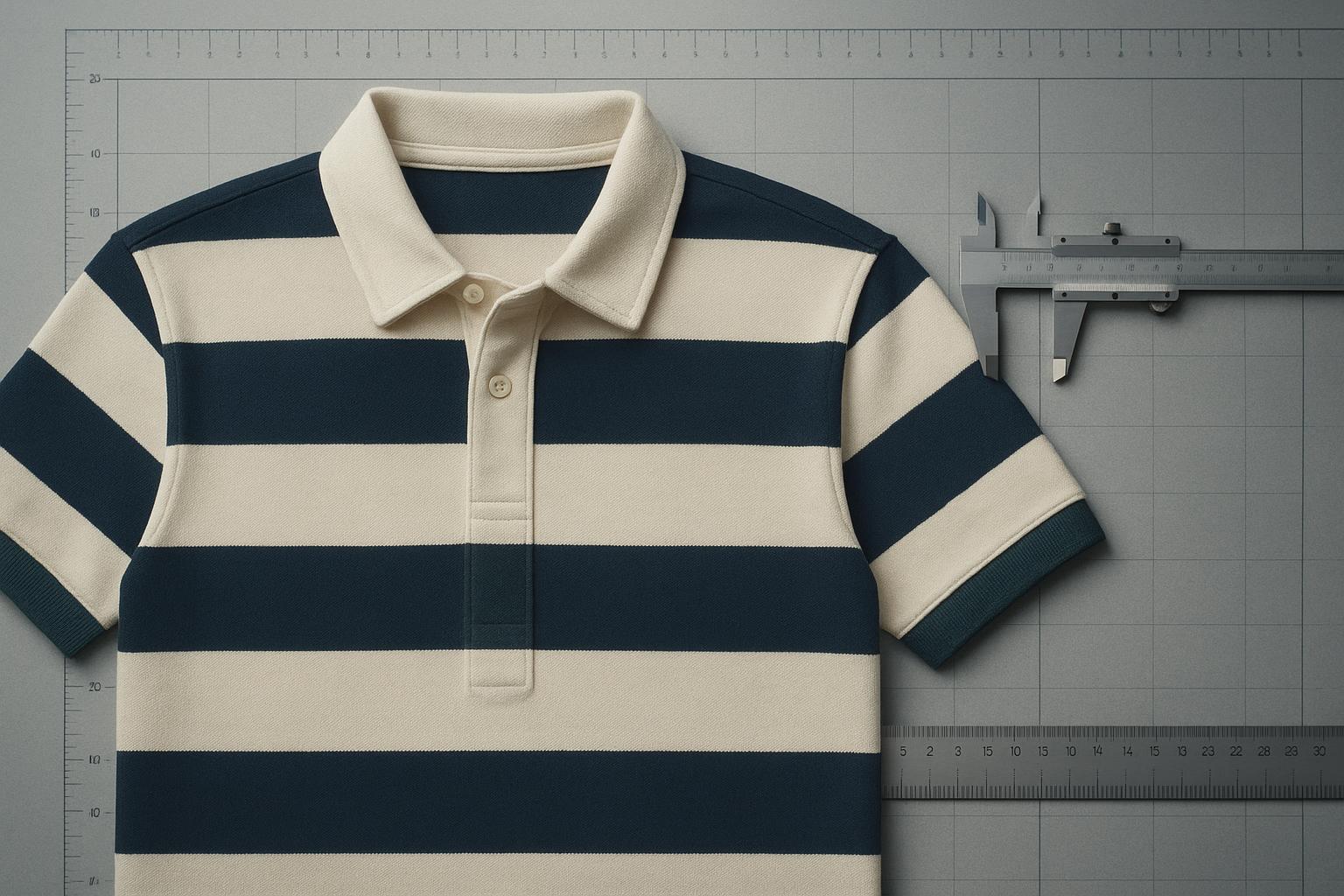
We inspect stripe match at four critical seams under D65 lighting with calipers. Targets below reflect best practice in retail rugby polos.
Seam location | Target max mis-match |
|---|---|
Center-front placket | ≤ 2 mm |
Side seams | ≤ 3 mm |
Armhole join | ≤ 3 mm |
Sleeve cuff join | ≤ 2 mm |
How we document: close-up photos with caliper readings and annotated measurements. Acceptance is based on percent of sampled units within tolerance and the maximum deviation observed.
3) Fabric durability & performance (hero evidence)
Required data to score:
Abrasion: Martindale cycles to endpoint (ISO 12947/ASTM D4966), target ≥ 20,000 cycles without hole.
Pilling: ISO 12945-2 grade after 2,000 rubs, target ≥ Grade 4.
Colorfastness: to washing (ISO 105-C06/AATCC 61), to rubbing (ISO 105-X12/AATCC 8), to perspiration (ISO 105-E04/AATCC 15), target gray scale ≥ 4.
Dimensional stability: shrinkage after 5 wash/dry cycles (ISO 6330/AATCC 135), target ≤ 3% length/width; track collar/placket distortion.
Status for AzKnit: Insufficient data pending lab PDFs or reproducible in-house test logs.
4) Speed & flexibility (hero evidence)
KPIs we expect to see for rugby polos:
Sampling: proto within 7–14 days; PP sample within 7 days of comments.
Bulk lead time: 30–45 days post-approvals at MOQ 500–2,000; faster if fabric greige is pre-positioned.
MOQs: by color/size; clarity on exceptions for pilot runs.
Change management: documented turnaround times for stripe CAD corrections, grading tweaks, and label/pack changes.
Status for AzKnit: Insufficient data — no verified MOQs, timelines, or change-SLAs published.
Case study anchor — needed to finalize this review
What we’re looking for (public-safe):
Market: e.g., a UK or EU heritage brand rugby polo order.
Scope: 1 SKU, 2 colors, 2,000 pcs.
Timeline: sample to bulk in ≤ 28 days; courier and PP timestamps.
Quality: AQL plan ANSI/ASQ Z1.4 General II @ 2.5 (or 1.5 premium); pass rate ≥ 97%; field return rate ≤ 1% after 60 days.
Evidence: lab reports (last 12–18 months), stripe mis-match photo set with calipers, shrinkage/pilling tables.
Status for AzKnit: Insufficient data — no public case accepted for citation yet.
Certifications & compliance
OEKO-TEX STANDARD 100: No public Label Check entry for “AzKnit/Az Knit” found as of March 2, 2026.
amfori BSCI: No public participant/supplier directory listing found as of March 2, 2026.
What we need: the exact certificate ID(s), facility legal name(s), scope, and validity window, plus the official registry/Label Check URLs. Without these, we cannot score this dimension. If/when supplied, we will update this review.
Operations, documentation, and QA expectations (custom rugby polo manufacturer standards)
What good looks like for a rugby-polo program with a custom rugby polo manufacturer:
A documented OEM/ODM workflow from tech pack → proto → PP → bulk, with clear approval gates and sample labeling. Educational reference: see Knitwear.io’s OEM/ODM process overview.
AQL plan with sampling levels, defect categories, and pass/fail criteria. Educational reference: Knitwear.io’s AQL and inline control explained.
Tolerance/fit sheets listing key measurement points and allowed variance; QC checklists for stripe alignment at CF/side seam/cuff.
Dimensional stability controls (wash tests before bulk); educational reference for shrinkage/pilling concepts: Knitwear.io’s QC guide on shrinkage and pilling.
Status for AzKnit: Insufficient data — none of the above documents are publicly linked as of today.
Alternatives to consider (neutral, evidence-led)
The vendors below publish more operational details than we found for AzKnit. Certificate claims are noted with on-page statements; where registry IDs are absent, treat them as unverified until checked.
Vendor | Region | Published MOQs/lead times | Certification visibility | Rugby/polo program signal |
|---|---|---|---|---|
Thai Son S.P. | Vietnam | States MOQ ≈ 1,000 pcs/color/style; lead time 75–110 days. Source: site pages as of Mar 2, 2026. | OEKO-TEX claimed on-site; ID not shown on page. Source: Thai Son S.P. certification page. | Knit T-shirt/polo capacity stated on site. |
Thygesen | Vietnam | FAQ lists samples 7–10 days; bulk 10–12 weeks including fabric. | OEKO-TEX/SteP asserted on site; Label Check URL not captured publicly. | Dedicated custom polo page available. |
SiATEX | Bangladesh | MOQs/lead times not clearly published on cited pages. | Claims ISO/WRAP/BSCI/SEDEX; registry links not shown on cited pages. | Multiple striped polo pages indicate capability focus. |
Customkit.eu | Latvia (EU) | Minimums from 5 pieces; express production up to 2 weeks. | Certifications not enumerated on the cited page. | EU teamwear producer; customs-light for EU buyers. |
Sources: Thai Son S.P. certification page and site; Thygesen certifications and FAQs; SiATEX striped polo supplier page; Customkit.eu private label. All accessed March 2, 2026.
Who should consider AzKnit — and who should not
Consider if: you can run a small pilot order with full documentation and independent lab tests before a major buy, and you’re prepared to validate MOQs/lead times directly.
Probably not a fit if: you require immediate proof of OEKO-TEX/BSCI via registry links, or you need published case studies and SOPs before first contact.
FAQ
Can AzKnit provide a PP sample and stripe-alignment proof? We require annotated photos with calipers at CF, side seam, armhole, and cuff, plus a summary table of max deviation. Status: Insufficient data until samples are provided.
What MOQs and lead times should we assume? Typical rugby-polo benchmarks are proto 7–14 days and bulk 30–45 days post-approvals at 500–2,000 MOQ, but we cannot attribute these to AzKnit without sources.
Does AzKnit hold OEKO-TEX/BSCI? As of March 2, 2026, we have not found registry entries tied to AzKnit. Provide Label Check and amfori directory URLs to confirm.
Are AzKnit and Xindi the same factory? No. They are independent entities. Any knitwear.io links in this review serve educational purposes only.
Methodology appendix and evidence request checklist
We score only what we can verify via Tier 1–2 evidence. To complete this review, please provide:
OEKO-TEX STANDARD 100 certificate ID(s) with Label Check URL(s) and validity window(s).
amfori BSCI membership/audit reference (public directory or audit summary page).
Lab reports (last 12–18 months): Martindale abrasion, ISO 12945-2 pilling, ISO 105/AATCC colorfastness, ISO 6330/AATCC 135 shrinkage.
A rugby-polo case study: volumes, timelines, AQL plan/results, defect/return rate, stripe tolerances with photo proof.
Operational KPIs: MOQs by stripe construction, sample and bulk lead times by tier, change-management SLAs.
If/when this evidence is supplied, we will update the review and assign scores across durability, speed/flexibility, compliance, and engineering control.
Author’s note: This review adheres to human-first, evidence-backed writing standards. External sources are limited and descriptive; all time-sensitive claims are tagged as of March 2, 2026. No sponsorship or affiliate relationship has influenced this analysis.