
If you’re ready to place a small run of beanies, scarves, gloves, or accessory sets, you don’t need another factory that says “low MOQ” and then quietly adds a per-color surcharge, a 2-week sampling queue, and a vague bulk timeline.
Here’s the practical verdict:
Verdict: Xindi Knitwear (Knitwear.io) is a strong fit for emerging labels that need 50-piece low MOQs, a fast sample loop, and a process you can control—especially when you’re launching accessories on a tight calendar.
This review is written for brands searching for a sustainable knit accessories manufacturer and a 3–5 day sampling knitwear factory—without getting trapped by hidden per-color minimums.
Who Xindi is (and isn’t) a fit for as a low MOQ knit accessories manufacturer
Xindi is a fit if you need:
Low MOQ starting at 50 pcs per style for early drops and demand tests.
A sampling partner that can turn a prototype in 3–5 days when inputs are clean.
A factory that can support certified material requests (OEKO‑TEX/GRS/RWS/GOTS options) and explain what documentation you’ll receive.
Technical capability for seamless construction (WHOLEGARMENT® / 3D knitting) when it actually benefits your accessory.
Xindi is not a fit if you need:
Ultra-low “1 pc” custom programs (those are usually promotional or not repeatable at bulk quality).
A partner that can publish every certificate ID publicly on a web page (most compliance packs are shared per project).
A guaranteed delivered cost for the US without first confirming HS code, fiber content, carton size, and shipping lane.
What “low MOQ” should mean for accessories (and where brands get burned)
Most brands don’t fail on design—they fail on math.
When a factory’s “low MOQ” is only low on paper, you get stuck with one of these traps:
MOQ per color that forces you into dead inventory.
MOQ per size ratio that doesn’t match how accessories actually sell.
Hidden costs from “small order fees” that erase your margin.
Xindi’s baseline is straightforward: low MOQ starting from 50 units—the practical benchmark many teams use when shortlisting a MOQ 50 knitwear manufacturer for small accessories drops— a level that’s realistic for accessories where you’re testing colorways and branding details before scaling.
What this means for you: you can run a tight first drop (50–150 pcs) and still keep your next move open—reorder, add colors, or kill the style without a warehouse problem.
Proof of speed: 3–5 day sampling plus accessory-specific timelines
If you’re in decision mode, sampling speed isn’t a nice-to-have. It determines whether you hit your content calendar, your wholesale pitch window, or a retailer’s preorder deadline.
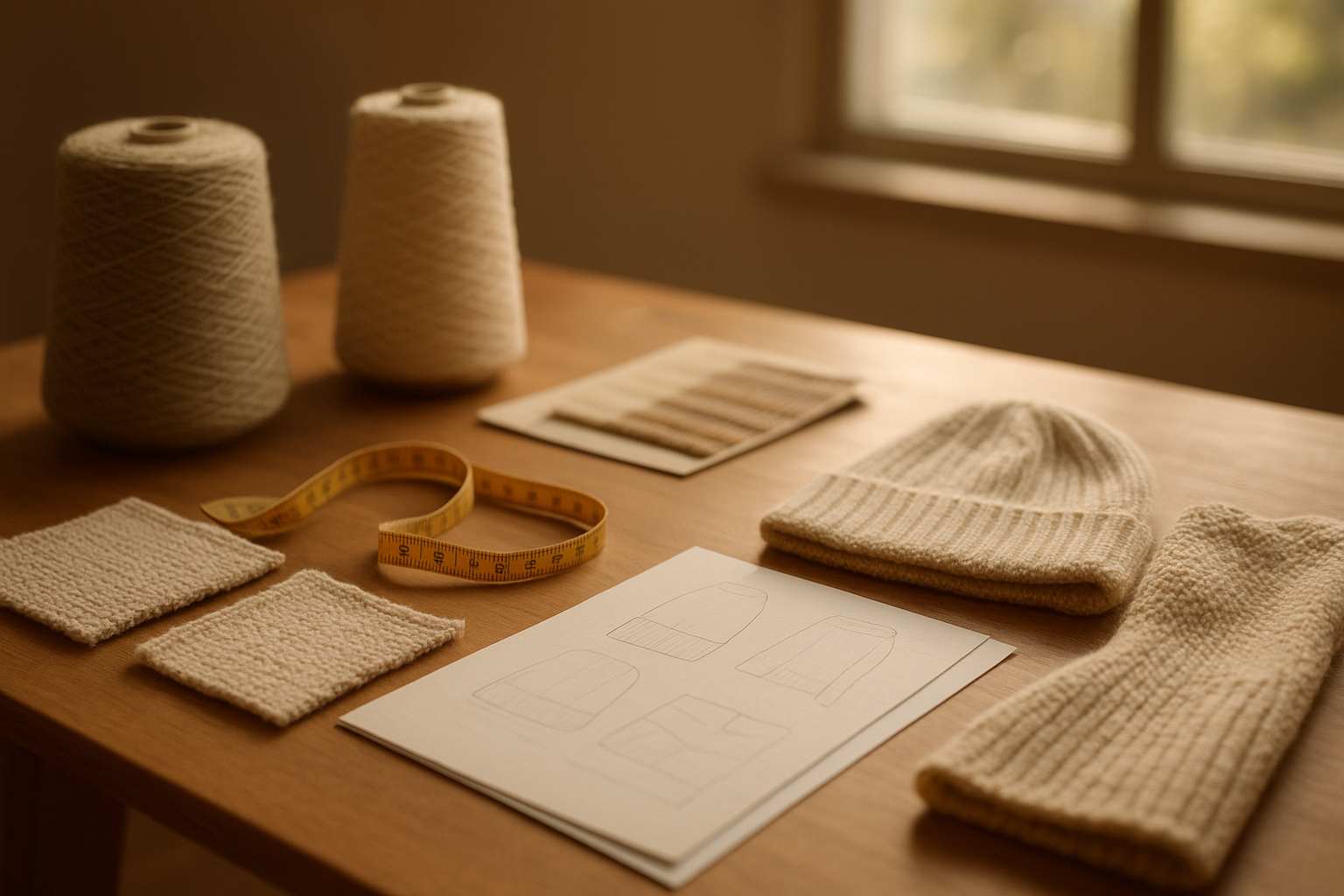
On Xindi’s own site, the quick sampling workflow states “from initial tech pack to finished prototype in 3–5 days,” with accessory timelines as short as ~3 days, and beanies at 2–3 days depending on complexity.
That page also breaks down what speed is actually made of:
Tech pack / reference submission
Yarn + gauge confirmation
Knitting + linking
Washing + finishing
Measurements + QC
Revision (if needed)
What this means for you: you can plan sampling like a sprint, not an open-ended “we’ll see.”
Risk control: how you avoid the sample-to-bulk quality cliff
The biggest fear at low MOQ isn’t a small defect rate—it’s inconsistency.
You approve a beautiful sample, then bulk arrives with different hand-feel, different measurements after wash, or a different stitch tension. That’s a brand reputation event, not a minor inconvenience.
Xindi’s sampling workflow emphasizes two controls worth calling out:
QC checkpoints built into the sample loop
Their sampling process includes checks for fit accuracy, tension behavior, surface stability, and color accuracy (outlined in the Quick Sampling page).
“Golden sample” discipline
The same quick-sampling documentation describes using a “golden sample” to lock the reference for bulk consistency.
Pro Tip: Treat the golden sample like a spec document. Photograph it under consistent light, record post-wash measurements, and freeze your yarn lot and stitch map before you approve bulk.
Sustainability without hand-waving: what certifications can (and can’t) prove
“Sustainable accessories” is easy to say and hard to document.
A credible program has two layers:
Material proof (what the yarn is)
Traceability + process proof (how it’s handled from fiber to garment)
Xindi’s Sustainable Knitwear program explicitly references certification frameworks like OEKO‑TEX Standard 100, GRS, RWS, OCS, and GOTS, and frames documentation around yarn-lot traceability and audit-ready packs.
Separately, the site’s FAQ confirms they can work with certified inputs: in “Do you support sustainable or certified materials?”, Xindi states: “We can produce garments using OEKO‑TEX certified yarns, recycled fibers (GRS), organic cotton, and responsibly sourced wool…”.
Important reality check: Certification scope numbers and transaction certificates are usually shared per order and per yarn lot. If you need certificate IDs for your launch claims or retailer onboarding, plan to request them during material approval.
3D knitting / WHOLEGARMENT for accessories: when it’s worth it (and what to ask a WHOLEGARMENT accessories manufacturer)
3D knitting is not marketing glitter. It’s a manufacturing method with real constraints.
On Xindi’s 3D Knitting & WHOLEGARMENT® page, WHOLEGARMENT is described as a seamless construction approach that eliminates major seams and reduces assembly operations. The same page ties it to waste reduction (citing <1% waste for 3D knitting vs. 10–20% for cut-and-sew).
For accessories, this matters in a few specific cases:
Comfort-first products (no seam irritation on beanies or neck pieces)
Cleaner interiors for minimal branding aesthetics
Repeatability once the programming is locked
But it’s not always the right choice. The same technical overview notes trade-offs: yarn stability requirements, programming complexity, and pattern constraints.
What this means for you: If your accessory is simple but premium (clean rib beanie, seamless neck warmer), WHOLEGARMENT can make sense. If you’re pushing hairy yarns or complex multi-color transitions, you may be better off with a different construction method.
Mini case stats: three timelines you can sanity-check
These are anonymized examples based on recent accessory/small-run timelines:
German brand: 100 pcs · 2 colors · 4 sizes · sample in 5 days · bulk in 3 weeks
UK TikTok influencer brand: 100 pcs · 1 color · 4 sizes · sample in 5 days · bulk in 3 weeks
Norway retail: 300 pcs · 3 colors · 4 sizes · preorder sample · bulk in 3 weeks
What this means for you: A 3-week bulk cycle only helps if you don’t spend 3 weeks drifting in revisions. The real win is a controlled sample loop.
How to start: a shortlist-ready sampling checklist
If you want a sample in 3–5 days, the input quality matters as much as the factory speed.
Here’s the checklist to send with your first message:
One tech pack (PDF) per style, with:
measurements (including post-wash tolerances)
yarn preference (or target hand-feel + fiber content)
stitch map / artwork (if jacquard or placement)
trims + label placement
Target MOQ (start with 50 pcs) and expected reorder path
Color plan (how many colors now vs. later)
Deadline (shoot date / launch / preorder close)
A simple milestone plan that keeps you out of revision hell:
Day 0: Confirm yarn + gauge + measurements
Day 2–5: Receive first prototype
Day 5–7: Fit/hand-feel review + one consolidated revision note
After approval: Lock the golden sample, confirm bulk materials, schedule production
⚠️ Warning: Don’t approve bulk until you’ve recorded post-wash measurements and confirmed what yarn lot and finishing process will be used for production.
FAQ
Is 50 pcs really possible per color?
The clean answer is: it depends on the yarn, gauge, and color plan. Xindi publicly positions low MOQs starting at 50 units, but you should confirm how MOQ is applied (per color vs. per style) during sampling so your inventory math stays sane.
Can you support OEKO‑TEX and GRS requests?
Yes—Xindi’s site states support for OEKO‑TEX yarns and GRS recycled fibers, and their sustainability pages describe how documentation and traceability are handled. Start by specifying your material requirement in the tech pack and request the documentation you’ll need for your product claims.
What’s the fastest realistic timeline from “go” to bulk?
Xindi’s Quick Sampling page frames sampling at 3–5 days and bulk as fast as 2–3 weeks under the right conditions (stock yarn, controlled revisions). Your fastest path is a clean tech pack, fast feedback, and one consolidated revision.
Next steps
If you’re already comparing factories and want a clear yes/no answer quickly, do this:
Send one accessory tech pack and your target MOQ (start at 50 pcs) and ask for a sampling slot.
Include your color plan and deadline so the factory can advise on the fastest construction method.
If you’d like, share your accessory concept (photo + target hand-feel + size spec), and we’ll recommend the sampling route that’s most likely to hit a 3–5 day window.