
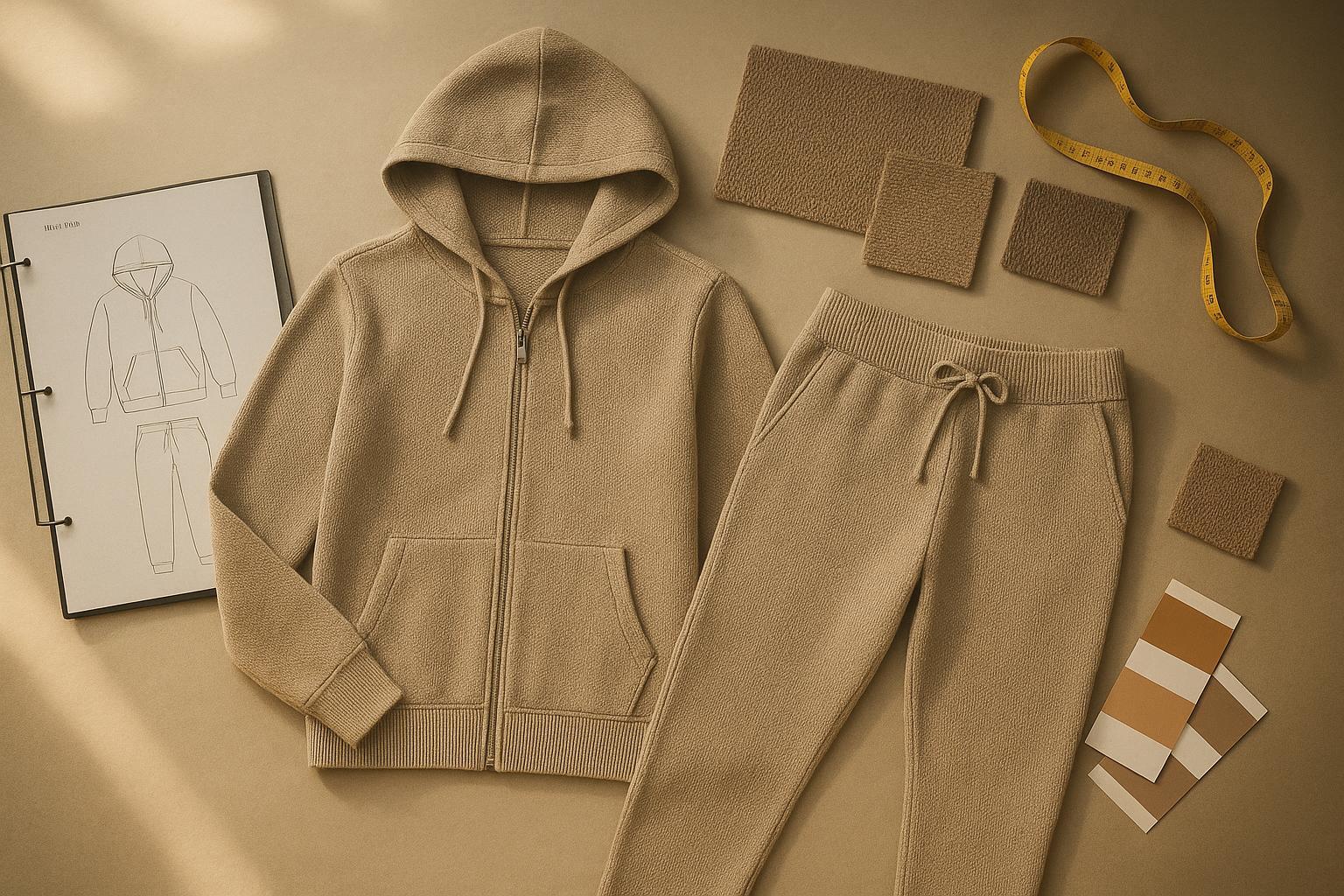
If you’ve ever tried to develop a knit tracksuit (top + joggers) like it’s just a “sweat suit, but nicer,” you already know the pain: the first sample looks close on the table, then it grows at the knees, rides up at the crotch, or comes back shorter after wash.
A custom knit tracksuit can feel premium and distinctive — especially with seamless construction — but only if your spec controls what factories actually build from: gauge, structure, finishing, and measurable checkpoints.
This is a MOFU, factory-ready guide for emerging brands that need to move fast without repeating samples three times.
Start with the constraint: WHAT WHOLEGARMENT changes in your tech pack
WHOLEGARMENT® is a form of 3D knitting (developed by Shima Seiki) where a garment is knitted in one piece, in three dimensions, with minimal or no seams. That’s the appeal — comfort and clean lines — but it also means your garment is “born” from a program, not cut panels.
Shima Seiki describes the concept on its official WHOLEGARMENT page.
The Woolmark Company’s overview of whole garment knitting technology frames it as an innovation focused on construction and comfort.
What this means for you: if your tech pack only lists body measurements and a sketch, you’re under-spec’d. For a WHOLEGARMENT knitwear tracksuit, you also need to control:
Zone-level structure (where it’s dense vs breathable; where it needs recovery)
Gauge and stitch density targets (and what “close enough” means)
Finishing expectations (because post-finish dimensions are what you sell)
Key Takeaway: With WHOLEGARMENT, “construction” is mostly programming. Your tech pack needs a stitch/zone map and version control — not just a silhouette.
The step-by-step spec workflow for a custom knit tracksuit
Use this sequence as your development loop. Each step ends with a deliverable you can hand to a factory.
Step 1: Define the use case and the “feel target”
Input: your references, target retail price band, and how the customer will wear this.
Action: write a 6–10 line wear brief:
Is it lounging, travel, streetwear, or light athletic?
Should it drape or hold shape?
How warm should it feel?
Is pilling tolerance low (premium) or acceptable (casual)?
Output: a one-page wear brief.
Done when: you can describe the tracksuit in touch + behavior terms (not only in aesthetic terms).
Step 2: Lock yarn + gauge + a 3D knitting tech pack “zone map”
Input: wear brief + any certification requirements.
Action: specify:
Yarn composition and yarn count (plus approved alternatives)
Gauge range (even if preliminary)
A simple stitch/zone map for both top and pants
If your design includes certifications (OEKO-TEX, GOTS, GRS, RWS), treat them as requirements to verify with documentation tied to the actual yarn lot — not just a label claim.
Output: yarn + gauge sheet + zone map.
Done when: you can point to each zone and explain what it’s doing (recovery, comfort, breathability, stability).
Pro Tip: Ask the factory to bind every revision to a specific program/file version. Otherwise, “Sample #2” is just a memory — not a reproducible build.
Step 3: Build your knitwear tech pack checklist like knitwear, not like woven pants
Input: base size (often your best-selling target size) + intended fit (regular/relaxed/oversized).
Action: create a spec sheet with:
A complete POM list (points of measure)
A tolerance table (what variation is acceptable)
Notes on whether measurements are taken relaxed vs stretched at openings
If you want a practical baseline for what factories expect across the workflow (inputs, sampling, and production checkpoints), use a manufacturing overview like the Custom Knitwear Manufacturer Guide.
Output: spec sheet + tolerance table.
Done when: someone who has never met you can measure the sample and decide pass/fail.
POM checklist: top (zip hoodie or crew)
At minimum:
Chest width (relaxed)
Body length (HPS to hem)
Shoulder width
Sleeve length
Bicep width
Armhole depth
Bottom opening (relaxed + stretched)
Cuff opening (relaxed + stretched)
Rib height (hem + cuff)
Hood opening / neck opening
Knit joggers fit measurements: POM checklist
At minimum:
Waist (relaxed + stretched)
Front rise and back rise
Hip
Thigh
Knee
Inseam and outseam
Leg opening / cuff opening (relaxed + stretched)
If you’re trying to avoid “baggy knees,” your knee width + stitch choice + finishing matter more than your inseam.
Step 4: Decide the construction truths for a seamless knit tracksuit
Input: sketches + zone map + POM spec.
Action: make four decisions explicitly:
Seamless vs hybrid
Full WHOLEGARMENT (max comfort, clean look)
Hybrid (seamless body + additional assembly for zipper/pockets)
Closure and neckline
Full-zip hoodie, quarter-zip, crew
Any hardware adds complexity: specify zipper type, tape color, puller finish
Waistband method (pants)
Fully knit waistband with drawcord
Elastic-in-casing
Exposed elastic (flatter, but needs careful control)
Pocket type (pants + top)
Inseam pockets (clean, low bulk)
Patch pockets (casual, can distort drape)
Zipper pockets (adds cost, improves security)
Output: a construction decision page.
Done when: you can answer “what exactly are we making?” without waving at the sketch.
⚠️ Warning: On small runs, multi-color complexity can quietly raise cost and risk. If your design depends on crisp micro-text or fine lines, expect knit translation to soften edges. Simplify early.
Step 5: Finishing, care, and shrinkage are part of the spec
Input: yarn choice + target handfeel.
Action: specify:
Target handfeel and appearance after wash (softness, fuzz level, drape)
Whether the garment must be washed / steamed / blocked before final measurement
Care label intent (machine wash cold? lay flat dry?)
Knitwear finishing impacts shrinkage and final dimensions; if you need a factory-side view of how yarn, knitting, washing, and QC connect, the OEM/ODM knitwear production process is a useful reference.
Output: finishing and care notes.
Done when: you’ve defined what “final, sellable condition” looks like.
Step 6: Sampling deliverables that prevent endless back-and-forth
Input: full tech pack.
Action: request that the factory returns:
Front/side/back photos + detail macros
An on-body try-on video (even if it’s basic)
A measurement table against your spec
Output: a sample review sheet with “approve / adjust / remake” decisions.
Done when: every change request is written as a measurable delta (e.g., “+1 cm chest width, -1 cm body length”).
Step 7: The pre-bulk QC test plan for knit tracksuits
Input: approved sample.
Action: decide what you will test before bulk approval:
Dimensional stability: measure before/after wash to confirm shrinkage stays within tolerance
Pilling risk: check high-abrasion zones (inner thigh, cuffs, elbows)
Colorfastness: especially on dark colors and contrast trims
Stretch & recovery: cuffs, hem, waistband, knees, elbows
Output: a one-page test plan + pass/fail thresholds.
Done when: you can say “yes to bulk” with fewer assumptions.
Common failure modes (and the spec change that prevents them)
The knees bag out after one wear
Usually caused by: insufficient recovery in the knee zone; too-relaxed fit; finishing that relaxes the structure.
Spec fix: tighten the zone map around knee; specify recovery expectations; test stretch/recovery at knees.
The waistband twists or rolls
Usually caused by: elastic not secured; waistband height too small; mismatch between elastic and knit recovery.
Spec fix: specify waistband construction method, elastic width, and anchoring points; add a waistband twist test.
The fit is “right” in photos but wrong in motion
Usually caused by: rise/crotch balance not validated; stretch hides issues until wear.
Spec fix: request a short movement try-on video (squat, step-up, arm raise) + measure after rest.
Bulk doesn’t match the approved sample
Usually caused by: program changes, tension changes, yarn lot differences.
Spec fix: version control: tie approvals to the exact program version, yarn lot, and finishing method.
Key takeaways
A custom knit tracksuit succeeds or fails on gauge, zone mapping, and finishing — not just silhouettes.
For WHOLEGARMENT, treat the program as part of the spec: version control isn’t optional.
Make sampling measurable: photos + on-body video + measurement table.
Don’t skip the test plan: shrinkage, pilling, colorfastness, and recovery decide whether bulk is safe.
Next steps
If you want a deeper, factory-facing overview of seamless construction options before you finalize your spec, read the Knitwear.io guide to 3D knitting & WHOLEGARMENT.
And if you’re building a shortlist of production partners for small runs, this guide on how to choose a knitwear factory for small brands can help you compare responsiveness, sampling process, and QC transparency.