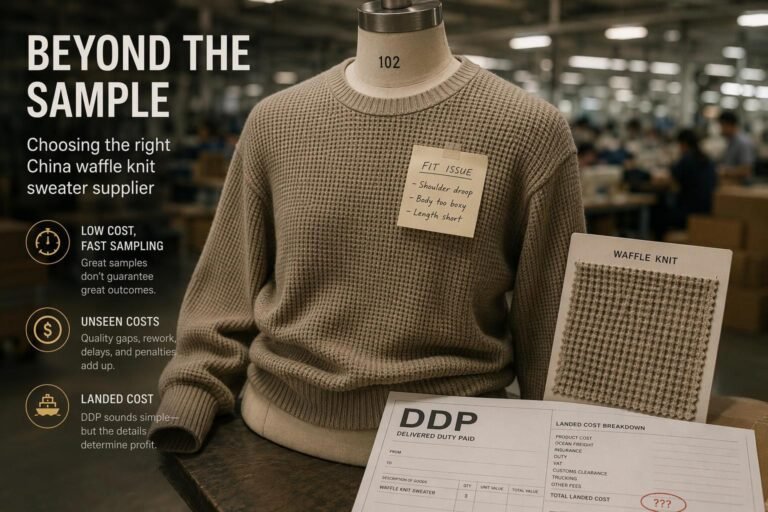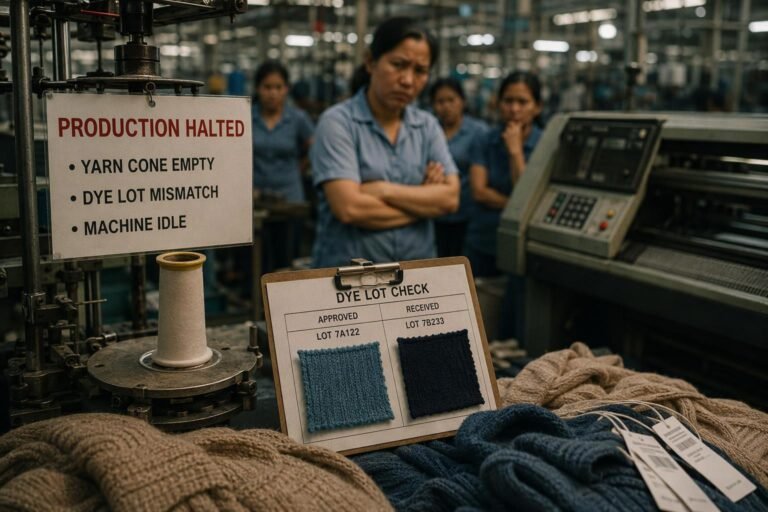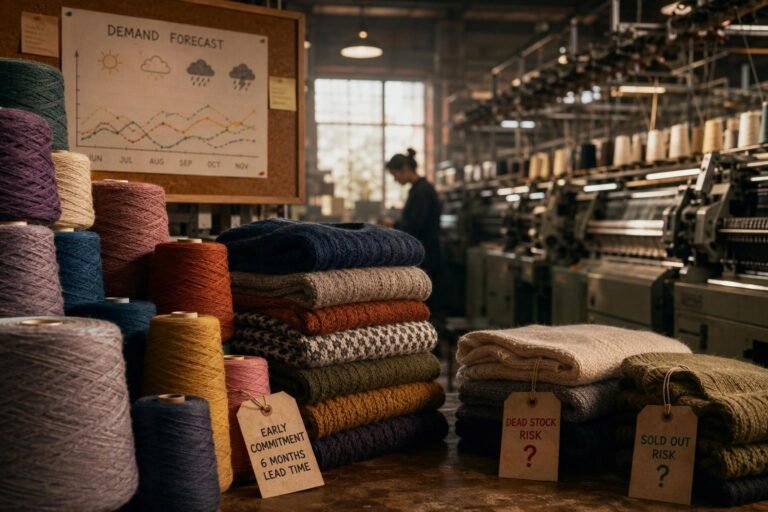

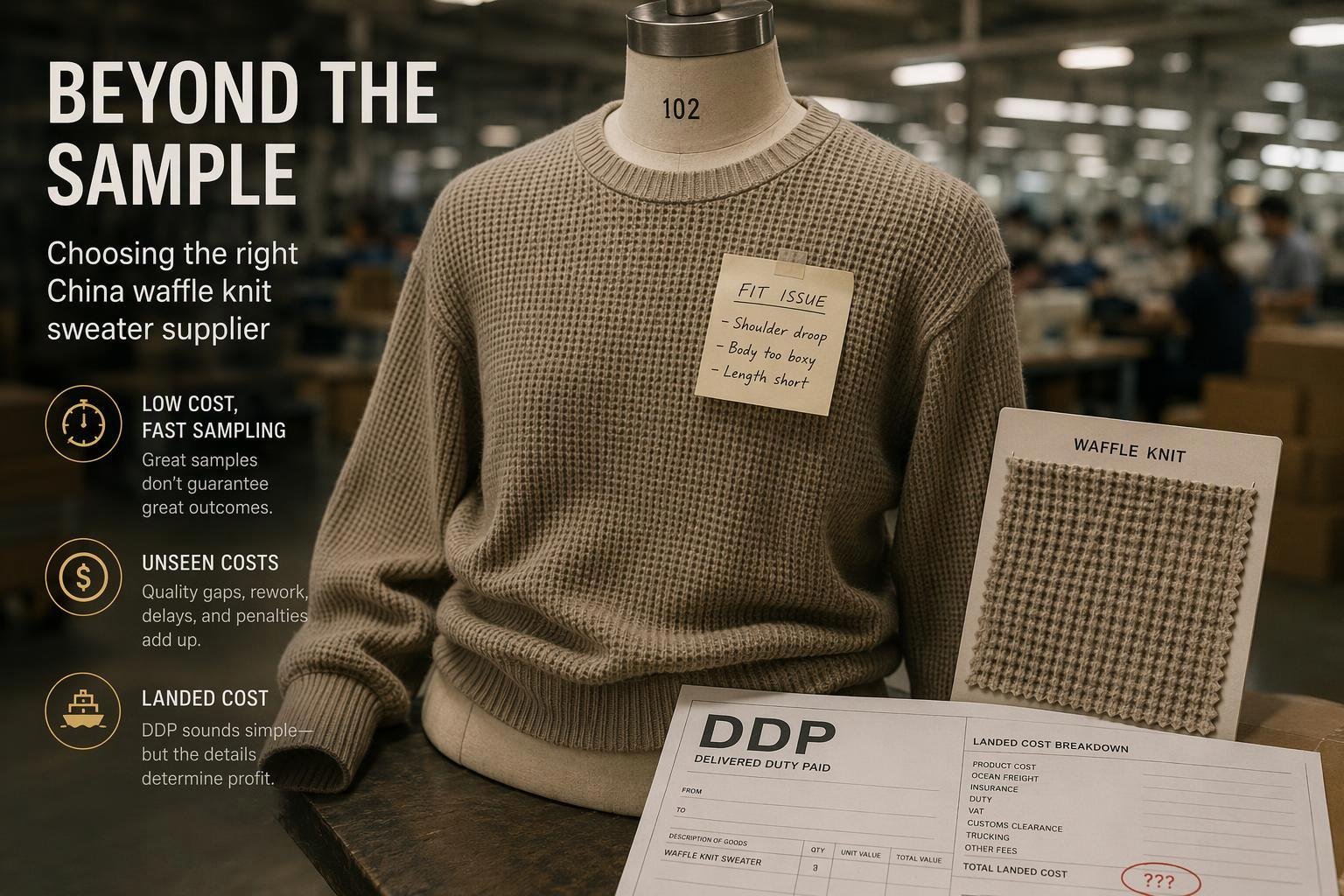
A low unit price, a three-day sample promise and a DDP quote can all be true at the same time — and still leave you with a garment that doesn’t fit your customer, a sample that never becomes bulk, or a landed cost that keeps growing after the invoice is paid. None of those three numbers is wrong on its own. The problem is that each one is only meaningful against a written specification, and most first-time buyers send the specification after they’ve already started comparing prices.
This guide is an evaluation framework, not a supplier ranking. It is written for North American and European independent brands and designer labels working at low volume — the first one to three seasons, where a pilot order has to prove a style without tying up cash you need for the next one. The sequence runs from your own requirements, through a comparable quote sheet and factory verification, into sampling, DDP arithmetic, waffle-specific quality control and a first order structured to limit exposure. Must-have criteria and red flags are separated throughout, so you can tell which gaps are negotiable and which ones should end the conversation.
Start With Your Own Requirements, Not the Supplier List
Before you open a supplier list, write down what you are actually buying. The same waffle crewneck can be quoted at very different prices and lead times depending on choices you make, not choices the factory makes — and a supplier who receives a vague brief will quote the cheapest interpretation of it, because that is the one most likely to win the order.
The decisions that move cost and time most:
Structure and weight. Waffle knit is a textured honeycomb structure, and the market commonly runs from roughly 180 GSM for lightweight layering pieces up to 360 GSM for heavier pullovers and hoodies (White Cotton’s fabric reference gives that band). Single-face waffle shows the honeycomb on the face and a flatter back; double-face carries texture on both sides and typically costs more at the same weight because it needs finer needles and slower machine speeds. Decide which one your design needs and state a GSM band with a tolerance, not a single number.
Fiber and yarn route. Yarn is the largest single line in a knitwear cost build — one published worked example puts it at roughly 45% of FOB for a 7-gauge cotton-blend crew (Yarnstick’s cost breakdown). Stock yarn shortens the critical path; custom-dyed yarn adds lab dips and a dye lot minimum before any knitting starts.
Gauge and construction. Gauge is the needle density of the machine, not a quality grade — a 12GG and a 7GG sweater are different products, not better and worse versions of one. Construction method (fully fashioned, whole garment, or cut-and-sew from knitted yardage) changes yarn waste, seam bulk and minimums.
Color count and size range. Every additional color is a separate yarn lot and often a separate minimum. Every additional size is grading work and a separate measurement set to approve.
Retail window and cash ceiling. Work backwards from your launch date, and set the maximum you are willing to have tied up in a first order before you ask for prices. That ceiling determines whether a pilot in one color is the right move.
What this means for you: write the brief down before the first email. A one-page specification with structure, GSM band, fiber, gauge, construction, colors, sizes, target date and budget ceiling turns every reply into a comparison instead of an impression.
Build a Comparable Quote Sheet Before You Email Anyone
Two quotes only compare if they describe the same garment. The practical fix is a single quote sheet you send to every supplier, with every field filled in or explicitly marked “not offered.” If a field comes back blank, ask once in writing; if it stays blank, treat the quote as incomplete rather than cheap.
Field | What to require |
|---|---|
Fiber composition and yarn type | Percentages by weight; stock or custom-dyed; named yarn count or ply if known |
Waffle structure and weight | Single-face or double-face; GSM with a stated tolerance (for example ±5%) |
Gauge | Machine gauge in GG, and confirmation that sample and bulk use the same gauge |
Construction | Fully fashioned, whole garment, or cut-and-sew |
Size grading | Base size, grading basis, and which market’s size chart (US, EU, UK) |
Color count and dye route | Number of colors, yarn-dyed or piece-dyed, lab dip responsibility |
Trims and labeling | Labels, hangtags, buttons, zippers, patches — who sources and who pays |
Packaging | Polybag, carton, folding standard, any retail-ready requirement |
Sample lead time | Working days from approved tech pack, and what is excluded |
Bulk lead time | Working days from sample approval to ex-factory, with a written schedule |
MOQ basis | Per style, per color, per size and per order — all four numbers |
Incoterm and named place | The exact term and the exact address or place |
Payment terms | Deposit percentage, milestone triggers, balance timing |
The MOQ line deserves its own paragraph, because it is where most comparisons quietly break. A supplier who says “MOQ 100” may mean 100 pieces per order, 100 per color, or 100 per style with a 50-per-color floor underneath. Ask for all four numbers explicitly. A per-order figure that hides a per-color minimum is the most common trap in low-volume sourcing: you plan a 100-piece pilot in three colors, then discover the real commitment is 150 pieces because each color carries its own floor.
What this means for you: the quote sheet is also your purchase order skeleton. Every field you define now is a field you can hold a supplier to later, and every field you leave out is one you will negotiate after you have already paid a deposit.
Tell a Real Manufacturer From a Trading Company
A trading company is not automatically disqualifying — many are competent, and some carry technical staff a small factory cannot. What matters is knowing which party is accountable for the knitting, the quality and the customs declarations, because that is the party you will be chasing when something goes wrong.
Evidence worth requesting, in roughly this order:
Business license scope. Ask for the license and read what the registered scope covers. A scope that includes manufacturing is a starting point, not proof; a scope limited to trading tells you the knitting happens elsewhere.
Where the panels are knitted versus where the garment is finished. These can be different addresses, and for knitwear that difference has legal consequences (below).
Machine list with gauge range. A flat-knit factory should be able to tell you which gauges it runs and on what equipment. A list that stops at “various” is not a machine list.
Whether sampling and bulk run on the same floor at the same gauge. This is the question that predicts sample-to-bulk consistency more than any other. A development room that knits samples on a different machine from the production floor is a common source of “the sample fit, the bulk didn’t.”
Knitting location matters beyond vetting. For knit-to-shape garments — fully fashioned and whole-garment styles — country of origin can follow the country where the panels are knitted rather than where the garment is linked, washed and packed. Cut-and-sew knitwear behaves differently: if the garment is cut from knitted yardage, origin generally falls to the assembly country. That distinction affects the origin label, the duty rate your entry pays, and which country’s compliance profile you are declaring. Confirm any specific determination with a licensed customs broker before you file, and put the knitting location on the tech pack and the purchase order rather than treating it as a logistics detail.
What this means for you: ask where the panels are knitted, not where the company is located. If the answer is an intermediary, ask who the knitting factory is, whether you can see its machine list, and which party signs the quality and origin declarations on your order.
What Actually Slows Sampling Down — and the Levers You Control
Sampling speed is usually presented as a factory capability. In practice it is mostly a function of what sits ahead of the first knit-down and how disciplined the approval loop is — and several of those inputs are yours.
The sequence before a sample exists:
Yarn availability. Stock yarn can be pulled quickly; custom-dyed yarn needs lab dips and dyeing first. Published accounts of the knitwear calendar put yarn dyeing and lab dips at roughly two to four weeks before a knit-down is possible, with proto and fit rounds adding several more weeks (Yarnstick).
Color approval. Lab dips are approved or rejected, and a rejection restarts the clock.
Programming. The structure, gauge and measurements are translated into machine programs.
First proto. The garment is knitted, linked and finished.
Fit rounds. Each round has a purpose: fit, then detail, then final sign-off.
The levers you control:
Tech pack completeness. A waffle knit tech pack should carry flat measurements by size, the GSM band and structure, fiber and yarn direction, gauge, color references, stitch and trim details, labeling placement, and reference images or a reference garment. The less the factory has to guess, the fewer rounds you need.
Reference garment quality. A physical reference communicates fit and hand-feel faster than any drawing. Send one if you have one.
Number of revision rounds. Budget two to three rounds and make each one count. A round that changes fit, color and trim at once produces a sample you cannot evaluate.
Speed of feedback. Every day a sample sits unapproved is a day added to your calendar.
Trims ordered alongside yarn. Labels, buttons and packaging that arrive after the garment is knitted turn a finished sample into a waiting sample.
A short example of how an incomplete brief costs time without adding information: a buyer sends a photo and asks for “a waffle hoodie, oversized, cream.” The first proto arrives at the factory’s default weight and gauge. The buyer realizes the hand-feel is too light and the body too long, so round two changes GSM and length. Round three fixes the hood proportion that was never specified. Three rounds have produced what one complete brief plus one fit round would have produced — and the launch date has moved.
One confirmation to build into every sample approval: ask whether the sample was knitted at the same gauge and with the same yarn as bulk will use. Factories sometimes knit samples in a development room and move production to the main floor, and a sample that does not represent the production setup is not a reference — it is a prototype.
What this means for you: treat a sampling quote as “working days from an approved tech pack with yarn in house,” and ask what is excluded. Then control the excluded parts yourself.
Read the DDP Quote Line by Line
A DDP quote is legitimately higher than FOB plus freight, because under DDP the seller handles export clearance, carriage, import clearance, duty and delivery to the named place. Under Incoterms 2020, DDP places the maximum obligation on the seller — including import formalities, which in some countries foreign entities are not permitted to perform at all (ICC Academy’s DDP explainer notes this constraint). The question is not why DDP costs more. It is whether the quote itemizes what it covers.
Illustrative landed-cost stack for a $10,000 FOB shipment of China-origin cotton waffle-knit pullovers (HTS 6110.20.20), entry 2026. Duty layers: 16.5% MFN + 7.5% Section 301 List 4A + 12.5% forced-labour Section 301 = 36.5% of FOB. MPF 0.3464% of customs value, capped at $670.86; HMF 0.125% (ocean only). Freight, insurance, brokerage and last-mile are assumed at $1,850. Illustration only — excludes AD/CVD, assumes no exclusions apply, and requires rate verification with a licensed broker before entry.
The layers a DDP seller absorbs:
Export clearance and origin documentation
International freight
Cargo insurance
Import clearance and broker fees
Customs duty
Import VAT or sales tax
Final delivery to the named place
Duty and VAT stack on the customs value, not on the FOB price alone. A transparent worked example: take a shipment with a customs value of $10,000 in cotton sweaters classified under HTS 6110.20.20, where the general duty rate is 16.5% (USITC tariff lines via Borderless). Duty is $1,650. Add freight and insurance of, say, $800, and the value on which import VAT or sales tax is assessed becomes $12,450. In the EU, import VAT applies regardless of value, while customs duty is relieved for goods sent directly to the buyer when their value does not exceed €150 (European Commission). In the UK, import VAT is normally 20%, and VAT-registered businesses can use postponed VAT accounting to declare and recover it on the same return instead of paying at the border (GOV.UK).
For US-bound goods, note that the de minimis exemption for non-postal shipments has been suspended, so low-value entries now go through formal or informal entry procedures rather than releasing free of duty (Federal Register). Duty rates within heading 6110 vary by fiber and construction — cotton, wool, cashmere and man-made fiber lines carry different general rates — so the classification of your actual garment drives the number.
The structural risk: under DDP the seller handles import formalities, but US customs law places responsibility for accurate declarations, classification and duty payment on the importer of record, regardless of who physically pays (StoneTurn’s analysis of DDP exposure sets out the penalty framework). If the supplier designates you as importer of record, or files under its own entity without telling you, the liability question needs an answer before the order ships, not after.
Questions to send back on any DDP quote:
Who is named as importer of record, and under what registration?
What is the exact named place of delivery — a full address, not a country or port?
What HTS or commodity code will be declared, and on what fiber and construction basis?
What customs value will be declared, and does it include freight and insurance?
Which duties and taxes are included, and at what rates?
What happens if duty is reassessed after entry — who pays, and under what clause?
Which broker will file the entry, and can you see the entry summary?
What documents will you receive, and when?
What this means for you: “door to door” and “tax included” are not terms. A DDP quote is usable when it names the importer, the place and the duty basis — and when the contract says who carries a reassessment.
Set QC Checkpoints That Match Waffle Knit’s Failure Modes
Generic AQL language does not catch what goes wrong in a waffle knit. The honeycomb structure has its own failure modes, and each one should become a measurable requirement in the purchase order rather than a verbal expectation.
Failure mode | What it looks like | How to specify it |
|---|---|---|
Collapsed or uneven cells | Dark spots or thin streaks in the texture; the waffle reads flat | Visual grading against the sealed sample; backlight inspection for cell integrity |
Skipped stitches | Holes or dropped loops in the knit | Visual inspection at knitting and linking; zero tolerance for open holes |
GSM drift | Fabric heavier or lighter than specified | GSM with a stated tolerance (for example ±5%) measured on the bulk lot |
Shrinkage | Garment measures smaller after washing | A named test method and limit, for example AATCC TM 135 |
Spirality | Side seams twist after washing | A named test method and limit, for example ISO 16322 |
Pilling | Surface fuzz and pills on the ridges | A named method and grade, agreed with the supplier and lab |
Colorfastness | Color bleeding or fading | A named method and grade, for example ISO 105-C06 |
Published starting points exist for several of these — one knit-fabric QC summary cites shrinkage of ≤5% after five washes per AATCC TM 135, spirality of ≤5% per ISO 16322, and colorfastness of Grade 4 minimum per ISO 105-C06 (TextileTuts). Treat those as a starting point, not a universal standard: confirm the applicable method and limit with your supplier and, where relevant, a testing lab, because the right limit depends on your fiber, your customer and your care label.
The checkpoints:
Approved sealed sample. Signed, dated, and held by both parties. Every later inspection compares against it.
In-line inspection during knitting and linking. Catch skipped stitches and tension problems while the machine is still running, not after finishing.
Pre-shipment inspection with a stated sampling plan. Name the sampling plan and the AQL levels in the PO so the inspection has a pass/fail basis.
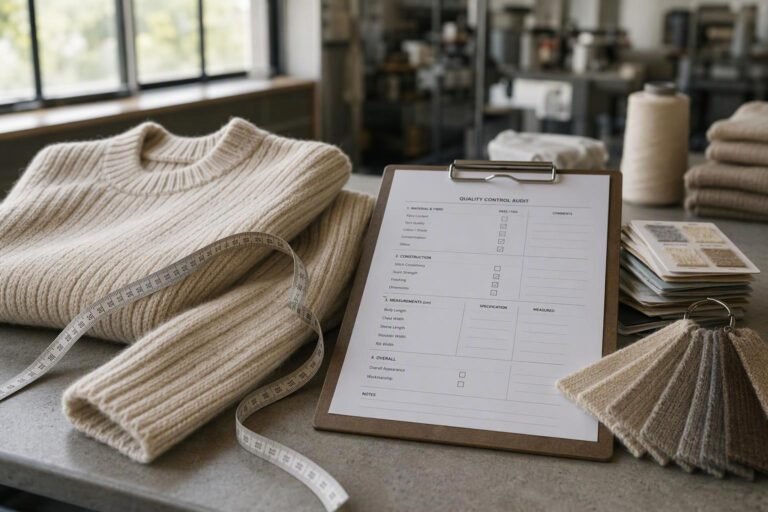
Backlight check. Lay the fabric or garment on a light table and look for dark spots (collapsed cells) and bright streaks (thin areas). It is a low-cost in-house check you can ask the factory to run and document.
What this means for you: a waffle knit PO should read like a test schedule, not a description. “Good quality waffle” is not a requirement; “200 GSM ±5%, shrinkage ≤5% per AATCC TM 135 after five washes, spirality ≤5% per ISO 16322” is.
De-Risk the First Order Without Over-Committing Cash
The goal of a first order is sellable stock with limited exposure, not the lowest possible unit price. Those two goals pull in opposite directions, and the sequence below favors the first.
Pilot in one or two colors. Color consolidation is the single biggest lever on minimums. Fewer colors means fewer yarn lots, fewer lab dips and a smaller commitment per style.
Use stock yarn where the design allows. Stock yarn removes the dyeing step from the critical path and typically lowers the minimum. If your brand story depends on a custom color, keep the custom color for the style you are most confident in and pilot the rest in stock shades.
Structure payment against milestones. A deposit to start, a payment on sample approval, a balance against shipping documents. Milestones give you a decision point at each stage instead of one large commitment up front.
Order trims with the yarn. Labels, hangtags and packaging that arrive late delay the whole order.
Hold a sealed sample as the production reference. It is the cheapest insurance you will buy on the order.
The trade-off to reason through explicitly: a slightly higher unit price at low volume is usually cheaper than unsold inventory. If a pilot of 100 pieces costs a few dollars more per unit than a run of 500, the extra cost is bounded and known. The cost of 400 unsold pieces is not bounded — it includes the cash, the storage and the markdown. Run the arithmetic on your own expected sell-through before you let a volume discount talk you into a larger first order.
A blanket order with staged releases can work when you have confidence in a style and want to lock capacity and yarn without taking delivery of everything at once. It suits a repeat or a proven silhouette more than a first-time style.
Terms that belong in the PO rather than in a chat message: the approved specification and sealed sample reference, the MOQ basis per style and per color, the inspection standard and sampling plan, the delivery date and named place, the Incoterm, the payment milestones, and what happens if the delivery date slips.
What this means for you: decide the maximum cash you are willing to have tied up before you negotiate price. Then negotiate inside that ceiling.
Common Mistakes to Avoid
Comparing quotes built on different specifications. The cause is a brief that left fields open, so each supplier quoted its own default. The fix is the quote sheet: one specification, every supplier, blanks treated as incomplete.
Treating a per-order MOQ as if it were per-color. The cause is a single number with no basis stated. The fix is asking for per-style, per-color, per-size and per-order minimums in writing.
Accepting “door to door” or “tax included” without a named place and importer. The cause is convenience language standing in for contract terms. The fix is a DDP quote that names the importer of record, the full delivery address and the duty basis.
Approving a sample without confirming it matches bulk gauge and yarn. The cause is a development room that differs from the production floor. The fix is a written confirmation, plus a sealed sample held by both parties.
Leaving trims and labels until the end. The cause is treating them as packaging rather than production inputs. The fix is ordering them with the yarn and putting them on the critical path.
Specifying quality verbally. The cause is “good quality” as a requirement. The fix is measurable PO terms: GSM with tolerance, named test methods and limits, a stated sampling plan.
Putting It Together: A Decision Sequence
Write the brief. Structure, GSM band, fiber, gauge, construction, colors, sizes, target date, cash ceiling.
Build the quote sheet. Every field from the table above, with MOQ broken into per style, per color, per size and per order.
Shortlist suppliers and request evidence. Business license scope, knitting location, machine list and gauge range, and whether sampling and bulk share a floor.
Compare quotes on matched specifications. Discard or requalify any quote with blank fields.
Read the DDP layer by layer. Importer of record, named place, commodity code, customs value, duty and tax basis, reassessment clause.
Agree QC checkpoints and the sealed sample. Waffle-specific requirements written into the PO, with test methods and limits.
Place a pilot order with milestone payments. One or two colors, stock yarn where possible, trims ordered with the yarn.
For a repeat order with an existing supplier, the sequence compresses: the brief and quote sheet already exist, the sealed sample is on file, and the DDP terms are agreed. What remains is confirming yarn availability, the delivery date and the inspection plan.
Next Step
The most useful next action is not to request a price — it is to finish the specification sheet and ask for swatches and a sample quote against it. A supplier who receives a complete brief can tell you what your garment will cost, how long the sample will take and what the DDP landed cost will be, because the variables are defined.
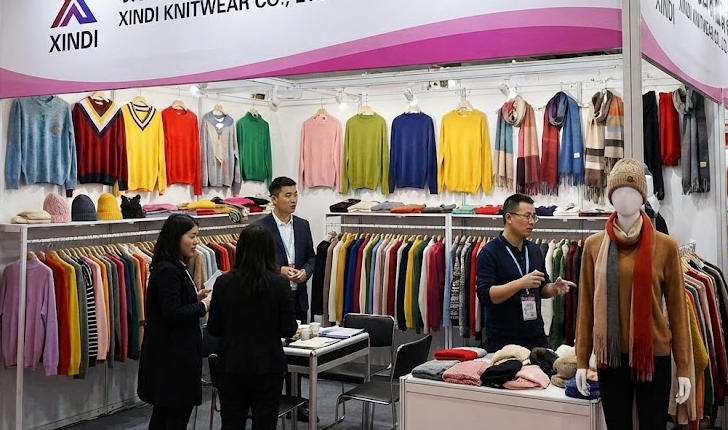
If your brief points toward a China-based partner, Xindi Knitwear in Dalang works with low-MOQ production, sampling quoted at 3–5 days from a tech pack or reference photos, and waffle knit styles including a midweight thermal waffle hoodie. Those timelines assume a clear specification and yarn availability, so the brief comes first. DDP terms should be confirmed in writing with a named place and importer before any order is placed, whichever supplier you choose.
Send the specification sheet, the GSM band and a reference image or garment, and ask for swatches plus a sample quote that states what is included and what is excluded.
Key takeaways
A low unit price, a fast sample and a DDP quote are only meaningful when compared against the same written specification.
MOQ must be quoted per style, per color, per size and per order; a single number usually hides a per-color minimum.
A DDP quote exceeds FOB plus freight because it carries duty, import VAT or sales tax and clearance; itemize it and name the importer and delivery place.
Sampling speed is driven by tech pack completeness, revision rounds and approval speed — levers the buyer controls.
Waffle knits need their own QC requirements: cell integrity, GSM tolerance, shrinkage, spirality, pilling and colorfastness, specified as measurable PO terms.
A pilot order in limited colors, with milestone payments and a sealed reference sample, limits first-order exposure.