
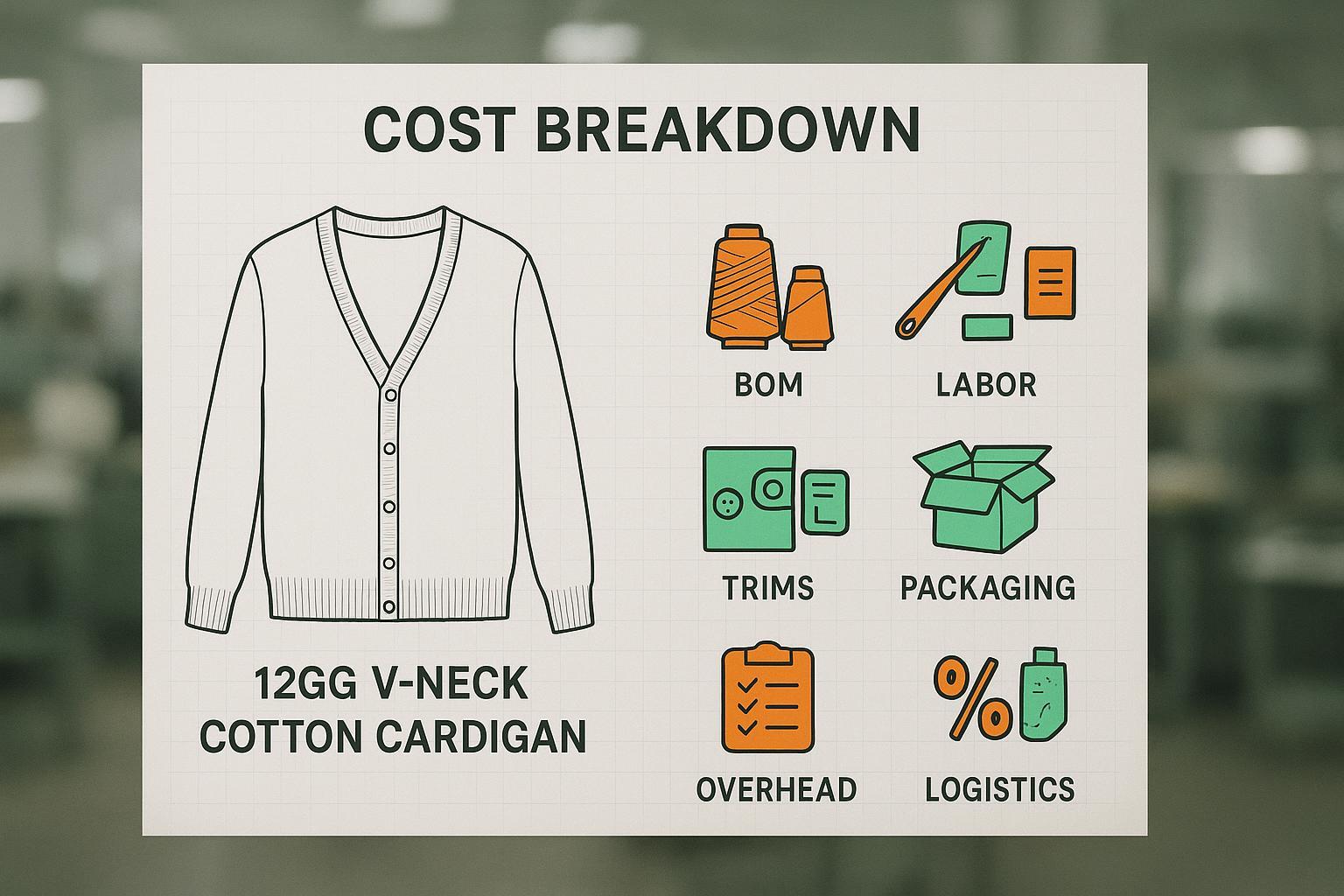
A clear knitwear cost breakdown helps small brands move from idea to PO with confidence. This guide walks through a realistic costing flow for a 100-piece adult cardigan run using a base spec: 100% cotton, 12GG, plain V‑neck, solid dye, sizes XS–XL, standard buttons and labels. You’ll learn how to estimate BOM/yarn, labor, wastage, trims, packaging, QA, overhead, and target margin; how to compare EXW vs FOB; and how to budget freight and duty for US/EU/UK. There’s also a copy‑and‑paste mini calculator you can drop into Sheets/Excel, plus a worked example.
We use authoritative sources for Incoterms and tariff lookups and avoid hardcoding volatile rates—so you’ll know exactly where to get live numbers.
Key takeaways
Your total unit cost is a sum of: yarn (by grams × $/kg × wastage), labor (minutes × rate), trims/pack, QA, overhead, and margin. Logistics (freight, duty, VAT) sit outside the factory price and vary by EXW vs FOB.
For a 12GG cotton cardigan, a practical planning weight is often 300–400 g per piece depending on program density and size curve; validate with sampling and then lock yields.
Small runs (100 pcs) magnify setup and wastage. Allocate a fixed setup across units and include 5–12% yarn allowance unless your factory confirms lower.
EXW puts more origin‑side costs and risk on the buyer; FOB shifts export and origin terminal handling to the seller. Learn the responsibility split before you choose a term.
Always get live freight quotes and look up duty on official portals: US HTS, EU TARIC, and UK Trade Tariff. Replace placeholders in the model with those live numbers.
Quick calculator you can paste into Sheets/Excel
Copy the CSV block below into a new Sheet. Replace the light‑gray inputs. Formulas show a baseline structure for a knitwear cost breakdown.
Section,Item,Unit,Input,Formula/Notes
Assumptions,Quantity (pcs),pcs,100,
Assumptions,Weighted grams per piece,g,350,From size table below; replace with PPS data
Assumptions,Yarn price,$/kg,6.00,Replace with current supplier quote
Assumptions,Yarn wastage allowance,%,10%,Plan 5–12% for small runs; tune with factory
Assumptions,Labor cost per piece,$/pc,4.50,Enter combined knitting+linking+finish cost or use minutes×rate
Assumptions,Trims & labels,$/pc,0.80,Buttons/labels/thread/hangtag
Assumptions,Packaging,$/pc,0.60,Polybag+carton allocation+stickers
Assumptions,QA & inspection,$/pc,0.30,AQL inspection/inline checks apportionment
Assumptions,Overhead allocation,$/pc,1.20,Setup amortization + factory overhead
Assumptions,Target margin on COM,%,12%,For FOB quote (optional)

BOM,Yarn consumption per piece,kg,,= (350/1000)
BOM,Yarn with wastage,kg,,= (350/1000) * (1+10%)
BOM,Yarn cost per piece,$/pc,,= [Yarn with wastage]*6.00

Factory Cost (COM),COM per piece,$/pc,,= [Yarn cost per piece] + 4.50 + 0.80 + 0.60 + 0.30 + 1.20
Factory Price (FOB),FOB unit price,$/pc,,= [COM per piece] * (1+12%)

Logistics (if EXW),Origin+export costs,$/order,250,Buyer pays under EXW; $0 for FOB
Logistics (freight),Ocean LCL to USWC,$/order,450,Replace with live quote; use air $/kg if flying
Logistics (duties),Estimated duty,$/order,0,Look up in HTS/TARIC/UK portals
Logistics,Total landed logistics,$/order,,= sum(Origin+export costs + Ocean LCL + Duties)
Logistics,Per‑piece logistics,$/pc,,= [Total landed logistics]/100

Landed Cost,Landed cost per piece,$/pc,,= ([FOB unit price] or [COM per piece for EXW]) + [Per‑piece logistics]
Tip: If you’d rather enter labor by minutes, add rows for each step (knitting, linking, trimming, washing, pressing, packing) with Minutes × $/minute.
Knitwear cost breakdown SOP for a 12GG cotton cardigan (100 pcs)
Start with a complete tech pack: spec sheet, measurements, size curve, stitch map/program notes, yarn spec and color(s), trims list, and packing plan. Build cost progressively and replace estimates with sample‑verified data.
Sampling and grams‑per‑size. Approve yarn, knit a size M proto or SMS, and record washed/finished garment weight per size. Confirm density in your program. This locks the consumption backbone.
Wastage planning. Agree a yarn allowance (often 5–12% for small runs) to cover joins, breaks, and line stops. Document it in the PO.
Labor minutes and rates. Confirm whether panels are fully fashioned and linked loop‑to‑loop or assembled with overlock; linking minutes vary widely.
Trims and packaging. Finalize button count, label set, hangtag, polybag, and carton specs. Get unit quotes from the factory or your nominated suppliers.
QA and AQL. Decide inspection plan (e.g., General II, AQL 1.5 major / 2.5 minor). Budget in‑line checks and final AQL.
Overhead and setup. Amortize programming/setup and any special tooling across 100 pcs.
Margin and price. Add target margin to arrive at an FOB unit price, or stop at COM if negotiating on open‑book.
Freight and duty. Choose EXW or FOB, request live quotes, and use official tariff tools to price duty/VAT before you set retail margins.
For a walkthrough of factory workflow from knitting to packing, see the internal guide on the OEM/ODM knitwear production process.
BOM & yarn consumption (size table, wastage, formulas)
Gauge influences consumption because stitch density changes mass. If you’re new to gauge, this primer helps: see how 12GG sits among other gauges in the internal explainer on sweater types by gauge.
Example editable grams‑per‑size table (plain jersey, 12GG, adult):
Size | Qty | Est. grams/pc | Total grams |
|---|---|---|---|
XS | 10 | 310 | 3,100 |
S | 20 | 330 | 6,600 |
M | 40 | 350 | 14,000 |
L | 20 | 370 | 7,400 |
XL | 10 | 390 | 3,900 |
Total | 100 | — | 35,000 |
Weighted average grams per piece = 35,000 g / 100 = 350 g.
Yarn with wastage (kg) per piece = (350/1000) × (1 + wastage%). For a 10% allowance: 0.35 × 1.10 = 0.385 kg.
Small‑run note: Fully fashioned knitting minimizes fabric offcuts, but operational yield losses still occur. Plan conservatively and update after PPS approval.
Labor & process times (minutes → cost)
For a 12GG cardigan, the typical flow is knitting → linking/assembly → trimming/mending → washing/softening → drying → pressing/blocking → QA → packing. Linking is often the most time‑intensive step for quality knitwear. If your factory will share SAM or minutes, plug them into the model and multiply by the per‑minute labor rate. If not, use a combined per‑piece labor figure and adjust after your SMS/PPS run confirms real minutes.
Trims, packaging, and QA allocations
Build a trims/pack checklist so you don’t miss costs that creep in later:
Buttons (main + spare) and sewing thread; brand/main/care/size labels; hangtag + string.
Polybag + size sticker; master carton + labels; desiccant/silica where needed.
QA: in‑line checks, final AQL sampling (plan and acceptance numbers per lot size and AQL policy).
Allocate per piece (e.g., $0.80 trims, $0.60 pack in the example) or apportion per carton for items like cartons and desiccants.
Freight and duties — EXW vs FOB and small‑shipment scenarios
Responsibility matrix (EXW vs FOB)
Under EXW, the buyer pays and manages nearly all origin‑side steps. Under FOB, the seller handles export clearance and origin terminal handling until goods are loaded on board at the named port. For an overview of EXW responsibilities, see this concise guide on the Incoterms EXW responsibilities and risk transfer. For a side‑by‑side comparison and context, this explainer on differences between EXW and FOB in practice is helpful.
Cost line | EXW (who pays) | FOB (who pays) |
|---|---|---|
Factory loading | Buyer | Seller |
Origin trucking to port | Buyer | Seller |
Export customs/broker | Buyer | Seller |
Terminal handling (origin) | Buyer | Seller |
Main carriage (ocean/air) | Buyer | Buyer |
Insurance (from risk point) | Buyer | Buyer |
Destination port/terminal | Buyer | Buyer |
Customs duty & taxes | Buyer | Buyer |
Last‑mile delivery | Buyer | Buyer |
Note: Some shipments use FCA instead of EXW when the seller handles loading; read the official guidance on free carrier (FCA) responsibilities and loading clarification before choosing terms.
LCL ocean to US/EU/UK (how to budget)
For 100 folded cardigans, you’ll often see 0.3–0.6 CBM total depending on your pack plan. Compute CBM as (L×W×H in m) × carton count. Market rates for LCL are volatile; use a working range and replace with live quotes. Historical context is available from the Freightos ocean index and rate resources, but your lane quotes rule.
Budget example: If base is $120/CBM and local charges sum to $350 on a 0.40 CBM shipment, total ≈ $398. Per‑piece freight ≈ $3.98 for 100 pcs. Replace with your forwarder’s quote and itemized origin/destination fees.
Airfreight comparison (chargeable weight)
Airfreight is priced on chargeable weight (the greater of actual vs volumetric). General‑cargo snapshots late‑2025 placed China→North America around $7–8/kg and China→North Europe/UK around $3–4/kg excluding surcharges; always verify current quotes. See the quick air freight rates and pricing guide for how carriers compute chargeable weight and common surcharges.
How to look up duty and VAT (official portals)
United States: Start with HS 6110.20 (cotton pullovers/cardigans) and refine by garment specifics on the official USITC HTS search portal.
European Union: Use the official TARIC consultation tool. Enter your code, set origin to China, and export the measures summary.
United Kingdom: Query 6110.20 and refine to the 10‑digit code on the UK Trade Tariff portal. VAT is assessed on CIF value plus duty.
Payment terms tip: Align deposits/balances with key milestones (e.g., 30/70 at inspection) and ensure documents match your chosen Incoterm so cargo can depart on time.
Worked example with Knitwear.io example inputs (disclosure)
Disclosure: Xindi Knitwear (Knitwear.io) is our product. The following are example inputs we commonly see quoted for a 12GG 100% cotton V‑neck cardigan at a 100‑piece run; replace every number with your live quotes and PPS data.
Weighted grams per piece: 350 g; yarn price: $6.00/kg; wastage: 10% → yarn per piece: 0.385 kg → yarn cost: $2.31/pc.
Labor (combined): $4.50/pc; trims: $0.80/pc; packaging: $0.60/pc; QA: $0.30/pc; overhead allocation: $1.20/pc.
Cost of manufacturing (COM): $2.31 + 4.50 + 0.80 + 0.60 + 0.30 + 1.20 = $9.71/pc.
Target margin (12%): FOB unit price ≈ $10.88/pc.
Ocean LCL to US West Coast example: total logistics $398/order on 100 pcs → $3.98/pc. Landed (FOB basis) ≈ $14.86/pc before duty. Duty/VAT: use official portals above.
Note: If you buy EXW, remember to add origin loading/export/THC to your logistics line before comparing landed cost to an FOB quote.
Next steps
Copy the CSV calculator into your Sheet and replace placeholders with your live data (supplier quotes, PPS weights, forwarder quotes, duty lookups). If you need a more detailed version with minute‑by‑minute labor inputs and EXW↔FOB toggles, use the same structure and add rows for each operation.