
Introduction: Jacquard vs Intarsia vs Prints (why it matters)
If you run an indie label, “graphic knit” isn’t one decision—it’s at least three. All-over jacquard, intarsia, and prints on knits can all deliver color and artwork, but they behave very differently once you start sampling, grading sizes, and shipping to real customers.
Choosing the right method affects:
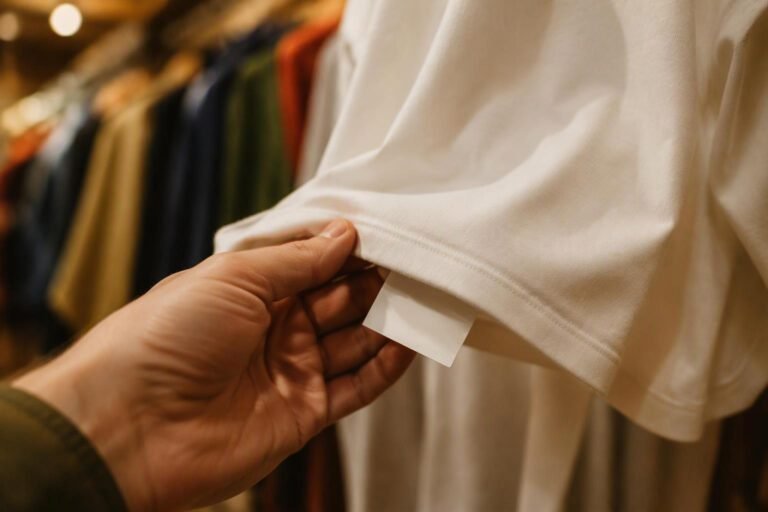
Handfeel (especially on the reverse side)
Durability (snags, pilling, cracking, rub-off)
MOQs and cash flow (what you must commit to in yarn, setup, and production time)
Sampling speed (how quickly you can test sell-through)
Sustainability (waste, chemistry, and how long the garment stays in rotation)
This guide compares Jacquard vs Intarsia vs Prints through a production lens—and keeps the trade-offs tied to real sampling and production decisions. You’ll learn the mechanics, the cost drivers, the testing that prevents painful surprises, and a simple decision path you can use for your next drop.
Core mechanics
All-over jacquard: structure and floats
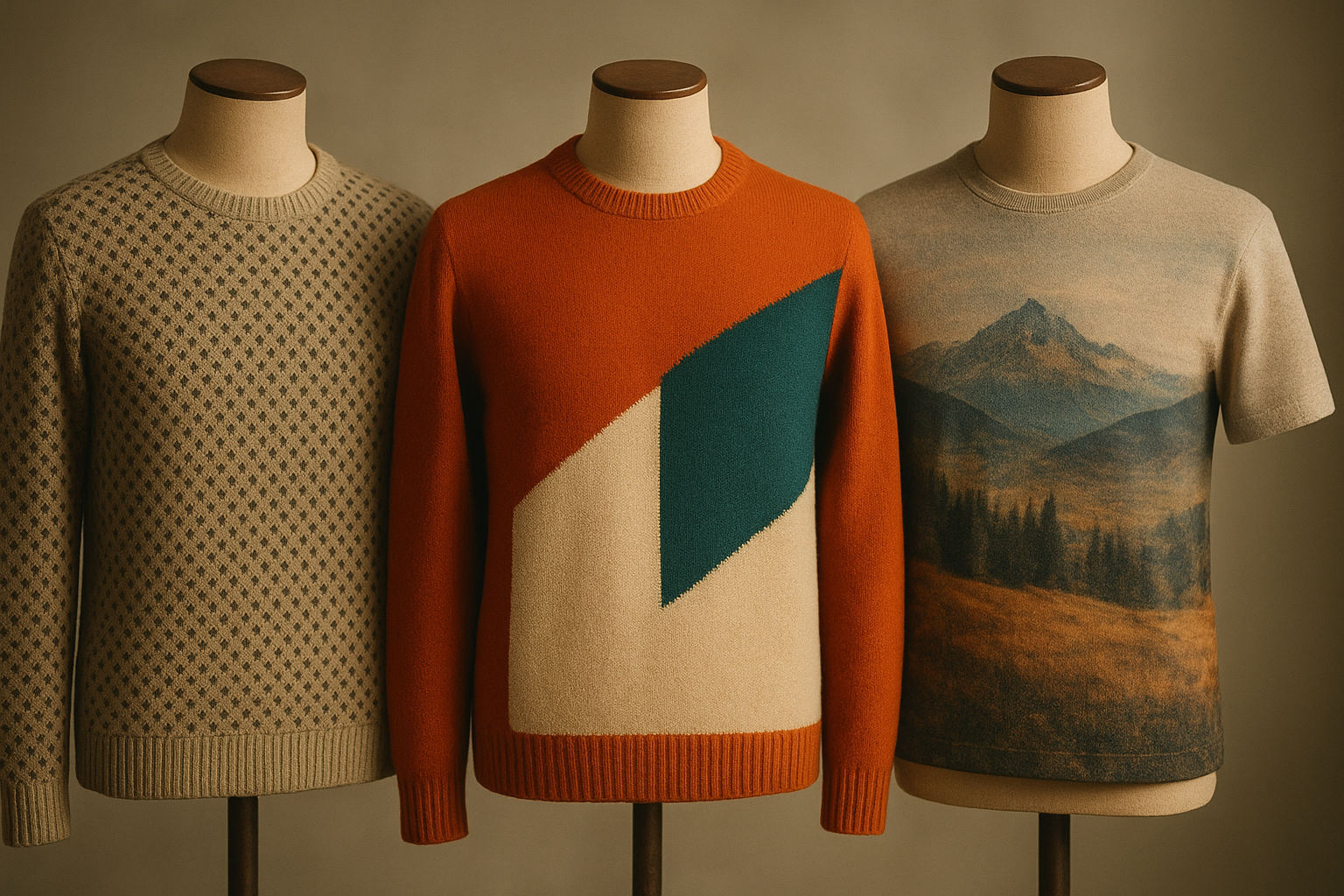
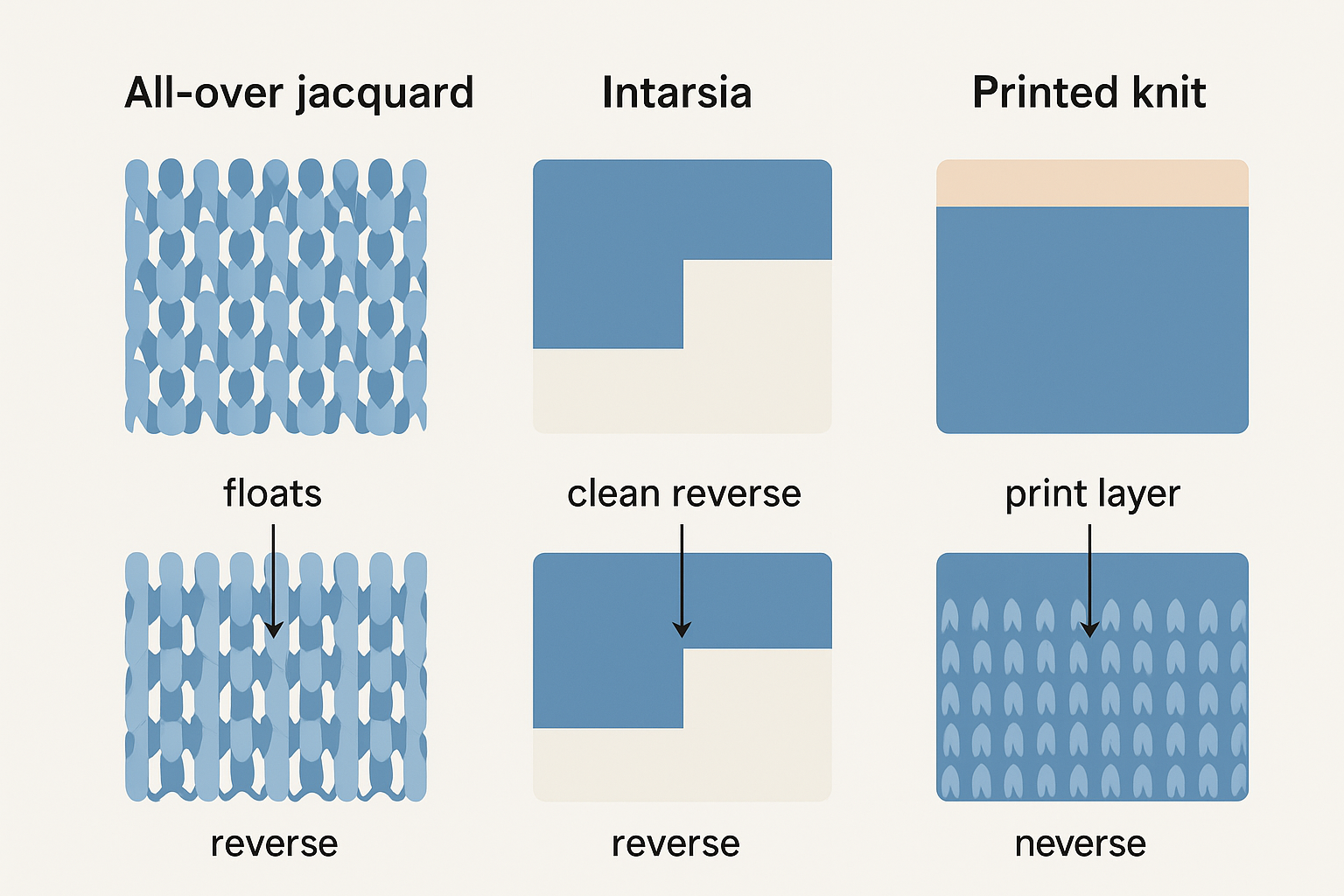
Jacquard in knitwear is essentially “pattern built into the fabric.” Multiple yarn colors are worked in the same course, and the yarns not showing on the face are carried on the reverse as floats.
From a brand point of view, jacquard’s superpower is repeatability and scale: once the program is stable, it’s efficient for all-over repeats and engineered placements.
But floats are not just a trivia detail—they change how the garment wears.
Reverse feel: floats can feel snag-prone or “busy” against the skin.
Weight and warmth: carrying extra yarn adds mass and insulation.
Snag risk: long floats can catch on rings, nails, or zippers. As Wolf vs Goat notes in its explainer on Jacquard vs Fair Isle (2024), longer floats tend to increase both weight and snag risk.
Factory notes: Knitwear.io’s overview of Jacquard & Intarsia Knit Techniques highlights that float length and tension control are key QC points. Some jacquard structures (like double-jersey jacquard) can minimize or hide floats, changing the reverse comfort profile.
Intarsia knit: clean blocks, no floats
Intarsia is colorwork with separate yarn “islands.” Each color block uses its own yarn feed, and the yarn doesn’t travel across the row—so there are no floats on the back.
If you’ve ever flipped a sweater inside out and seen a clean, smooth reverse behind a logo or a big geometric panel, you were probably looking at intarsia.
The trade-off is operational complexity:
You must manage joins between color blocks carefully (or you’ll get tiny holes or tension ripples).
Programming and knitting time often go up as color areas increase.
Knit-sis summarizes the core difference plainly: in “Intarsia vs. Jacquard” (2025), intarsia avoids floats on the reverse because each colored area uses its own yarn.
Prints on knits: screen, digital, and sublimation
Printing skips knit-in colorwork entirely. You make (or buy) a knit base, then apply artwork through a print process. In practice, “prints on knits” usually shows up in three buckets:
Screen print (often plastisol or water-based): great for bold shapes; durability depends on ink system, stretch, and cure. Heavy prints can change handfeel.
Digital print (DTG or pigment-based systems depending on substrate): flexible for many colors and gradients, often faster to sample, but requires careful testing for rub-off and wash.
Sublimation (mostly on polyester): dye becomes part of the fiber surface, enabling high detail with low handfeel impact—but it’s substrate-limited and color behavior depends on base fabric and heat control.
The key mechanical difference: prints can sit on top of a knit (a surface layer) rather than being the fabric itself. That’s why you see print-specific failure modes like cracking, peeling, and crocking (color rub-off). A Look Behind the Seams explains that pigment colorants can sit on the surface and are prone to rub-off in its crocking explainer (2019).
Engineering and fit impacts
Drape, stretch, and reverse feel
When your customer wears the piece, they don’t care how clever the technique is—they care how it feels and moves. That’s the practical heart of any Jacquard vs Intarsia vs Prints decision.
Jacquard
Drape: tends to be more structured because extra yarn is carried behind the face.
Stretch: can be slightly restricted depending on float management and stitch density.
Reverse feel: floats can feel textured; consider lining, plating, or float-minimizing structures if it’s close-to-skin.
Intarsia
Drape: often cleaner and less bulky than jacquard because there’s no extra yarn carried across.
Stretch: generally more “honest” to the base knit structure.
Reverse feel: clean, making it a good choice for pieces likely to be worn against bare arms/neck.
Prints
Drape: mostly determined by the base knit—until the print becomes heavy.
Stretch: the risk is the print film not stretching like the knit (cracking can show up first at elbows, ribs, and hem).
Reverse feel: clean on the inside because the ink is on the face—but if the print is stiff, the whole panel can feel boardy.
Key Takeaway: If reverse comfort is a first-class requirement (or you’re printing a close-to-skin tee knit), you’re usually choosing between intarsia and prints—or a jacquard structure that hides floats.
Color count, carriers, and WHOLEGARMENT fit zones
Color and placement aren’t only design choices; they are production constraints.
Jacquard is efficient for repeats, but practical color handling depends on machine setup (carriers/feeds) and how many colors appear per course. The more colors you force into a row, the more you fight tension balancing and yarn management.
Intarsia can place bold, isolated artwork, but each color block behaves like a mini project: more blocks means more joins to manage and more opportunities for tension artifacts.
Prints can handle “unlimited colors,” but placement is limited by how you print: panel printing, yardage printing, or printing on the completed garment. Each choice has its own distortion and alignment risks.
If you’re using 3D knitting / seamless construction, think in fit zones:
high-movement zones (underarm, side body, elbow)
high-abrasion zones (cuff, hem, backpack rub)
high-visibility zones (center chest, upper back)
Those zones should influence method selection. For example:
A jacquard with unmanaged floats in a high-abrasion zone can pill or snag faster.
An intarsia join line placed through a high-stretch zone can reveal tension differences.
A print across an elbow bend can crack if ink elasticity doesn’t match the knit.
If you’re exploring seamless or engineered knit placements, Knitwear.io’s custom sweater resources (see the custom knit sweater category) are a useful starting point for what’s feasible with engineered panels and 3D knitting workflows.
Gauge choices and artwork resolution
Gauge (GG) is the silent boss of graphic knit.
Lower gauge (chunkier): bigger stitches, more visible “pixelation.” Great for bold motifs, not great for fine text or tight curves.
Higher gauge (finer): more resolution, cleaner diagonals, and tighter detail.
How it plays out by method:
Jacquard: can run across a wide gauge range, but floats become more obvious and longer at coarse gauges when motifs have large single-color spans.
Intarsia: often happiest in mid gauges for crisp blocks; very fine-gauge intarsia increases complexity and join control demands.
Prints: can deliver photographic detail even on a coarse knit—but the knit texture will still telegraph through. You get “photo on knit,” not “photo on paper.”
Pro Tip: Before you fall in love with artwork, ask your factory for a quick “stitch-grid” mock (or a small knit strike-off) at your target gauge. It’s the fastest way to see whether your linework survives translation.
Commercials: MOQs, lead times, cost drivers
Indicative MOQs and sampling/bulk timelines
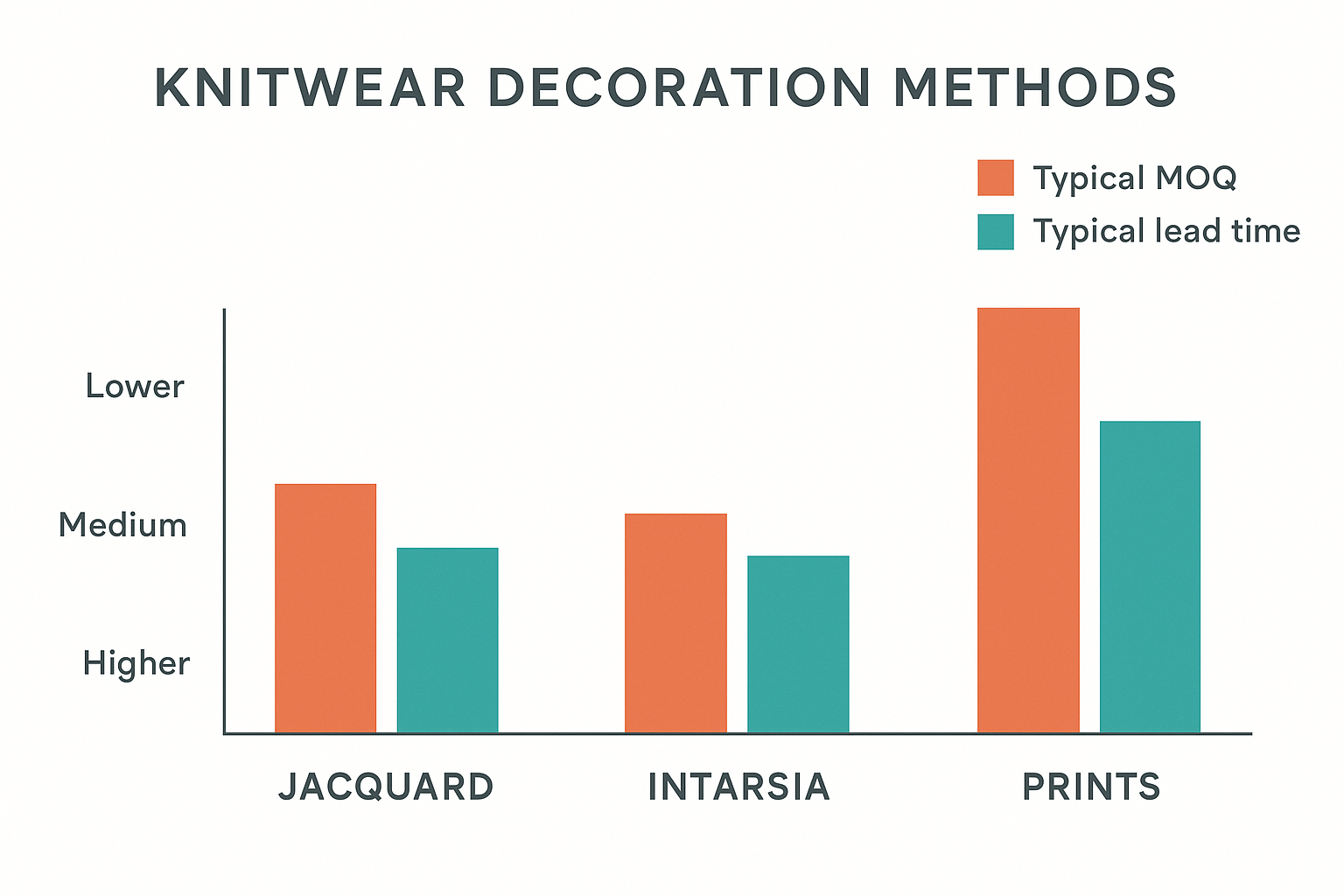
There is no universal MOQ table that’s honest for every factory. MOQs and lead times swing based on yarn availability, machine schedule, and whether you’re making one style in one color or four styles across multiple sizes and colors.
Still, the pattern is consistent:
Jacquard often scales well once setup is done—especially for repeats.
Intarsia can be slower to sample and slower to knit because of programming and join management.
Prints can be fast to sample when the base fabric/garment is ready and the print workflow is dialed.
The chart below is intentionally relative (not fake precision) so you can plan your calendar without being trapped by someone else’s factory assumptions.
Cost levers: colors, machine time, yarn/ink, finishing
If you want to control cost, don’t start by asking “what’s the price?” Start by asking “what are the levers?”
Jacquard cost levers
Color count and per-course color complexity: more tension balancing and yarn handling.
Float control / structure choice: float-minimizing structures can change yarn use and knitting time.
Yarn selection: finer, certified, or specialty yarns increase cost quickly.
Finishing and QC: inspecting for float issues, tension lines, and panel alignment.
Intarsia cost levers
Number of color blocks: each join is labor + risk.
Artwork shape complexity: sharp angles and small islands increase programming difficulty.
Knitting speed: Knitwear.io notes intarsia can run materially slower than jacquard in its technical discussion of jacquard vs intarsia use cases.
Post-knit work: securing ends, linking, and cleaning join areas.
Print cost levers
Print method choice: screen setup vs digital flexibility.
Ink system and curing: stretch performance and wash durability depend heavily on chemistry + process control.
Pre-treatment and base fabric prep: crucial for color and adhesion.
Registration and placement: especially if printing after garment construction.
Risk hotspots and how to de-risk small runs
Small runs fail in predictable places. In Jacquard vs Intarsia vs Prints projects, most surprises show up in the same handful of hotspots. Here’s where to look, and what to do early.
Jacquard risk hotspots
Snags and pilling from long floats: keep floats controlled and confirm reverse feel on-body.
Tension striping between colors: test yarn combinations (twist, elasticity) and adjust tension.
De-risk moves
Ask for inside-out photos and a quick wear test.
If your motif creates long spans, discuss float-control approaches early.
Intarsia risk hotspots
Holes at joins and tension ridges between color blocks.
Distortion if blocks are too small for the chosen gauge.
De-risk moves
Use a slightly simplified version of the artwork for the first sample.
Pilot the motif at the final gauge before scaling to multiple sizes.
Print risk hotspots
Crocking (rub-off) and wash fade, especially for darks.
Cracking on stretch points.
Handfeel complaints if ink film is heavy.
De-risk moves
Require a wash + rub test set (details in the next section).
Test on the real base knit, not a similar fabric.
⚠️ Warning: Don’t judge any method from a single pristine sample. You need at least one “abuse test” sample: wash it, rub it, and wear it with a bag. Most surprises show up there first.
Quality and sustainability
Key tests: pilling, shrink, colorfastness, crocking
If you’re producing for the US market (or any market with returns you actually honor), testing is cheaper than rework.
At minimum, build a test plan around:
Pilling: critical for jacquard and any fuzzy yarns; also relevant for prints if the base pills and makes the print look “dirty.”
Shrink and dimensional stability: especially after wash; impacts fit consistency across sizes.
Colorfastness to washing: for dyed yarns (jacquard/intarsia) and for prints.
Crocking (rubbing): a must for prints (and also for dark dyed yarns in some cases).
For prints, pay extra attention to how the color is fixed. As summarized in A Look Behind the Seams’ crocking overview (2019), surface-applied pigment systems can be more prone to rub-off because the color sits on top of the fabric.
Certifications and fiber/ink choices (OEKO-TEX, GOTS, GRS, RWS)
Certifications don’t automatically make a product “sustainable,” but they help you verify claims and reduce compliance risk.
Common ones you’ll see in knitwear supply chains:
OEKO-TEX: focuses on harmful substance testing (commonly used as a safety/chemical compliance signal).
GOTS: for organic fibers with stricter processing and social criteria.
GRS: for recycled content with chain-of-custody.
RWS: for responsible wool sourcing.
If certifications matter to your brand story, don’t treat them as a footnote. Ask for:
certificate scope (which product or facility it covers)
validity dates
traceability/transaction documents where applicable
Knitwear.io references multiple certified yarn options and sustainability positioning on its About Us page, which can help you align the materials story with the method you choose.
Environmental profiles: knit-in graphics vs printing
A practical way to think about impact is to compare where the color comes from and what waste it creates.
Knit-in graphics (jacquard/intarsia)
Color comes from dyed yarn.
Waste drivers: yarn dyeing impacts, yarn overage, sampling iterations.
Upside: no extra print chemistry layer; aesthetics can age well if yarn quality is strong.
Printing on knits
Color comes from ink/chemistry + curing energy.
Waste drivers: pre-treatment, misprints, wash-off, and energy for curing.
Upside: can reduce sampling loops for high-color artwork because you aren’t reprogramming knit structures.
No method is automatically “best.” The more honest question is: Which method helps you make a garment that stays in rotation longer? Durability and customer satisfaction are sustainability factors too.
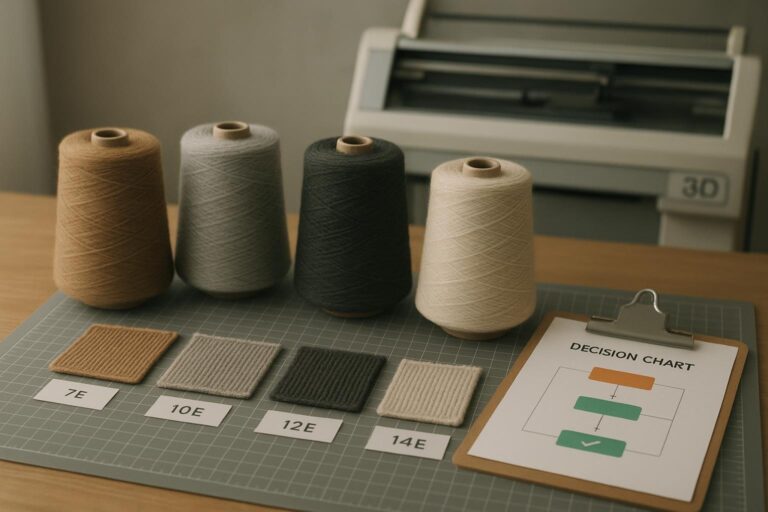
Decision framework: when to choose which
If you need repeats, texture, and scalability → jacquard
Choose jacquard when:
your artwork is a repeat (micro motifs, geometric all-overs)
you want texture and depth built into the knit
you expect to scale bulk and need stable throughput
Reality check before you commit:
Flip the sample inside out. If reverse comfort matters, control floats early.
Validate how the pattern behaves across sizes (repeat alignment and panel matching).
If you need bold isolated artwork and clean reverse → intarsia
Choose intarsia when:
you need big, isolated shapes (logos, characters, bold blocks)
the garment is likely to be worn close-to-skin and a clean reverse matters
you’re okay paying more for join control and slower runtime
Reality check before you commit:
Examine joins under bright light for holes and tension ridges.
Make sure your smallest sizes don’t compress the artwork into unreadable blocks.
If you need fast sampling, many colors, photo detail → prints
Choose prints when:
you need many colors, gradients, or photo-level detail
you want a fast visual strike-off without reprogramming knit colorwork
your base knit is already approved and consistent
Reality check before you commit:
Test crocking and wash fade (dark colors are where you’ll see problems first).
Stress-test elbow and rib areas for cracking.
Where Knitwear.io fits in this workflow (rapid sampling + low MOQ): If you’re in the “test the drop quickly” stage, a partner like Knitwear.io can be useful because it supports low MOQs (starting around 50 units) and rapid sampling (often 3–5 days) from tech packs or reference photos—so you can validate handfeel and durability before you lock in a bigger commitment.
Conclusion
Jacquard, intarsia, and prints can all deliver “graphic knit,” but they solve different problems. If you remember one thing from this Jacquard vs Intarsia vs Prints comparison, let it be this: pick the method that survives wear, wash, and scaling—at your MOQ and calendar.
Jacquard is the repeatable workhorse—great for all-overs and scalable production, with floats and reverse feel as the main watch-outs.
Intarsia is the clean, bold option—best for isolated artwork and a smooth inside, with join control and slower runtime as the main costs.
Prints are the speed-and-color option—ideal for high-detail artwork and quick strike-offs, with crocking/cracking/handfeel as the main risks.
Next steps to move from opinion to a confident choice:
Request swatches/mini panels in your target yarn and gauge (one for each method you’re considering).
Specify a test set: pilling, shrink, wash colorfastness, and crocking (especially for prints).
Pilot sizes (at least one small and one large) to confirm artwork legibility and fit-zone behavior.
If you want to shorten the sampling loop, you can also start by sharing your tech pack and artwork notes with Knitwear.io and asking for method recommendations plus a small set of comparison strike-offs.