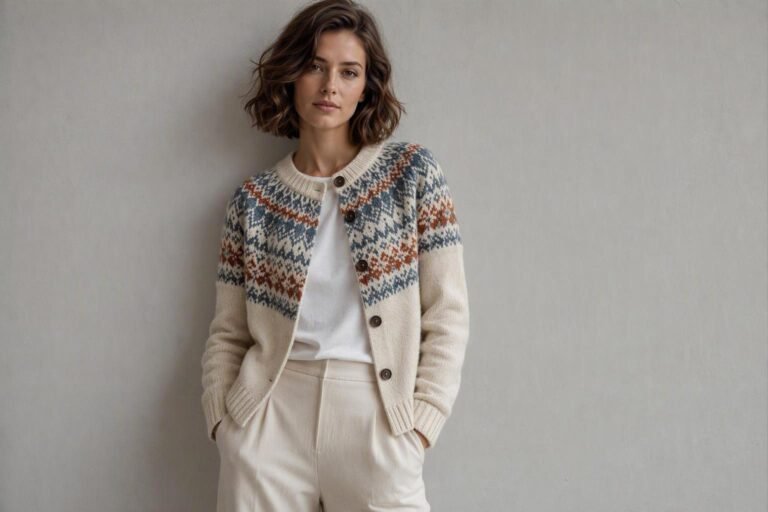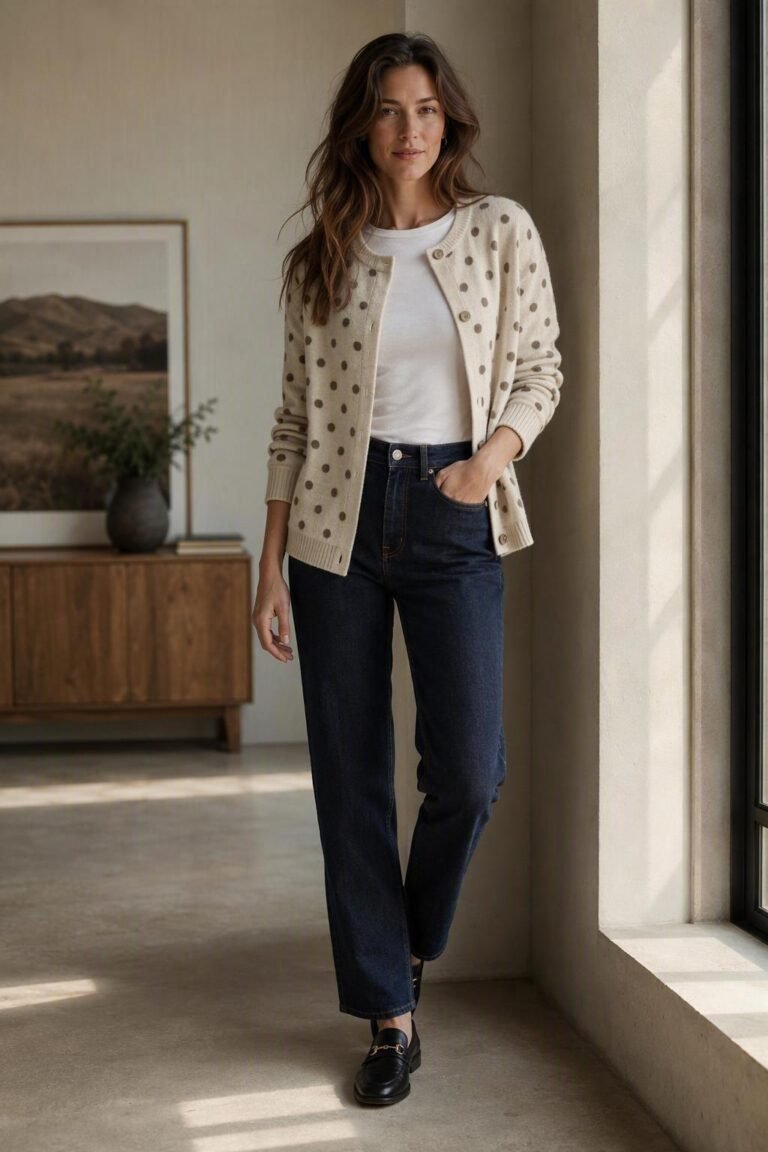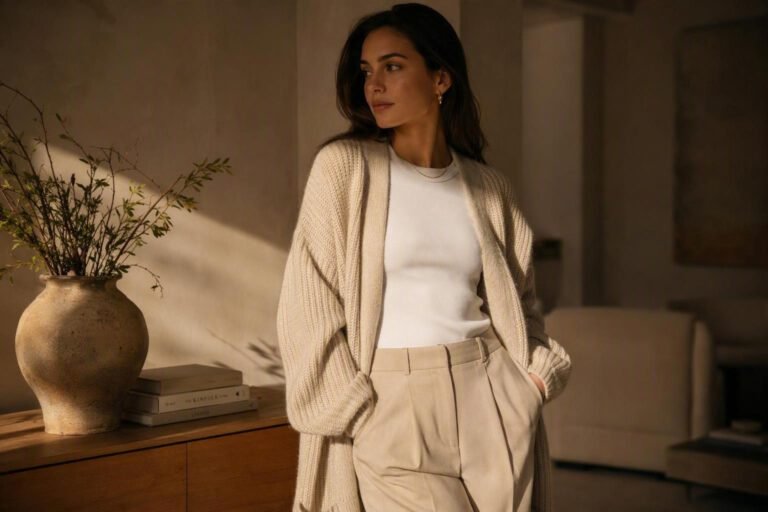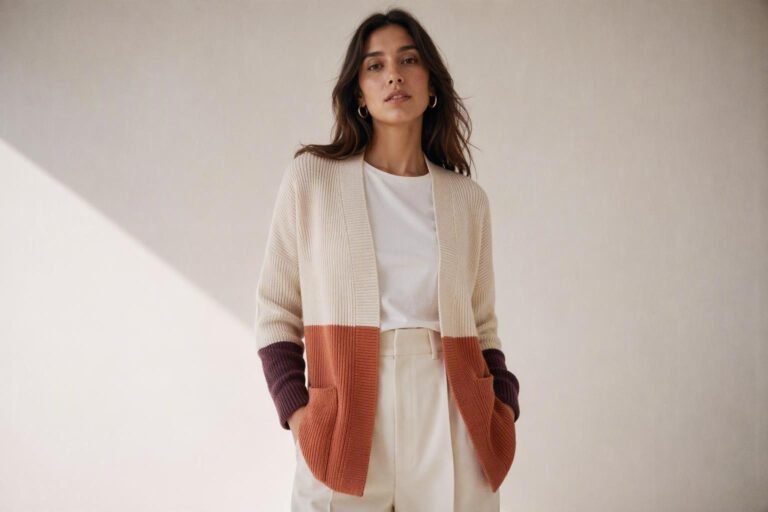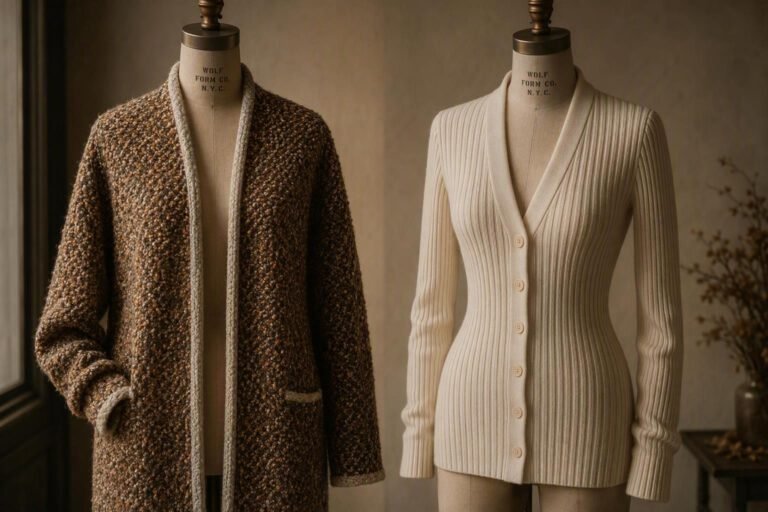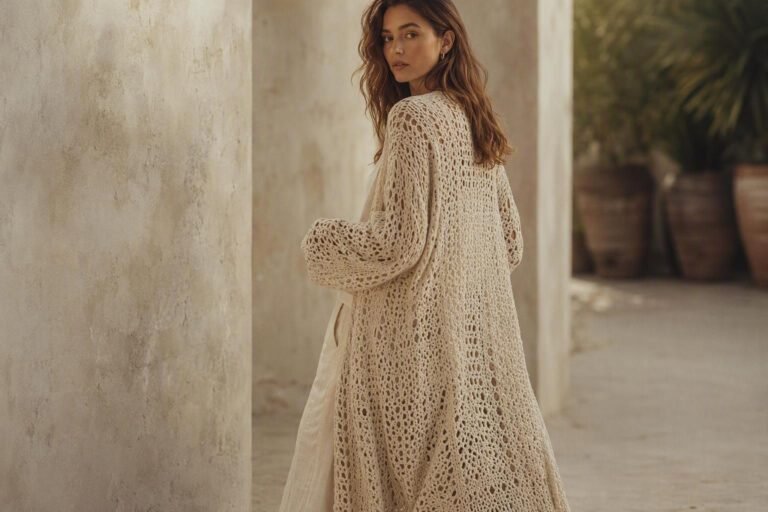

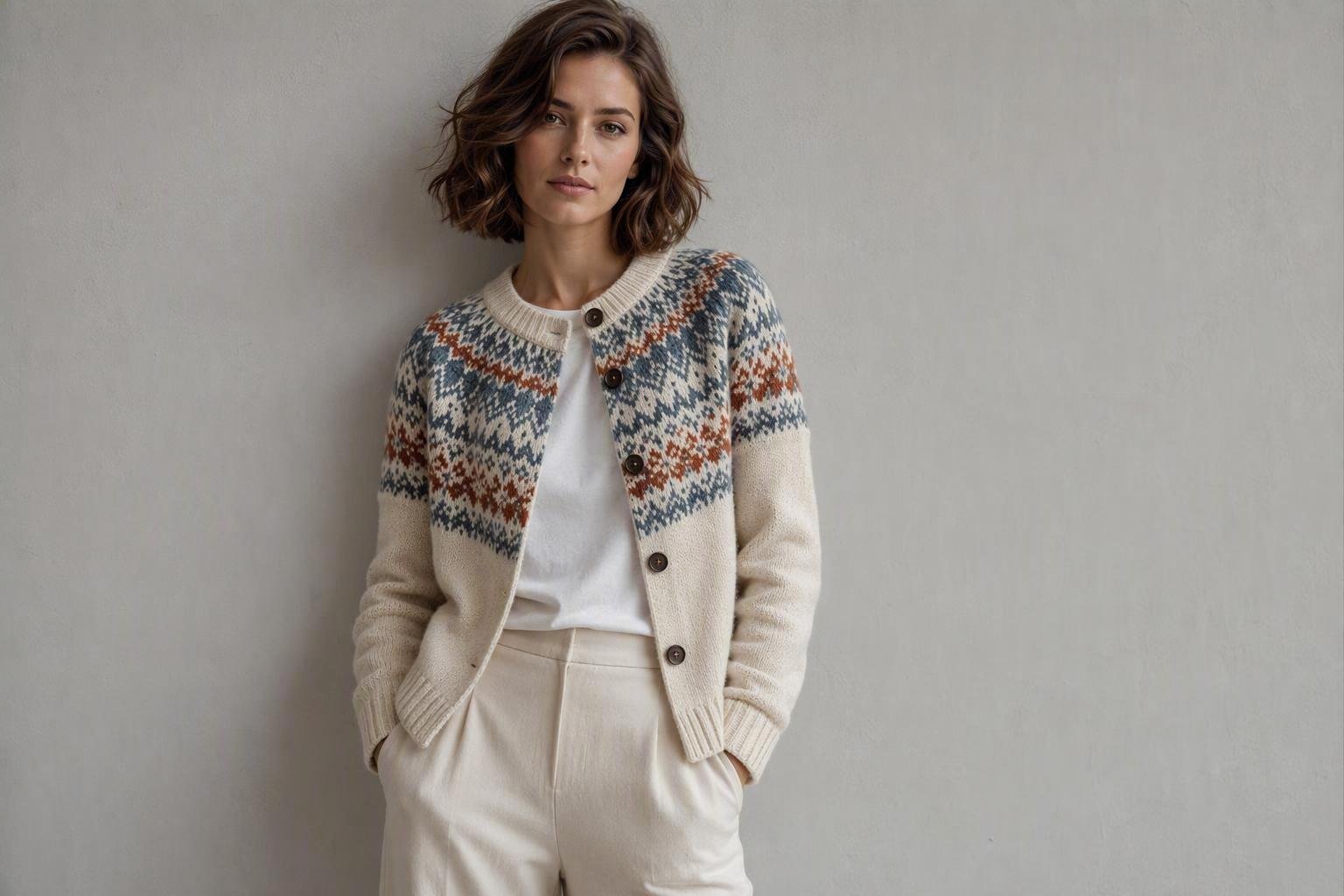
A knitted patterned cardigan is one of the few knitwear pieces that reads instantly as designed rather than merely worn. The pattern runs through the fabric itself — built from colored yarn or stitch structure as the garment is knitted — so it never looks like a print slapped on top. That artisanal depth is exactly why heritage patterns are having a moment again, refreshed in softer color rather than the rustic shades you might expect.
But “patterned” is a big umbrella, and choosing the wrong pattern language is the fastest way to burn a small label’s sampling budget. This guide is written for emerging knitwear brands and designers who want to put their own patterned cardigan into the world: which pattern family to pick, how to spec it so the sample matches your art, how to style and shoot it so it sells in the US market, and how to produce a small run without a monster MOQ.
Key Takeaway: A knitted patterned cardigan looks premium and sells best when the pattern reads clearly on the stitch grid, the color story is disciplined, and the garment is styled as one hero piece over quiet basics.
What “patterned” actually means on a knitted cardigan
Before you pick anything, get this straight, because it changes every design and sourcing decision downstream. On a knitted cardigan there are two distinct ways to create a pattern:
Colorwork (color pattern) — the pattern is built from colored yarns during knitting. Think stripes, fair isle, Nordic geometric motifs, jacquard all-over repeats, or a single intarsia graphic on the chest.
Stitch texture — the pattern comes from the stitch structure rather than color, like ribs, pointelle openwork, seed or moss stitches, or even cable-style texture that reads as a pattern even in a single yarn.
Both count as “patterned,” but they live in completely different design, cost, and sampling territory. A big colorwork fair-isle band and a subtle pointelle eyelet cardigan are not the same project, even though shoppers would file both under “patterned cardigan.”
What this means for you: decide early whether your cardigan is color-led or texture-led. That one choice drives the technique, the gauge you’ll need, the sampling time, and how many colorways you can realistically launch.
The pattern families: choose the one that fits your cardigan
If your cardigan is color-led, four families cover almost everything you can knit. Each changes your cost, your lead time, and the final look — so think of them as tools, not just styles.
Fair isle and Scandinavian motifs: heritage with a fresh palette
Fair isle is a stranded colorwork method: small, repeating geometric motifs knitted with two (occasionally up to five) colors per row, with the unused yarn carried loosely across the back as floats. In modern production it’s usually treated as a form of jacquard patterning, so check how your factory classifies and programs it.
The look is instant heritage — think Shetland, Norwegian, and Nordic cardigans — but today’s update lives in the colors: frosty blue, burgundy, neon pink, blush, and sage refreshing an otherwise classic motif. The trade-off is real: stranded colorwork is slower and heavier than a solid, with manufacturing notes putting knitting time at roughly 1.5 to 3 times a plain equivalent depending on complexity and gauge. Mid-to-finer gauges carry the motifs best.
Jacquard: the workhorse for all-over and repeating patterns
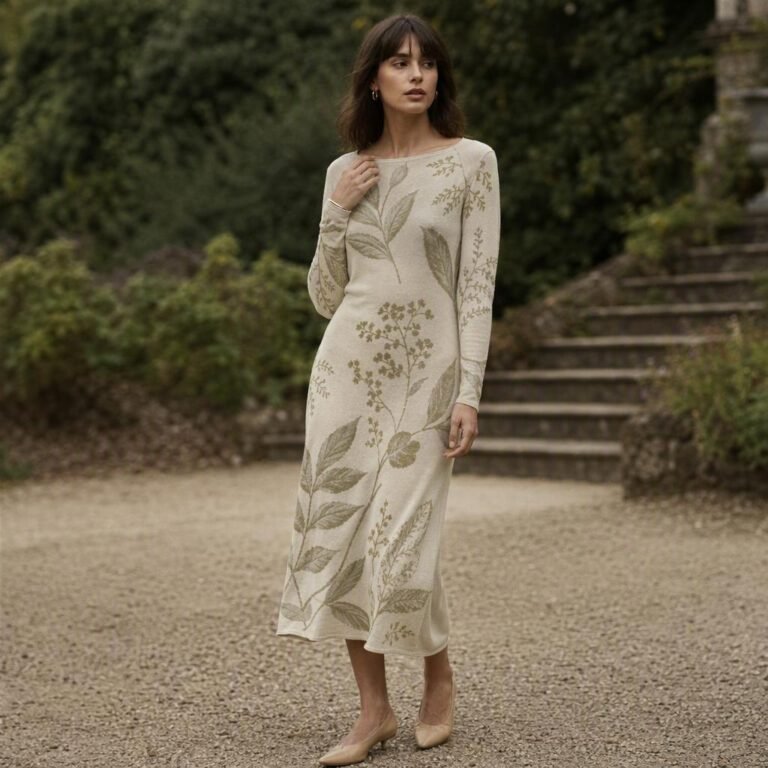
Jacquard is the broader manufacturing term for machine-knitted color patterning. Where fair isle is a specific heritage tradition, jacquard is the scalable, design-flexible option — ideal for repeating artwork, geometric repeats, banded florals, or an all-over botanical, and generally more cost-efficient than intarsia because the machine does more of the work.
The thing to watch is the float situation: yarn not shown on the face is carried behind, and long floats on a fine cardigan can snag or distort with wear. A double-jersey jacquard construction hides the floats for a cleaner interior. Jacquard runs across a wide gauge range — roughly 3 to 16 gauge, with 7 to 10 gauge a safe commercial middle — so it suits everything from a chunky Nordic cardigan to a finer, dressier piece.
Intarsia: for big, clean graphic blocks
Intarsia knits each large color area from its own separate yarn “island.” Because every block uses its own feed, there are no floats carried across the back — the reverse stays clean, which makes intarsia perfect for a bold chest motif, a single oversized graphic, or a logo panel that needs to read sharply.
What it means financially: intarsia is slower to knit and pricier than jacquard, and each color block adds joins and careful finishing at the boundaries. It lives best in mid gauge — around 5 to 14 gauge, with 7 to 10 gauge the practical sweet spot — and gets hard to execute cleanly in very fine gauge. Xindi Knitwear’s jacquard-and-intarsia breakdown walks through exactly where each technique earns its keep, including how pattern complexity, color count, and gauge drive speed and cost.
Stripes: the low-risk gateway into color
Stripes are colorwork at its simplest — you change yarn across rows or sections rather than within a single course. There’s almost no stranding or float management, which makes striped cardigans the easiest, most cost-efficient color pattern to sample and produce, and they sit naturally across many gauges.
Never underestimate stripes as a marketing story: they’re a perennial trend and, for a first pattern cardigan on a tight budget or timeline, the smartest first run you can make. You get the “patterned” read and the color story without paying the fair-isle or intarsia premium.
Stitch texture: a pattern that never needs color
Finally, remember you can pattern a cardigan entirely through structure. Pointelle openwork, rib geometries, seed and moss stitches, and heavy cable or braid textures all read as deliberate pattern while staying in a single colorway. This is a strong low-MOQ lever: a textured cardigan needs no custom colorwork program, samples faster, and still photographs with the knit-forward texture premium buyers pay for. To match a stitch pattern to your target hand-feel and gauge, a knitwear stitch-type reference is worth a close read.
Which pattern should you pick? A quick way to decide
If you’re weighing the colorwork families, simplify it to one question: is this one hero motif, or an all-over story?
Your intent | Better route | Why |
|---|---|---|
A heritage-band or small repeating geometric motif | Fair isle / jacquard | Stranded pattern built cleanly across a band; classic, warm look |
An all-over repeating floral or geometric | Jacquard | Machine-driven repeat, cost-efficient, scales for production |
One big bold chest graphic / logo / motif | Intarsia | Clean back, no floats, bold isolated color block |
Easiest, fastest, lowest-risk color cardigan | Stripes | Minimal programming, simplest sampling, broad appeal |
Deliberate pattern in a single color | Stitch texture | No custom colorwork; quick sample; premium knit-forward feel |
Fair isle gives you the warmest heritage read. Jacquard is the scalable all-over option. Intarsia delivers the cleanest single graphic. Stripes are the practical first step, and texture gives you pattern without color at all. None is “correct” — the right answer tracks your artwork, your gauge, and your budget.
What this means for you: don’t switch families halfway. Lock the motif direction up front, then let it drive the spec, because changing technique after you’ve approved a sample means paying for programming and sampling all over again.
Spec the pattern so the sample matches your art
Most patterned-cardigan disappointments in small-batch production aren’t quality failures — they’re spec failures. Your art looks lovely as a drawing and turns muddy as a knit, usually because the design wasn’t built for the stitch grid. Treat the motif as if you were designing in pixels, because on a knit fabric, a stitch is a pixel.
Three controls decide how every colorwork pattern reads: gauge (resolution), pattern repeat/size, and placement. Change any one and the whole look shifts. Patterns read best when motifs are simplified with clear negative space and strong value contrast — a pale pattern on a pale base disappears, while a design with genuine light/dark contrast reads at a glance. Fine linework and tiny details simply “mush” on a coarse grid, so if your art must stay sharp, knit a bold simplified motif and add the crisp detail with embroidery on top.
Practical spec package to send a factory:
Vector artwork (AI/PDF/SVG) plus a pixel-grid version of the motif so the programmer sees your intent.
Color count per course and repeat size, locked against your chosen gauge.
Named colorways with yarn references, not just “blue.”
A target gauge range and stitch density note.
Pattern placement measurements and motif size — from the center front, neckline, hem, and sleeve.
Seam and trim notes (buttons, placket, band width) and, where relevant, whether you want seamed panels or a WHOLEGARMENT one-piece construction.
Two spec details matter more than most small labels realize. First, grade the pattern across sizes: a motif that fits a size XS can look lost on an XL, so ask for a graded-motif approach rather than uniform scaling. Second, insist on a patterned swatch before the full sample — that catches repeat-size drift, color-switch distortion, and float problems while they’re cheap to fix. Xindi’s guide to motifs and graphic elements for knitwear is the clearest plain-English run-through of how motif readability, pixel-grid conversion, placement, and grading work together.
What this means for you: a proper spec package is the cheapest insurance you’ll buy. It turns “the sample doesn’t look like my sketch” into a fast, fixable revision instead of a costly mystery.
Style it to sell: patterned cardigans in the current US market
A patterned cardigan is easy to photograph as a cozy afterthought and hard to photograph as a premium hero. Style it with intent and it reads as considered, heritage-rooted luxury — and that distinction decides whether a US shopper clicks add-to-cart. The market’s recent direction is heritage patterns refreshed with fresher color, shown on everything from structured, tailored cardigans to floor-length coatigans and cardigan co-ords.
A few styling rules do the heavy lifting:
Let the cardigan be the one hero. Ground everything else in solids and neutrals — a plain tee, cream or navy trouser, straight denim, or a simple slip dress. The formula is patterned knit plus quiet basics plus one clean shoe.
Give it a current silhouette. A structured or softly boxy patterned cardigan, a cardigan worn open as a coat, or a matching cardigan-and-skirt set over tailored bottoms reads current rather than dated. Keep the base streamlined so the pattern supplies the character.
Control the color story. Heritage motifs look modern when the palette is disciplined — a couple of accent colors on a neutral base beats a rainbow. Color choice is often what separates a fashion-forward piece from a dated one.
Balance pattern scale to the body. A bold motif on a small frame or a delicate all-over on a tall frame can both feel off; match pattern weight to silhouette intention.
On a US direct-to-consumer product page, film the cardigan like the knit it is. Lead with an on-model hero so buyers see fit, drape, and how it layers. Add an open-on-model view, a back view, and — non-negotiably — a macro close-up of the pattern, because the stitch structure and colorwork are exactly what justify the price. Shoot against a clean neutral backdrop with minimal props; a busy “cozy” set is the fastest route to reading dated. With knitwear, texture is the product, so the pattern has to survive into the image — bright, even light and a camera close enough to catch the strand work.
Produce a small patterned run without a huge MOQ
The good news: a patterned cardigan is highly producible at low volume — if you don’t blow up your own requirements. Low-MOQ cardigan programs for indie brands typically sit in the 50 to 100 pieces per style and color range (some boutique factories quote from 50, others need 100), and that band doesn’t rise just because you added a pattern. What drives the MOQ and per-unit cost up is custom yarn, color count, complex construction, and trims.
The low-cost levers are consistent across suppliers:
One core cardigan block. Keep the silhouette simple and only change the pattern or colorway.
One or two launch colorways. Each colorway splits your order across SKUs and machine setups; multi-color pattern work adds its own programming pass.
Stock yarns and stock colors. Factory-held or stock-available yarn is the single strongest low-MOQ enabler; custom dyeing and spinning carry their own minimums.
Standard buttons and trims. Resist over-customizing on the first run.
Limit the grade band on the first order. Focus on core sizes, then expand.
These levers matter even more for colorwork than for solids, because a multi-color fair-isle or intarsia design needs its own sample pass. Give yourself a realistic sampling window and budget for a revision or two — normal and cheap at the sample stage, painful only after you order bulk. Patterned swatches first, then a prototype, then a pre-production sample, then bulk is the sequence that keeps surprises small. Xindi Knitwear runs low-MOQ cardigan programs through its low-MOQ production page, with quick sampling that handles multi-color jacquard and intarsia motifs on a tightened window for small designers — worth reading before you lock a sell-in calendar.
What this means for you: a patterned cardigan is not intrinsically expensive or high-MOQ — but it is pattern-led, so the smart move is to swatch the pattern itself, not just the base fabric, before you commit yarn to a whole size range.
Certification: build the heritage story into the yarn
If your patterned cardigan sits in a heritage, nature, or “made responsibly” brand story, the yarn has to carry as much weight as the pattern. Certified yarn is a genuine, sellable differentiator for a small label — not an afterthought.
The certifications worth knowing in plain terms:
OEKO-TEX — the finished product is tested for harmful substances; class-level matters for how close the yarn sits to skin.
RWS (Responsible Wool Standard) — wool comes from responsibly treated sheep and well-managed land.
GRS (Global Recycled Standard) — tracks recycled content through the supply chain.
GOTS — certified organic cotton fiber, from field to finished garment.
A sustainable knitwear supplier can offer a range of these, and one aligned to your pattern story gives you a credible environmental claim — a responsibly sourced merino for a heritage fair-isle, or recycled wool for a trail-focused Nordic cardigan. Just source honestly: ask your factory which fibers and certifications the actual yarn holds rather than assuming one certificate covers everything. And on a nature-led cardigan, quote the yarn’s construction and source specifically so you can defend the label claim.
What this means for you: lead with the fiber story on the product page — “this knitted patterned cardigan is knitted from GRS-recycled merino” — and let certified yarn reinforce the premium, heritage positioning your pattern opens up.
Test the pattern before you trust it
Colorwork and fuzzy yarns behave differently from solids, so a patterned cardigan deserves a real test plan before bulk. The essentials:
Pilling — critical for jacquard and any brushed or fuzzy yarn; the pattern makes pilling more visible.
Shrinkage / dimensional stability — after wash; a patterned piece that shrinks unevenly can distort the motif and pull it off-grain.
Colorfastness to washing and crocking (color rub-off) — test on the actual color combination, not just a solid test piece, because adjacent high-contrast colors interact.
Repeat and gauge consistency between sample and bulk, and across your size grades.
Ask for the lab results and the fiber documents up front, and keep a physical reference sample so bulk can be graded against it. For a deep look at how jacquard, intarsia, and prints differ on cost and on the test plan each deserves, Xindi’s jacquard-vs-intarsia-vs-prints guide lays it out in practical terms.
What this means for you: budget one wash-and-wear test on a real swatch before you commit to bulk. A patterned knit that fails colorfastness or unravels a motif after the first wash will destroy your return rate faster than any marketing mistake.
Common questions about designing a patterned cardigan
What’s the difference between fair isle and jacquard on a cardigan? Fair isle is a specific stranded-colorwork tradition with small repeating motifs and limited colors per row; jacquard is the broader machine-knitting category for knitted-in patterns and can handle larger or more complex repeats. In production, fair isle is often treated as a form of jacquard.
Should my cardigan motif be fair isle, jacquard, or intarsia? Repeatable all-over or banded pattern → fair isle (as jacquard) or jacquard. One big clean chest motif, graphic, or logo → intarsia. Lowest-cost color cardigan or first run → stripes. A single-color patterned cardigan → stitch texture.
What gauge do I need for a patterned cardigan? Mid gauge of about 7 to 10 gauge is the safest commercial middle for most colorwork and stitch patterns. Finer gauges (12 to 16) yield finer, lighter, more detailed knits; low gauges (3 to 7) are chunkier, bolder, and faster to knit. Your pattern’s repeat size and detail should drive the choice.
Can I get a patterned swatch before bulk? Yes, and you should. Ask for a small swatch of just the pattern on the correct gauge before committing to a full sample or bulk. It catches repeat-size, color-registration, and distortion problems while they’re cheap to fix.
Is a small patterned run expensive at low MOQ? Not inherently. A pattern raises cost mainly through color count, gauge, and custom yarn. Keep one silhouette, one or two colorways, stock yarn, standard trims, and a tight size range, and a run of roughly 50 to 100 pieces per style and color stays achievable for many OEM suppliers.
Key takeaways
“Patterned” on a knitted cardigan comes from colorwork (fair isle, jacquard, intarsia, stripes) or stitch texture — decide which before you spec.
Pick your pattern family to your intent: fair isle/jacquard for heritage repeats, intarsia for one bold graphic, stripes for an easy first run, texture for single-color pattern.
Treat your motif as pixel-art on a stitch grid: control gauge, repeat, and placement, and grade the pattern across sizes.
Use a patterned swatch before bulk, keep one silhouette and 1–2 disciplined colorways, and lean on stock yarn and standard trims to hold the MOQ down.
Style the cardigan as one hero piece over neutrals and shoot an on-model hero plus a macro pattern close-up to sell it as premium knitwear.
Test colorwork for pilling, shrinkage, colorfastness, and crocking on the real color combination before you order bulk.
Next steps (for small labels)
If you’re ready to turn a patterned-cardigan concept into a real SKU, the safe sequence is: lock your artwork and pattern family, send a clean spec package, then start with a patterned swatch or quick sample so you can see the motif on the actual gauge before you order bulk.
Xindi Knitwear (Knitwear.io) builds low-MOQ cardigan programs and handles fair-isle/jacquard and intarsia colorwork plus whole-garment construction for small designers, with quick sampling for multi-color motifs and cardigan runs starting around 50 to 100 pieces per style and color. If you’d like help tightening your pattern spec or confirm a sampling plan before you commit, request swatches on your chosen yarn and lock the timeline against your sell-in window before placing a bulk order.