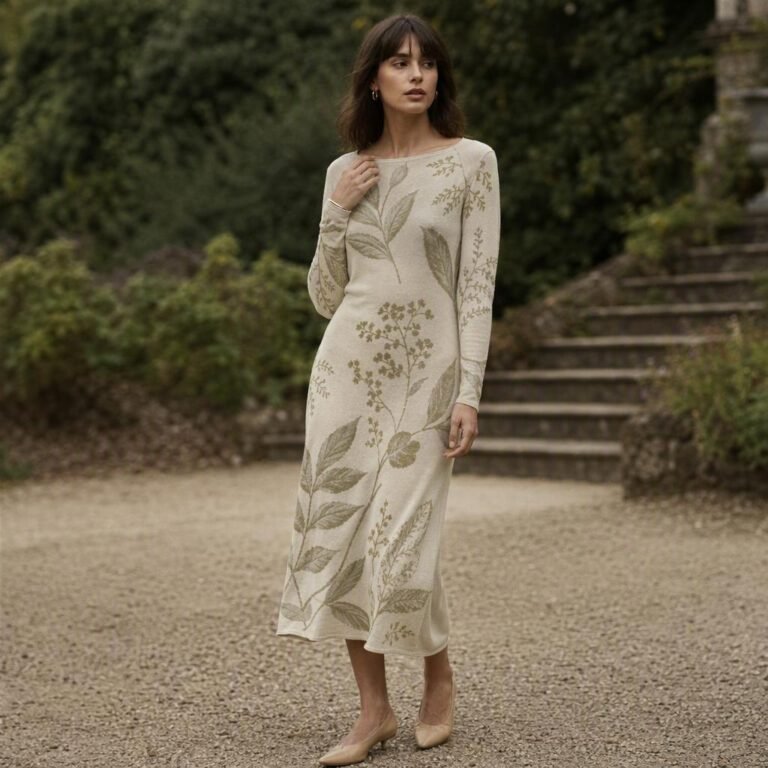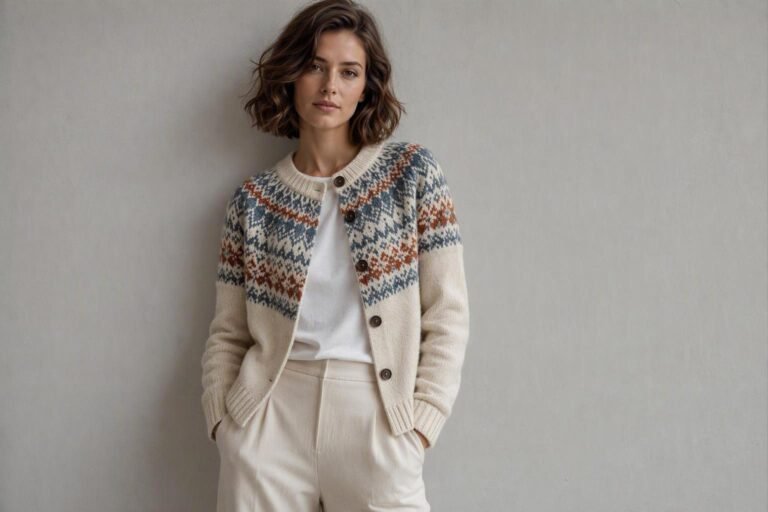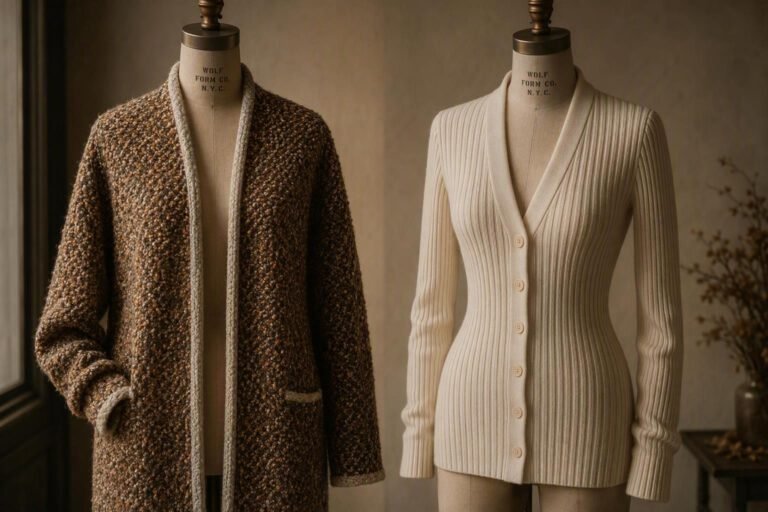

Polka dots keep coming back, and right now they are having one of their biggest moments in years. The twist in the current wave is that the playful, saccharine versions have been pushed aside. As ELLE put it for the spring 2026 season, designers shrank the scale, leaned into neutral palettes, and styled dots with clean tailoring instead of retro accessories.
That change makes the polka dot cardigan one of the easiest printed knits to wear. It is still a print, so a few rules apply, but done well it reads as a wardrobe staple rather than a costume piece.
This guide walks through the three decisions that decide whether a dotted cardigan works, the styling rules worth keeping, which color pairings look current, and outfit ideas you can copy straight into your week. If you design or sell knitwear, there is a section at the end on how dots are actually made in a cardigan and what to specify when you order a small run.
The three decisions that decide whether the cardigan works
Before you think about outfits, settle three things about the cardigan itself. Get these right and everything else gets easier, because they apply to any polka dot cardigan regardless of where you bought it.
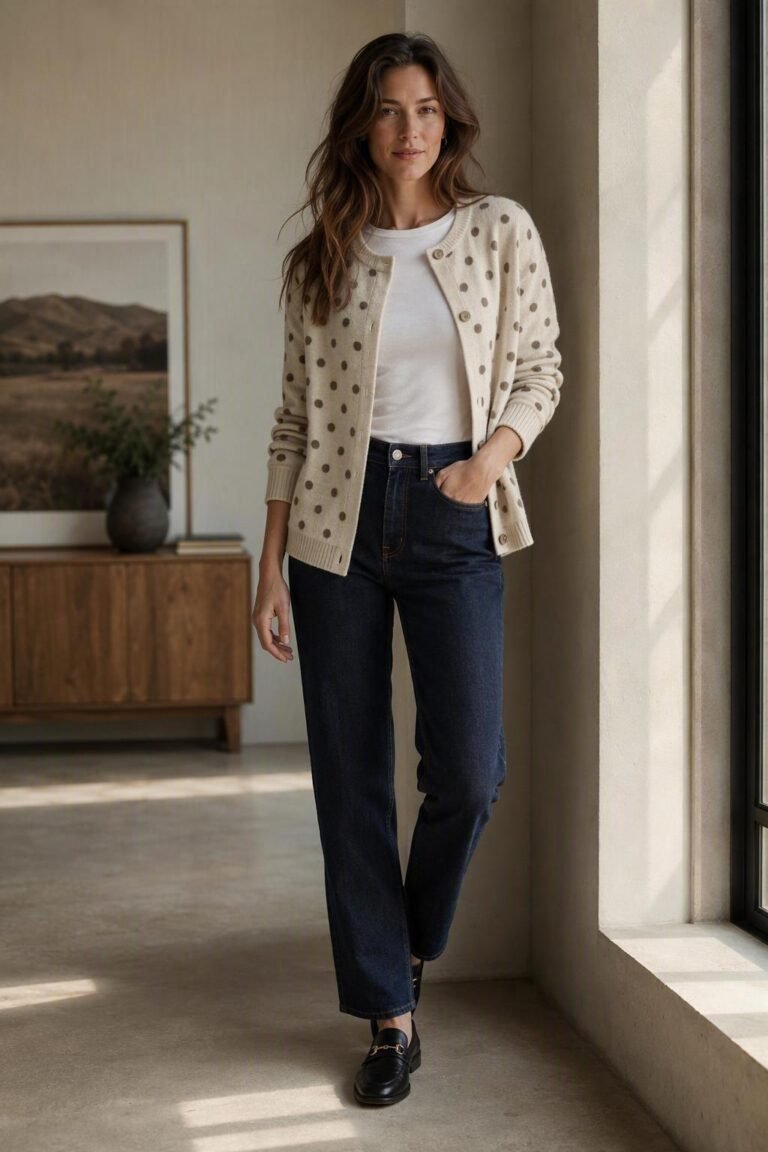
1. The colorway. A dotted cardigan reads differently depending on the base and dot colors. Near-black dots on cream, brown dots on oat, and navy on white all behave like neutrals. You can wear them with almost anything. Red-and-white or pastel versions are statements; they ask for a more careful outfit around them. For a cardigan you will reach for weekly, a neutral base wins.
2. The dot scale. Small, tightly packed dots lean retro and can look dated. Large, widely spaced coin dots read graphic and intentional, which is why the larger-scale direction feels deliberate rather than fussy. Your body frame matters too. Big dots sit better on taller or broader frames, while petite frames often carry a medium dot more easily.
3. The silhouette. A fitted cardigan buttons up and behaves like a top. An oversized or longline one works as a topper over a streamlined base. Decide which job the cardigan is doing before you pick its partners.
Key Takeaway: Treat the colors, dot size, and cut as a single decision. A neutral-base cardigan with medium-to-large spaced dots in a classic or slightly oversized cut is the most reusable combination.
The dot-styling rules that always work
Once the cardigan itself is sorted, a small set of rules keeps the whole outfit balanced.
Keep the rest of the outfit solid. This is the biggest one. The dot is doing the visual work, so everything else should step back. Let a plain tank, tee, or top sit under the cardigan and let your bottoms stay solid. Mixing dots with a second print on the same cardigan collar or placket can work, but two bold prints in one outfit rarely do.
Streamline the base layer. Because a printed cardigan adds busyness to the torso, the layer underneath and the bottoms should read clean. Fitted tops, straight or tailored trousers, and simple silhouettes are the reliable partners. Balance an oversized or chunky dotted cardigan by wearing a fitted tee, a bodysuit, or a slip dress beneath it.
Give the outfit a waist point. A boxy print can swallow your shape if nothing anchors it. Add a belt over a fine-gauge sweater, tie a self-belt just above the natural waist, button a single button to suggest shape, or tuck your base top so the waistband shows. Any one of these gives the eye a place to rest.
Cap the colors at about three. Picture an outfit as a dominant color, a secondary color that takes up around a third, and a small accent. The dots are their own element, so the combined color count climbs fast. Fewer moving pieces means the print reads intentional rather than cluttered.
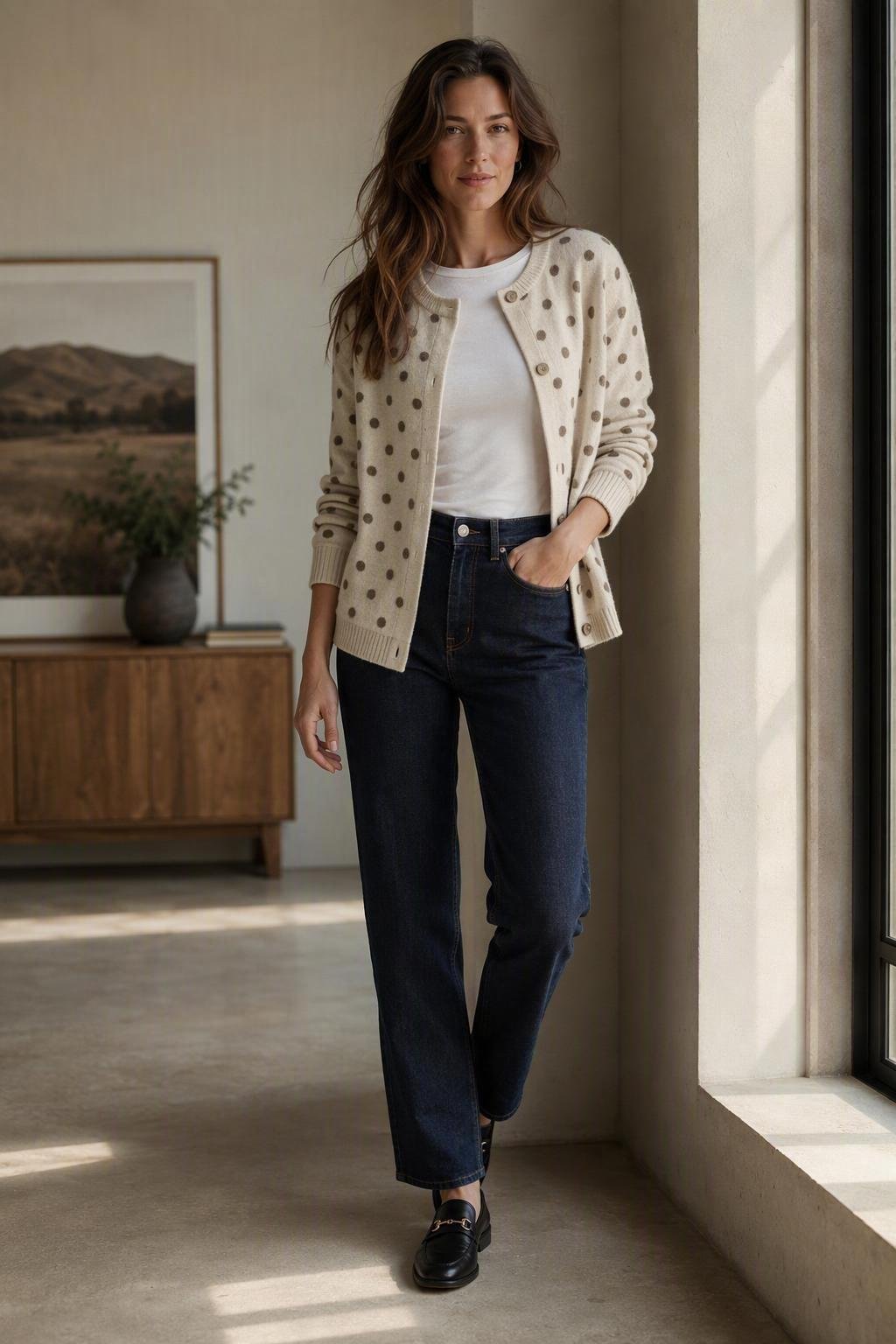
Pair dots with clean or sporty companions. Sneakers, loafers, straight denim, and structured trousers are what make dotted knitwear look current. Heavily retro accessories, bow-tied ballet flats, and kitten heels push it back toward vintage costuming. If the dots are the point, keep the shoes and bag simple.
Pro Tip: When you are unsure, shoot for one dotted piece, one solid fitted top or bottom, denim or a tailored trouser, and flat, minimal shoes. That combination almost never misses.
Which colors go with a polka dot cardigan
The classic black-and-white dotted cardigan is the most graphic and the easiest to pair, because it works as a neutral against almost any color. But the 2026 refresh has moved toward softer, earthier mixes, and those tend to read more elevated on a knit.
Tonal and natural pairings look most current. Brown-on-cream, chocolate-on-camel, and oat or beige bases with darker dots sit within the muted, natural palette that stylists are leaning into this season. These combinations feel refined rather than cutesy, and they extend easily into fall and winter layering.
Navy and white is the softer classic. If black-and-white feels too stark, navy gives the same clean effect with less contrast. It pairs well with denim, cream, camel, and rust-toned accents.
Red-and-white is a stronger statement. It works, but the surrounding outfit matters more. Keep it minimal: dark denim or a pencil silhouette and simple shoes, so the red reads as a deliberate pop rather than a costume.
Pastels with tiny dots are romantic, not retro. A soft pink or cream cardigan with small dots suits warm, minimal styling. The risk is drifting sweet, so ground it with tailored or more masculine pieces.
The fastest way to buy into the current look is to reach for a neutral-toned cardigan first, then treat black-and-white as the go-anywhere option and save the brighter or pastel versions for when you want to make an entrance. If you are not sure, a tonal or navy base almost always wins: it photographs cleanly, pairs with more, and stays wearable across more seasons.
Outfit ideas for every part of your week
Here are five ready-to-wear formulas. Each treats the cardigan as the hero and keeps the rest of the look uncluttered.
For the office. A fitted dotted cardigan layered over a white or black shell with a pencil skirt or tailored trousers. Button the top button and tuck the shell so the waist is clear. Loafers or low heels finish it. This is the version that looks sharp, not sweet.
For the weekend. An oversized dotted cardigan worn open over a fitted tank, straight-leg or wide-leg denim, and sneakers. Keep accessories minimal. The loose cardigan over clean denim is the easiest modern daytime look you will wear repeatedly.
For date night. A dotted cardigan over a slip dress or a slim midi skirt, with sleek flats or low heels. Leave it open so the dress line stays visible, or button it higher for a more covered, cozy feel. A tonal cardigan over a toned dress reads especially put-together.
For travel. A mid-length dotted cardigan over a plain top and comfortable straight pants or leggings, with sneakers or loafers. It layers for the plane, works in transit, and keeps the print low-effort. Choose a small-to-medium dot so it does not dominate the whole day.
For layering over a monochrome outfit. Put the dotted cardigan on top of an all-black or all-cream base. The single printed layer becomes an accent that adds a trend without overwhelming the silhouette. This is a subtle nod to the dot revival that still reads quietly.
If you want to test the waters without committing to a big print, this last approach is the gentlest entry: a fully neutral outfit with a dotted cardigan as the only pattern.
Dot, do, and don’t: quick fixes that stop the retro look
A few fast rules stop the retro look before it starts. Keep these in mind whenever you are putting together polka dot cardigan outfit ideas for a shoot or a real day out.
Do keep the cardigan as the one printed piece in the outfit. Do pair it with denim, tailoring, clean knit tops, and simple shoes. Do use tonal or neutral bases if you want it to last beyond one season. Do choose larger, spaced dots if you want a modern, graphic feel.
Don’t stack dots with a second bold print in the same outfit. Don’t lean on bow-tipped ballet flats, kitten heels, or heavy vintage accessories. Don’t buy tiny, dense all-over dots if you want the cardigan to read current.
If you already own a high-contrast cardigan and it feels too costumey, the fix is not to get rid of it. Change what surrounds it: swap the retro skirt for straight denim, the bow flats for loafers, and cut the accessories down to one simple piece. The same cardigan can look completely different on a modern base.
How to build a polka dot cardigan that lasts
If you are an emerging label deciding whether to put dotted knitwear in your line, or a buyer who wants to understand what you are paying for, the construction matters as much as the styling. A cardigan is a printed top that has to survive seams, a front placket, and buttons, so how the dot is made shapes what is actually possible.
Dots on knitwear are usually made one of three ways: jacquard, intarsia, or print. They differ in how the pattern gets into the fabric and in what each method does well.
Jacquard builds the dots in by working multiple yarn colors across the row, with the unused yarn carried as floats on the inside. It suits repeating dot fields and all-over patterns, and it scales well to production. The tradeoff is that the fabric can feel denser or heavier in patterned areas, and the floats show on the reverse.
Intarsia treats each color as its own yarn island, joined to its neighbor only where the color changes. That gives a cleaner inside with no long floats, which makes it a strong choice for larger, isolated dots or a positioned motif. It is slower and more labor-intensive, so the joins need careful control.
Print applies the dot artwork on top of a finished knit base. It allows fine detail, gradients, and quick visual strike-offs that knit colorwork cannot easily match. The catch is that durability, colorfastness, and hand-feel become the main risks, and print can look flatter than a knit-in dot.
The practical rule for a cardigan: small, frequent dots usually lean toward jacquard; large statement dots often suit intarsia; and highly detailed or gradient effects favor print. Whichever you choose, the dot layout has to be mapped to the front, back, and sleeve pieces before seaming so the dot centers, placket edges, and button zones stay aligned after construction.
Two things get underestimated. First, a pattern must stay legible at knit resolution, so keep the dot shapes clear and spaced rather than tiny and fiddly. Second, test the motif in a swatch before committing to a run, because gauge and placement change how the dot reads in the finished garment.
For a small brand, this is exactly the kind of decision a low-MOQ manufacturer exists to solve. You can order a short run, see a real swatch of the dot on the actual yarn and gauge, and refine the placement before you commit to more. Cardigan styles commonly sample in about six days, since the placket, buttonholes, and pocket work add steps, and production can start around 50 to 100 pieces per style and color depending on the yarn.
Key Takeaway: For an emerging label, weight the dot method against your priorities. Jacquard suits scalable all-over dots, intarsia suits clean large dots, and print suits fine detail, but only a real sample tells you how it drapes and survives wearing.
Start with one dotted cardigan and build from there
The polka dot cardigan is having a moment because it is a print that works as a functional layer. Own one good version, learn the few rules above, and it will pull dozens of outfits together across seasons without ever looking like a costume.
Settle the colorway, the dot scale, and the cut first, then let the dots lead. Keep the rest of the outfit solid, clean, and minimal, give the waist a clear point, and stop around three colors. Choose tonal or navy bases when you want it to last, save the bright or pastel versions for statement days, and let denim, tailoring, and flat shoes do the modernizing for you.
If you design or sell knitwear and have been thinking about a dotted cardigan for your next run, the same logic applies on the spec sheet. Pick the dot method that matches your motif, keep the pattern legible, and test a real swatch before you scale. Sampling a single style at low quantities is the lowest-risk way to see whether the trend works for your customer, and it is a step most custom knit cardigan suppliers support. Understand the difference between jacquard, intarsia, and printed knit, keep your knit motifs legible and well placed, and you can move from a single sample to a small run with confidence.