

A launch date is a promise you make to a retailer, a collaborator or your own marketing calendar. The ocean leg is not a promise anyone can keep. Sea-Intelligence’s September 2026 Global Liner Performance data put global schedule reliability at 50.6%, up 0.9 percentage points month on month but still down from a 64.5% peak in May, with late vessels averaging 6.65 days behind schedule (Sea-Intelligence). Roughly half of arrivals miss their window, and the ones that miss tend to miss by about a week.
The instinctive fix is to build finished sweaters earlier and hold them. That converts a timing risk into a cash and markdown risk, and it is the most expensive buffer available to a small label. This playbook argues that flexibility is bought earlier in the chain — in yarn position, staged commitments, gated bulk releases and packaging readiness — rather than at the port. By the end you will have a method for sizing buffers by style risk, a rule for which yarn to commit early, a set of written gates before bulk release, and a backward calendar from launch date to tech pack.
Knitwear is the case study because its production sequence is yarn-first. Yarn is ordered and dyed before a single loop is knitted, which gives buyers more levers to pull than cut-and-sew — and more places for a plan to break.
Disclosure: this guide is published by Xindi Knitwear (Knitwear.io), a knitwear manufacturer in Dalang, China. The planning advice below is written to be useful whether or not you work with us, but you should read it knowing the publisher benefits if you choose a manufacturing partner.
Key takeaways
Schedule reliability is volatile, not steadily bad. Buffer by style risk rather than applying one number of days to every style.
Yarn is the longest and least reversible commitment in a knit program. Split it into what you must commit early and what you can stage.
Release bulk only against written approvals covering colour lot, gauge and structure, measurement method and size ratio.
Close label, hangtag and carton artwork at order stage. Packaging confirmed after production is a documented cause of delay.
The goal is protecting the launch date with staged commitments, not pre-building sellable inventory.
Why freight friction lands on the sourcing calendar, not just the freight budget
Schedule reliability near 50% means about half of vessel arrivals miss their window. The average late arrival in September 2026 was 6.65 days behind schedule — an improvement of 0.30 days on August, but still the second-highest September figure on record (Sea-Intelligence). A single ocean leg can therefore absorb a week or more of slack that most launch calendars never budgeted.
On the data used here: the Sea-Intelligence figures are monthly Global Liner Performance readings, so each figure describes one month’s global vessel performance across the carriers tracked rather than a full-year average. They are the most recent monthly readings available as this guide was written, which is why they are treated as a current snapshot rather than a stable norm — check the latest release before you set buffer against them.
The routing layer makes it worse on some lanes. Cape of Good Hope diversions on Asia–Europe added roughly 3,500 nautical miles per round trip and 10 to 14 days of additional transit, according to GoFreight’s disruption analysis. C.H. Robinson’s March 2026 ocean update described diversions as “often measured in weeks rather than days” and warned that space availability may differ meaningfully by port pair and by week, even within the same trade lane (C.H. Robinson).
What this means for you: the factory ship date sits in the middle of your critical path, not at the end. After it come gate-in, cut-offs, the sailing itself, clearance and the inland leg. And it is variability, not average transit, that breaks launch dates — a 35-day average that sometimes runs 50 is a different planning problem from a 35-day average that always runs 35.
Four levers follow from that, and the rest of this piece develops them: how much calendar buffer to hold and where, which yarn commitments to make early, what must be true before bulk is released, and when packaging has to be closed.
The flexibility principle: buy options early, commit late
A flexible sourcing model is not the absence of commitments. It is a portfolio of commitments with different reversal costs, and the job is to place each one where its cost of being wrong is lowest.
Ranked from hardest to easiest to reverse:
Finished goods in your colours and sizes. Once knitted, washed, labelled and packed, the money is spent. If the launch slips or the shade reads wrong, you are carrying stock you cannot re-cut into something else.
Custom-dyed yarn. A dye lot is made to a shade. If the colour changes after dyeing, the yarn is dead stock; if the style is cancelled, you own cones.
Stock-supported yarn. Reversible in the sense that it is a catalogue item, but you still hold inventory and you are limited to the colours and blends the mill carries.
Trims, labels and packaging. Moderately reversible. Artwork can be amended and cartons reprinted, usually at a cost and a delay rather than a write-off.
Calendar buffer. Costs you time-to-market and, if you hold it unused, nothing at all.
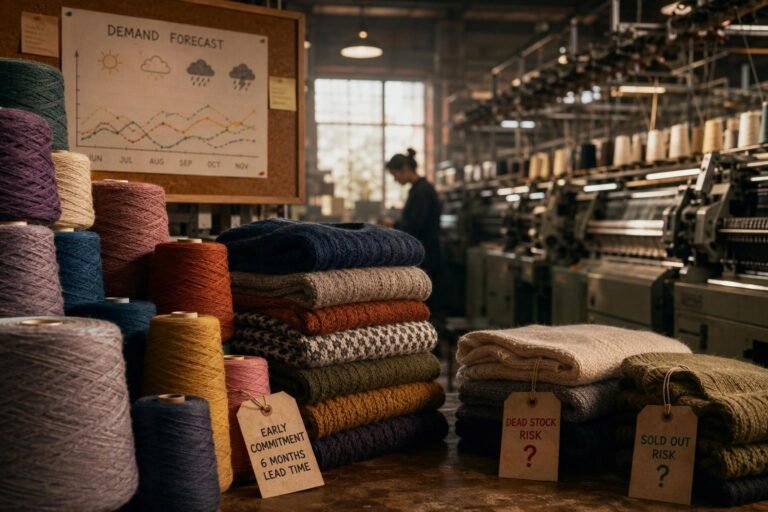
The governing rule is to push commitment as late as the process allows, and where you must commit early — and in knitwear you must commit to yarn early — commit in a form that keeps options open. That means stock-supported colours where the shade permits, staged lots rather than one full-season dye booking, and a written substitution rule agreed before the order is placed so a mill shade-out does not become an email negotiation in week six.
On the “without excessive inventory” constraint: carrying finished stock is one buffer, and it is the most expensive one because it ties up cash, incurs storage and carrying cost, and exposes you to markdown if the season reads differently than you expected. Calendar buffer, yarn position and gated releases are cheaper buffers that protect the same date. They ask you to plan earlier and approve faster rather than to buy more.
Sizing the buffer by style risk, not a blanket number of days
There is no universal number of buffer days, and any guide that gives you one is guessing about your styles. What you can do is score each style on the factors that actually drive its variability, then match the buffer type to the score.
Score each style on five inputs:
Yarn availability. Stock-supported colour, or custom-dyed to a Pantone reference?
Colour complexity. One shade or four, and how tight are the dye-lot tolerances?
Construction complexity. Simple jersey or rib, versus jacquard, intarsia, fine gauge or fully-fashioned panels.
Trim and packaging lead time. Stock labels, or custom woven labels, printed hangtags and branded cartons?
How immovable the date is. A collab drop or retailer window is fixed; a first web launch can move a week.
Low-risk styles — stock yarn, one or two shades, simple construction, flexible date — can run on standard transit assumptions. High-risk styles need calendar buffer plus a documented air-freight decision point: a date and a named person who decides whether to fly, agreed before the season starts.
Size the buffer against the cost of the recovery option, not against habit. Ocean Asia–Europe runs roughly 30–40 days against 4–7 days by air, and air costs several times more per piece; CBI’s export guidance frames the trade-off in terms of transport as a share of goods value. The practical reading: air is a recovery tool you budget for on high-risk styles, not a default and not a decision you make in a panic at the terminal.
Buffer type | What it protects | What it costs | When to use |
|---|---|---|---|
Calendar buffer (earlier order placement) | The whole chain, by moving every downstream date earlier | Time-to-market; earlier cash outlay | Every style, sized to risk tier |
Yarn position (stock-supported or early-committed lot) | Knitting start date; colour consistency | Cash tied in yarn; narrower shade range | Styles with custom shades or long dye lead times |
Gated bulk release | Against rework and re-makes from unapproved changes | Administrative discipline; slightly later bulk start | Every style, non-negotiable |
Air-freight contingency | The launch date if the vessel misses its window | A multiple of ocean cost per piece | High-risk styles with immovable dates |
Pre-built finished inventory | The date, fully | Cash, storage, markdown exposure | Only where the date is worth more than the inventory risk |
Yarn and trim planning: what to commit early, what to stage
In knitwear, yarn is ordered before knitting begins, so yarn lead time sits on the critical path in a way that fabric ordering often does not in cut-and-sew. The single biggest planning decision is whether a shade can come from mill stock or has to be custom-dyed.
Supplier-reported figures illustrate the gap. JM Sweater’s low-MOQ guide puts stock-supported colours at no per-shade minimum with 1–3 day yarn lead times, against roughly 50–200 kg minimums per shade and 20–30 day lead times for Pantone custom-dyed yarn. Textile Yarn’s custom production guide describes custom colours at roughly 50–300 kg per colour with 3–5 weeks after colour approval, rising to 100–500 kg for small-batch custom blends and around 1,000 kg for full custom development. A separate 2026 knitwear sourcing benchmark, compiled across multiple mills, lands in the same band at 30 pieces per colour for stock yarn and 30 pieces with a small-lot dyeing surcharge for custom-dyed colour (Knitwear Sourcing Benchmark Report 2026).
These remain supplier-reported ranges from individual businesses, not industry rules — your mill’s numbers will differ, and publishable minimums are quoted per colour rather than per order. The consistent picture across sources is a planning assumption of roughly 3–6 weeks and 50–200 kg per shade for ordinary custom-colour knitwear yarn, with small dyehouses starting around 20 kg and industrial mills requiring 50–100 kg or more. That is the planning point: a custom shade can add three to six weeks before knitting starts, plus a minimum quantity that may exceed a capsule’s whole buy. Note also that a yarn minimum converts to garments by weight — 50 kg at roughly 400–450 g per sweater is about 100–125 pieces before waste.
Staging logic:
Commit early for shades that are core to the range, high-volume, or impossible to substitute — a signature colour you will reorder, or a shade that defines the style.
Stage or substitute for accent shades, contrast trims and packaging that can be finalised closer to bulk. If an accent can live with a stock shade that is close rather than exact, you have removed a month from the critical path.
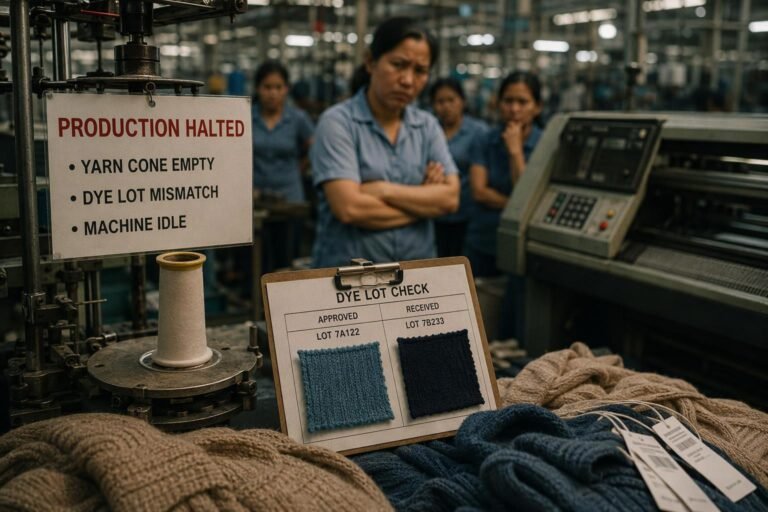
Book each colour in one dye lot and record the colour standard the sample was approved against. CZ Knitwear’s sample-to-bulk guide identifies bulk yarn from a different dye lot than the sample as a common source of colour drift — the kind of difference that passes a factory check and fails a buyer’s eye.
Trims follow the same logic at lower stakes. Close label, hangtag and carton artwork at order stage, not after production. Late artwork confirmation is a documented cause of packing drift, and unlike yarn it is almost entirely within the buyer’s control.
What we see on our own orders
Because most published lead-time figures come from suppliers describing themselves, it is worth stating where our own programme constraints sit, so you can calibrate this guide against a concrete case. On our lines, sampling from a tech pack or photo takes about 3–5 working days and garment minimums start at 50 units per style; those are our numbers, not an industry norm, and they are the reason staging logic matters more for small labels than for large ones.
The failure points we see repeat most often are not exotic. They are a lab dip approved off a screen instead of a physical swatch, a gauge change made verbally during sampling and never written into the order, measurement taken on a freshly finished piece when the approval was on a relaxed one, and packaging artwork still being revised while bulk was already knitting. Each is cheap to prevent at order stage and expensive to correct after bulk. A fifth, less obvious one is a size ratio inferred from a sample rather than specified in the order confirmation — which arrives as a correct-looking delivery in the wrong size mix.
Sample-to-bulk checkpoints: what must be true before you release bulk
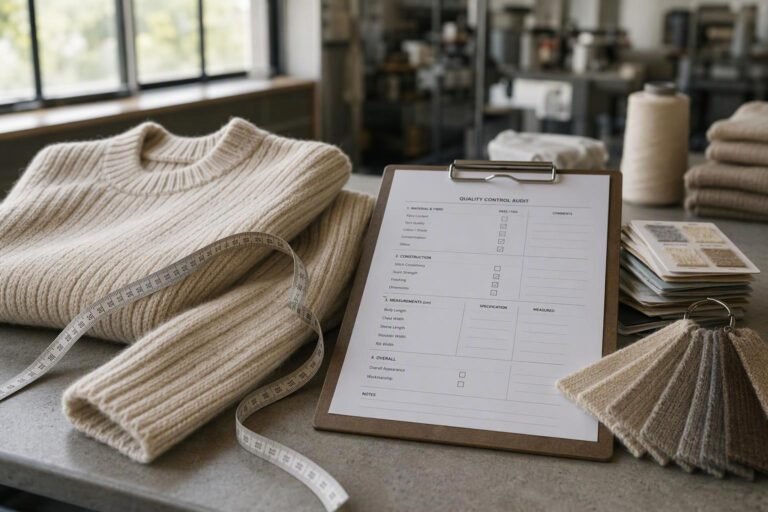
A sample approval is a conversation until it is written down. The gates below convert it into conditions, each of which must be true and signed before bulk is released. They reflect general industry practice; they are not a description of any specific factory’s process, so confirm the actual checkpoints with your supplier.
1. Yarn and colour gate
What must be true: an approved lab dip or swatch, tied to a recorded dye lot, with the colour standard documented.
What failure looks like: bulk arrives a shade off because the sample yarn and the bulk yarn came from different lots and nobody recorded which was approved.
2. Construction gate
What must be true: gauge and structure frozen by name — gauge, stitch, panel construction — with any later change treated as a change order.
What failure looks like: a “minor” adjustment made during sampling is applied to the whole order, and the hand-feel or weight shifts.
3. Fit and measurement gate
What must be true: measurement points, measurement method and garment state (relaxed versus freshly finished) agreed in writing.
What failure looks like: the sample was measured relaxed and the bulk piece freshly finished, so the same nominal size measures differently and the fit reads wrong.
4. Size-ratio gate
What must be true: sizes and the size breakdown confirmed in the order confirmation, not assumed from the sample.
What failure looks like: the ratio was inferred rather than specified, and the size run that arrives does not match the plan.
5. Commercial gate
What must be true: the delivery window confirmed after sample approval, when yarn position is known.
What failure looks like: a delivery date quoted before yarn was secured, which then slips the moment the mill confirms its lead time.
Run these as a single sign-off sheet per style. The discipline is not bureaucracy — it is the cheapest way to prevent the rework and re-makes that turn a tight calendar into an air-freight decision.
Packaging and freight readiness: closing the last mile before the container
Packaging readiness is a date on the critical path, and it is the one most often left to the end because it feels like admin. A finished order with the wrong carton label or a missing document can sit at the terminal while your launch date passes.
Carton and label data. If your stockist or marketplace requires GS1 logistics labelling, the SSCC is the unit identifier, with product variant, production and packaging dates, and lot or batch numbers as supplier-segment data (GS1). Agree the label content and format with the receiver before cartons are printed, not after.
Export documentation. A commercial invoice and a packing list with net and gross weights and package marks are the baseline; the destination may require certificates as well. Trade.gov’s guidance recommends asking the buyer at the start of the transaction which documents will be needed for clearance in the import country — which is a question to settle at order stage, not at the port.
Marketplace packaging rules. Where relevant, these are specific and non-negotiable. Amazon FBA, for example, requires apparel in transparent sealed poly bags of at least 1.5 mil, with a suffocation warning on bags with a 5-inch opening or larger, and a scannable label visible after bagging (Amazon FBA). Build those requirements into the packaging spec you send with the order.
Cut-offs. Gate-in, documentation, VGM and customs cut-offs vary by terminal, carrier and equipment type, and some are counted back from vessel arrival rather than departure (CargoLinked). Read the specific fields on your own booking rather than assuming a standard, and agree who owns each deadline — supplier for cargo readiness, forwarder for shipping instructions and VGM, importer for any import filing.
What this means for you: packaging and documentation should be closed at order stage, so that when the goods are ready the container can move. Late artwork or a missing certificate is a self-inflicted delay on a chain that already has enough of them.
Working backward from the launch date across the whole chain
The reliable way to plan a launch is to start at the launch date and walk backward, assigning each stage a range rather than a point estimate. OneAim’s lead-time benchmark frames total calendar as sample, bulk, freight and customs; the specific day counts below are supplier-reported and lane-dependent, so substitute your own quotes where you have them.
Stage | Typical duration range | Variability | Buyer lever |
|---|---|---|---|
Tech pack and spec confirmation | Days | Low | Completeness of the tech pack |
Sampling and approval | 1–3 weeks plus revisions | High | Number of revision rounds; parallel sampling |
Yarn order and dyeing | Days for stock; several weeks for custom | High | Stock versus custom shade; early commitment |
Yarn in-house | Days | Low | Confirm receipt before releasing bulk |
Bulk release gate | Days | Low | Written sign-off sheet |
Bulk production | Several weeks | Medium | Construction complexity; capacity booking |
Final inspection and packing | Days | Medium | Packaging closed at order stage |
Gate-in and cut-offs | Days | Medium | Booking discipline; who owns each deadline |
Ocean transit | Weeks; longer via Cape | High | Risk-adjusted upper bound, not the average |
Customs clearance | Days | Medium | Correct documentation |
Inland delivery and DC appointment | Days | Medium | Book the appointment early |
Two things stand out when you build the chain this way. First, the links with the highest variability are sampling, yarn and ocean transit — and two of those three are influenced by decisions you make at order stage. Second, the factory ship date is roughly the midpoint. Everything after it is yours to manage, and everything before it is where the cheapest levers sit.
The decision rule: where the backward calendar shows a gap, close it with the cheapest lever that works — calendar buffer, staged yarn, gated release, or air contingency — before defaulting to pre-built inventory. Pre-built inventory is the lever of last resort, not the first.
Common mistakes that turn a timing problem into an inventory problem
Applying a blanket buffer to every style. A single number over-buffers simple styles and under-protects complex ones. Fix: score each style on the five risk inputs and match the buffer type to the score.
Committing to custom-dyed yarn before colour is locked. If the shade changes after dyeing, the yarn is dead stock. Fix: lock the lab dip before the dye lot is booked, and keep accent shades on stock yarn until the range is settled.
Releasing bulk on verbal sample approval. Without a written colour lot, gauge and measurement record, “approved” means different things to you and the factory. Fix: use the five-gate sign-off sheet and treat later changes as changes.
Treating the factory ship date as the delivery date. It ignores cut-offs, clearance and the inland leg. Fix: plan to the retail-ready date, not the ex-factory date.
Closing packaging artwork after production. This forces rework or air freight on goods that were otherwise on time. Fix: close label, hangtag and carton artwork at order stage.
Pre-building finished goods as the default buffer. It protects the date but converts freight risk into markdown risk. Fix: reserve pre-building for styles where the date is demonstrably worth more than the inventory exposure.
A worked example: one knitwear style, two buffer strategies
The numbers below are illustrative planning assumptions, not benchmarks. Substitute your own unit cost, carry rate and air quote; the reasoning is what matters.
Take a mid-complexity knit sweater with one custom-dyed shade and a fixed collab launch date. Assume a bulk order of 1,000 units, a goods value of $30 per unit, and a carrying cost of 25% of average inventory value per year — the mid-point of the 20–30% annual range commonly used for apparel, and roughly 2% per month once annualised (inventory carrying-cost benchmark). Higher-turnover basics sit nearer 20%; seasonal, fashion-forward ranges can run higher once markdown and obsolescence exposure is included.
Strategy A — blanket buffer plus pre-built stock. Place the order 30 days earlier than strictly needed and build 20% extra finished stock (200 units) as insurance. The calendar buffer costs time-to-market but little cash. The pre-built stock ties up about $6,000 in goods, plus carrying cost, and if the drop underperforms, those 200 units are markdown candidates.
Strategy B — risk-tiered buffer. Commit the custom shade early with a recorded lot, keep any accent on stock yarn, gate bulk release on the five-gate sign-off, close packaging at order stage, and set an air-freight decision point 21 days before launch. If the vessel makes its window, you have spent nothing on recovery. If it misses, you fly a partial quantity — enough to hit the drop date — and let the balance arrive by sea. The air premium is real, but it is paid once, on part of the order, and only when needed.
When each is right. Strategy A suits a style where the date is worth more than the inventory risk and you expect to sell through regardless — a proven repeat, or a drop with strong pre-orders. Strategy B suits most first-time and capsule styles, where the inventory risk is the bigger exposure and the air contingency is a cheaper insurance policy than a warehouse of sweaters.
FAQ
How much buffer should a first-time knitwear buyer add?
There is no universal number. Score each style on yarn availability, colour complexity, construction complexity, trim lead time and how immovable the date is, then give high-risk styles calendar buffer plus a documented air-freight decision point. Low-risk styles can run on standard transit assumptions.
Can I use stock yarn to shorten lead time, and what do I give up?
Yes, and it can remove weeks from the critical path and lower per-shade minimums. What you give up is control: the colour and blend are fixed to what the mill carries, so a signature shade may not be achievable. Use stock yarn for accents and sampling, and reserve custom dyeing for core shades.
What should I do if the vessel misses the cut-off?
Roll the booking to the next sailing, re-plan the inland leg and DC appointment against the new arrival, and trigger the air-contingency decision you set in advance. The decision is easier if the date and the decision-maker were agreed before the season started.
How do I protect a launch date without pre-building inventory?
Stage your commitments: commit early only where you must (core yarn), gate bulk release on written approvals, close packaging at order stage, and hold calendar buffer sized to risk. These protect the date at lower carrying cost than finished stock.
Is air freight ever justified for knitwear?
Yes, as a recovery tool on high-risk styles with immovable dates, or for a partial quantity to hit a drop. It costs several times ocean per piece, so treat it as insurance you budget for rather than a default mode.
Conclusion and next steps
Flexibility in knitwear sourcing is bought in yarn position, staged commitments, gated releases and packaging readiness — not in a warehouse of finished sweaters. A risk-tiered buffer protects the launch date at lower carrying cost than blanket inventory, and it keeps your cash available for the next collection rather than tied up in the last one.
The practical next step is small, and it does not require choosing a supplier:
Build one backward calendar for your next launch, using ranges rather than point estimates.
Request yarn swatches and confirm which shades are stock-supported versus custom-dyed before you lock the range.
Ask for certification documentation on the yarns you plan to use.
Write the five-gate sign-off sheet and use it on your next sample approval.
Pilot a small run — a capsule or a single style — before committing to a full seasonal buy, so the gates and the calendar are tested on a low-stakes order.
About the publisher
Xindi Knitwear (Knitwear.io) is an OEM/ODM knitwear manufacturer based in Dalang, China, working with international labels on sampling, private-label production and certified yarn programmes. Capabilities relevant to this guide include sampling from tech packs or photos in about 3–5 working days, minimum order quantities from 50 units, and OEKO-TEX, RWS, GRS and GOTS yarn options. If you want to work through the backward calendar on a real style, a swatch request and a conversation about your launch date is the usual starting point.