
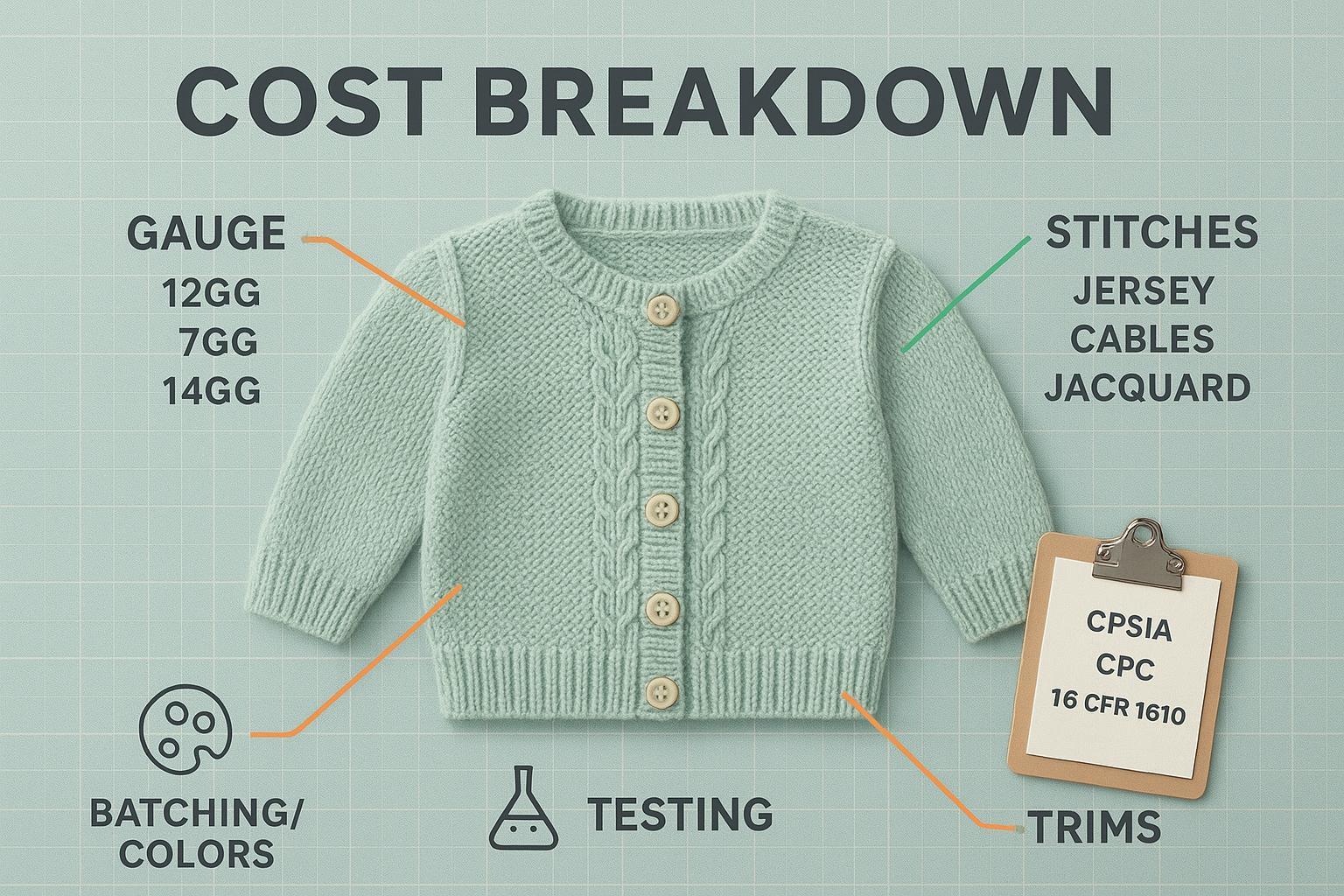
Launching a baby knitwear capsule on a 50–80 piece color run sounds simple—until you cost it. This guide shows exactly how the CPSIA framework, gauge and stitch choices, and low-MOQ realities flow into your per‑unit price. We’ll use three baseline SKUs, a textile‑only compliance plan (16 CFR 1610 + CPC + tracking labels), and one practical savings lever: batching colors/lots and consolidating gauges where permissible.
Key takeaways
CPSIA for general children’s wearing apparel centers on the 16 CFR 1610 flammability standard, a Children’s Product Certificate (CPC), and permanent tracking labels; sleepwear rules (1615/1616) are out of scope unless you market as sleepwear.
Many plain-surface knit fabrics are exempt from flammability testing under 16 CFR 1610; when not exempt, plan representative testing by color/lot with your lab. Document rationale either way.
Your biggest cost drivers at low MOQs: yarn price/kg, grams per piece (gauge + stitches), machine minutes (cables/jacquard slowdowns), setup/waste on color changes, and how you allocate any lab fees.
The fastest savings lever is operational: batch colors from the same fabric/finish for representative testing (where permissible) and consolidate gauges to cut changeover waste. Always confirm with a CPSC‑accepted lab.
CPSIA essentials for knit baby sweaters (textile‑only plan)
For children’s apparel not marketed as sleepwear, the baseline rule is the clothing textiles flammability standard, 16 CFR Part 1610. It classifies textiles into allowed (Class 1/2) versus prohibited (Class 3) and specifies exemptions. See the full text in the eCFR under the standard for the flammability of clothing textiles and its methods in 16 CFR Part 1610. According to the CPSC’s fact sheet, plain‑surface fabrics weighing at least 2.6 oz/yd² (≈88.2 g/m²), and all fabrics composed entirely of acrylic, modacrylic, nylon, olefin, polyester, wool, or combinations thereof, are exempt from testing (but still subject to the standard) [CPSC 1610 Fact Sheet; eCFR Part 1610]. In 2023, the CPSC clarified methodological details without changing pass/fail criteria in its final rule update.
Read the primary texts: the full standard in the eCFR 16 CFR Part 1610 and the Federal Register 2023 final rule update.
Beyond flammability, you must issue a CPC based on testing or documentation of exemptions via a CPSC‑accepted lab, and you must add permanent tracking labels to the product and packaging to the extent practicable.
CPC and tracking labels: see the CPSC overview pages for a Children’s Product Certificate and the Tracking Label FAQ.
Buttons and small parts context: The small parts rule (16 CFR 1501) primarily targets toys and some products intended for under‑3s; apparel buttons are generally not automatically banned. That said, ensure robust attachment and consider voluntary use/abuse tests, especially for sizes up to 2T. See the CPSC small parts guidance.
Note on sleepwear: If your sweater is marketed as sleepwear or loungewear intended for sleeping, different flammability standards (16 CFR 1615/1616) apply and this guide’s testing strategy does not cover that scope.
What drives CPSIA-compliant knit baby sweater cost?
At low MOQs, costs concentrate into a few buckets that you can model transparently. Gather these inputs first: yarn spec and certification with USD/kg quotes; gauge and stitch density; size curve; colorways and anticipated lots; machine availability and changeover plan; and whether fabrics are exempt under 1610 (or require representative testing by color/lot, per lab advice). For care labeling, fiber identity and COO labels must comply with FTC rules; see the FTC Care Labeling Rule and textiles guidance.
Core cost buckets and formulas:
Yarn cost = (grams per piece including waste ÷ 1000) × USD/kg (by fiber/certification)
Knitting = machine minutes per piece × machine cost/minute × pattern factor
Linking/assembly = operations count × labor rate/minute (reduced for WHOLEGARMENT)
Finishing = fiber‑dependent washing/blocking and stabilization
Trims/labels/packaging = care + content + CPSIA tracking labels; buttons if applicable
QA/AQL = inspection allocation per lot ÷ units
Compliance = flammability (test or exemption documentation), CPC issuance, label execution
Freight/duties buffer = % of FOB for a landed planning view
Here’s a compact waterfall we’ll reuse in the cases below. All numbers are indicative as of Feb 2026—obtain current quotes.
Bucket | Formula/driver | Example range (USD/pc) |
|---|---|---|
Yarn | (g/pc incl. waste ÷ 1000) × USD/kg | $2.00–$6.00 |
Knitting | machine min/pc × $/min × pattern factor | $1.20–$4.50 |
Linking/assembly | ops × labor $/min | $0.30–$2.20 |
Finishing | wash/block/stabilize | $0.25–$0.90 |
Trims/labels/packaging | care/content + CPSIA tracking label; buttons if any | $0.20–$1.20 |
QA/AQL | inline + final insp. allocation | $0.10–$0.40 |
Compliance | 1610 test or exemption documentation; CPC admin | $0.05–$0.60 |
Freight/duties buffer | % of FOB for landed planning | $0.50–$2.00 |
Estimated subtotal | sum | Illustrative only |
Assumptions behind the ranges:
Yarn price/kg varies widely by fiber/certification and lot size; grams/pc are driven by gauge, stitch density, and size. Pattern factors increase both yarn and time for cables/jacquard.
WHOLEGARMENT reduces linking but adds programming/setup that must be amortized at low MOQs.
If your fabric/color is exempt under 1610, compliance cost may be limited to documentation and CPC admin; if not exempt, allocate lab fees across units.
For manufacturing context without bloating this page, see OEM/ODM knitwear production process.
Three costed BOM mini‑cases (indicative; confirm in sampling)
All ranges below are illustrative as of Feb 2026 and depend on supplier quotes, pattern density, and lab advice.
Case 1A — 12GG combed cotton, jersey + 1×1 ribs (OEKO‑TEX), no hard trims; 2 colors; sizes 3–24m; MOQ 50/color
BOM highlights: Plain‑surface jersey body with 1×1 rib neck/cuffs/hem; OEKO‑TEX yarn; no buttons/zippers. Typical consumption for baby sizes at 12GG jersey is modest; include 3–6% waste for cone ends and trials. Most combed cotton jerseys may not be exempt based on fiber alone; check weight. If fabric weight per unit area clears the 2.6 oz/yd² threshold and is plain‑surface, you may rely on the exemption with documentation.
Operations: Panel knitting, standard linking, light steam/block. No buttonholes.
Testing approach: If exempt under 1610, document exemption and cite in CPC; if not, plan representative testing by color/lot in consultation with the lab. CPC and tracking labels still required.
Indicative waterfall (per unit @ 50 pcs/color): Yarn $2.00–$3.50; Knitting $1.20–$2.00; Linking $0.40–$0.70; Finishing $0.25–$0.45; Trims/labels $0.20–$0.35; QA/AQL $0.10–$0.20; Compliance $0.05–$0.30 (exempt documentation vs one test allocation); Freight/duties buffer $0.60–$1.20.
What moves the number most? Yarn price/kg and whether you can rely on exemption (documentation cost only) versus paying for at least one representative 1610 test per color/lot.
Case 1B — 7GG RWS wool/nylon, cable body + linked neck, corozo buttons; 2 colors; sizes 3–24m; MOQ 80/color
BOM highlights: Cable patterns increase grams/pc and slow machine throughput. RWS wool/nylon blend pricing varies by market and season. Cables plus a linked neck drive higher labor; add buttonhole operations and secure button attachment (consider voluntary use/abuse tests for peace of mind, especially in smaller sizes).
Compliance note: Wool‑blend fabrics are among fiber types exempt from 1610 testing (testing exemptions do not remove the obligation to meet the standard). Confirm composition and document exemption on the CPC. Buttons themselves do not trigger 1610; small parts rule generally targets toys, but ensure attachment robustness.
Operations: Slower cable knitting (pattern factor), linking including neck, buttonholes, button sewing; finishing to controlled shrink targets.
Indicative waterfall (per unit @ 80 pcs/color): Yarn $3.50–$6.00; Knitting $2.20–$4.50; Linking/assembly $1.10–$2.20; Finishing $0.35–$0.70; Trims/labels (incl. corozo buttons) $0.60–$1.20; QA/AQL $0.15–$0.35; Compliance $0.10–$0.30 (documentation/CPC admin); Freight/duties buffer $0.80–$1.60.
What moves the number most? Cable density and button spec/attachment time; yarn price/kg is the second big lever.
Case 1C — 14GG WHOLEGARMENT viscose blend, front jacquard/intarsia; pull‑on; 3 colors; sizes 3–24m; MOQ 50/color
BOM highlights: WHOLEGARMENT reduces linking operations but introduces programming/setup that must be amortized at low MOQs. Jacquard/intarsia increases both yarn usage (floats, color changes) and machine time.
Compliance note: Viscose blends are not automatically exempt based on fiber; check fabric weight and surface; if your program does not meet an exemption, consider representative testing by color/lot (lab‑advised) and allocate the fee across units.
Operations: WG programming/setup, seamless knitting, minimal seaming, finishing/blocking to handle viscose hand and dimensional stability.
Indicative waterfall (per unit @ 50 pcs/color): Yarn $2.60–$4.40; Knitting (incl. amortized WG setup) $1.80–$3.60; Linking/assembly $0.30–$0.60; Finishing $0.30–$0.55; Trims/labels $0.25–$0.40; QA/AQL $0.10–$0.25; Compliance $0.10–$0.60 (doc vs one 1610 test allocation); Freight/duties buffer $0.70–$1.40.
What moves the number most? The amortization of WG programming across a 50‑piece color run and the jacquard density.
For stitch and neckline cost context, see Cable knit structure basics.
Testing plan and lab fees under Strategy 2A
Strategy 2A is textile‑only: evaluate 16 CFR 1610 applicability and exemptions, add tracking labels, and issue a CPC. If exempt, keep material specs and exemption rationale on file and cite them on the CPC. If not exempt, discuss representative testing by color/lot with a CPSC‑accepted lab. There is no formal FPU/GPU construct for non‑sleepwear apparel like there is for sleepwear; treat batching as an operational practice guided by material similarity and lab advice.
Read the standard text in the eCFR 16 CFR Part 1610 and the CPSC’s CPC overview. For labeling, consult the FTC Care Labeling Rule.
Indicative lab fees and timelines (as of Feb 2026; obtain quotes): 16 CFR 1610 flammability tests are quote‑based; public price sheets are uncommon. Industry experience suggests standard TATs of ~3–10 business days depending on queue and service level. Some labs provide standards overviews without fees; for example, SGS maintains a consolidated standards guide referencing 16 CFR 1610. Always confirm whether the fee is per color, per representative fabric lot, or per sample count.
CPC issuance checklist (minimum): Identify product and model/SKU, cite applicable rule(s) (e.g., 16 CFR 1610), list CPSC‑accepted third‑party lab, include date/place of manufacture, and trackable batch/lot codes. Keep the CPC accessible to distributors/retailers and accompany shipments electronically or on paper.
Savings lever: batching colors/lots and consolidating gauges (3A)
Think of this as project management with compliance guardrails. When permissible and advised by your lab:
Group colors that share the same base fabric lot and finishing to enable representative testing under 1610 when you’re not exempt; document the rationale.
Consolidate gauges across styles where your design language allows (e.g., keep 12GG across two styles) to reduce yarn changeovers and setup waste.
Build the lot so you can allocate any lab fee across more units (e.g., two colors × 50 pcs/color instead of isolated 50‑piece micro‑lots).
Illustrative impact: If a single representative 1610 test is agreed for a two‑color lot of 100 pcs, and the fee were, hypothetically, $120–$180, the per‑unit allocation would be ~$1.20–$1.80 for a 100‑piece lot versus ~$2.40–$3.60 if run as two separate 50‑piece tests. This is a simplified illustration—always follow your lab’s direction and the standard’s requirements.
QA and AQL mini‑playbook for baby knit sweaters
Inline controls and a clear AQL plan protect cost and timelines. Common AQL settings in apparel use ISO 2859‑1 tables (ANSI/ASQ Z1.4 equivalent), often Critical 0.0 / Major 2.5 / Minor 4.0 at General Inspection Level II. For very low MOQs, Level I may be used with a higher acceptance risk; align with your customer promise. See this AQL overview explaining ISO 2859‑1 practice.
Plan checkpoints: yarn lot verification and cone mapping; first‑article knit approval at each gauge; dimensional stability after finishing; button pull tests for 1B; packaging and tracking label placement sign‑off.
WHOLEGARMENT implications (esp. Case 1C)
WHOLEGARMENT simplifies assembly but frontloads programming and setup. At 50 pieces/color, you must amortize that setup into the per‑unit knitting cost. A 14GG WG program with jacquard will run slower than plain jersey and demands careful finishing to stabilize hand and dimensions. Industry profiles of on‑demand manufacturers describe the trade: higher unit price, lower inventory, less waste. See a qualitative overview in Textile World’s feature on WholeGarment economics.
Practical guardrails:
Lock the program after a signed size set; last‑minute pattern tweaks multiply setup amortization.
Use machine simulation to estimate grams/pc before committing yarn lots.
Validate blocking recipes early to avoid rework.
Practical workflow example (neutral): how an OEM/ODM would scope a 50–80 MOQ project
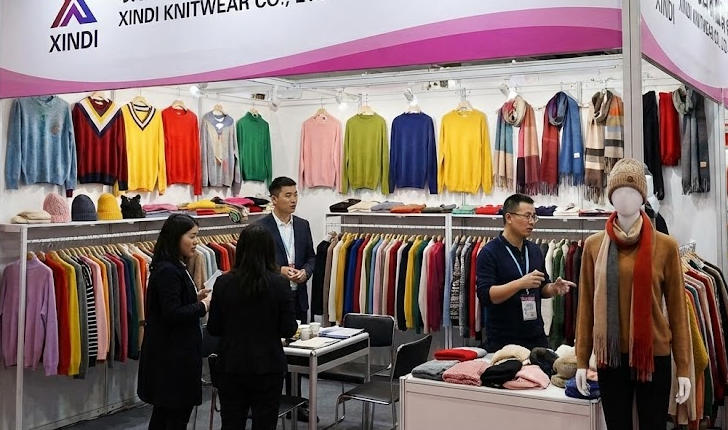
Disclosure: Xindi Knitwear is our product.
A factory partner with low‑MOQ and 3D/WHOLEGARMENT capability would typically:
Propose a sampling plan in ~3–5 business days from a tech pack/photos (jersey and 1×1 ribs are fastest; cables/jacquard add time).
Offer tiered, illustrative unit ranges at MOQ levels, subject to yarn quotes and confirmed grams/pc:
• Case 1A at 50 pcs/color: often mid‑teens to low‑20s USD/pc FOB;
• Case 1B at 80 pcs/color: often low‑20s to low‑30s USD/pc FOB;
• Case 1C at 50 pcs/color: often high‑teens to high‑20s USD/pc FOB.Apply batching where permissible (e.g., one representative 1610 test per color‑grouped lot if not exempt, per lab advice) and consolidate gauges to reduce changeovers.
These ranges are illustrative as of Feb 2026; they depend on yarn procurement, stitch density, and the agreed compliance plan. Comparable OEM/ODM knitwear manufacturers with similar capabilities may quote differently based on capacity and location.
Next steps
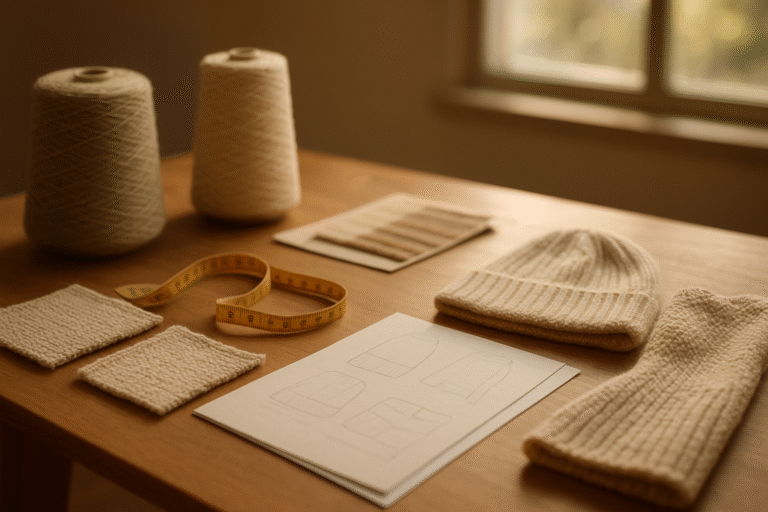
Prepare a tech pack with gauge, stitches, colorways, size curve, and care intent; request yarn quotes (USD/kg) for your chosen certifications.
Ask a CPSC‑accepted lab to confirm 1610 exemption status or advise a representative testing plan by color/lot; request TAT and fee basis.
Build your BOM calculator with grams/pc from sampling or machine simulation; include waste and setup amortization.
If you’d like a neutral, factory‑side estimate using the three cases above, you can contact Xindi Knitwear or another OEM/ODM with similar capabilities for a custom quote and timeline.
Appendix: sources and glossary notes
Standard for the flammability of clothing textiles: eCFR 16 CFR Part 1610 (primary legal text).
2023 clarification of methods/threads: Federal Register final rule (Oct 25, 2023).
CPC requirements: CPSC CPC overview and CPC clothing example.
Tracking labels (CPSIA Section 103): CPSC Tracking Label FAQ.
Small parts guidance: CPSC small parts page.
FTC care labeling: Care Labeling Rule.
AQL explainer: ISO 2859‑1 practice overview.
WHOLEGARMENT economics (qualitative): Textile World feature.
Glossary highlights: CPC (Children’s Product Certificate); 16 CFR 1610 (flammability of clothing textiles); Representative testing (lab‑advised grouping by material/color/lot for non‑sleepwear apparel); WHOLEGARMENT (seamless knit construction); AQL (Acceptable Quality Limit).