
Introduction
You are not really asking whether a factory is modern. You are asking which of its capabilities changes the outcome of a 50–300 unit run, and which one you pay for without ever using.
Those are different questions, and they often get different answers. A plant can be genuinely automated, fully digitised and still be a poor fit for a capsule collection, because the economics of most factory technology are set by volume and changeover rather than by sophistication. The reverse is also true: a modestly equipped knitwear mill with disciplined records and fast sampling can beat a showcase factory on a small order.
This guide is written for emerging labels placing knitwear runs in the low hundreds, not the low thousands. It treats each capability as a separate decision rather than a verdict on technology in general. For every class of tool, you will get three tests: what it protects on a small batch (consistency, traceability, speed or flexibility), what it costs at your volume, and whether it slows changeover. It also separates evidence you can request and check from claims you cannot verify, which is the practical difference between a supplier pitch and a supplier you can hold to a standard.
Why “Modern Factory” Is the Wrong Question at Low MOQ
The instinct behind “is this a modern factory?” is sound — you want a supplier that is not going to lose your order in a paper trail. But the question bundles together things that behave very differently at small volume.
Automation economics are driven by two variables: how many units a setup runs before it changes, and how long the change takes. A machine that cuts labour per unit on a stable, repeated operation is a good investment for a factory running the same style for weeks. The same machine can be a liability on a 120-unit order that needs three colourways, because the setup and programming time is spread over very few garments. This is not a criticism of the technology. It is the ordinary arithmetic of fixed cost divided by small volume, and it is why a factory can be excellent at scale and awkward at 100 pieces.
Two failure modes follow, and small labels hit both.
The first is paying for capability you cannot use. A tool whose value depends on long runs still has to be paid for, and at low MOQ it usually arrives as a line item or a padded unit price. You absorb the fixed cost of a capability that was never going to pay back on your batch size.
The second is mistaking a data system for a quality system. A factory that logs every defect in real time is doing something genuinely useful, but the log records what happened; it does not stop the defect. If the underlying operation — the knitting, the finishing, the seaming — is inconsistent, better record-keeping gives you a clearer picture of an inconsistent product. Records make quality visible and auditable. They do not manufacture it.
That gives you the core tension to hold through the rest of this guide. Consistency tools help small runs most when they reduce rework, because a reworked batch of 150 units is a much larger share of your order than a reworked batch of 15,000. But any tool that raises the minimum efficient batch size, or adds changeover time between styles, works directly against the flexibility you chose low MOQ to get. The useful question is never “is this advanced?” but “does this reduce rework or add documentation without slowing the change from one style to the next?”
A Four-Part Framework: Classify Before You Compare
Before comparing factories, sort what they show you into four classes. Each class protects something different, and each has its own test at low volume.
1. Production records and traceability. Barcode or tag tracking of fabric rolls and work-in-progress, output and defect logging, measurement data captured at source. Test: does the record follow your shipment, and can you export it? Risk: a system built for throughput may produce reports nobody will hand to a buyer.
2. Sampling and design tools. 3D virtual sampling, flat-knit design platforms, digital tech packs. Test: does it cut the number of physical rounds before approval? Risk: digital sign-off presented as a replacement for the confirmation sample, which for knitwear it is not.
3. Inspection and measurement systems. AQL plans, measurement recording, smart tape measures feeding values into a system. Test: what exactly gets recorded, by whom, and does the record reach you? Risk: “100% checked” asserted with no record of what was checked.
4. Selective automation. Automated cutting, whole-garment knitting, automated transport, specialised sewing automats. Test: does it shorten sampling or reduce finishing labour on styles you repeat, without lengthening changeover? Risk: payback that only exists at volumes far above your order.
A single capability can be valuable in one class and hype in another. Automated cutting is a strong consistency tool for a factory running many layers of the same fabric; it tells you little about whether your 80-piece colourway will be knitted to the right gauge. Whole-garment knitting is a genuine waste and labour advantage and also a machine with a long style-changeover. Classify first, then judge.
A short test you can apply to any pitch:
Does it reduce rework or defects on a small batch? If the answer is only “at volume,” it is not your capability.
Does it produce documentation a buyer, stockist or regulator will actually ask for? If the output is internal only, ask why.
Does it add fixed cost or changeover time your run cannot absorb? If yes, negotiate it out or expect it in the price.
Digital Production Records: The Capability That Pays Back Quietly
Production-record systems are the least glamorous capability on a factory tour and often the most useful to a small label. In practice they do four things: tag fabric rolls so the material can be identified and located, track work-in-progress between stages, log output and defects as they occur, and capture measurement data directly rather than transcribing it from a paper sheet.
A documented example of the practice at scale is Hansae’s Factory 7 in Tien Giang province, Vietnam, which the Korea Herald reported on in 2026. Each roll of fabric receives a barcode registering fabric type, quantity and storage location; bundles of 30 to 50 garments are tagged with QR codes that workers scan at terminals; a sewing-floor control system logs output and efficiency; and a smart tape measure feeds measurements straight into a spreadsheet on a connected screen, replacing written readings entered separately. The same report notes the facility employs around 4,300 workers and produces roughly 40 million garments a year, and that it has the highest concentration of automated equipment among the company’s Vietnam facilities.
Be careful with that example. It is a high-volume operation, and it does not by itself prove the economics at 50–300 units. What it does show is what the practice looks like when it is real: named systems, data captured at the point of work, records that follow the product through stages.
For a small run, the value is not throughput. It is two things. First, fewer transcription errors — a measurement written on a sheet and typed up later can be misread, and on a 150-unit order a handful of misrecorded measurements can trigger a needless rejection. Second, a defensible record. If a stockist questions a batch, or a certification body asks how a shipment was made, a factory that can produce a dated record of what was knitted, measured and packed is in a different position from one reconstructing it from memory.
The honest limit: a records system documents what happened. It does not make the garment better. If the knitting is off-gauge, the record will faithfully show an off-gauge garment.
Questions to ask:
What is recorded, and at which stage — fabric intake, knitting, finishing, inspection, packing?
Who enters the data, and is it captured at the machine or transcribed later?
Can you export the record for my order, and does it follow the shipment rather than staying in the factory’s system?
What does the record contain for a 100-unit order specifically, not for a bulk programme?
Sampling and 3D Tools: Where They Save Rounds and Where They Cannot
3D virtual sampling is the capability most often oversold to small labels, and also one of the genuinely useful ones when its boundary is stated honestly.
What it does well: it lets you compare colourways, gauge and fit on screen before committing yarn and machine time. For flat knitting, Shima Seiki’s SDS-ONE APEX series designs structure, intarsia and jacquard patterns and simulates yarns — mohair, slub, shiny — accounting for plating, number of yarn ends and counts, with a structure-pattern database linked to the company’s knitting machines. That is a real development tool, not a rendering toy: it lets a designer test a jacquard layout or a colourway sequence without knitting it.
The saving is in rounds. A knitwear style can absorb several physical sample rounds, each consuming yarn, machine time and courier traffic. Cutting two of those rounds is a direct cost and calendar saving, and for a label launching a capsule on a retail deadline, the calendar saving matters more than the money.
The boundary: for knitwear, hand feel, drape, actual weight and seaming still have to be judged on a physical garment. Loop structure and elasticity are hard to model, cable and jacquard structures may only be approximated, and the same nominal yarn can behave differently by spinner, count and dyeing. The practical split is simple — use the digital sample to lock the design, and the physical sample to sign off the product.
That is not a concession; it is what makes the rest of the digital sign-off credible. Browzwear, a 3D sampling platform vendor, draws the same line in its own guidance on fabrics that still need a physical sample: structured wovens and stable knits can move through the full development cycle digitally, while high-stretch, bonded and technical fabrics still require at least one physical checkpoint to confirm fit, recovery and hand. The company frames naming that limit as protecting the investment rather than undermining it, because a sign-off that later fails costs more than an extra sample round.
For a low-MOQ knitwear order, the working rule is:
Use 3D to iterate colourways, placement and proportions cheaply, and to arrive at the factory with a resolved design.
Never use it to skip the confirmation sample. Approve hand feel, weight, stretch recovery and seaming on a knitted garment.
Ask which platform the factory uses, who operates it, and how the digital file feeds the physical sample that follows. A file that does not connect to the knitting programme saves you nothing.
Inspection and Measurement: What the System Should Record, and How AQL Fits a Small Batch
Inspection is where small labels most often accept a phrase — “100% checked” — in place of a system. It is worth understanding what the standard method actually does, because at your volumes it behaves differently from how it behaves on a bulk order.
Sample size at AQL 2.5 for major defects, General Inspection Level II, single sampling, normal inspection, from Table II-A of MIL-STD-105E (the ancestor of ANSI/ASQ Z1.4 and ISO 2859-1). The 51–90 lot row points to the next row, so 20 units are inspected. Where the sample size equals or exceeds the lot size, every piece is inspected. Figures are for one inspection of one lot.
AQL stands for acceptance quality limit. Under ISO 2859-1:2026, it is the “worst tolerable quality level” — a rate for a factory’s process across a continuing series of orders, not a count of allowed faults in one inspection. The count that decides a single inspection is the acceptance number, which the sampling tables derive from your lot size, inspection level and AQL.
The widely used apparel defaults are AQL 2.5 for major defects, 4.0 for minor defects, and zero tolerance for critical defects, usually at General Inspection Level II with single sampling and normal inspection. Tighter limits are available and appropriate for premium positioning, but they cost more, because a stricter standard means more rejected units. Critical defects — a broken needle in a seam, a choking hazard on childrenswear — are normally set at zero and written into the order separately, because no column of the table represents zero tolerance.
Here is the part that matters at your scale. At AQL 2.5 for major defects, General Inspection Level II, the table gives a 51–90 unit lot a sample of 20 units, accept 1, reject 2; a 91–150 unit lot gets the same 20-unit sample and the same accept/reject numbers; a 151–280 unit lot gets 32 units, accept 2, reject 3. (These figures come from Table II-A of MIL-STD-105E, the ancestor of ANSI/ASQ Z1.4 and ISO 2859-1, as set out in this practitioner’s guide to AQL in apparel.) One rule to know: where the sample size equals or exceeds the lot size, every piece is inspected.
So on a 60-unit run, a 20-piece sample is a third of your order. On a 150-unit run it is under a seventh. Many factories simply inspect the whole lot at these sizes, and that is reasonable — the statistical apparatus exists because inspecting every garment in a 50,000-piece order is impractical, not because sampling is inherently better.
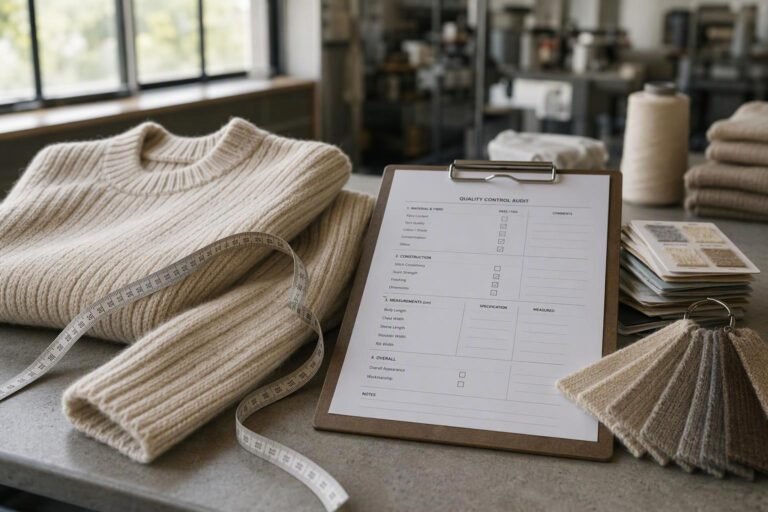
The low-MOQ implication is that inspection at 50–300 units is less a question of statistical sampling and more a question of what gets recorded and who inspects. A useful inspection record captures:
defect type and grade (critical, major, minor), against agreed definitions — a loose thread and a skipped seam are not the same thing;
measurement values against the spec sheet, point by point;
who inspected, and on what date;
photo evidence of any defect that caused a rejection or rework decision;
what happens on a fail — rework, replacement, discount or rejection, agreed before there is a problem.
Measurement capture is where a small system earns its place. When a worker measures a garment and the reading appears directly in a connected spreadsheet — the smart-tape-measure setup described at Hansae’s Factory 7 — you remove the transcription step where errors enter. That benefit does not depend on volume: it works the same on 80 units as on 80,000, and it means the measurement record you receive is closer to what was actually on the table.
What this means for you: specify the AQL levels, the defect definitions, who inspects and what happens on a fail in the order confirmation. At your volume, ask for the full record rather than a pass/fail line.
Selective Automation: Which Steps Pay Off at 50–300 Units
The automation question at low MOQ is a changeover question. Sort automated steps into two groups and the decision becomes much clearer.
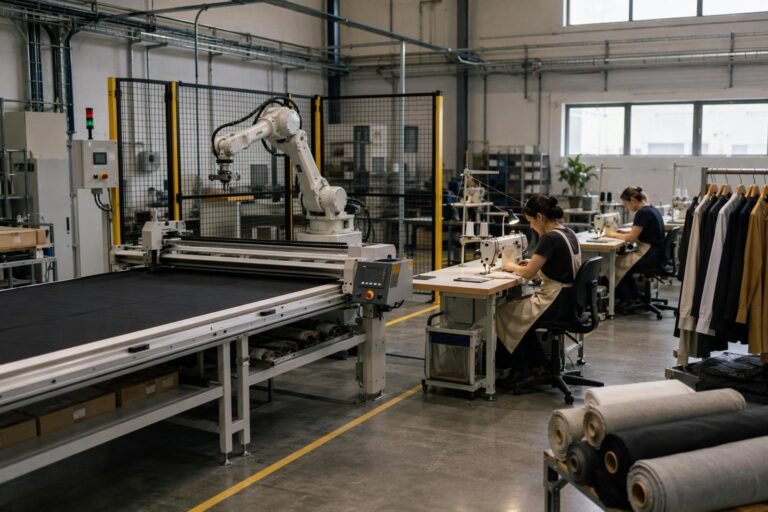
Automation that reduces per-unit labour on a stable, repeated operation tends to pay off even at modest volume, because the setup is amortised across styles you repeat and the saving is per garment. Automated cutting is the classic case: once a pattern is set, the machine cuts layers quickly and precisely, and the precision itself is a consistency gain. On a small order the setup still has to be absorbed, but if you are reordering a style, the second run benefits.
Automation whose payback depends on long runs and infrequent style changes is a different proposition. Whole-garment knitting is the clearest apparel example, and the numbers are worth knowing because they explain the trade-off precisely.
A WHOLEGARMENT-class four-needle-bed flat knitting machine produces a complete shaped garment — body, sleeves, neckline — in one piece, with no linking or seaming. The comparison of seamless and cut-and-sew knitting sets out the trade: offcut waste under 3% versus 15–30% for cut-and-sew; near-zero assembly labour versus one to two hours of linking and seaming per pullover; knitting time of 45–90 minutes versus two to four hours plus assembly. Against that, a WHOLEGARMENT-class four-needle-bed machine costs roughly USD 200,000–600,000 depending on gauge and width, against USD 30,000–100,000 for a comparable cut-and-sew flat knitting machine. And style changeover is the decisive figure for a small label: one to four weeks for a new knitting programme, against minutes for cutting new panels.
That changeover number is why whole-garment capability can look irrelevant to low MOQ and then turn out to be central. The technology does not serve small batches when it is retrofitted into a mass-production line optimised for long runs. It serves them when the factory is built around on-demand production. Tailored Industry, operating WHOLEGARMENT machines in Brooklyn, describes a just-in-time model — produce a limited amount for the start of the season, add small quantities for what sells, and deliver to domestic users within two weeks of order. That is the same machine, organised differently.
For your order, the automation worth paying for is the kind that:
shortens sampling — design and programming tools that get to a knittable file faster;
reduces finishing labour on styles you repeat — seaming, linking, trimming, pressing;
improves measurement consistency — automated or assisted measurement that removes transcription.
And the kind to question is the kind that locks you into long runs or slow changeovers, or whose cost only makes sense spread across a volume you will never order. If a factory pitches whole-garment capability for a 100-unit run, the fair question is not whether the machine is impressive but how long the programming takes and whether the factory already runs small batches on it.
Sustainability Claims: The Evidence to Request, and What It Does and Does Not Prove
Sustainability claims are the easiest to make and the easiest to check, which makes them a good test of how a factory talks about all its capabilities.
The document distinction to learn is between a scope certificate and a transaction certificate. A scope certificate states what a facility is certified to produce under a given standard. A transaction certificate states that a specific shipment of goods was produced according to that standard, following the material through the chain of custody. Textile Exchange’s Brand & Retailer Certification Toolkit is explicit: companies purchasing certified products should request a transaction certificate with each shipment order. A scope certificate on the wall tells you the factory is capable of certified production; the transaction certificate tells you your order was.
Two honest limits. First, certification is a snapshot: the audit happens at a particular place and time and does not guarantee conditions between visits. That is Textile Exchange’s own framing, and it is a reason to value a working relationship and continuous improvement alongside the paperwork, not a reason to dismiss certification. Second, cost: because certification cost is based on the number of facilities, companies producing a small number of certified products may find the cost per unit prohibitive. That is a real constraint for low-MOQ buyers, and it is worth asking early whether transaction certificates carry a fee and how it is calculated.
The regulatory direction of travel is worth knowing, but read it at the right scope. The EU ban on destroying unsold clothes and shoes applies to large companies from 19 July 2026 and to medium-sized companies from 2030, with small and micro-businesses exempt from the reporting requirements, according to the European Commission’s announcement. The textile Digital Product Passport is planned under a delegated act, with adoption targeted for Q4 2027 according to the Commission’s textile DPP page, and the exact information requirements will be defined in that act.
None of that means a small label must comply today. It means the records that make traceability checkable — which yarn, which batch, which shipment, which certificate — are becoming the currency of the market you sell into. A factory that can produce them on request is better prepared for where this is going than one that cannot.
What to request:
the scope certificate, with its number and validity dates, for the standard claimed;
a transaction certificate with each shipment, not once at the start of the relationship;
clarity on which standard covers which claim — OEKO-TEX, RWS, GRS and GOTS cover different things, and a certificate for one does not support a claim under another;
the fee basis for transaction certificates, so it does not arrive as a surprise line item.
Red Flags in a Technology Pitch
A pitch is not evidence. These are the patterns worth flagging in a factory conversation, each paired with the question that resolves it.
Capability described only in adjectives. “State-of-the-art,” “smart,” “Industry 4.0” with no named system or record. Ask: which system, and can I see a sample record from an order like mine?
Automation pitched without changeover time or minimum batch. Ask: how long does a style changeover take on that machine, and what is the smallest batch you run on it?
“Digital” used to mean a PDF. A tech pack emailed as a file is not a tracked production record. Ask: where is the data captured, and does it follow the shipment?
Sustainability claims with no certificate number, scope or transaction document. Ask: which standard, which scope certificate number, and will you issue a transaction certificate for this shipment?
Inspection described as “100% checked” with no record of what was checked or by whom. Ask: what does the inspection record contain, and can I see the format?
A tool whose value is asserted at volume but sold to a 100-unit order. Ask: what does this do for my batch size specifically, and what does it add to the unit price?
A quality claim resting on a data system. Ask: what in the process prevents the defect, as distinct from recording it?
None of these flags means the factory is bad. They mean the claim is unfinished, and the question is how you finish it.
Pricing Technology Into a Low-MOQ Order
Technology costs reach a small order in one of two ways: as a visible line item, or buried in the unit price. Your job is to make the basis explicit, because a capability you cannot see is a capability you cannot decline.
The line items to expect and clarify:
Sampling and 3D development — charged per style or per sample round. Ask whether sampling cost is credited against bulk if you place the order, and what happens if you do not.
Inspection — usually included, but a stricter AQL changes the rejection rate and therefore the cost. Ask whether a tighter AQL changes the price, and by how much.
Transaction certificates — may carry a fee. Ask the basis before you assume it is included.
Programming and setup — for whole-garment or complex jacquard work, the programming time is real cost. Ask whether it is charged per style and whether it is repeated on a reorder.
Re-quote triggers — ask what causes a re-quote: a colourway change, a yarn substitution, a quantity change, a measurement spec change. Knowing the triggers in advance is how you avoid a mid-production surprise.
The judgement to apply is simple. Paying for a consistency tool is rational when it prevents a rework or a rejected batch — a reworked 150-unit order is a large share of your season, and the cost of the tool is small against that. It is irrational when it only adds fixed cost to a run too small to benefit, which is why the changeover and minimum-batch questions from the automation section belong in the pricing conversation too.
What this means for you: ask for the cost basis in writing, per style, per sample round and per inspection, and confirm which items are included in the FOB price rather than added later.
Putting It Together: A Capability Scorecard for Your Next Factory Conversation
Here is the framework as a single page you can take into a call. For each capability class, the middle column is what to ask for; the right column is the flexibility risk to check before you commit.
Capability class | What it should do for a 50–300 unit run | Evidence to request | Flexibility risk to check |
|---|---|---|---|
Production records and traceability | Reduce transcription errors; give you a dated record that follows the shipment | A sample order record showing stages, measurements and who entered data; confirmation you can export it | Whether the system is configured for small orders or only produces bulk reports |
Sampling and 3D tools | Cut physical sample rounds before approval; resolve colourway and structure cheaply | Which platform, who operates it, how the digital file feeds the knitting programme | Whether digital sign-off is being offered in place of the confirmation sample |
Inspection and measurement | Near-full checking at your lot size; a record of defect type, measurements, inspector and photos | The inspection record format; agreed defect definitions; AQL levels and who inspects | Whether a stricter AQL changes price or lead time; what happens on a fail |
Selective automation | Shorten sampling, reduce finishing labour on repeated styles, improve measurement consistency | Changeover time and minimum batch for the specific machine; whether small batches already run on it | Whether the capability only pays back at volumes far above your order |
Sustainability documentation | Prove what your shipment is made of, under which standard | Scope certificate with number and dates; transaction certificate per shipment; fee basis | Whether certificate costs are prohibitive at your volume, and who bears them |
The through-line is the one this guide started with. The capabilities that matter at low MOQ are the ones that reduce rework, produce checkable records, and leave changeover fast. The ones to question are the ones that only make sense at volume — not because they are bad technology, but because you would be paying for a capability your order cannot use.
If you are developing a knitwear run in the low hundreds, the practical next step is a short conversation about which of these the factory can evidence today: request a sample record, ask what a virtual sample can resolve and what genuinely needs to be knitted, and confirm the inspection and certificate documents before the order is placed. That conversation tells you more about a supplier than any factory tour.
Key Takeaways
Judge each factory capability by what it protects on a 50–300 unit run — consistency, traceability, speed or flexibility — not by how advanced it sounds.
Digital production records pay back through traceability and fewer transcription errors; they document quality but do not create it.
3D sampling cuts iteration rounds and cost, but knitwear hand feel, drape, weight and seaming still need a physical confirmation sample.
At small lot sizes, inspection is close to full checking; what matters is what the record captures and who inspects, with AQL 2.5 for major defects, 4.0 for minor and zero tolerance for critical as the common apparel baseline.
Automation pays off at low MOQ when it shortens sampling or finishing on repeated styles; whole-garment machines cut waste and labour but carry high machine cost and one-to-four-week style changeover.
For sustainability, request scope and transaction certificates per shipment, and treat certification as a point-in-time snapshot rather than a guarantee.
Make technology costs explicit per style, per sample round and per inspection so they do not become hidden fees that erode low-MOQ flexibility.