
Looking for knitwear quality guarantees you can actually measure and audit? This FAQ publishes our acceptance criteria for pilling resistance and our post‑wash fit tolerance policy—plus the warranty and escalation SLA you can rely on.
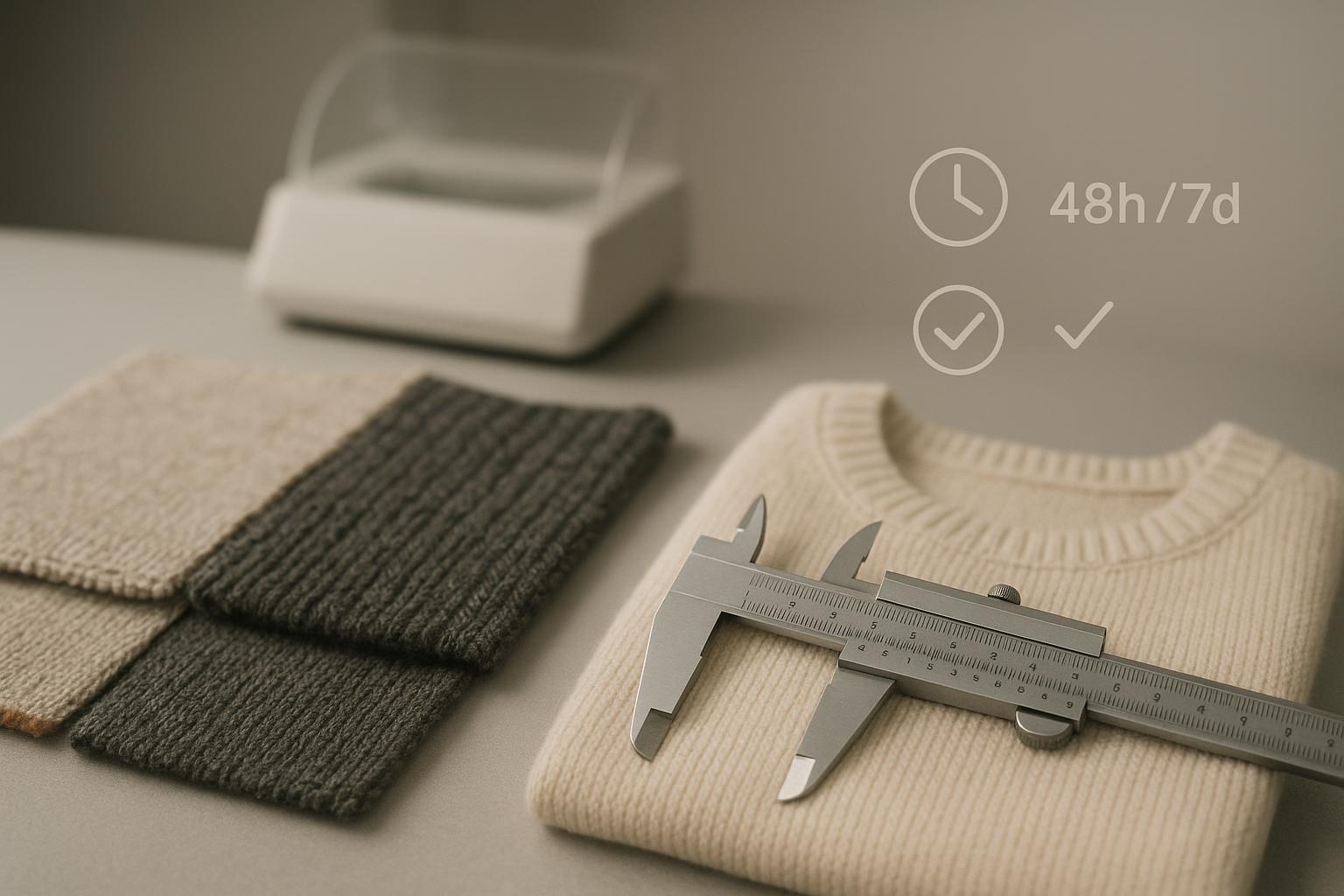
TL;DR: Pilling acceptance is ICI Pilling Box, 7,200 tumbles, visual grade ≥ 4/5 under standard grading conditions. Fit tolerances are defined post‑wash/post‑blocking by silhouette (tight/regular/oversized) and gauge/weight. Warranty SLA: response within 48 hours; resolution within 7 calendar days. First remedy is rework/redone; if overdue or re‑check fails, refund/discount applies.
Key takeaways
Knitwear quality guarantees are stated in testable numbers: ICI Pilling Box 7,200 tumbles; accept ≥ 4/5 (photographic 1–5 scale).
Fit tolerance windows are locked on post‑wash/post‑blocking measurements and vary by silhouette and gauge/weight to reflect real knit variability.
QC verification spans sampling through bulk with lab reports and AQL‑based inspections for consistent acceptance decisions.
Warranty SLA: 48‑hour response and 7‑day resolution; rework/redone prioritized, then refund/discount if deadlines or re‑checks are missed.
What pilling test methods and grading scale do you use?
We use internationally recognized methods and the standard 1–5 photographic visual scale (5 = no pilling; 1 = very severe):
ICI Pilling Box (ISO 12945‑1): specimens tumble in a cork‑lined box; appearance is graded against reference photos. See an equipment/method explainer in Roaches Instruments’ Opti‑Pill page: Roaches Opti‑Pill tester overview.
Martindale Pilling (ISO 12945‑2): circular specimens are rubbed along a Lissajous path under defined pressure; pilling is graded on the same 1–5 scale. Useful quick reference: Darong Tester’s ISO 12945‑2 guide.
Random Tumble (ASTM D3512): fabric tumbles with air injection in a cork‑lined chamber; evaluation again uses the 1–5 scale. Background explainer: TextileBlog on ASTM D3512 random tumble.
Half‑grades such as 3–4 are common in lab practice; reports should state method, turns/revolutions or minutes, pre‑conditioning, light box settings, and the photographic scale used.
Fit tolerance policy by silhouette and gauge
All tolerances apply to post‑wash/post‑blocking measurements. This reflects how garments will fit after relaxation and stabilization in finishing. For context on finishing and measuring, see our background guide on knitwear washing, blocking, and stabilization.
Core POM tolerances for tops and sweaters (post‑wash)
Silhouette | Gauge/Weight band | Chest/Bust (±) | Body Length (±) | Sleeve Length (±) | Across Shoulder (±) |
|---|---|---|---|---|---|
Tight | Fine (12–14 gg, light) | 1.0–1.5 cm (0.4–0.6 in) | 1.0–1.5 cm (0.4–0.6 in) | 0.8–1.2 cm (0.3–0.5 in) | 0.8–1.2 cm (0.3–0.5 in) |
Tight | Medium (8–12 gg, mid) | 1.2–1.8 cm (0.5–0.7 in) | 1.2–1.8 cm (0.5–0.7 in) | 1.0–1.5 cm (0.4–0.6 in) | 1.0–1.5 cm (0.4–0.6 in) |
Tight | Coarse/Heavy (3–7 gg, heavy) | 1.5–2.0 cm (0.6–0.8 in) | 1.5–2.0 cm (0.6–0.8 in) | 1.2–1.8 cm (0.5–0.7 in) | 1.2–1.8 cm (0.5–0.7 in) |
Regular | Fine (12–14 gg, light) | 1.5–2.0 cm (0.6–0.8 in) | 1.5–2.0 cm (0.6–0.8 in) | 1.2–1.8 cm (0.5–0.7 in) | 1.2–1.8 cm (0.5–0.7 in) |
Regular | Medium (8–12 gg, mid) | 1.8–2.3 cm (0.7–0.9 in) | 1.8–2.3 cm (0.7–0.9 in) | 1.5–2.0 cm (0.6–0.8 in) | 1.5–2.0 cm (0.6–0.8 in) |
Regular | Coarse/Heavy (3–7 gg, heavy) | 2.0–2.5 cm (0.8–1.0 in) | 2.0–2.5 cm (0.8–1.0 in) | 1.5–2.3 cm (0.6–0.9 in) | 1.5–2.3 cm (0.6–0.9 in) |
Oversized | Fine (12–14 gg, light) | 2.0–2.5 cm (0.8–1.0 in) | 2.0–2.5 cm (0.8–1.0 in) | 1.8–2.3 cm (0.7–0.9 in) | 1.8–2.3 cm (0.7–0.9 in) |
Oversized | Medium (8–12 gg, mid) | 2.5–3.0 cm (1.0–1.2 in) | 2.5–3.0 cm (1.0–1.2 in) | 2.0–2.5 cm (0.8–1.0 in) | 2.0–2.5 cm (0.8–1.0 in) |
Oversized | Coarse/Heavy (3–7 gg, heavy) | 3.0–3.5 cm (1.2–1.4 in) | 3.0–3.5 cm (1.2–1.4 in) | 2.3–3.0 cm (0.9–1.2 in) | 2.3–3.0 cm (0.9–1.2 in) |
Notes:
Ribbed structures and fully fashioned edges can introduce directional stretch; use the upper bound for heavy ribs or yarns with lower elastic recovery.
WHOLEGARMENT/seamless: measure POMs on the finished garment (no seam allowances). Establish PPS samples on a standardized blocking board and lock the cell values above per silhouette/gauge.
Pilling acceptance thresholds and cross‑method notes
Primary guarantee (policy): ICI Pilling Box (ISO 12945‑1), 7,200 tumbles; acceptance grade ≥ 4/5 on the photographic scale under standard viewing conditions. See a concise method/equipment overview from Roaches Instruments.
Cross‑method transparency:
Martindale Pilling (ISO 12945‑2): internal target grade ≥ 4 at 7,000 revs for typical apparel knits; buyer specs may vary. Method quick guide: Darong Tester’s ISO 12945‑2 brief.
ASTM D3512 Random Tumble: used selectively for lofty/brushed knits; acceptance grades stated per project using the 1–5 visual scale. Background explainer: TextileBlog random tumble overview.
These thresholds are Xindi policy commitments anchored to ISO/ASTM methods and grading procedures; they are not claimed as universal industry pass/fail rules.
How do you verify these knitwear quality guarantees during sampling and bulk?
We verify across the lifecycle with lab and in‑factory controls. Sampling submits yarn/fabric or PPS garments for the chosen pilling method; the acceptance grade and reporting format are locked in the PO/QC plan. Inline and finishing checks confirm dimensional stability, and pre‑shipment inspections apply AQL plans (e.g., ISO 2859‑1/ANSI Z1.4, General Level II with typical AQLs 0.0/2.5/4.0). For a concise primer on AQL practice, see QIMA’s overview of acceptable quality limit sampling.
What happens if a shipment fails these knitwear quality guarantees?
Response time: within 48 hours of a complete claim package.
Resolution target: within 7 calendar days.
Remedy order: priority rework or priority remake. If the deadline is exceeded or the re‑check fails to meet acceptance criteria, we apply refund or discount per the escalation matrix.
Evidence package required to start a claim: defect photos with POM highlights; approved size spec and tolerance chart with redlines; lab pilling report (method, cycles/turns, grade, grading conditions); pre‑shipment AQL summary and lot size; RMA number; return label or mutually agreed destruction waiver.
Practical example: how results are recorded
Disclosure: Xindi Knitwear (Knitwear.io) is our own factory brand.
Example record excerpt (neutral, for illustration): Style: 12gg merino crew, Regular silhouette. Pilling: ICI Pilling Box 7,200 tumbles → Grade 4/5; lab: ABC Textiles Lab; light box D65. Fit POM checks (post‑wash): Chest +1.7 cm (within ±2.0 cm window), Length −0.8 cm (within ±2.0 cm), Sleeve +1.2 cm (within ±2.0 cm). Inspection: PSI per ISO 2859‑1, Level II; AQLs 0.0/2.5/4.0; status: Accept.
Downloads and contacts
QC annex (photographic grade chart 1–5, tolerance tables in cm/in, sample submission form, RMA template): available on request—please reach us via the Contact page on Knitwear.io.
Company background for vendor onboarding: see About Xindi Knitwear.
Have questions about applying these knitwear quality guarantees to your next PO? Send your tech pack, target silhouette, and preferred test method via the Contact page, and we’ll confirm the plan within the SLA.